
She didn’t ask for my help.
She assigned me a new life.
“Starting immediately,” Chloe said, tapping one manicured fingernail against her glass, “Grandma will be watching all five kids every weekend.”
She paused just long enough to let the words settle over the picnic tables.
“Free, obviously.”
A few people smiled uncertainly, believing they had missed the beginning of a joke.
Chloe’s smile widened.
“It’s not like she has anything else going on anymore.”
The backyard fell silent.
Only the grill continued making noise, fat hissing over the coals while smoke drifted through the hydrangeas I had planted with my husband twenty-seven years earlier.
Until that moment, it had been an ordinary Saturday barbecue.
Paper plates sagged beneath potato salad and corn on the cob. My cousins sat beneath striped umbrellas. Neighbors chatted near the fence. Children ran across the lawn, knocking over plastic cups and crushing the flowers along the stone path.
I had spent three days preparing everything.
Chloe had arrived forty minutes late carrying one bag of ice and had accepted compliments on the party as though she had organized it herself.
Now every face turned toward me.
My son Jason stood beside his wife with his arms crossed. At thirty-eight, he still had the same dark hair and serious brown eyes he had inherited from his father, but the warmth that once lived behind those eyes had slowly disappeared.
He looked at me with the exhausted impatience of a manager waiting for a difficult employee to obey.
Chloe had never called to ask whether I was available.
She had never asked about my blood pressure, my cardiology appointments, my part-time bookkeeping job, or the fact that maintaining a four-bedroom house on one income was not free.
She had not asked whether I had plans.
She had simply made her announcement in front of an audience, confident that humiliation would force me to agree.
My oldest grandson, Mason, stopped near the swing set.
At twelve, he was old enough to understand exactly what his mother had done.
His younger siblings continued chasing one another, but Mason stared at me with a strange, worried expression. When our eyes met, he looked down.
“Every weekend?” my cousin Rachel asked cautiously.
Chloe laughed.
“Well, Friday evening until Sunday night. Sometimes Monday morning if we’re tired.”
“And school holidays,” Jason added.
Chloe nodded brightly.
“Of course. Holidays too.”
I looked at my son.
“Have the two of you already made plans?”
“We need time for our marriage,” Chloe said. “Parents deserve breaks.”
“So do grandmothers,” Rachel murmured.
Chloe’s smile tightened.
Jason stepped closer to me.
“Mom, please don’t make this uncomfortable.”
I almost laughed.
He spoke as though I were the one standing in someone else’s backyard, publicly confiscating her time.
“I work Saturdays twice a month,” I reminded him.
“You can change your schedule.”
“I have medical appointments.”
“Not on weekends.”
“I also have a life.”
Chloe sighed dramatically.
“There it is.”
“There what is?”
“The selfishness.”
The word struck harder than it should have.
Perhaps because I had spent most of my life ensuring no one could ever use it against me.
I had raised Jason while working full-time after his father’s construction company nearly collapsed during the recession. I had packed lunches before sunrise, worked overtime, attended school conferences, organized birthday parties, sat beside hospital beds and quietly solved problems before anyone else realized they existed.
After my husband Henry died, I had helped Jason and Chloe with their rent.
Then their house deposit.
Then groceries.
Then braces for Mason.
Then dance lessons for Lily.
Then emergency repairs on their minivan.
Then eight consecutive payments on Jason’s black SUV.
Every request had arrived wrapped in urgency.
Just this once.
Until next month.
For the children.
Because family helps family.
Yet standing in my own backyard, I was suddenly selfish because I wanted to decide how to spend my Saturdays.
Jason lowered his voice.
“If you refuse, Mom, don’t expect us to be there when you need help.”
The people nearest us pretended not to hear.
But they heard.
Everyone heard.
My throat tightened.
This was my only son.
The boy whose feverish body I had held against my chest at three in the morning. The teenager I had defended when his teachers called him unfocused. The young man whose first failed business had cost Henry and me nearly one hundred thousand dollars.
The man whose car payments I had quietly covered while Chloe posted photographs from expensive restaurants and captioned them Choosing joy.
Now he was threatening to abandon me unless I became their unpaid nanny.
Something inside me became perfectly still.
Not broken.
Not angry.
Still.
For years, I had been terrified of losing Jason.
That fear had made me useful.
It had made me quiet.
It had made me generous long after generosity became exploitation.
In that moment, however, I understood something that should have been obvious years earlier.
I was already losing him.
Every payment, every favor and every surrendered boundary had not brought my son closer.
It had only taught him how much of me he could take.
I placed my water glass carefully on the bench.
“Deal,” I said.
Chloe’s face lit up.
Jason’s shoulders relaxed.
Around us, the guests released uncomfortable breaths, grateful that the confrontation had ended without shouting.
“See?” Chloe said, turning toward the others. “I knew she’d come around.”
But none of them understood what I had agreed to.
I had not agreed to spend every weekend raising Chloe’s children.
I had agreed that Jason and Chloe were no longer people I would ever depend on again.
Once I accepted that truth, I stopped allowing them to drain me.
I collected my purse, slipped through the side gate and walked the long way around the block to my front door.
Behind me, Chloe laughed too loudly, already celebrating her victory.
By the time I entered my home office, my pulse was steady.
I sat at Henry’s old walnut desk and opened the bottom drawer.
Inside was a blue folder I had hidden because admitting what it contained wounded my pride.
Bank transfers.
Insurance payments.
Grocery deliveries.
Birthday gifts.
Summer-camp deposits.
The minivan repair bill.
Jason’s SUV payments.
A receipt for the vacation rental Chloe had insisted was necessary because their children “deserved memories.”
I had kept every document because I was a bookkeeper.
Numbers made sense to me, even when people did not.
I began adding.
After forty minutes, I stared at the total.
In thirty-one months, I had given Jason and Chloe $86,420.
That did not include birthday presents, meals, childcare or the countless small purchases I had stopped noticing.
My phone buzzed.
A message from Chloe appeared.
Bring fresh bagels tomorrow morning. Sesame only. The kids hate plain.
Another message followed.
Also, Mason has soccer at ten. Lily needs to be at dance by eleven. The twins can’t have red dye. Ben still needs help wiping.
No question.
No thank-you.
No acknowledgment that twenty minutes earlier she had humiliated me in front of everyone I knew.
Only instructions.
I stared until the screen went dark.
Then I switched my phone to silent.
At nine the next morning, a locksmith named Luis arrived.
By 9:22, the spare key Jason and Chloe had abused for years no longer opened my front door.
That key had originally been provided for emergencies.
Somehow, it had become permission for Chloe to enter without knocking, deposit five children in my hallway and send a message afterward saying she had “one quick errand.”
Once, the errand lasted nine hours.
Another time, I woke from a Sunday afternoon nap to discover the children watching television in my living room. Chloe had used her key, told them Grandma was upstairs and left.
I threw the old lock into the trash.
Next, I emptied the pantry shelf Chloe had claimed for “kid snacks.”
Juice boxes, candy packets, cookies and overpriced animal crackers went into cardboard boxes. I delivered them to a nearby daycare center.
In their place, I arranged herbal tea, dark chocolate and two bottles of wine.
All week, Chloe sent instructions.
Snack schedules.
Bath times.
Approved movies.
Bedtime routines.
Warnings about which child required “extra patience.”
I read every message.
I answered none.
On Thursday evening, Jason finally called.
“Mom, are you getting Chloe’s texts?”
“Yes.”
“Then why aren’t you answering?”
“I’ve been busy.”
“With what?”
The question was so sincere that I almost felt sorry for him.
“My life.”
He exhaled sharply.
“Look, don’t start making this into some power struggle.”
“I’m not.”
“Chloe already booked a hotel.”
“That sounds lovely.”
“We can’t get a refund.”
“That’s unfortunate.”
“Mom.”
I let the silence stretch.
He softened his voice.
“Please don’t embarrass me.”
The request revealed more than he intended.
He was not worried about exhausting me.
He was worried that Chloe might discover he could no longer control me.
“Have a good evening, Jason.”
“Wait—”
I ended the call.
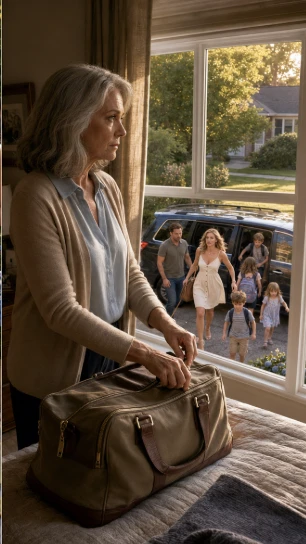
Friday evening at exactly 5:45, their minivan rolled into my driveway.
But I was not sitting in the living room.
I was upstairs, zipping a weekender bag for the lake resort I had booked that morning.
Car doors slammed.
Children shouted.
Chloe’s heels struck the walkway.
Then came the first furious knock.
I lifted my bag, slipped through the back door and crossed the narrow path behind my garage.
My small sedan was parked on the next street.
The knocking became pounding.
“Evelyn!” Chloe shouted.
She never called me Mom unless she wanted something.
I reached my car and drove away.
At the first red light, my phone erupted with calls.
Chloe.
Jason.
Chloe again.
Then twelve messages appeared in less than a minute.
I opened the family group chat and typed one sentence.
Headed out of town for the weekend. Have fun, you guys.
Jason replied instantly.
We’re on your porch. Your key doesn’t work.
Then:
You said it was a deal.
I smiled.
It was.
Before he could respond, another notification appeared.
It was an email bearing the logo of Jason’s bank.
The subject contained five words:
FINAL NOTICE BEFORE VEHICLE REPOSSESSION.
The deadline was midnight.
I pulled into a grocery-store parking lot and read the message twice.
I had cosigned for Jason’s SUV eighteen months earlier after he promised the bank that his new sales job was stable.
For the first six months, he paid on time.
Then the excuses began.
A delayed commission.
A payroll error.
An unexpected dental bill.
I had quietly covered the difference because a missed payment affected my credit too.
But the email contained something I had never seen before.
There had been three previous default notices.
They had not come to my address.
The mailing information had been changed.
So had the contact number.
I dialed the bank.
A representative named Dennis asked several security questions before accessing the loan.
“Mrs. Carter,” he said, “we have you listed as the primary payment contact.”
“I’m the cosigner.”
There was a pause.
“Our records show a modification request submitted four months ago. You agreed to become the primary guarantor.”
“No, I didn’t.”
Another pause.
“Did you sign an electronic authorization on March fourteenth?”
“No.”
“Did you provide a copy of your driver’s license?”
“No.”
“Mrs. Carter, I need to transfer you to our fraud department.”
The air inside my car changed.
I lowered the window, suddenly unable to breathe.
A woman from the fraud department reviewed the account.
An authorization bearing my electronic signature had changed my status on the loan. It also directed all notices to an email address I did not recognize.
When she read the address aloud, my stomach tightened.
It contained my name followed by the year of Henry’s birth.
Someone had created an email account designed to look like mine.
“Can the repossession be stopped?” I asked.
“Yes, if the overdue balance is paid tonight.”
“How much?”
“Four thousand eight hundred and sixty dollars.”
I looked through the windshield at shoppers pushing carts beneath the parking-lot lights.
For years, the answer would have been automatic.
I would have paid.
Then I would have convinced myself it was for the grandchildren.
But this was not a request for help.
This was fraud.
“Do not take the payment from any account belonging to me,” I said. “And place an identity-theft alert on the loan.”
Dennis returned to the line.
“If the balance remains unpaid, recovery may begin tonight.”
“I understand.”
When I arrived at the lake resort two hours later, my phone showed thirty-seven missed calls.
I turned it off.
For the first time in years, I slept through the night.
At seven the following morning, I walked onto my balcony.
Mist floated above the lake. The water was so smooth that the trees on the opposite bank seemed to continue upside down beneath the surface.
I wrapped both hands around a cup of coffee.
My chest hurt, but not in the way it had during my cardiology appointment.
This pain had a shape.
It was grief.
I was grieving the son I had spent years pretending still existed.
At 7:23, I turned on my phone.
The first message was from Jason.
They took my car.
The second was from Chloe.
You have destroyed this family.
Then:
The kids saw everything.
Then:
You are sick.
Then:
We’re coming to the hotel.
I had never told them which hotel I booked.
That realization sent a cold ripple through me.
I called the front desk and requested that no information about my room be given to anyone.
Then I contacted the bank again and asked for copies of every document related to the loan modification.
Afterward, I called my oldest friend, Naomi Bell.
Naomi and I had met when we were twenty-two and working in the same insurance office. She had spent thirty-five years as a paralegal before retiring to a house filled with rescue dogs and unfinished crossword puzzles.
She listened without interrupting.
When I finished, she said, “Check your credit.”
“I already monitor it.”
“Check the full report, Evelyn. Every inquiry. Every address. Every account.”
I opened my laptop.
Two unfamiliar credit inquiries appeared.
One came from a home-equity lender.
The other came from a company called Vantage Ridge Development.
My hands began to shake.
I had never contacted either company.
Naomi stopped sounding like my friend and began sounding like the paralegal who had once made a corporate attorney cry during a deposition.
“Do not confront Jason,” she said. “Do not warn Chloe. Freeze your credit. Call your bank, your insurance company and your mortgage lender. Then come home tomorrow and meet me at Andrea Solis’s office.”
“Who is Andrea?”
“The best elder-law attorney in the county.”
“I’m sixty-three, not ninety.”
“And your son has forged your signature.”
The words silenced me.
Naomi continued.
“This is not a family disagreement anymore.”
She was right.
By noon, my credit was frozen.
My banks had added verbal passwords to every account.
My mortgage lender confirmed that someone had requested information about the remaining balance on my house.
The request had included my correct Social Security number.
I spent the afternoon walking around the lake, trying to understand when my son had crossed the distance between selfishness and criminality.
The answer, I eventually realized, did not matter.
What mattered was that he had crossed it.
That evening, while I ate dinner alone near the resort fireplace, a message appeared from an unfamiliar number.
Grandma, it’s Mason.
I stared at the screen.
I’m using Tyler’s old phone. Please don’t tell Dad.
My fingers went cold.
Are you safe?
His reply came immediately.
Yes. But they are planning something.
A photograph appeared.
It showed a folder lying on Jason’s desk.
Across the cover, someone had written:
EVELYN CARTER — CAPACITY AND CONSERVATORSHIP DOCUMENTS.
Underneath the folder was a brochure for a private assisted-living facility called Silver Pines.
I stopped breathing.
Another message arrived.
Dad says you’re getting confused and we have to take over your money before you lose everything.
Then:
You’re not confused, right?
My eyes filled with tears.
No, sweetheart. I’m not confused.
Several minutes passed.
I knew it.
I asked him how he had found the folder.
He said he had been looking for a charger in his father’s desk. Jason had entered the room and shouted at him to leave. Later, Mason returned and photographed the documents.
There are papers about your house too, he wrote. Mom said once they get the orchard, everything works.
The orchard.
I read the word three times.
Behind my house lay eleven acres of neglected apple trees, separated from my property by an old stone wall.
Most people assumed the orchard belonged to the county because it had sat unused for decades.
It did not.
Henry had purchased it quietly twenty-one years earlier after learning that a highway expansion might eventually reach our area.
The expansion never happened.
The orchard remained inside a family land trust.
Jason knew Henry had once discussed buying it.
I did not know he knew the purchase had actually occurred.
What did your mother mean by everything works? I asked.
Mason’s response took longer.
They talk when they think we’re asleep.
Then he sent a six-second audio recording.
Chloe’s voice came first.
“Once she signs, Vantage releases the advance.”
Jason replied, “She won’t understand what she’s signing.”
“She changed the locks.”
“Then we prove she’s unstable.”
The recording ended.
I listened again.
Then a third time.
The crackling fireplace and murmured conversations around me faded.
I could hear only my son saying, “Then we prove she’s unstable.”
I wanted to believe the recording was incomplete.
I wanted to imagine an explanation.
But love could no longer survive by manufacturing excuses.
I called Naomi.
She contacted Andrea Solis immediately.
By ten the next morning, I was sitting in Andrea’s office with the bank documents, credit reports and Mason’s messages spread across a conference table.
Andrea was in her early fifties, with silver-streaked black hair and an expression that made dishonesty seem physically dangerous.
She reviewed everything twice.
“Have you experienced memory loss?” she asked.
“No.”
“Recent falls?”
“No.”
“Hospitalizations?”
“No.”
“Have you authorized Jason to communicate with your physicians?”
“I listed him as an emergency contact years ago.”
“Remove him today.”
My cardiology appointments had started after several episodes of dizziness and chest pressure. Tests showed an irregular rhythm that could be managed with medication.
Jason knew about the appointments.
Chloe had once asked whether the condition affected my decision-making.
At the time, I had considered it an insensitive question.
Now it felt like evidence gathering.
Andrea opened the photograph of the conservatorship folder.
“They cannot simply declare you incompetent,” she explained. “But they can file a petition, provide statements and create enough confusion to force an evaluation.”
“What kind of statements?”
“Claims that you forget appointments. Leave appliances running. Mismanage money. Behave unpredictably.”
I thought of the barbecue.
The public announcement.
The witnesses.
My refusal to take the children.
“They wanted me to react,” I whispered.
Andrea nodded.
“A public outburst would have been useful.”
The weekend arrangement suddenly looked different.
Five children delivered every Friday.
Constant instructions.
Exhaustion.
Chaos.
Opportunities for something to go wrong.
If a child wandered away, missed medication or was injured, Chloe and Jason could describe me as incapable.
If I forgot a pickup time after managing five schedules, they could document confusion.
If I refused, they could call it erratic behavior.
They had not merely wanted free childcare.
They had wanted a pattern of evidence.
Naomi reached across the table and covered my hand.
Andrea asked what I knew about Vantage Ridge.
“Nothing.”
She searched the state business registry.
Vantage Ridge Development had been formed fourteen months earlier.
Its mailing address belonged to an accounting firm downtown.
One of its managers was listed as a holding company.
Andrea searched that company.
The registered agent was a lawyer named Calvin Price.
I recognized the name.
Calvin had attended the barbecue.
He was one of Jason’s friends.
He had stood near the grill, drinking my beer and watching Chloe humiliate me.
Andrea continued searching.
Vantage Ridge had submitted preliminary plans for a luxury development consisting of forty-two townhouses, retail space and a private recreation center.
The proposed entrance crossed my property.
The project could not proceed without my house and the orchard.
According to a planning document, the combined land was estimated to be worth $4.7 million after rezoning.
I stared at the number.
Jason and Chloe were drowning in debt.
Their house was overmortgaged.
Their credit cards were nearly exhausted.
Jason’s sales income had become unreliable.
But if they controlled my assets, they could sell my house and the orchard to Vantage Ridge.
And if Jason had a hidden interest in the development, he stood to make far more than a simple commission.
Andrea leaned back.
“They may have already promised investors they can deliver your property.”
A terrible calm came over me.
“They announced the childcare plan because they needed access to me.”
“And to your house,” Naomi added.
“If you were occupied with the children every weekend,” Andrea said, “they could bring documents, inspect the property and pressure you without outsiders around.”
I remembered Chloe’s insistence that the arrangement begin immediately.
I remembered Jason’s threat.
I remembered Calvin Price smiling beside the grill.
My humiliation had not been spontaneous.
The barbecue had been the first step of an attempted takeover.
Andrea helped me revoke Jason’s access to medical information and prepare a statement of capacity with my cardiologist.
We notified Adult Protective Services that I suspected attempted financial exploitation.
We filed an identity-theft report regarding the vehicle documents.
Then Andrea asked a question I did not expect.
“Do you have a current estate plan?”
“Yes.”
“Who inherits?”
“Jason.”
“All of it?”
“After several gifts to the grandchildren.”
She closed her pen.
“Change it.”
The words hurt more than the bank documents.
More than the recording.
More than the public threat.
A will had always felt like a final expression of love.
Changing it felt like admitting that my love had failed.
Naomi seemed to read my thoughts.
“Protecting him from consequences has never saved him, Evie.”
I looked at Henry’s wedding ring, which I still wore beside my own.
“What would Henry do?”
Naomi’s expression softened.
“He would protect you.”
That afternoon, I signed a new will.
The house, orchard and most of my assets would be placed in an independent trust for the grandchildren.
Jason and Chloe would have no control over the money.
Funds could be used only for education, medical care and housing approved by a professional trustee.
Jason would receive one dollar.
Not because one dollar was legally necessary, as people sometimes believed.
Because I wanted there to be no doubt that he had not been forgotten.
He had been considered.
Then deliberately excluded.
When I returned home, Jason was sitting on my front steps.
The repossessed SUV was gone.
Chloe’s minivan stood at the curb.
He rose quickly.
“You changed the locks.”
“Yes.”
“You let them take my car.”
“You stopped paying for it.”
“I had a bad quarter.”
“You submitted a loan modification using my identity.”
His expression changed for less than a second.
Then outrage returned.
“What are you talking about?”
I unlocked my door but did not enter.
“The bank has the documents.”
“Chloe handled those forms.”
The speed with which he blamed his wife told me everything.
“Did she also create the false email account?”
He looked toward the minivan.
“I don’t know what she did.”
“Did she contact a home-equity lender?”
“Mom, you’re confused.”
There it was.
Not angry.
Not mistaken.
Confused.
He softened his voice and stepped closer.
“You’ve had health problems. You’ve been under stress since Dad died. Maybe you filled something out and forgot.”
“My husband died six years ago.”
“I know.”
“Then stop speaking as though I became incompetent last Tuesday.”
His jaw tightened.
“I’m trying to help you.”
“By threatening to abandon me?”
“That wasn’t a threat.”
“By assigning me five children every weekend?”
“You always complain you’re lonely.”
“I have never complained about being lonely.”
“Maybe you don’t remember.”
I looked into his face and saw the strategy taking shape.
Every denial could become evidence of confusion.
Every accusation could become paranoia.
Every boundary could become instability.
Behind the minivan window, Mason watched us.
His face was pale.
Jason followed my gaze.
For one terrifying moment, I thought he knew Mason had contacted me.
Then Chloe emerged from the vehicle.
She wore enormous sunglasses and carried a thick folder.
“There she is,” she said. “The woman who stranded five children on a sidewalk.”
“You were with them.”
“That’s not the point.”
“It is exactly the point.”
Chloe climbed the steps.
“We need to settle this calmly.”
She held out the folder.
“What is that?”
“Basic estate-planning paperwork.”
I almost admired her audacity.
“What kind?”
“A temporary financial authorization. Just so Jason can help with bills if you have another episode.”
“I have never had an episode.”
“Your heart.”
“My heart is not my brain.”
Chloe glanced at Jason, exchanging a look designed to make me feel unreasonable.
“You see?” she whispered.
I laughed.
I could not help it.
The sound startled both of them.
Jason stepped forward.
“This isn’t funny.”
“No,” I said. “It stopped being funny when you forged my signature.”
His face drained.
I opened my door.
“You need to leave.”
“We’re family,” Chloe snapped.
“Family members knock.”
“We need the original orchard documents,” Jason said.
The words escaped before he could stop them.
Silence gathered on the porch.
Chloe slowly turned toward him.
He looked furious with himself.
I tightened my grip on the doorknob.
“What orchard documents?”
Jason recovered quickly.
“Dad mentioned land years ago. We’re trying to organize your records.”
“Why?”
“So you don’t lose things.”
“The documents are secure.”
“Where?”
I smiled.
“That is no longer your concern.”
I stepped inside and closed the door.
Jason shoved his foot against it.
“Mom, don’t do this.”
I looked down at his shoe.
“Remove your foot, or I call the police.”
“You’d call the police on your own son?”
“You used my identity to alter a bank loan.”
Chloe’s face twisted.
“You ungrateful—”
I slammed the door hard enough that Jason pulled back.
Then I locked it.
They remained outside for almost twenty minutes.
Jason knocked.
Chloe shouted.
Mason sent one message from the minivan.
I’m sorry.
I replied:
None of this is your fault.
The following week became a war conducted through whispers.
Chloe posted a long message online describing an unnamed “elderly relative” whose sudden personality changes had devastated the family.
She mentioned impulsive travel, changed locks, financial paranoia and abandonment of grandchildren.
People understood who she meant.
Several relatives called me.
Some were concerned.
Others suggested I apologize.
My cousin Rachel came to my house carrying soup and shame.
“I didn’t realize what they were doing at the barbecue,” she said.
“Neither did I.”
“Chloe says you agreed and then disappeared.”
“I agreed to the deal Jason offered.”
Rachel frowned.
“What deal?”
“If I refused, they would not help me when I needed them.”
Understanding spread across her face.
“So you decided not to need them.”
“Exactly.”
She looked around my clean kitchen.
“You don’t seem confused.”
“Thank you for the glowing medical evaluation.”
She laughed, then covered her mouth.
It was the first time I had laughed with anyone in days.
Rachel became my quiet witness.
She wrote down everything she remembered about the barbecue, including Jason’s threat and Chloe’s announcement.
Three other guests did the same.
Calvin Price refused.
Two days later, Vantage Ridge’s attorney sent me a letter offering to purchase my property for $910,000.
The amount might have impressed me if I had not already seen their estimate of its future value.
Andrea drafted a rejection.
Vantage responded with a second offer.
Then a third.
Each arrived with increasing urgency.
Meanwhile, Jason and Chloe stopped paying every bill I had once covered.
Their home internet was disconnected.
Lily’s dance tuition became overdue.
Mason was removed from his travel soccer team.
The twins’ summer-camp registration was canceled.
Each consequence produced another message accusing me of punishing the children.
The accusations hurt because they contained a fragment of truth.
The children were suffering.
But continuing to fund Jason and Chloe would not protect them.
It would preserve the system that harmed them.
I contacted the dance studio privately and paid Lily’s tuition directly under one condition: the account would remain confidential and no cash refund could be issued.
I arranged a scholarship through Mason’s soccer league.
I paid the summer camp itself, not Chloe.
When she discovered the children’s activities had been restored, she demanded access to the money instead.
That confirmed I had made the right decision.
One Thursday night, Mason called from the borrowed phone.
He whispered so softly I could barely hear him.
“They know someone took pictures.”
My body went cold.
“Do they suspect you?”
“I don’t know.”
“Where are you?”
“In the garage.”
“Are your siblings safe?”
“Yes.”
A door slammed in the background.
Mason inhaled sharply.
“Grandma, Dad has a meeting at your house Saturday.”
“What meeting?”
“He said you don’t know about it yet.”
The call ended.
The following morning, a courier delivered an envelope.
Inside was a petition requesting an emergency evaluation of my mental capacity.
Jason claimed I had become paranoid, isolated and financially reckless.
Chloe provided a written statement describing my “abandonment” of the children.
Calvin Price described my behavior at the barbecue as “emotionally volatile.”
The most painful statement came from my son.
My mother is no longer the woman who raised me.
I read the sentence until the letters blurred.
Andrea filed an immediate response supported by my cardiologist, employer, bank records and witness statements.
The emergency request was denied.
But the court scheduled a preliminary hearing.
Jason had done it.
He had placed my sanity on a public docket to gain control of my property.
That evening, I sat at Henry’s desk and finally allowed myself to cry.
I cried for the baby who used to curl his fingers around mine.
For the teenager who once left a handwritten Mother’s Day card beneath my pillow.
For the young man who had danced with me at his wedding and whispered, “I’ll always take care of you.”
I cried because I still loved him.
That was the cruelest part.
Love did not disappear when trust did.
It remained inside me, injured and useless.
Near midnight, I opened Henry’s old desk cabinet.
I was searching for the orchard trust agreement when I found a sealed envelope wedged behind a stack of tax files.
My name was written across the front in Henry’s handwriting.
For Evelyn, if Jason ever asks about the orchard.
I stopped breathing.
Henry had been dead six years.
Yet the envelope felt like a hand reaching through time.
I called Naomi.
She arrived twenty minutes later wearing pajamas beneath her coat.
Together, we opened it.
Inside was a letter, a flash drive and a copy of a document titled Acknowledgment of Advancement and Waiver of Future Interest.
The document bore Jason’s signature.
The date was eleven years earlier.
I began reading Henry’s letter.
My dearest Evelyn,
If you are reading this, then the problem I prayed would disappear has returned.
Jason believes the money we gave him for Carter Custom Homes was an investment. It was not. After he took company funds without permission, I gave him a choice: prosecution or repayment through his future inheritance.
My hands trembled.
Naomi sat beside me, silent.
Henry continued.
Jason signed the enclosed waiver in exchange for $420,000. That sum covered the missing money, his business debts and the taxes created by the withdrawal.
I looked at the legal document.
Jason had signed away any future claim to the orchard and Henry’s business assets.
The money I remembered as an investment in Jason’s company had actually been a settlement.
Henry had told me the business failed because of market conditions.
He had hidden Jason’s theft to protect me.
Or perhaps to protect the image I carried of our son.
The letter continued.
I did not tell you because I knew you would blame yourself.
A sob escaped me.
Naomi took my hand.
The orchard is not merely land. Several years ago, a group approached me about assembling the surrounding parcels for development. Jason learned enough to understand its potential value. I refused their offer.
I created the Carter Family Land Trust to ensure no beneficiary could sell the orchard without the independent trustee’s approval.
Jason is not a beneficiary.
I stared at the sentence.
The orchard did not belong to me personally.
I was its lifetime steward.
After my death, it would pass directly into an environmental and educational trust for Henry’s grandchildren.
Jason could never inherit it.
He could never sell it.
Even if he gained control of my personal finances, the orchard remained beyond his reach.
Unless he found the original trust documents and destroyed or altered them.
That was why he had asked where they were.
Naomi inserted the flash drive into my computer.
It contained scanned bank records, emails and a recorded conversation between Henry and Jason.
The audio began with my husband’s tired voice.
“You took money from your own family.”
Jason sounded younger, frightened and angry.
“I was going to replace it.”
“You forged purchase orders.”
“I panicked.”
“You blamed an employee who trusted you.”
“I said I was sorry.”
“No, you said you were caught.”
There was a long silence.
Then Henry spoke again.
“This is the last time I save you from yourself.”
Jason replied, “The orchard will be mine one day anyway.”
Henry’s answer came quietly.
“No, son. It won’t.”
The recording ended.
I sat motionless.
Jason’s plan had not begun with Chloe.
It had not begun with the barbecue.
He had been waiting for the orchard for more than a decade.
Henry had known.
Perhaps that was why he had insisted I keep the documents in a bank vault instead of at home.
I had forgotten his exact reason.
Jason had assumed they remained inside the desk.
On Saturday morning, three cars pulled into my driveway.
Jason and Chloe emerged from the first.
Calvin Price exited the second with a leather briefcase.
A woman I did not recognize stepped from the third.
She wore a navy suit and carried identification from a private geriatric-care company.
They had arrived for their meeting.
They believed the emergency petition had frightened me.
They expected to find an aging widow ready to surrender.
Instead, they found Andrea Solis, Naomi and an investigator from the district attorney’s financial-crimes unit sitting at my dining table.
Rachel stood near the kitchen.
Two small recording devices rested in plain sight.
When Jason entered, he stopped so abruptly that Chloe collided with him.
“What is this?” he demanded.
“My meeting,” I said.
Calvin’s face changed first.
He recognized Andrea.
The woman from the care company looked uncomfortable.
Chloe removed her sunglasses.
“You said she’d be alone.”
Jason shot her a warning look.
Andrea gestured toward the empty chairs.
“Please sit.”
“We’re leaving,” Calvin said.
The investigator spoke.
“You may leave. But I recommend preserving every document in your possession. Destruction of evidence would create additional problems.”
Calvin slowly lowered his briefcase.
Jason looked at me.
“Mom, whatever you think is happening—”
“I know about Vantage Ridge.”
His mouth closed.
“I know about the false email account.”
Chloe turned toward him.
“What false account?”
“I know about the forged vehicle authorization, the home-equity inquiry and the petition to have me declared incompetent.”
“We were trying to protect you,” Jason said.
“From what?”
“Yourself.”
“And the $4.7 million development value?”
The woman from the care company stood.
“I was told this was a routine family-care consultation.”
“It is,” Chloe said quickly.
“No,” the woman replied. “It is not.”
She placed her brochure on the table and left.
Calvin remained seated, but sweat had appeared along his hairline.
Andrea opened a folder.
“Vantage Ridge accepted deposits from seven investors based on representations that it had secured conditional control of Mrs. Carter’s property and the adjacent orchard.”
Jason glared at Calvin.
Calvin stared back.
Neither spoke.
I looked at Chloe.
“Did you know?”
She folded her arms.
“Know what?”
“That your husband promised investors land he did not own.”
Jason interrupted.
“Don’t answer her.”
Chloe turned on him.
“You told me the trust automatically transferred to you.”
“It was supposed to.”
“You said your father’s documents were outdated.”
“They are.”
“No,” I said. “They are not.”
I placed a copy of Henry’s trust agreement on the table.
Jason stared at it.
For the first time since the barbecue, genuine fear appeared in his face.
“The orchard belongs to an irrevocable trust,” I said. “I could not sell it to Vantage Ridge even if I wanted to.”
“That’s not possible.”
“It is.”
“I’m the heir.”
“No.”
His face reddened.
“I’m your only child.”
“You signed away your interest eleven years ago.”
I slid the waiver across the table.
Jason looked at his signature.
Chloe snatched the document before he could reach it.
“What is this?”
“Give it to me,” he said.
She read the first page.
Her lips parted.
“Four hundred and twenty thousand dollars?”
“It wasn’t like that.”
“You told me your parents refused to invest in you.”
“They did refuse.”
“You received nearly half a million dollars.”
“It paid debts.”
“What debts?”
Jason looked at me with hatred.
“You had no right to show her.”
“You signed the document.”
“My father forced me.”
“After you stole from his company.”
Chloe stepped away from him.
The investigator leaned forward.
“Mr. Carter, I advise you not to make further statements without counsel.”
Calvin immediately stood.
“I represent Vantage Ridge, not Jason personally.”
Jason stared at his friend.
“You set this up.”
“I filed the corporate documents you provided.”
“You knew the land wasn’t secured.”
“You assured me it would be.”
Their alliance disintegrated in less than thirty seconds.
Chloe dropped the waiver onto the table.
“What happens to the investors’ money?”
Calvin answered carefully.
“That depends on where it went.”
Everyone looked at Jason.
He did not answer.
Chloe’s voice became very quiet.
“Where did it go?”
“We had expenses.”
“What expenses?”
“Planning. Consultants. Debt.”
“Our debt?”
Jason said nothing.
Chloe grabbed his arm.
“How much is left?”
“Don’t do this here.”
“How much?”
He pulled away.
“About sixty thousand.”
Chloe went pale.
Andrea reviewed the company records.
Vantage Ridge had collected more than $1.3 million.
Most of it was gone.
Some had paid old business debts.
Some had financed their mortgage.
Nearly ninety thousand dollars had been transferred to an account Chloe controlled.
She had used it for vacations, clothing, cosmetic procedures and private-school deposits.
Her claim of innocence collapsed.
“You knew the money came from investors,” I said.
“I thought the project was real.”
“You thought my house belonged to you.”
“It would have eventually.”
“No,” I said. “You believed I would eventually die.”
The words struck the room like breaking glass.
Chloe’s eyes filled, but I felt no sympathy.
She had stood in my backyard and divided my remaining life into weekends she could use.
She had not seen me as a person.
Only as an obstacle that could babysit.
Jason pushed back his chair.
“This is ridiculous. Nobody has been charged with anything.”
The investigator stood too.
“Not yet.”
Jason looked toward the door.
Then a sound came from the hallway.
A floorboard creaked.
Mason stepped into the dining room.
Behind him stood Lily and the twins.
Rachel had brought them through the rear entrance after Chloe’s sister dropped them off, unaware of the meeting.
Mason’s face was white, but his voice remained steady.
“I have the rest.”
Jason froze.
“What are you doing here?”
Mason held up the borrowed phone.
“The rest of what?” the investigator asked.
“The recordings.”
Chloe stared at her son.
“What recordings?”
Mason looked at me.
I wanted to tell him he did not have to continue.
Before I could speak, he placed the phone on the table.
“I recorded them because Dad kept saying Grandma was going away.”
Jason moved toward him.
The investigator stepped between them.
Mason pressed play.
Jason’s voice filled the room.
“Once the evaluation starts, she’ll panic.”
Chloe replied, “What if she gets a lawyer?”
“Then we use the kids. We tell everyone she abandoned them.”
“What about Silver Pines?”
“We only need her there until the sale closes.”
“How long?”
“Ninety days. Maybe less.”
“And after?”
“We move her somewhere cheaper.”
The recording continued.
Chloe laughed.
“What if she refuses to sign?”
Jason answered, “Then I sign for her. I’ve done it before.”
My knees nearly gave way.
Mason stopped the recording.
No one spoke.
The investigator asked, “How did you obtain this?”
“I left my tablet recording under the couch.”
Jason’s face twisted.
“You little liar.”
Mason flinched.
I stood between them.
“Do not speak to him that way.”
“He stole private conversations.”
“He protected me.”
“He’s twelve!”
“And he has more integrity than the two of you combined.”
Jason looked as though I had struck him.
Mason swallowed.
“There’s something else.”
He opened the email application on the borrowed phone.
“I found Dad’s 𝒻𝒶𝓀𝑒 Grandma account because it was logged in on the family laptop.”
Jason stopped moving.
Mason continued.
“I saw the bank messages. Dad deleted them whenever Grandma paid. Last Friday, he was waiting for her to pay again.”
He looked at me.
“So I changed the recovery address to your real email.”
The room disappeared around me.
The final repossession notice.
The message that had reached my screen at the red light.
The email Jason had tried to hide.
It had not appeared because the bank suddenly corrected its records.
Mason had sent it to me.
“I didn’t know they would take Dad’s car that night,” he whispered. “I only wanted you to see what he was doing.”
Tears blurred my vision.
“That email saved me.”
Jason lunged for the phone.
The investigator caught his arm.
Calvin shouted.
Chloe began screaming that the recordings were illegal.
The twins started crying.
Lily covered her ears.
Within seconds, the carefully staged family intervention became chaos.
Police officers arrived less than five minutes later.
Andrea had asked them to remain nearby because she feared Jason might become aggressive.
They separated everyone.
Jason was questioned in the living room.
Chloe sat on the patio, sobbing into her hands.
Calvin requested an attorney.
Mason stood beside me in the kitchen, shaking.
I crouched in front of him.
“You should never have been placed in this situation.”
“I thought you were going to disappear.”
“I’m not.”
“Dad said they could make you go away.”
I pulled him into my arms.
For years, I had believed protecting a child meant hiding the ugliest parts of a family.
Mason had taught me the opposite.
Sometimes protection meant exposing the truth before it consumed everyone.
Jason was not arrested that afternoon.
Not immediately.
Financial investigations move more slowly than family betrayals.
But his laptop, phone and business records were seized under warrant three days later.
Calvin cooperated with prosecutors.
He claimed Jason had misrepresented ownership of the land.
Chloe hired a separate attorney and blamed Jason.
Jason blamed Chloe.
Their marriage collapsed with impressive speed once there was no money left to steal.
The attempted conservatorship petition was withdrawn.
The identity-theft investigation expanded beyond the vehicle loan.
Jason had used my information to apply for two credit lines.
He had forged Henry’s name on an old land-transfer memorandum.
He had also submitted false ownership documents to Vantage Ridge’s investors.
Chloe had signed several disclosures and transferred company funds into her personal account.
Neither of them could convincingly claim ignorance.
For several weeks, the grandchildren stayed with Chloe’s sister, Melissa, who lived twenty minutes away.
I visited often.
I did not become their automatic full-time caretaker.
That mattered.
The old version of me would have rushed in, canceled my job, abandoned my health and taken responsibility for all five children because guilt demanded it.
Instead, Melissa and I created a schedule.
The children had counseling.
A family advocate coordinated school transportation.
I spent time with them because I chose to, not because Chloe had assigned them to me.
Mason came to my house most Saturdays.
Sometimes we talked.
Sometimes we worked in the orchard.
He had always believed the land was abandoned.
When I showed him the trust documents and Henry’s plans for an outdoor education center, his face brightened.
“Grandpa wanted kids to come here?”
“He wanted them to learn how things grow.”
Mason looked across the rows of twisted apple trees.
“Can we fix it?”
“Not all at once.”
“But we can start.”
So we did.
We cleared weeds around the healthiest trees.
We repaired part of the stone wall.
Lily painted signs for the walking paths.
The twins collected fallen branches and argued over who had found the largest one.
Even four-year-old Ben helped by transporting three leaves at a time in a toy wheelbarrow.
The orchard began to breathe again.
My cardiologist adjusted my medication.
The dizziness faded.
I reduced my hours at the garden center, not because Chloe had ordered me to surrender my weekends, but because I finally had enough savings after stopping the endless payments.
I joined Naomi on a trip to Vermont.
I took a pottery class.
I drank wine on my own patio without listening for an uninvited key in the lock.
Seven months after the barbecue, Jason pleaded guilty to financial exploitation, identity theft and investor fraud.
The court considered his cooperation, his lack of prior convictions and the amount of restitution that could be recovered.
He received a prison sentence.
Chloe pleaded guilty to misuse of investor funds and conspiracy-related charges.
Her sentence included time in county custody, probation and restitution.
Some relatives said I should have protected them.
Others said I had destroyed my grandchildren’s family.
But the family had not been destroyed when the police arrived.
It had been destroyed slowly, each time Jason lied and Chloe decided she was entitled to what belonged to someone else.
The investigation only turned on the lights.
A week before Jason began serving his sentence, he requested that I visit him at the county detention center.
I nearly refused.
Then I remembered Henry’s letter.
Love did not require surrender.
But sometimes it required one final honest conversation.
Jason entered the visitation room wearing a gray uniform.
He looked smaller without the expensive watch, polished shoes and carefully styled hair.
For several seconds, neither of us spoke.
“You look well,” he said finally.
“So do you.”
He gave a bitter laugh.
“No, I don’t.”
I waited.
“Are the kids okay?”
“They’re healing.”
“Do they ask about me?”
“Yes.”
He looked down.
“Does Mason hate me?”
“No.”
That seemed to hurt more than if I had said yes.
Jason pressed his palms together.
“I never meant for it to become this.”
“What did you mean for it to become?”
“A development.”
“And me?”
“You were supposed to be taken care of.”
“In an institution while you sold my home?”
He closed his eyes.
“Chloe pushed the Silver Pines idea.”
“And you said you would move me somewhere cheaper after the sale.”
His face tightened.
“Mason recorded everything.”
“Fortunately.”
He looked through the reinforced glass in the door.
“I needed the orchard.”
“You wanted it.”
“No, Mom. I needed it.”
“Why?”
“Because I kept thinking one successful deal would fix everything.”
The failed business.
The stolen company funds.
The debts.
The investor fraud.
The house.
The forged signatures.
One deal would erase all the previous damage.
One inheritance would restore him.
One sacrifice—mine—would finally allow him to become the man he believed he deserved to be.
“I thought Dad cheated me,” he said.
“Your father saved you from prosecution.”
“He humiliated me.”
“He protected you.”
“He never believed in me.”
“He gave you four hundred and twenty thousand dollars.”
“He made me sign away millions.”
“You had stolen from him.”
Jason struck the table with his palm.
“I was twenty-seven!”
“And Mason was twelve when he had to protect his grandmother from his own parents.”
The anger vanished from Jason’s face.
I leaned forward.
“That is your inheritance, Jason.”
He frowned.
“Not the orchard. Not my house. Not Henry’s money.”
I touched my hand to my chest.
“The consequences your father kept taking away from you. I inherited them. Then Chloe inherited them. Then your children nearly did.”
His eyes filled with tears.
“I’m sorry.”
I had imagined hearing those words many times.
In my imagination, they healed something.
In reality, they were only words.
Perhaps they were sincere.
Perhaps he was sorry because he had been caught.
I no longer needed to decide.
“I love you,” I said.
He began to cry.
“But I will never rescue you from yourself again.”
When our time ended, I stood.
“Mom.”
I turned.
“Will you visit?”
“I don’t know.”
He nodded as though uncertainty was more than he deserved.
As I walked away, grief followed me down the corridor.
But guilt did not.
That difference felt like freedom.
The following spring, the county approved Henry’s orchard plan.
The land would become the Henry Carter Children’s Learning Grove, operated through the independent trust.
Local schools would use it for environmental programs.
A small building near the entrance would provide counseling rooms and supervised family-visitation space.
The idea came from Mason.
“Kids shouldn’t have to talk about scary things in police stations,” he had said.
He was right.
On opening day, dozens of families gathered beneath the restored apple trees.
Rachel organized food.
Naomi ran the registration table and terrified anyone who attempted to skip the waiver forms.
Melissa stood beside the children.
Lily wore a yellow dress.
The twins chased each other along the stone wall.
Ben carried a wooden shovel far too large for him.
Mason helped me plant the final tree near the entrance.
A brass plaque beneath it carried Henry’s words:
What we protect reveals what we truly love.
After the ceremony, Andrea approached with a small envelope.
“This was found among the trust records,” she said. “The bank overlooked it when they released Henry’s files.”
My name appeared on the front.
Again, the handwriting was Henry’s.
I waited until the guests had left.
Then I sat beneath the new tree and opened it.
The letter inside was short.
Evie,
If the orchard has opened, then you did what I was too afraid to do.
I spent years believing love meant preventing Jason from falling. I was wrong. Each time I caught him, I taught him that someone else would absorb the impact.
There is one truth I never told you.
I stopped reading.
The evening wind moved through the young branches.
I continued.
The first person to discover Jason had returned to the orchard scheme was not me.
It was Mason.
My breath caught.
The letter had been written six years earlier, when Mason was only six.
He overheard Jason asking me about the land during a family dinner. Later, Mason came into my office and said, “Daddy only smiles at Grandma’s house when he talks about selling it.”
He was too young to understand what he had noticed, but he noticed.
That was the day I created the independent trust.
I looked across the orchard.
Mason was helping Ben climb onto a low branch.
Henry’s letter continued.
Children see the truths adults train themselves to ignore.
If Mason is still the boy I knew, trust his heart.
Tears rolled down my face.
All along, I had believed the final bank email was the moment Mason chose to protect me.
It was not.
He had been trying to protect me since he was six years old.
A child had seen what his parents, grandparents and entire family refused to name.
Jason did not suddenly become dangerous at the barbecue.
Chloe did not suddenly become entitled.
The danger had lived beneath our family for years, fed by secrecy, money and the belief that keeping peace mattered more than telling the truth.
Mason walked toward me.
“What does the letter say?”
I folded it carefully.
“It says your grandfather trusted you.”
His eyes widened.
“Me?”
“More than any of us knew.”
He sat beside me.
For a while, we watched the younger children play among the trees.
“Grandma?”
“Yes?”
“Do you still hate weekends?”
I smiled.
“I never hated weekends.”
“You hated being told what to do with them.”
“Exactly.”
He leaned against my shoulder.
The sun lowered behind the orchard, turning the leaves gold.
That weekend, all five children stayed at my house.
Not because Chloe demanded it.
Not because Jason threatened me.
Not because fear or guilt had cornered me into surrender.
They stayed because I invited them.
We made pizza.
We watched an old movie.
The twins spilled popcorn between the sofa cushions.
Ben fell asleep with chocolate on his face.
Lily showed me a dance routine in the kitchen.
Mason helped me lock the new front door before bed.
For the first time in years, my house was noisy without feeling invaded.
Before turning off the lights, I stood beside Henry’s desk and looked at the blue folder containing every payment I had once mistaken for love.
Then I carried it to the fireplace.
One page at a time, I fed the receipts into the flames.
The car payments curled first.
Then the grocery transfers.
Then the vacations.
Then the emergency loans.
I kept the evidence required by the court.
Everything else burned.
The papers blackened, folded inward and disappeared.
I had spent years believing my value came from how much I could give away.
My money.
My time.
My home.
My health.
My forgiveness.
But love was not measured by how completely I allowed someone to consume me.
Love without boundaries was not devotion.
It was permission.
Chloe had stood in my backyard and announced that she had taken possession of every weekend I had left on earth.
She had been wrong.
My weekends had never belonged to her.
Neither had my house.
Neither had the orchard.
Neither had my sanity.
Neither had the rest of my life.
And as I watched the final receipt turn to ash, I understood the real deal I had made that afternoon.
Jason had threatened not to help me when I needed him.
So I stopped needing him.
But I had done something even more important.
I had finally stopped teaching him that he was allowed to need everything from me.
Upstairs, one of the children laughed in a dream.
Outside, beyond the locked door, the orchard waited for morning.
And for the first time since Henry died, so did I.
THE END!