The instant Drill Sergeant Cole Rourke’s fist closed around Avery Bennett’s collar, her dog tags cut into her throat—and 284 recruits forgot how to breathe.
Her rifle struck the pavement with a metallic crash that seemed to echo longer than physics allowed.
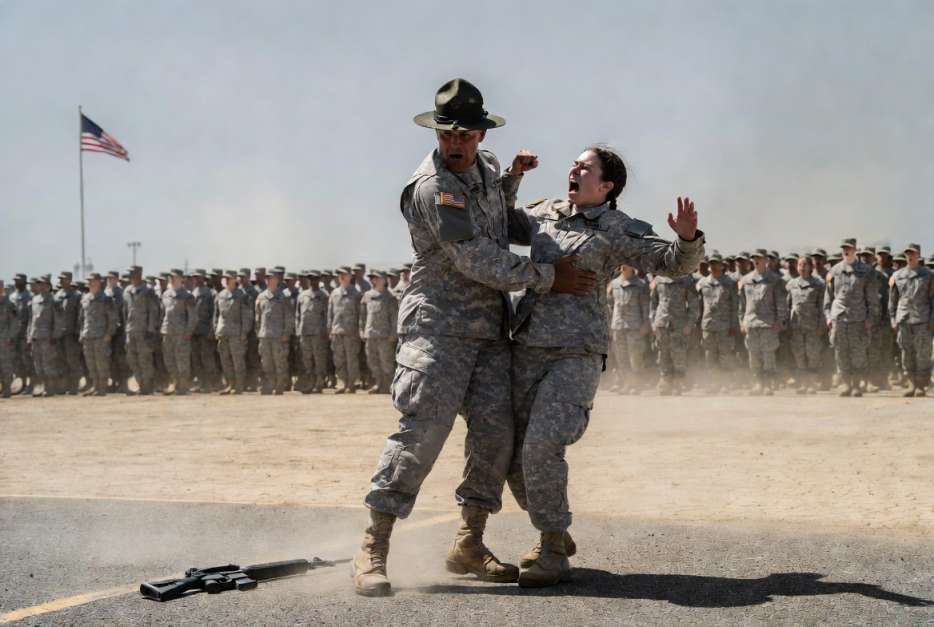
Rourke dragged her forward until the toes of her combat boots barely kissed the ground. His face hovered inches from hers, red with rage, while the South Carolina sun burned white-hot over Fort Granger’s parade field. Sweat slid down the back of Avery’s neck and pooled at the waistband of her ACUs. The air smelled of cut grass, gun oil, and fear.
“You are a disgrace to this uniform,” he snarled. Spittle flecked her cheek. “A weak little girl pretending to be a soldier.”
Avery felt his knuckles grinding against her collarbone. Her lungs clawed for air that wouldn’t come. Sweat ran into her eyes, stinging, but she refused to blink. She would not give him the satisfaction of seeing her flinch.
Behind her, nine perfectly aligned platoons stood motionless under the weight of the moment. Boots locked. Eyes locked forward. No one dared breathe too loudly.
Rourke was a decorated combat veteran with sixteen years of service, a Bronze Star, a Purple Heart, and three overseas deployments. His photograph hung in the training headquarters beneath the words LEADERSHIP THROUGH STRENGTH. The brass loved him. The recruits feared him. The system protected him.
Avery knew another version of him.
For six weeks, he had turned her life into a private war.
He had made her run extra miles after everyone else was dismissed, until her shins screamed and her vision tunneled. He had forced her to hold a sandbag above her head until her arms collapsed and the bag crushed her chest. During a ninety-eight-degree land-navigation exercise, he had blocked her from the water station for nearly three hours while the rest of the company drank freely. Her tongue had swollen. Her legs had shaken. She had still finished the course.
Whenever another recruit tried to help—offered a canteen, slowed their pace, whispered encouragement—Rourke punished that person too. Harder. Publicly.
Three nights earlier, he had leaned close enough for his breath to touch her cheek in the darkened bay.
“Women like you weaken the Army,” he had whispered. The words smelled of coffee and contempt. “I’m going to make sure you quit. Quietly. Or loudly. Your choice.”
Avery hadn’t quit.
Instead, every night after lights-out, she had opened a small green notebook beneath her blanket, writing by the thin blue glow of a penlight she kept hidden in her sock.
August 3. Denied water from 1105 to 1358. Witnesses: Lewis, Harper, Grant.
August 7. Ordered eighty additional push-ups after meeting the stated standard. Called me “charity-case girl” in front of Second Platoon.
August 11. Blocked from water again. Temperature 97°F. Witnesses: Madison Cole, Private First Class Torres.
August 14. Forced to stand at attention in full kit for two hours after range qualification while others broke down weapons. No reason given.
Dates. Times. Exact words. Witnesses. Locations. Weather conditions.
Her mother, Diane Bennett, had taught her to keep records years earlier when a restaurant manager in rural Ohio stole wages from Avery’s paycheck and called her a liar when she complained.
“People can argue with your memory, baby,” Diane had said, pressing a cheap spiral notebook into her sixteen-year-old hands. “They have a harder time arguing with dates, names, and facts. Write it down. Always.”
Avery had followed that advice without knowing whether anyone would ever see the notebook. She wrote because the act of writing made the abuse real instead of something she might later gaslight herself into doubting.
Now, as Rourke held her suspended in front of 284 witnesses, she understood why she had written every word.
He had claimed her rifle was dirty during inspection. Avery knew it wasn’t. She had spent two hours cleaning it the night before, and another instructor—Sergeant First Class Morales—had examined it and nodded approval before formation. Rourke didn’t care about the rifle.
He wanted submission. He wanted the sound of her breaking.
“Tell them you don’t belong here,” he ordered, voice low and venomous. “Say it so they all hear you. Say it.”
Avery’s heart pounded so violently that her vision pulsed with every beat. She saw her friend Madison Cole standing fifteen feet away in the second rank, face pale with fear, eyes wide. She saw two other drill sergeants watching from beside the reviewing stand, arms crossed, faces unreadable. Neither moved.
Rourke tightened his grip. The dog tags bit deeper.
“Say it, Bennett!”
Something inside Avery shifted.
Not broke.
Locked into place—like a bolt sliding home.
She raised her eyes and stared directly into his. The sun was behind him, turning his face into a red silhouette, but she found his eyes anyway.
“Article 93, Drill Sergeant.”
Rourke’s expression changed.
Only for a second—a flicker of pure, unfiltered shock—but Avery saw it. The entire parade field seemed to lean in.
“What did you say?”
“Article 93 of the Uniform Code of Military Justice,” Avery said, louder this time. Her voice did not shake. “Cruelty and maltreatment of subordinates.”
The parade field became so quiet she could hear a flag halyard tapping against a metal pole two hundred yards away. A crow called once, then fell silent as if even the birds understood.
Rourke’s grip loosened slightly.
Avery continued before fear could silence her. Before the old voice in her head—the one that said keep your head down, don’t make it worse—could reclaim control.
“I have documented three weeks of violations. Dates. Times. Locations. Witnesses. Exact words. You have repeatedly crossed the line between lawful training and abuse. I am formally requesting protection and an investigation by the Judge Advocate General’s Corps.”
A recruit somewhere behind her gasped—a short, sharp sound instantly swallowed by the silence.
Rourke released her as if her uniform had suddenly become electrified. Avery dropped onto both feet. Her knees nearly buckled. Pins and needles exploded up her calves. She remained standing. Barely.
Rourke’s face darkened from red to a dangerous purple. The veins in his neck stood out like cords.
“You think a notebook will protect you?” he asked quietly. The quiet was worse than the shouting.
“No, Drill Sergeant.”
Avery bent, picked up her rifle with hands that only trembled once, and returned it to a safe position across her chest. The metal was hot from the sun.
“The truth will.”
For one terrifying moment, Avery believed he was going to strike her. His right hand curled into a fist. His shoulders tightened. The entire formation seemed to hold a collective breath.
Then a voice exploded from the reviewing stand like a thunderclap.
“Drill Sergeant Rourke, step away from that recruit!”
Senior Drill Sergeant Nathan Briggs marched across the pavement with the kind of authority that made conversations die mid-sentence when he entered a room. Though several inches shorter than Rourke and built more like a coiled spring than a wrecking ball, Briggs carried presence the way some men carried weapons—effortlessly lethal.
Rourke faced him. “Senior Drill Sergeant, I was conducting corrective training.”
“I saw what you were conducting.” Briggs’s voice was flat iron. “You lifted a recruit by the collar in front of the entire training battalion. That is not corrective training. That is assault.”
“She dropped her weapon.”
“After you lifted her off the ground by her throat.”
Rourke glanced at the formation. For the first time, the mathematics of 284 pairs of eyes seemed to reach him. Witnesses. Living, breathing, memory-keeping witnesses.
Briggs stopped between them, close enough that Rourke had to look slightly down.
“Report to Lieutenant Colonel Shaw’s office. Immediately. You are not to speak to Private Bennett or any other recruit until further notice. You will not enter the company area. You will not make phone calls. You will sit in that office and wait. Am I understood?”
“Senior Drill Sergeant—”
“That was an order, Drill Sergeant.”
Rourke’s eyes returned to Avery. The fury inside them made his message unmistakable.
You just destroyed yourself.
He turned on his heel and marched toward headquarters, boots striking the pavement with controlled violence.
Briggs watched him leave before pivoting to address the recruits. His voice carried without effort.
“You will not spread rumors about what happened here. If contacted by an investigator, you will tell the complete truth—nothing more, nothing less. Anyone who threatens, intimidates, or retaliates against a witness will answer directly to me. And I promise you, that conversation will not be brief. Understood?”
“Yes, Senior Drill Sergeant!”
The response thundered across the field, shaking something loose in Avery’s chest.
Thirty minutes later, Avery entered the dining facility beneath hundreds of suspicious stares. Conversations died as she passed. Trays paused halfway to mouths. A male recruit from Third Platoon deliberately struck her shoulder hard enough to spin her half a step.
“Snitch,” he muttered, just loud enough.
Madison Cole appeared at her elbow like a shadow with purpose and pulled her toward a corner table near the trash cans—the least desirable real estate in the DFAC.
“What were you thinking?” Madison whispered, eyes darting. “You challenged Rourke in front of the entire training battalion. In front of God and everybody.”
“He was choking me.”
“I know. I saw. Half the company saw.” Madison’s hands shook as she unwrapped a protein bar she clearly had no intention of eating. “That’s not the point. The point is he has medals and you’ve been here six weeks. The point is the system doesn’t like it when the little people start quoting the UCMJ.”
Before Avery could answer, a military police officer appeared at the entrance—crisp, expressionless, the kind of stillness that made people straighten their spines.
“Private Avery Bennett?”
Every face in the dining facility turned toward her. The silence was absolute.
“Lieutenant Colonel Shaw wants you in her office. Bring the notebook.”
Avery slowly stood. The officer had never mentioned its color. He shouldn’t have known the notebook existed unless someone had already told him.
As she followed him outside into the white-hot glare, Avery looked toward headquarters and saw Rourke watching from a second-floor window. He lifted one finger and dragged it slowly across his throat.
Avery kept walking.
For the first time that morning, she was no longer afraid that no one would believe her.
She was afraid of what would happen when they did.
CHAPTER 2: THE OFFICE WITH NO WINDOWS
Lieutenant Colonel Shaw’s office smelled of lemon oil and old paper and the faint metallic tang of ambition. The blinds were drawn against the South Carolina sun, leaving the room in a permanent soft dusk. No windows looked out onto the parade field. No windows looked anywhere that mattered.
Shaw sat behind a desk that had outlived three previous commanders. She was fifty-two, silver threaded through black hair cut regulation-short, and she possessed the stillness of someone who had learned long ago that movement was often a form of weakness. Her combat patch was from the 101st. Her eyes were the color of wet slate.
Avery stood at parade rest three feet from the desk, the green notebook held in both hands like an offering or a weapon.
“At ease, Private. Sit.”
Avery sat. The chair was hard. Everything in the room was hard.
Shaw extended one hand. “The notebook.”
Avery hesitated half a second—long enough for Shaw to notice—then placed it on the desk. Shaw opened it without ceremony and began to read. Page after page. Her expression never changed. The only sound was the soft tick of a wall clock and the occasional rustle of paper.
After seven minutes that felt like an hour, Shaw closed the notebook and set it carefully in the exact center of her blotter.
“You kept this for three weeks.”
“Yes, ma’am.”
“Alone.”
“Yes, ma’am. Until this morning.”
Shaw leaned back. “Drill Sergeant Rourke has sixteen years of exemplary service. He has letters of commendation from two general officers. He has never been the subject of a formal complaint.” She paused. “Until now.”
Avery’s throat tightened. “Ma’am, the witnesses—”
“I am aware of the witnesses. I am also aware that 284 people watched a senior NCO lift a junior enlisted soldier by the collar in broad daylight. That is not a fact that can be walked back.” Shaw’s voice remained level. “What I need to know is whether you understand what you have started.”
Avery met her eyes. “I understand that I was being abused, ma’am. And that I have the right—no, the obligation—to report it.”
Something flickered behind Shaw’s slate gaze. Approval, perhaps. Or calculation.
“You have the right. The obligation is more complicated.” Shaw opened a drawer, withdrew a single sheet of paper, and slid it across. “This is a formal request for investigation under AR 15-6. You will sign it if you wish to proceed. Once you sign, this leaves my hands and enters a process that does not care about your feelings, your career, or your desire for justice. It cares about evidence, procedure, and the preservation of good order and discipline. Do you understand?”
“Yes, ma’am.”
“Do you still wish to proceed?”
Avery thought of the dog tags cutting into her throat. Of the sandbag crushing her chest. Of the water she had been denied while the South Carolina sun tried to cook her alive. Of Madison’s pale face. Of the word snitch hissed like a curse.
She thought of her mother’s voice: Write it down. Always.
She signed.
Shaw took the paper, initialed it, and placed it in a folder stamped FOR OFFICIAL USE ONLY.
“You will be moved this afternoon. New company. New barracks. You will not discuss this investigation with anyone except the investigating officer and legal counsel. If anyone approaches you—recruit, NCO, officer—you will report it immediately. Clear?”
“Clear, ma’am.”
Shaw stood. The meeting was over. But as Avery reached the door, the lieutenant colonel spoke again, softer.
“Private Bennett.”
Avery turned.
“I believe you. That does not mean this will be easy. The Army is a machine that prefers its gears to turn without friction. You have introduced friction. Be prepared for the heat.”
Avery nodded once. “Yes, ma’am.”
Outside, the MP waited. Avery looked up at the second-floor window. It was empty now. But the ghost of that finger drawing across a throat lingered in the air like smoke.
CHAPTER 3: THE COST OF BREATHING
They moved her that same afternoon.
New company. New bay. New set of eyes that already knew her name and the story attached to it. Word traveled faster than any official channel. By evening chow, half the training battalion had heard three versions of what happened on the parade field, and none of them were kind to the girl with the notebook.
Avery sat alone at the end of a table. No one joined her. Madison had been ordered not to make contact until the investigation permitted it. The isolation was surgical.
That night, lying on a thin mattress that still smelled of someone else’s sweat, Avery opened the green notebook one last time. She did not write new entries. She read the old ones. Each date was a bruise. Each witness name a potential liability.
She closed it and slid it under her pillow.
At 0230, the bay door opened. Soft footsteps. A silhouette paused at the foot of her bunk.
Avery’s hand closed around the notebook.
The silhouette leaned close. Male. Breath smelling of wintergreen dip.
“You should’ve just quit, Bennett,” the voice whispered. “Would’ve been easier for everybody.”
Then he was gone.
Avery did not sleep again that night. She lay awake counting the breaths of the women around her, listening for the door, cataloguing every sound the old barracks made. At 0500, when the lights slammed on and the duty NCO began shouting, she was already dressed, boots laced, notebook secured inside her blouse against her skin.
The investigation officer arrived at 0900. Captain Elias Voss. Thin, precise, glasses that caught the light like small shields. He took her statement in a windowless interview room that smelled of industrial cleaner and stale coffee. He recorded everything. He asked the same questions three different ways. He never once said he believed her.
When he finished, he closed his laptop and looked at her for a long moment.
“Private, I need you to understand something. Drill Sergeant Rourke has friends. Some of them wear oak leaves. Some of them wear stars. The evidence you provided is strong—stronger than most I’ve seen. But strong evidence and a clean outcome are not the same thing. People will test you. They will offer you easier paths. They will suggest that perhaps you misremembered. That perhaps the heat affected your judgment. That perhaps a young female recruit simply couldn’t handle the pressure.”
Avery’s jaw tightened. “I know what happened, sir.”
“I know you do. The question is whether the system will allow what you know to matter.” He stood. “Keep your head down. Document everything that happens from this point forward. And if anyone—anyone—threatens you, you call me. Day or night. My number is on this card.”
He handed her a plain white card with a cell number written in precise black ink.
Outside, the sky had turned the color of a bruise. Storm coming. The air was thick enough to chew.
Avery walked back to her new company area alone. Every window she passed seemed to hold a face. Every face seemed to already have decided what she was.
CHAPTER 4: GHOSTS IN THE FILE
The informal inquiry became a formal 15-6 investigation on the fourth day.
Captain Voss worked with the methodical patience of a man who had learned that rushing justice was a form of sabotage. He interviewed twenty-three recruits. He interviewed three other drill sergeants who had been present. He interviewed Senior Drill Sergeant Briggs twice. He pulled Rourke’s training records, his counseling packets, his previous evaluations.
What he found in the files was not what the medals suggested.
Three previous companies. Three patterns that looked, in hindsight, like weather systems forming. Female recruits who “voluntarily” left training. Male recruits who suddenly developed “attitude problems” after intervening. Counseling statements that used the same language—weak, unprepared, not suited for the profession of arms—over and over, as if copied from a template of contempt.
None of it had risen to a formal complaint. The system had absorbed the friction and kept turning.
Until Avery Bennett and her green notebook.
On the seventh day, Rourke was suspended from all training duties pending the outcome. He was restricted to the staff barracks and the headquarters building. He was not to approach any trainee.
That night, Avery’s new battle buddy—a quiet girl from Montana named Reese who had so far spoken fewer than twenty words to her—slid a folded piece of paper onto Avery’s bunk while the rest of the bay was at the latrine.
Avery waited until lights-out, then unfolded it under the blanket with her penlight.
He’s telling people you’re lying. That you came on to him. That the notebook is fake. That you got the dates from somebody else. Watch your six. — M
Madison. Somehow. Against orders.
Avery burned the note in the metal trash can outside the bay at 0200, watching the flame eat Madison’s handwriting until nothing remained but ash and the smell of smoke that might have been mistaken for a cigarette.
She returned to her bunk and lay in the dark with her eyes open, listening to the barracks breathe, and understood with sudden clarity that the real battle had only just begun.
The parade field had been the opening engagement.
What came next would be the campaign.
CHAPTER 5: THE WEIGHT OF PAPER
Two weeks into the investigation, Avery was called to the JAG office.
The building was newer than the rest of Fort Granger—glass and steel and the faint hum of air conditioning that felt like luxury after the swamp heat of the training areas. A civilian attorney named Miriam Solano met her in a conference room with a view of the tree line. Solano was in her forties, sharp-eyed, with the compact energy of someone who had spent a career being underestimated and turning that underestimation into ammunition.
“I’ve read your notebook cover to cover,” Solano said without preamble. “I’ve read the witness statements. I’ve read Rourke’s rebuttal.” She steepled her fingers. “He’s claiming you fabricated the entries. That you colluded with other disgruntled trainees. That the collar grab was a legitimate correction after you dropped your weapon during a safety violation.”
Avery’s stomach turned. “I didn’t drop it until he lifted me.”
“I know. The physical evidence—bruising on your collarbone, the angle of the drag marks on the pavement, the fact that 284 people saw it—supports you. But he has character witnesses. Senior officers who will testify that he is a tough but fair trainer. That the Army needs men like him. That soft soldiers get people killed.”
Solano leaned forward.
“Here’s what I need from you, Avery. I need you to be boring. I need you to be unimpeachable. No arguments. No emotional outbursts. No social media. No private conversations that can be twisted. You are going to become the most regulation-compliant, quiet, professional trainee this installation has ever seen. Because the moment you give them a crack—any crack—they will drive a truck through it and call it your character.”
Avery nodded. The green notebook felt heavy in her cargo pocket.
“And one more thing,” Solano said. “They’re going to offer you a deal. Quiet discharge. Honorable. No further action against Rourke if you drop the complaint and transfer. It will sound like mercy. It will feel like oxygen after drowning. Do not take it. Do you hear me? Do not take it.”
“Why would they offer that if the evidence is strong?”
Solano’s smile was thin and without humor. “Because strong evidence still requires someone with stars to decide the Army’s reputation is worth the cost of one decorated NCO. And right now, that calculation is still being made.”
Outside, thunder rolled across the low country. The storm that had been promising for days finally arrived, hard and sudden, turning the world beyond the glass into a gray roar.
Avery walked back through the rain without seeking cover. The water soaked her ACUs, plastered her hair to her skull, ran into her eyes like tears she refused to acknowledge. By the time she reached her company area, she was drenched and clean and certain of one thing:
She would not take the deal.
She had already paid too much for the truth to sell it cheap.
CHAPTER 6: THE FIRST CRACK
The deal came on a Tuesday.
A major Avery had never met sat across from her in a different windowless room and spoke in the gentle tones of a man offering a life raft to a drowning woman. Honorable discharge. Full benefits. A letter of recommendation. A clean break. All she had to do was sign a statement acknowledging that the events of August had been a misunderstanding exacerbated by the stress of training.
Avery looked at the paper. The words swam.
“And Drill Sergeant Rourke?” she asked.
The major’s smile did not reach his eyes. “He will receive appropriate administrative counseling and be reassigned to a non-training billet. The Army takes these matters seriously, Private. But we also take the readiness of the force seriously. Prolonged investigations damage unit cohesion. This is the cleanest path for everyone.”
Avery thought of the sandbag. The denied water. The finger across the throat. The whispered threats in the dark. The word snitch. The isolation that had become her second uniform.
She thought of every woman who would come after her if she signed.
“No, sir.”
The major’s expression hardened by degrees. “I’m going to give you forty-eight hours to reconsider. This offer will not remain on the table indefinitely.”
“I don’t need forty-eight hours, sir. The answer is no.”
She stood, rendered a perfect salute, and walked out before he could find another way to call her foolish.
That night, someone painted the word LIAR across her wall locker in black permanent marker. The duty NCO made her clean it herself with acetone that burned her skin. No one admitted to seeing who did it. The bay was full of eyes that looked everywhere except at her.
Avery scrubbed until the word was a gray ghost. Then she opened her notebook and wrote:
August 29. Wall locker defaced. Word: LIAR. No witnesses willing to speak. Duty NCO: SGT Harlan. Action taken: none beyond ordering me to clean it.
She closed the book. Her hands smelled of chemicals and resolve.
CHAPTER 7: WITNESSES
The first crack in Rourke’s armor came from an unexpected direction.
Private First Class Torres—one of the names in Avery’s notebook, a quiet young man from El Paso who had once offered her water during the land-nav exercise and received a smoking for it—requested a private meeting with Captain Voss.
He brought his own notebook.
Small. Black. Filled with dates and times and the same cold precision Avery had used. He had been keeping records too. Not just about Avery. About three other female trainees in previous cycles. About a male recruit who had been driven to the edge of suicide and then quietly recycled. About a culture of selective cruelty that Rourke had perfected and protected.
Torres’s hands shook when he handed the notebook over. “I should’ve come forward sooner,” he said. “I was scared. I’m still scared. But I can’t watch them do to her what they did to the others.”
Voss took the notebook like it was radioactive and precious in equal measure.
Within forty-eight hours, three more trainees came forward. Then five. Then a former drill sergeant who had transferred out two years earlier and had been carrying his own silence like a stone in his gut. The stone, it turned out, had writing on it.
The investigation exploded outward.
Rourke’s supporters began to thin. Some quietly. Some with the sudden amnesia of people who had always known which way the wind was blowing and were now discovering it had shifted.
Avery received a single text from an unknown number at 2347 one night:
You’re not alone anymore. Keep writing.
She did not reply. She did not need to. She opened her green notebook and added the date, the time, and three words:
They are coming.
CHAPTER 8: THE HEARING
The Article 15 hearing was held in a wood-paneled room that had witnessed decades of careers ending and beginning. The air conditioning hummed like a held breath. Rourke sat at one table in dress greens, medals gleaming under the fluorescent lights—Bronze Star, Purple Heart, the whole constellation of a warrior’s résumé. Avery sat at the other in her Class A’s, green notebook on the table in front of her like a second heart.
Lieutenant Colonel Shaw presided. Captain Voss presented. Miriam Solano sat beside Avery, a quiet fortress in a dark suit.
Rourke’s counsel—a sharp major with a reputation for dismantling junior enlisted testimony—opened with character. Sixteen years. Combat. Mentorship. The necessity of hard training in a hard profession. He painted Avery as a young woman who had misinterpreted intensity for malice, who had been overwhelmed by the demands of becoming a soldier, who had chosen the path of accusation rather than the path of growth.
Then he made a mistake.
He called Avery to the stand and asked her, with carefully calibrated contempt, whether she had ever considered that perhaps she simply wasn’t cut out for the Army.
Avery looked at him. Then she looked at Rourke. Then she looked at Shaw.
“Sir,” she said, voice steady, “I have considered every night for six weeks whether I was strong enough. I ran the extra miles. I held the sandbag until my arms failed and then I held it longer. I finished the land-nav course with a swollen tongue and blurred vision because someone decided I didn’t deserve water. I cleaned my rifle until it shone and still got told it was dirty. I wrote everything down because my mother taught me that paper remembers when people pretend to forget.”
She opened the notebook.
“I am cut out for the Army, sir. The question this hearing is answering is whether the Army is still cut out for people like me—and for every soldier who comes after me who refuses to be broken in silence.”
The room was very quiet.
Shaw’s face did not change. But something in the set of her shoulders shifted, as if a decision long held in suspension had finally settled.
When the witnesses began—Torres, then Madison (released from her restriction for testimony), then two more, then the former drill sergeant who had carried his stone for two years—the mathematics of 284 pairs of eyes became something denser. Something that could not be argued away with medals and character letters.
Rourke sat very still. His counsel’s questions grew sharper, then shorter, then stopped.
At the end, Shaw recessed for ninety minutes.
When she returned, her voice was the same slate-flat instrument it had always been.
“Drill Sergeant Cole Rourke, I find that you did violate Article 93 of the Uniform Code of Military Justice. You did engage in cruelty and maltreatment of a subordinate. You did create a hostile training environment that exceeded the bounds of lawful correction. You will be reduced in rank to staff sergeant. You will forfeit pay. You will be permanently removed from the training cadre. And you will face a separation board to determine whether you will be allowed to remain in the United States Army.”
She looked at Avery.
“Private Bennett. Your courage in documenting and reporting this misconduct is noted. You will complete training with your new company. You will be afforded every opportunity to succeed that this installation can provide. And you will, if you choose, be given the chance to mentor future trainees on the importance of integrity under pressure.”
Shaw stood. The room stood with her.
“This hearing is adjourned.”
Rourke did not look at Avery as he was escorted out. But Avery looked at him. She looked until the door closed. Then she sat down, placed both hands flat on the green notebook, and allowed herself one full breath that did not taste of fear.
CHAPTER 9: AFTERMATH
Victory did not feel like victory.
It felt like standing in the center of a blast radius and realizing the shrapnel was still flying. Some recruits avoided her. Some treated her with a new, careful respect that was almost worse than contempt—as if she had become something fragile and dangerous at once. A few, quietly, thanked her. One left a single green pen on her bunk with no note.
Madison found her behind the company headquarters three days after the hearing. They stood in the shade of a live oak that had been there longer than either of them had been alive.
“You did it,” Madison said.
“We did it,” Avery corrected. “Torres. You. The others. I just held the match.”
Madison smiled, small and fierce. “Still burned the whole damn forest down.”
Avery looked at her hands. The calluses from the sandbag. The faint chemical burn from the acetone. The ink stains that never quite washed out.
“Some forests need burning,” she said. “So something better can grow.”
They stood in silence for a while, listening to the cicadas scream their endless summer song. Then Madison straightened.
“I’ve got range detail. You?”
“Land-nav make-up. Apparently almost dying of thirst wasn’t enough the first time.”
Madison laughed—real, sudden, the sound of pressure releasing. “Don’t forget water this time.”
“Never again,” Avery said.
And meant it in more ways than one.
CHAPTER 10: WHAT THE DOG TAGS KNEW
Two years later.
Sergeant Avery Bennett stood on a different parade field at a different post, the North Carolina humidity wrapping her like a wet wool blanket. The sun was lower, kinder. The recruits in front of her were new—faces still soft with civilian hope, eyes still bright with the particular terror of the unknown.
She wore the same rank Rourke had once worn. The same campaign hat. The same responsibility.
Different everything else.
Her phone buzzed. A text from Madison, now a staff sergeant at Bragg:
New cycle. Already spotted two who need watching. You free for a call tonight?
Avery smiled and typed back.
Always.
She stepped out onto the field as the sun began to drop. A young female recruit was struggling with a litter carry, face red, eyes bright with the particular shame of not being strong enough yet. An older male drill sergeant started to move toward her with the old look—the one that said break her down to build her up, the one that sometimes forgot the second half of the sentence.
Avery intercepted him with a quiet word and a hand on his shoulder.
“I’ve got this one, Sergeant.”
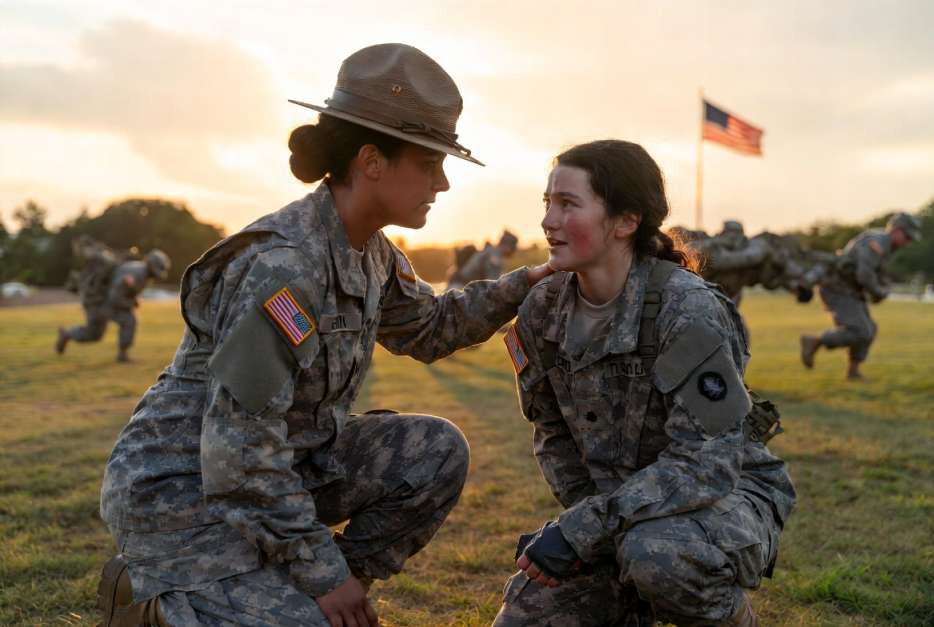
She walked over to the recruit, crouched to her level, and spoke just loud enough for the young woman to hear.
“You’re not weak. You’re tired. There’s a difference. Drink water. Adjust your grip. We finish this together. Clear?”
The recruit’s eyes widened—at the kindness, at the rank, at the simple fact of being seen.
“Clear, Drill Sergeant.”
As they moved out together, Avery felt the familiar weight of the dog tags against her chest. They no longer felt like a threat.
They felt like a promise.
Somewhere, in a prison cell in another state, a man who had once believed the Army belonged only to men like him was learning how long eighteen months could feel.
And somewhere else—in barracks and bays and dark corners where young soldiers still wrote by penlight—notebooks were filling with dates and times and names.
Not because the war was over.
Because the writers finally knew they were not alone.
And that, Avery had learned, was how you burned a forest down and still left something green standing in the ashes.
THE END