THE WOMAN IN GREEN
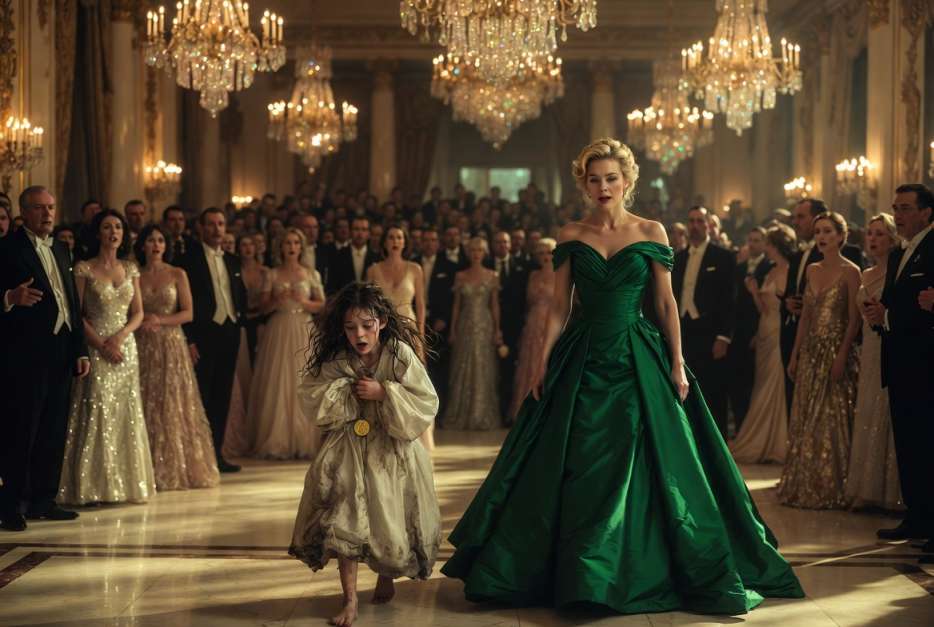
The marble under Mia’s bare feet was cold enough to hurt. She didn’t notice. Her whole world had shrunk to the size of the golden locket burning in her fist and the tall woman in the emerald gown who stood at the far end of the ballroom like a queen who had never learned how to kneel.
Chandeliers dripped light. A string quartet tried to keep playing Vivaldi, but the notes were dying one by one. Hundreds of faces—diamond earrings, black ties, mouths painted the color of expensive wine—turned toward the dirty little girl who did not belong.
Mia kept walking.
Two security men in charcoal suits stepped into her path. The bigger one held out a hand the size of a dinner plate.
“Miss, you need to leave. Now.”
Mia’s voice was a cracked whisper, but it carried farther than the music.
“Please… don’t take this away from me. My mom said you would know.”
The woman in green lifted one gloved hand. Just one. The guards froze like dogs hearing a silent whistle.
“Let her come closer.”
Mia’s oversized dress—once white, now the color of old dishwater—dragged behind her. She had walked fourteen city blocks in the rain to get here. Her mother had made her memorize the address, the floor, the color of the gown the woman would be wearing. Green. Always green on the third Saturday of July. The night the Hale Foundation thanked its donors.
Mia stopped three feet away. Up close the woman was even more terrifying. Bone structure like carved ice. Hair the color of winter wheat swept into a knot that had never known a single rebellious strand. Eyes the exact gray of a blade.
Mia’s fingers would not open. She had to pry them loose one by one. The locket dropped into the woman’s palm with a soft metallic kiss.
“Mom was saving it for you,” Mia whispered. Tears finally spilled, hot and humiliating. “She said… ‘Trova la donna in verde.’”
The ballroom stopped breathing.
Victoria Hale—because that was her name, printed in gold leaf on every invitation—felt the floor tilt. Twenty years of carefully constructed silence cracked open inside her chest. Only one person on earth had ever spoken those words to her. And that person was supposed to be bones and ash in a cemetery outside Florence.
Her hands shook so hard the locket almost slipped. She knew the engraving before she saw it. Two tiny swallows facing each other, wings locked. Their secret childhood seal.
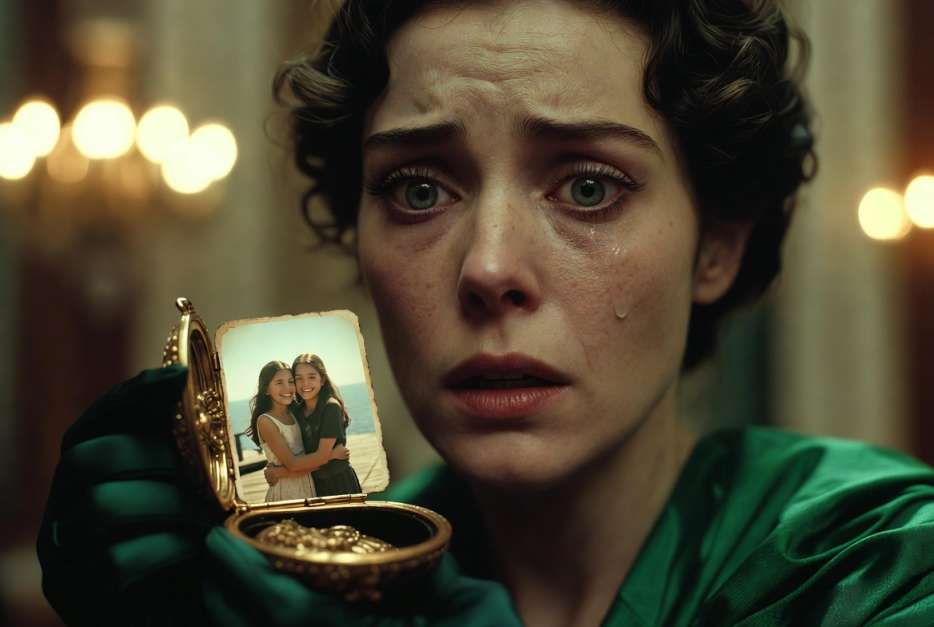
She opened it.
The photograph inside was yellowed, edges soft as old skin. Two girls, barefoot on a sun-bleached dock, arms wrapped around each other so tightly their shoulders disappeared. One girl was her—seventeen, freckles, laughing with her whole body. The other girl had the same eyes, the same stubborn chin.
Elena.
Alive in the picture. Dead everywhere else.
Victoria’s throat closed. A sound escaped her—half sob, half animal. She turned the locket over. Her thumbnail found the hidden seam only the two of them had ever known. The secret compartment sprang open with a soft click that sounded like a gunshot in the silence.
Something small and folded fell into her palm.
A strip of paper. No—thicker. A key. And beneath it, a single sheet of onionskin, written in the looping hand Victoria still dreamed about on the worst nights.
She read the first line and the world she had spent two decades building simply… ended.
Chapter 1
Three Hours Earlier
The rain over Manhattan was the polite kind—fine, cold, expensive. It silvered the glass towers and turned the streets into black mirrors. Inside the Hale Ballroom on the fifty-second floor of the Hale Tower, no one cared about rain. They cared about the woman in the emerald silk column gown who could make or break a foundation with a single nod.
Victoria Hale was forty-five and looked thirty-eight if the light was kind. Tonight the light was worshipful. She moved through the crowd the way a shark moves through warm water—effortless, inevitable. Every guest wanted a piece of her: a photograph, a promise, a smile that might later be cashed in for access.
She gave them exactly enough and nothing more.
Her assistant, a sharp-eyed woman named Priya, murmured at her elbow, “Senator Lang wants five minutes about the education bill. The Met curator is hoping you’ll look at the new wing naming rights. And your ex-husband’s lawyer is here. Again.”
Victoria’s smile never flickered. “Tell the senator I’ll call Monday. Tell the curator the answer is still no. And tell Richard’s lawyer that if he approaches me tonight I will have security throw him out the window he came in through.”
Priya almost smiled. Almost.
Victoria lifted a flute of untouched champagne to her lips and let the bubbles die against them. She hated champagne. She hated these nights. She hated the way the city looked at her like she had never been a scared seventeen-year-old running through olive groves with blood on her knees and her sister’s name in her mouth.
Elena.
Even thinking the name felt like pressing on a bruise that had never healed right.
Twenty years. Twenty years of silence. Twenty years of believing the fire in the old villa outside Siena had taken the only person who had ever known the real Victoria—the girl who stole peaches and climbed water towers and once punched a boy for calling Elena slow.
The official story was clean: tragic accident, two American sisters on a summer abroad, one body recovered, one survivor flown home catatonic. The survivor became Victoria Hale, heir to a shipping fortune she never wanted, builder of an empire of glass and goodwill. The dead sister became a tasteful marble angel in a cemetery no one visited.
Victoria had not visited either.
She was mid-conversation with a tech billionaire who wanted his name on a pediatric wing when the string quartet faltered. A ripple moved through the room the way wind moves through wheat. Heads turned. Conversations died mid-sentence.
Victoria followed their eyes.
A child.
Small. Filthy. Standing in the exact center of her perfect world like a crack in a diamond.
The girl’s dress looked like it had been white once. Now it was the color of sidewalk after rain. Her hair was a dark tangle stuck to her cheeks. She was barefoot. And she was walking straight toward Victoria as if the two hundred people between them simply did not exist.
Security moved. Victoria’s hand rose without her permission.
“Let her come closer.”
The child stopped in front of her. Up close she smelled of wet wool and fear and something sweeter—like the cheap strawberry shampoo Elena used to steal from drugstores.
Then the girl spoke, and the past kicked the door down.
Chapter 2
The Locket
Victoria’s private study on the fifty-third floor was soundproofed, climate-controlled, and lined with books she had never read. The only personal object was a single black-and-white photograph of two little girls on a beach, faces turned away from the camera. She had told everyone it was a stock photo. She had lied for twenty years.
She locked the door. Priya stood guard outside with orders to shoot anyone who knocked.
Mia sat on the edge of a leather chair too big for her, feet dangling, the oversized dress pooled around her like a melted wedding cake. She had stopped crying. Children that young ran out of tears the way adults ran out of hope—suddenly and completely.
Victoria poured two fingers of scotch she did not drink and set the glass down untouched. Her hands still shook.
“What’s your name?”
“Mia.” The girl swallowed. “Mia Rossi. But Mom said that might not be my real last name. She said names are just coats. You can take them off.”
Victoria’s heart did something violent. Rossi. Elena’s mother’s maiden name. The name they had used when they ran.
“How old are you, Mia?”
“Eight. And a half. Almost.”
“Where is your mother?”
The question landed like a slap. Mia’s face crumpled, then smoothed with the terrifying self-control of a child who has already learned that crying changes nothing.
“She’s gone. The hospital said her heart stopped. But I think it was the secrets. Secrets are heavy. They crush people.”
Victoria closed her eyes. When she opened them the room had tilted again.
She spread the contents of the secret compartment on the desk under the low lamp.
- A small brass key, old, the kind that opened safety deposit boxes in European banks that still believed in discretion.
- A strip of paper with an address in Brooklyn and a date three days from now.
- The letter.
The letter was written on the thin airmail paper Elena had always preferred. The ink was faded but the voice was not.
Vikki,
If you are reading this I am already dead and I am so fucking sorry.
I never meant to leave you. The fire was not an accident. They wanted both of us gone because of what we saw that night in the villa. I got out. You didn’t know I got out. I let you believe I was dead because staying dead was the only way to keep you breathing.
I had a daughter. Her name is Mia. She is the best thing I ever did and the only clean thing left in me. I told her to find the woman in green. I told her the words. I told her you would know.
The key opens a box at the Banca Monte dei Paschi in Siena. Inside is everything. The proof. The names. The money they paid to make us disappear. And the original birth certificate that says who Mia really is.
They will come for her when they realize I am gone. You are the only person left who can keep her safe. You are the only person I ever trusted with my whole heart.
I loved you every single day I was gone. I loved you more than I hated the people who made me leave.
Forgive me or don’t. Just keep her.
—E
Victoria read it twice. Then a third time. The scotch glass shattered in her hand. She did not feel the cut.
Mia watched blood drip onto the carpet with solemn interest.
“Mom said you might be mad,” the girl offered quietly. “She said you have a right to be. She said if you yell I should just wait until you’re done, because you’re the kind of person who yells when you’re scared, not when you’re mean.”
Victoria laughed. It sounded like something breaking.
She dropped to her knees in front of the child, emerald silk pooling like spilled wine, and took Mia’s small cold hands in her bloody ones.
“I’m not mad at you,” she whispered. “I’m mad at the universe. And at myself. And at every year I spent believing a lie.”
Mia’s lower lip trembled. “Are you going to send me away?”
“No.” The word came out raw. “Never. Do you understand me? Never.”
Something ancient and ferocious woke up inside Victoria Hale. The girl who had once bitten a boy’s ear half off for calling her sister names. The girl who had climbed out a third-story window with nothing but a backpack and her sister’s hand.
That girl was still alive. And she was fucking furious.
Chapter 3
The Night the Fire Started (Twenty Years Earlier)
The villa smelled of lemon trees and old money and secrets that had begun to rot.
Victoria (then just Vikki) was seventeen and drunk on cheap Chianti and the reckless joy of being far from their father’s house. Elena was sixteen, softer, quieter, the one who still believed people were mostly good. They had snuck out to the terraced garden to smoke stolen cigarettes and talk about the boys in the village who looked at them like they were miracles.
That was when they heard the shouting.
Their father’s business partner—Mr. Langford, the one with the kind smile and the dead eyes—was in the library with two men Victoria had never seen. Papers were being signed. Money was being counted. And then a third man was dragged in, bleeding from the mouth, begging in Italian.
Victoria would remember the exact words for the rest of her life.
“He knows about the shipments. The children. If he talks—”
Elena had gasped. The sound was tiny, but it carried.
The men looked up.
What happened next lived in Victoria’s nightmares in perfect high-definition. The chase through the olive grove. The gunshots. Elena falling. Victoria dragging her sister into the old well house. The decision—stupid, desperate, final—to set the villa on fire so the men would think both girls had burned with the evidence.
Only one of them made it out.
Victoria woke up in a hospital in Rome with third-degree burns on her left arm and a story already written for her by men in expensive suits: tragic accident, sole survivor, inheritance waiting in New York.
Elena’s body was never found because Elena’s body was never there.
She had crawled out the other side of the well house, half-dead, and kept crawling until a farmer’s wife found her three days later. She let the world believe she was ash because the men who wanted them dead would never stop looking if they knew a witness still breathed.
She changed her name. She ran. She survived. And nine years later, in a one-room apartment in Queens, she gave birth to a daughter with Victoria’s stubborn chin and her own soft eyes and named her Mia—because it meant “mine.”
Chapter 4
Brooklyn, Three Days Later
The address on the paper led to a storage unit under the BQE that smelled of mildew and old tires. Victoria went alone at 2 a.m., wearing black and carrying a gun she had not touched since the night she bought it after the first death threat twelve years ago. Mia was asleep in the penthouse under Priya’s fierce protection and two off-duty NYPD officers who owed Victoria favors.
The storage unit held one thing: a battered metal footlocker with Elena’s swallows scratched into the lid.
Inside:
- Stacks of cash in euros and dollars, carefully counted.
- A leather portfolio of photographs: shipping containers, children’s faces, ledgers with Langford’s signature.
- A flash drive.
- And a second letter, this one addressed to Mia.
Victoria read it on the cold concrete floor with tears running into her mouth.
My baby,
If Aunt Vikki is reading this with you, it means I finally got to rest. I need you to know I fought to stay. Every day. I fought the cancer and the fear and the men who still send people to look for me. I lost the cancer fight. I will never lose the fight for you.
You are not a secret. You are the reason I stayed alive as long as I did. You have her eyes when she laughs and my stubbornness when you’re mad. You are the best of both of us.
Be brave the way she is brave. Be soft the way I tried to be. And if the world ever tries to tell you that you do not belong in the rooms with the chandeliers, you look them dead in the eye and you say: My mother walked through fire so I could stand here. Try and move me.
I love you past the end of everything.
Mom
Victoria closed the letter, pressed it to her mouth, and screamed into the leather until her throat bled.
Then she wiped her face, locked the footlocker, and called the only journalist in the city she trusted—a woman who had once lost a child to the same dark network Elena had photographed.
“I have a story,” Victoria said. “And I have proof. And if you bury this I will bury you.”
Chapter 5
The Fall
The scandal hit like a meteor.
Senator Langford (yes, that Langford—the one who had wanted five minutes at the ball) was arrested at his Connecticut estate while pouring coffee. The photographs went global in eleven minutes. The flash drive contained names, routes, bank accounts, and a video of Langford personally ordering the “cleanup” of two American girls in Tuscany twenty years earlier.
Victoria held a press conference on the steps of the Hale Tower with Mia’s small hand locked in hers. She wore black. Mia wore a new green dress that fit.
“My sister did not die in that fire,” Victoria said into the microphones, voice steady as stone. “She survived. She hid. She raised a daughter alone while the men who tried to kill us built careers and legacies on the graves of children. Today that ends. My niece’s name is Mia Hale. She is home. And every person who touched this will burn.”
The crowd roared.
Somewhere in the noise, Mia looked up at her aunt and whispered, “Mom would have liked the green dress.”
Victoria squeezed her hand hard enough to hurt them both.
“She picked the color,” she answered. “A long time ago.”
Chapter 6
One Year Later
The house in Connecticut had too many windows and a garden Elena would have loved. Victoria had bought it the week after the trial ended. She still woke some nights gasping, smelling smoke that wasn’t there. But the nights were fewer.
Mia was nine now. She had a best friend named Sophie who came over every Saturday and a black cat named Trouble who only liked her. She still kept the locket under her pillow. Sometimes she took it out and opened the secret compartment just to make sure the key was still gone—given to the Italian authorities—and the photograph of two laughing girls was still there.
On the anniversary of the ballroom night, Victoria found her niece in the garden at dusk, barefoot again, talking to the sky.
“Who are you talking to?”
Mia didn’t turn around. “Mom. I tell her things. Today I told her you let me have ice cream for breakfast and that you cried at the school play even though you pretended you had allergies.”
Victoria sat in the grass beside her. Emerald silk was a memory. Tonight she wore jeans and one of Elena’s old flannel shirts that still smelled faintly of the strawberry shampoo if you breathed deep enough.
“Does she answer?”
Mia shrugged. “Not with words. But sometimes the wind feels like her. Or the way Trouble purrs. Or when you laugh with your whole face the way the picture shows.”
They sat in silence while the last light died.
Then Mia leaned her head against Victoria’s shoulder, small and solid and real.
“Aunt Vikki?”
“Mm?”
“Are we going to be okay?”
Victoria looked at the house glowing behind them, at the girl who carried her sister’s heart and her own stubborn blood, at the sky that had finally stopped feeling like an accusation.
She thought of every version of herself that had died along the way—the terrified seventeen-year-old, the ice queen in the green gown, the woman who almost let grief turn her to stone.
Then she thought of the two barefoot girls on the dock, promising never to let go.
“Yeah, baby,” she said, and the words felt true for the first time in twenty years. “We’re going to be more than okay.”
Mia smiled the exact smile from the photograph.
Somewhere, in a place beyond fire and secrets and the long cruel years, Elena smiled too.
And the woman in green—who was no longer only the woman in green—finally, finally, let herself cry.
Not from grief. From the unbearable, miraculous weight of still being loved.
THE END