The velvet ropes might as well have been iron bars.
Vivienne Vale felt the December wind slice through the thin gap between her silver gown and her skin, but the real cold came from inside. The little girl’s fingers had brushed the air near her wrist like a ghost from a grave she’d spent twenty years sealing shut. Now the child stood there, coat too thin, eyes too old, and that moonstone clip catching the light like a blade.
Vivienne’s publicist, Margot, was already at her elbow, perfume sharp as her whisper. “Vivienne. Inside. Smile. Now.”
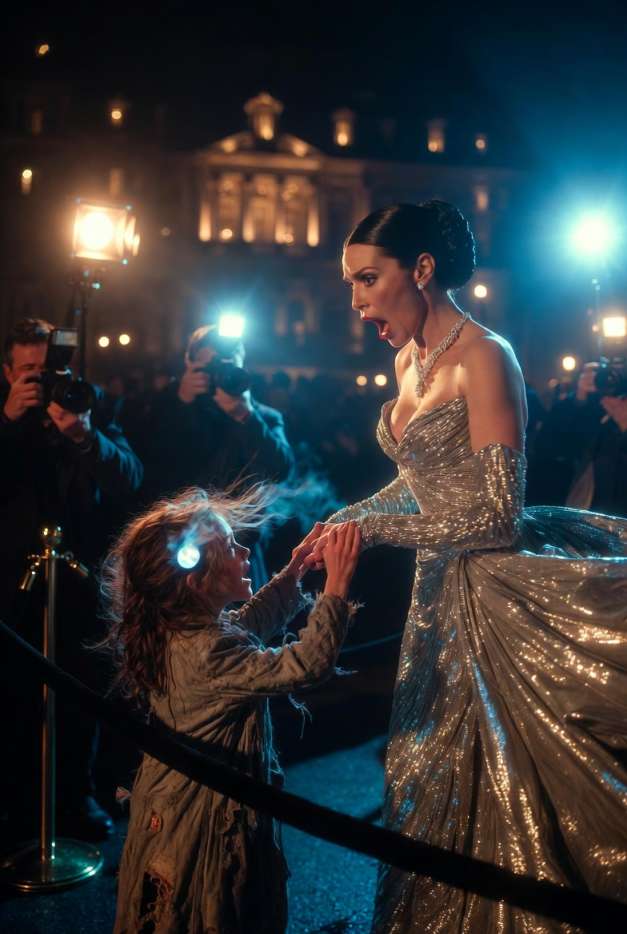
But Vivienne couldn’t look away.
The stone burned blue fire under the hotel awning. She remembered the weight of it in her own small hand once, Celeste fastening it into her hair before their father’s annual portrait. For luck, Celeste had said, voice warm with secrets. We carry the light when they try to snuff it out.
Arthur Vale stepped forward, his smile the same one he wore at board meetings and funerals. Polished. Final. “Vivienne, darling. Let security handle this. The guests are waiting.”
The little girl’s whisper cut through the murmurs like cracked glass. “That’s the man Mama said would kill the truth again.”
Arthur’s eyes flicked to the child. Something ancient and careful moved behind them. Not fear. Calculation.
Vivienne felt her pulse hammer against the diamond choker at her throat. The flashbulbs popped in a frenzy. Phones rose like periscopes in a sea of black ties and envy. Tomorrow’s headlines were already writing themselves: Vale Heiress Unravels at Charity Ball—Secret Love Child?
She didn’t care.
She reached again, slower this time, and touched the moonstone. The girl flinched but didn’t pull away. The stone was warm. Impossible. Stones didn’t hold memory, yet this one did. It carried the scent of rain on marble, the sound of Celeste’s laugh fading down a hallway twenty years gone.
“Where is your mother?” Vivienne asked. Her voice sounded foreign to her own ears—raw, stripped of the boardroom steel she’d spent a lifetime forging.
The girl’s lips trembled. “She said you’d ask that.”
Arthur’s gloved hand landed on Vivienne’s shoulder, heavy as a gavel. “Enough. This is clearly some tabloid stunt. Guards.”
Two broad men moved in. The crowd parted with that particular New York hunger—half scandalized, half delighted. A woman in emerald silk actually leaned forward, lips parted as if tasting the drama.
The girl looked straight at Vivienne, no tears, just the exhausted courage of someone who had practiced this moment in the dark. “Her name is Celeste Vale. She said you’d remember the clip. She said you’d remember the promise.”
The name landed like a slap.
Celeste.
Not supposedly betrayed. Not erased. Here, in the mouth of a child who should never have made it past the ropes.
Vivienne’s world narrowed to the blue fire in the stone. She saw Celeste again—older sister, golden-brown hair, the one who read her bedtime stories about girls who outsmarted kings. The one who vanished the night their father discovered the documents. The one everyone said had sold family secrets to the press for money and then ran.
Vivienne had believed it. She had needed to believe it.
Because the alternative meant her father had chosen power over blood.
A security guard’s hand closed on the girl’s thin arm. The child gasped—small, sharp, the sound of something breaking.
Something inside Vivienne snapped with it.
She stepped between them, silver gown flaring like a banner. “Don’t touch her.”
The guard hesitated. Arthur’s smile thinned.
“Vivienne,” her father said, low enough for only her to hear, “you’re making a scene. Think of the Foundation. The networks. Everything we built.”
We. The word tasted like rust.
She looked at him then—really looked. The man who had taught her to wield silence like a weapon. The man whose approval she had once craved more than oxygen. Now she saw the calculation in his eyes, the same one he’d worn the night Celeste disappeared. The night Vivienne had turned her back while her sister begged in the rain.
The girl’s voice rose, fragile but clear. “Mama has proof. Letters. Photos. She said the truth has been waiting in a safe-deposit box with your name on it. She said you’d know which bank.”
Arthur laughed softly, the sound meant to reassure the donors. It didn’t reach his eyes. “My dear, people have tried this before. Impostors. Opportunists. My eldest daughter made her choices. Tragic ones.”
But Vivienne heard the lie in the smoothness. She felt the old wound rip open, raw and bleeding.
She took the girl’s hand. It was ice-cold. Tiny bones under paper skin. “What’s your name?”
“Lila,” the child whispered. “Lila Vale.”
The surname hit harder than the clip.
Vivienne’s knees almost buckled. Twenty years of pretending Celeste had never existed. Twenty years of cutting her out of photos, out of conversations, out of her own heart. And here was proof in a scuffed coat and trembling fingers.
Margot hissed again, desperate. “Vivienne, the press—”
“Fuck the press,” Vivienne said. The words felt like freedom and ruin at once.
She pulled Lila closer, shielding her from the cameras with her own body. The silver gown became armor. The chandeliers above seemed to dim, or maybe that was the blood roaring in her ears.
Arthur’s voice dropped to a register only she knew—the one he used when deals went south. “You’re throwing everything away for a stranger’s child. For a ghost.”
“She’s not a ghost,” Vivienne said. “She’s standing right here.”
Lila looked up at her, and for the first time, the exhaustion in those eyes cracked into something like hope. It hurt worse than any accusation.
The wind whipped down Fifth Avenue, carrying the smell of roasted chestnuts and exhaust and money. Inside the Grand Maribel, string quartets played on, oblivious. Outside, the winter charity ball had become something else entirely—a reckoning dressed in diamonds.
Vivienne met her father’s gaze one last time. “If you try to stop this, I will burn every network I own to the ground to find the truth.”
Arthur’s face didn’t change. But something behind his eyes did. A door closing. Or opening onto darkness.
He stepped back, hands raised in elegant surrender for the cameras. “Security, stand down. Let my daughter handle her… family matters.”
The lie tasted like victory and poison.
Lila’s small hand tightened in Vivienne’s. “Mama said you might cry. She said it was okay.”
Vivienne didn’t cry. Not yet. But the pressure behind her eyes felt like the Hudson breaking its banks.
She turned toward the hotel doors, Lila beside her, the moonstone clip catching every flash like a signal fire across twenty lost years.
Behind them, Arthur Vale watched with the calm of a man who had buried worse things than rumors.
Inside Vivienne, a different storm gathered. One that had been waiting since the night she let her sister walk away into the rain.
One that would drag every secret into the light, no matter who it destroyed.
Including her.
Chapter 1: The Clip
The Grand Maribel’s ballroom swallowed them in warmth and crystal light, but Vivienne felt none of it. Lila’s hand stayed in hers as they moved past tables set with gold-rimmed china and centerpieces of white roses that smelled like funerals. Donors stared. A few offered tight, sympathetic smiles—the kind reserved for public meltdowns among the elite.
Vivienne’s mind raced ahead like a film reel on fast-forward. Celeste alive. A child. Proof in a safe-deposit box. The promise she’d broken the night she turned her back.
She guided Lila toward a private alcove off the main ballroom, away from the worst of the eyes. A waiter paused, silver tray trembling slightly at the sight of the child’s scuffed shoes on the marble. Vivienne took two glasses of water, pressed one into Lila’s hands.
“Drink,” she said. Softer than she’d spoken in years.
Lila sipped, eyes darting. “Mama’s sick. She said I had to come before… before she can’t tell the story anymore.”
The words landed like stones in still water. Ripples of dread spread through Vivienne’s chest.
She knelt—silver gown pooling like mercury on the floor—so they were eye-level. Up close, she saw it: the shape of Celeste’s nose, the stubborn tilt of the chin. Her own features softened and made small by time and hardship.
“Tell me everything you know,” Vivienne said. “Start from the beginning.”
Lila’s voice was quiet, but it carried the weight of rehearsed truth. “Grandpa Arthur made her leave. She had papers about the Foundation. Money that wasn’t supposed to go where it did. She tried to tell you, but you were scared. She said you were only fifteen and he had you convinced she was the monster.”
Vivienne’s throat closed. Fifteen. The age when she had chosen sides without understanding the war.
Outside the alcove, the quartet shifted into a waltz. Inside her skull, memories played in harsh cuts: Celeste’s tears on the rain-slicked terrace, Arthur’s voice from the study door—“She’s made her bed”—and Vivienne’s own silence, heavier than any shout.
A shadow fell across them. Arthur. He had followed, of course. He always did.
“Vivienne,” he said, voice velvet over steel, “this conversation is better had at home. With lawyers present.”
Lila shrank back. Vivienne rose slowly, positioning herself between them again. The protective instinct felt foreign, terrifying, alive.
“No lawyers tonight, Father. Tonight we talk like family. Or what’s left of it.”
Arthur’s eyes narrowed. For the first time in decades, she saw the man beneath the myth—the one who had built an empire on buried truths and convenient disappearances. He believed he was right. He always had. The family name above all. The Vale legacy, polished until it blinded.
“You have no idea what you’re opening,” he said quietly. “Celeste wasn’t innocent. None of us were.”
The admission—small, poisoned—hung between them.
Lila’s whisper broke it. “She has the originals. Signed. With your name too, Grandpa.”
Arthur’s hand twitched. Just once.
Vivienne felt the ground shift beneath her Louboutins. This wasn’t a scandal. This was an earthquake.
She looked at her father, really looked, and saw the fear he hid so well. Not of exposure. Of losing the narrative he had controlled for thirty years.
The waltz swelled. Cameras still flashed beyond the alcove doors. Tomorrow the world would know something had cracked open at the Harrington Foundation ball.
Vivienne took Lila’s hand again. “We’re leaving.”
Arthur didn’t stop them. He couldn’t. Not with half of Manhattan watching.
As they walked out into the night, the moonstone clip glowed against Lila’s hair like a second moon. A promise kept. A verdict delivered.
Vivienne’s heart hammered with terror and something sharper: hope, jagged and new.
Whatever came next—courtrooms, revelations, the slow unraveling of the empire she had helped build—she would face it.
For the sister she had betrayed.
For the child who had crossed velvet ropes and decades of lies to find her.
And for the woman she might still become if she stopped turning away.
The Manhattan wind howled down the avenue as their car pulled away, carrying them toward truths that had waited long enough.
Behind them, Arthur Vale stood under the awning, smiling for the lingering photographers.
But his hands were clenched so tightly the knuckles showed white.
The game had changed.
And for the first time in twenty years, Vivienne Vale was ready to play.
Chapter 3: Lions with Cracked Jaws
The town car tore up Central Park West, tires hissing over wet asphalt. Behind them, the dark SUV matched every weave, its headlights like twin accusations. Marcus gripped the wheel, knuckles pale. “Ms. Vale—where to?”
Vivienne’s mind sliced through options like a director cutting film. The penthouse was compromised. Police meant questions she couldn’t answer yet. Allies were few; most owed her father more than they owed her.
“Grand Central,” she said. “Lower level. Lose them in the tunnels if you have to.”
Lila pressed closer, her thin coat still carrying the December chill from outside the ball. The moonstone clip had slipped slightly in her hair, but the blue fire inside it refused to dim. Vivienne reached out, not to fix it, but to brush a strand of tangled brown hair from the girl’s forehead. The gesture felt clumsy, unpracticed. She had shaken hands with presidents and crushed competitors with a smile. Comfort was another country.
“You’re doing good,” Vivienne whispered. The words surprised her—raw, stripped of polish.
Lila looked up, eyes reflecting passing streetlights. “Mama said you’d be like this. All sharp on the outside. Soft underneath where it hurts most.”
The SUV surged closer. A horn blared as Marcus cut across lanes. Vivienne’s bag—weighted with the envelope, the drive, the letter—sat heavy on her lap. Celeste’s handwriting burned behind her eyelids. I tried to save us.
She had spent twenty years building walls around that night on the terrace. The rain. Celeste’s desperate grip. Her own voice, cold and certain: If you leave, don’t come back. Now those walls were rubble, and the rain felt like it was falling inside her chest.
Marcus swung the car down a service ramp near the station. Tires screeched. The SUV followed, closer now, close enough that Vivienne glimpsed the passenger’s face—Reyes, her father’s shadow since the nineties. The man who made problems disappear.
They abandoned the car in a loading zone, Vivienne pulling Lila through crowds of late-night travelers. The station’s vaulted ceilings echoed with announcements and footsteps, the air thick with coffee, pretzels, and the faint metallic tang of underground trains. Golden light spilled from chandeliers high above, but down here, shadows pooled deep.
They moved fast, dodging tourists and commuters. Lila’s scuffed shoes slapped concrete. Vivienne kept one hand on the girl’s shoulder, the other clutching the bag like a lifeline. Behind them, Reyes and another man pushed through the throng, professional, relentless.
“Platform 23,” Vivienne breathed. An old service tunnel she remembered from a long-ago late-night escape after a gala gone wrong. Hidden access. A freight elevator that still worked if you knew the override.
They slipped through a maintenance door, the clang echoing too loud. Darkness swallowed them, broken only by emergency strips. Pipes hummed overhead. The temperature dropped.
Lila stumbled. Vivienne caught her, lifting the child briefly before setting her down. “I’ve got you.”
In the dimness, Lila’s voice came small. “She’s in a hospital in New Haven. Room 412. They said the cancer moves fast. She made me promise to find you before she… before she can’t talk anymore.”
New Haven. Close enough to reach before dawn if they survived the next hour. Vivienne’s heart squeezed—grief and fury braiding tight. Celeste, alive but slipping away. A sister she had mourned as a traitor, now a woman fighting for breath and truth.
Footsteps behind them. Closer.
Reyes’s voice carried down the tunnel, calm and lethal. “Ms. Vale. Your father wants the documents. No one needs to get hurt.”
Vivienne pushed Lila behind her, back against cold concrete. The bag strap dug into her shoulder. She could hand it over. Walk away. Return to the life of diamonds and certainty.
Instead, she shouted back, voice echoing off tile and steel. “Tell him the lions are cracking, Reyes. And I’m done pretending they’re whole.”
A shot cracked—silenced, but unmistakable. Plaster dust sprayed near her head. Lila gasped, a sound that tore through Vivienne like nothing else had.
They ran.
The freight elevator waited at the end, doors half-open like a mouth. Vivienne slammed the override panel, years of memorized codes from rebellious youth paying off. The car shuddered upward, groaning.
Through the narrowing gap, she saw Reyes sprinting, face twisted in professional frustration. The doors closed. The car lurched.
Silence, except for their breathing.
Lila trembled against her side. Vivienne wrapped an arm around her—awkward at first, then tighter. The child smelled of cheap soap and fear-sweat. “I’m sorry,” Vivienne murmured into her hair. “I’m so sorry I didn’t believe her.”
Lila didn’t answer with words. She just leaned in, small body rigid, then slowly softening. The trust was a blade and a balm at once.
The elevator opened onto a side street. Marcus had circled around somehow—bless his quiet efficiency—and waited with the car running. They piled in. Tires screamed as they merged onto the FDR Drive, heading north toward the highway.
Vivienne pulled out her phone. Not Margot this time. An old contact—a journalist she had buried stories for, once. Someone who owed her. “Elena,” she said when the line picked up. “I have something that’s going to break the city. Meet me in New Haven. Bring people you trust. And come armed with questions.”
She hung up before replies. The flash drive felt alive in her pocket now. Proof. Blood money trails. Names that would end careers and launch investigations.
Dawn was still hours away, but the sky over the East River already held a bruised promise of light. Lila had fallen into an exhausted doze against her arm, the moonstone clip catching the occasional glow of passing signs.
Vivienne watched the child’s face—the faint freckles, the stubborn jaw that mirrored Celeste’s. Her own reflection in the window looked back: a woman carved from diamonds, now chipped and refracting differently. The ice queen was melting, and it hurt like fire.
Her phone buzzed. Arthur.
She answered, voice low so as not to wake Lila.
“Vivienne.” Her father’s tone was measured, almost gentle. The voice that had once read her bedtime stories about empires. “This doesn’t have to destroy us. Bring the materials. We’ll handle Celeste’s situation quietly. Family first.”
She laughed once, bitter and short. “Family first? You erased her. You made me help you do it.”
A pause. Then, softer: “She was going to ruin everything we built. The Foundation feeds thousands. The networks shape the country. One flawed daughter versus all that?”
“There it is,” Vivienne said. “The lie you tell yourself so you can sleep.”
Arthur’s voice hardened. “Don’t make me choose between you and the legacy.”
“You already did. Twenty years ago.”
She ended the call. The car crossed into Connecticut, lights thinning as they left the city behind. Trees rose dark on either side of the highway, branches like accusing fingers.
Lila stirred. “Is he coming?”
Vivienne met Marcus’s eyes in the rearview. The driver gave a tight nod—more trouble behind them, or ahead.
“He’s already here,” Vivienne said. “In every shadow we haven’t turned over yet.”
The hospital lights appeared in the distance, a beacon and a battlefield. Room 412. Celeste. The sister who had carried the truth alone.
Vivienne’s hand found the moonstone again, warm now from her own skin. The blue fire inside seemed brighter, alive with twenty years of unanswered questions.
Whatever waited in that room—emaciated form, accusations, forgiveness or rage—she would face it.
But as they pulled into the hospital lot, another dark SUV idled near the entrance. Reyes stepped out, flanked by two more. They weren’t alone.
Arthur had anticipated the destination. Of course he had.
Vivienne’s jaw tightened. She gathered Lila close as they slipped toward a side entrance, heart hammering with a cocktail of terror and ferocious love she hadn’t known she possessed.
The truth was dying in a bed upstairs.
And the men who buried it once were here to finish the job.
Chapter 4: Room 412
The side entrance of Yale New Haven Hospital smelled of antiseptic and old coffee, the kind of quiet desperation that clung to night-shift walls. Vivienne moved like a shadow in her black cashmere, Lila’s hand locked in hers, the bag of documents a lead weight against her hip. Marcus had stayed with the car, engine running, a silent guardian in the lot. Behind them, somewhere in the maze of corridors and elevators, Reyes and his men were hunting.
Room 412. Fourth floor. Oncology wing.
The elevator rose with agonizing slowness, fluorescent lights buzzing overhead like dying insects. Lila’s fingers were ice. Vivienne squeezed them once, twice, grounding herself in the small pulse there. I left you behind. I’m here now. The unspoken apology throbbed in her throat.
The doors opened to a dimly lit hallway. Beeps of monitors leaked from half-closed doors. A nurse at the station glanced up, eyes widening at the elegant woman and the child who looked like she’d walked out of a different life.
“Celeste Vale,” Vivienne said, voice low and commanding. “Or whatever name she’s using. Room 412.”
The nurse hesitated, then checked her screen. “She’s been asking for… family. End of the hall. She’s weak. Please—”
They were already moving.
The door to 412 stood ajar. Soft light spilled into the corridor, painting the linoleum in sickly gold. Vivienne paused on the threshold, heart slamming against her ribs. Lila slipped past her first, small shoes silent.
Inside, the room was a battlefield of machines and fading hope. Celeste lay propped against pillows, her once-golden-brown hair now thin and silvered at the temples. The face was still hers—high cheekbones sharpened by illness, eyes the same stormy gray as Vivienne’s own—but the vitality had been carved away. Tubes snaked across her chest. A morphine drip clicked steadily.
She looked up as they entered. For a moment, time fractured. The rain-soaked terrace. The begging. The turning away.
Celeste’s cracked lips curved into the faintest smile. “Vivi.”
The name undid her. Vivienne crossed the room in three strides and dropped to her knees beside the bed, silver gown long discarded but the diamonds still at her throat catching the monitor glow like guilty stars. Up close, Celeste smelled of hospital soap and something floral underneath—old perfume, or memory.
“I thought you were dead,” Vivienne whispered. Her voice broke on the last word. She didn’t care. “I thought you chose it.”
Celeste’s hand—frail, veins mapping a long war—lifted and brushed Vivienne’s cheek. The touch was paper-light. “I chose survival. For her.” Her gaze shifted to Lila, who stood at the foot of the bed, eyes wide and shining. “My brave girl. You made it.”
Lila climbed onto the bed carefully, curling against her mother’s side. Celeste stroked her hair, fingers lingering on the moonstone clip. The blue fire inside it seemed to pulse in time with the heart monitor.
“I have the box,” Vivienne said, pulling the envelope free. “The drive. Everything. Why didn’t you come to me sooner?”
Celeste’s laugh was a weak rattle. “Because you were his masterpiece, Vivi. Perfect heir. I couldn’t risk him turning you against me completely. And after a while… the running became easier than the remembering.” Her eyes met Vivienne’s, raw with twenty years. “But I watched you. Every network interview. Every charity ball. My sister, ruling the city I fled. I was proud. And so damn angry.”
The words landed like slow knives. Proud. Angry. Both true. Vivienne felt tears burn but refused them. Not yet. Instead, she unfolded the letter, pressing it into Celeste’s hand. “Read it to me. The parts that matter.”
Celeste’s voice was thin but steady as she recited passages from memory. Transfers routed through the Harrington Foundation to shell companies in the Caymans. Political favors disguised as donations. Names—senators, judges, media executives who had bent for Arthur Vale. “He didn’t just launder money,” Celeste whispered. “He laundered power. And when I found the ledgers… he gave me a choice. Disappear quietly, or watch him destroy you too. I chose the rain that night. I thought you’d understand one day.”
Vivienne’s jaw clenched. She saw it now—the marble hallway, the family portrait with Celeste’s face already slated for removal. Arthur’s calm instruction: She made her choice. The way Vivienne had nodded, fifteen and terrified of losing her world.
“I didn’t understand,” she said. “I chose him. I’m sorry.”
Celeste squeezed her hand. “You were a child. He was the monster who raised us both.” A cough took her, rattling deep. When it passed, her eyes sharpened on Lila. “Take her. Raise her right. Away from all this. The drive—get it to the right hands. Elena Voss? She still hates him as much as I do.”
Vivienne nodded. Elena was already en route. But the footsteps in the hallway were louder now. A nurse’s protest cut short. Reyes.
Celeste heard it too. Her face tightened. “Go. Both of you. I’ve said my piece.”
“No.” Vivienne stood, positioning herself between the bed and the door. Lila clung to her mother’s side. “I’m not leaving you again.”
The door swung open. Reyes entered first, gun low but ready, two others behind him. Suits tailored for violence. Arthur’s voice came through a speaker on Reyes’s phone, calm and paternal.
“Vivienne. This has gone far enough. Hand over the materials. Celeste is dying. Let her go in peace. Lila… the child belongs with family.”
Lila’s small body went rigid. “You’re not my family.”
Reyes stepped forward. “Ms. Vale. Don’t make this messy.”
The room felt too small—the beeps accelerating with Celeste’s rising pulse, the sterile air thick with fear and ozone from the machines. Vivienne’s mind raced cinematic cuts: the window too high, the call button too slow, Marcus waiting below. She reached for her phone, thumb hovering over emergency.
Celeste’s voice cut through, surprisingly strong. “Arthur always did send his dogs when the truth barked back.”
Reyes’s eyes flicked to her, pity mixed with duty. “Ma’am. It doesn’t have to end like this.”
But it did.
Vivienne moved first—lunging for the IV stand, swinging it like a makeshift bat. Metal connected with Reyes’s arm. The gun clattered. Chaos erupted. One of the men grabbed for Lila. Celeste screamed—a raw, mother’s sound that tore through the monitors.
Vivienne fought like someone who had never thrown a punch in boardrooms but carried twenty years of buried rage. She slammed an elbow into a throat, felt cartilage give. Reyes recovered, blood on his lip, and caught her wrist, twisting hard.
The bag spilled. Documents scattered across the floor like fallen leaves. The flash drive skittered under the bed.
Lila dove for it, small and quick, dodging legs. She came up with it clutched tight, moonstone clip askew.
“Run!” Celeste gasped. “Vivi—take her and run!”
Security alarms blared now. Footsteps pounded in the hall—real hospital security this time, but too late or too slow.
Reyes pinned Vivienne against the wall, breath hot on her face. “Your father wants you alive. The girl and the drive are negotiable.”
Vivienne spat blood from a split lip. “Then he’ll have to kill me himself.”
In the struggle, her eyes met Celeste’s across the room. A lifetime compressed into one look: forgiveness given freely, regret taken deep, love that had survived erasure.
Lila slipped toward the door, drive in hand, tears streaming but feet steady.
Reyes raised his gun toward the child.
Vivienne roared—primal, shattering—and drove her knee upward. The hold broke. She tackled him, both crashing into monitors. Glass shattered. Alarms screamed louder.
Celeste reached out one last time, fingers brushing Lila’s coat as the girl passed. “I love you. Both of you. Tell the truth for me.”
Then hands were pulling Vivienne up, dragging her toward the hallway while Lila vanished around the corner, small and fierce and carrying the future in her fist.
The last thing Vivienne saw before they hauled her out was Celeste’s eyes—stormy gray, proud, fading but unbroken—watching her sister fight for what she had started.
Chapter 5: The Weight of Blue Fire
Chaos in Room 412 fractured into shards of light and sound. Monitors flatlined in protest. Glass crunched under boots. Vivienne tasted copper and fury as Reyes’s weight pinned her against the cracked wall. His forearm pressed her throat, not enough to kill—Arthur’s orders—but enough to blur the edges of her vision.
Across the room, Celeste strained against the sheets, voice a ragged thread. “Let my sister go, you bastard.”
Lila was already gone. A flash of tangled hair and the moonstone clip vanishing around the doorframe, small feet pounding toward the stairwell. The drive clutched like a talisman. Run, little moon, Vivienne thought, willing strength into the child she had only just met. Run for all of us.
Reyes leaned in, breath sour with adrenaline. “This ends quiet if you let it. The girl won’t make it far.”
Vivienne drove her head forward. Cartilage cracked. Blood sprayed across her cashmere sweater. Reyes staggered, cursing. She twisted free, lunging for the scattered documents. Her fingers closed on a handful—signed ledgers, damning dates—before another guard grabbed her from behind, yanking her arms back.
Pain flared white-hot in her shoulder. She welcomed it. Pain meant she was still fighting.
Hospital security burst in, radios crackling, but Reyes flashed a badge—some private security fiction—and barked authority. “Federal matter. Stand down.” The lie worked just long enough.
Celeste’s hand fumbled for the call button, but a guard kicked the cord away. The machines wailed louder, a chorus of mechanical panic that matched the storm in Vivienne’s chest.
She saw her sister then, really saw her—not the ghost or the traitor, but the woman who had carried secrets like stones in her pockets for two decades. Celeste’s eyes, stormy and dimming, locked on hers. A lifetime passed in that glance: shared hiding spots in the Connecticut attic, whispered rebellions against their father’s iron rules, the night everything shattered.
“I should’ve believed you,” Vivienne gasped, voice raw as the guard hauled her toward the door.
Celeste smiled, faint and fierce. “You’re believing me now. That’s enough.” A wet cough took her. Blood flecked her lips. “Tell Lila… the clip was always hers.”
The words landed like a final gift. Vivienne fought harder, legs kicking, elbow slamming backward into ribs. The guard grunted but held. Reyes recovered, wiping blood from his nose, gun steady again.
Then—footsteps. Not more of Arthur’s men. Marcus, broad and loyal, filling the doorway with a fire extinguisher in his hands like a club. He swung. Metal met skull. One guard dropped.
“Ms. Vale—now!”
Vivienne wrenched free. She dove for Celeste’s bedside, pressing a fierce kiss to her sister’s forehead. The skin was fever-hot, paper-thin. “I’m finishing this. For you. For her. Hold on.”
Celeste’s fingers brushed her wrist, weak but deliberate—the same touch from that rainy night, only this time it felt like release instead of accusation. “Go.”
Reyes raised the gun. Marcus tackled him. Shots muffled. Plaster rained.
Vivienne ran.
The hallway blurred—white walls streaked with her own blood, nurses flattening against carts, alarms screaming like living things. She took the stairs two at a time, legs burning, shoulder screaming. Lila. She had to find Lila.
The child burst from a lower landing, eyes wild, moonstone clip askew but still glowing that impossible blue. “I hid it! In the vending machine—behind the stale cookies. Like Mama taught me. Hide in plain sight.”
Vivienne scooped her up without breaking stride, the girl’s weight both anchor and wings. “Smart girl. Just like her.”
They exploded into the parking lot. Marcus’s car waited, door open, engine roaring. Behind them, Reyes and the remaining guard spilled out, limping but determined. Sirens wailed in the distance—real police this time, drawn by the chaos.
The car peeled away, tires smoking. Lila curled in Vivienne’s lap, trembling but dry-eyed. The city lights of New Haven gave way to highway dark. Vivienne’s hands shook as she checked the girl for injury. Only bruises. Only terror that would scar deeper than skin.
“You saved us,” Vivienne whispered, pressing her cheek to Lila’s hair. The moonstone pressed cool against her skin. “You carried the truth when I couldn’t.”
Lila’s voice was muffled against her sweater. “Mama said we carry each other.”
The words lodged in Vivienne’s throat. She thought of the penthouse fortress, the empty nights, the way she had armored herself in power so no one could abandon her again. Now abandonment felt like the lie. Family—real family—was this: small hands and shared fire and the choice to run toward the storm instead of away.
Her phone buzzed. Elena Voss. “I’m at the old diner off 95. Bring what you have. I’ve got two trusted reporters and a secure upload ready. Arthur’s already spinning this as a mental health episode. We move fast or we lose.”
Vivienne glanced back. Headlights followed, distant but persistent. “We’re coming. And Elena—make it hurt.”
Marcus drove like the devil owed him money, weaving through pre-dawn traffic. Lila eventually slept, exhaustion claiming her small body. Vivienne kept one arm around her, the other clutching her own phone, thumb hovering over Arthur’s contact.
She dialed.
He answered on the first ring. “Vivienne.” No anger. Just that velvet disappointment that had once made her feel small. “You’ve made quite the mess. Celeste won’t survive the night. Do you really want the girl to lose her mother and her new savior in the same breath?”
The threat coiled around her heart. Vivienne stared out at the dark trees whipping past. “You taught me everything about power, Father. But you never taught me what it costs when the lies finally crack. I’m learning now.”
She heard him breathe—measured, calculating. “Come home. We’ll fix this. The Vale name—”
“Is poison,” she finished. “And I’m cutting it out.”
She hung up. The diner appeared ahead, neon sign flickering like a heartbeat. Elena waited outside, coat collar up, eyes sharp as the stories she broke. Two others flanked her—cameras ready, faces grim.
Vivienne carried Lila inside, the child stirring but trusting. They spread the surviving documents on a sticky booth table. Elena’s eyes widened at the figures, the signatures. “Jesus, Vivienne. This isn’t scandal. This is systemic.”
The upload began. Secure servers. Copies routed to safe hands. Vivienne dictated the story in clipped, cinematic bursts—the sister erased, the foundation corrupted, the child who crossed velvet ropes to deliver justice.
Outside, the pursuing SUV idled at the edge of the lot. Reyes watched but didn’t approach. Not yet. Not with witnesses.
As dawn bled pink across the sky, Vivienne’s phone rang again. The hospital.
Celeste had coded. They were trying to bring her back.
Vivienne’s knees buckled. She gripped the booth edge, Lila’s small hand slipping into hers once more. The moonstone caught the rising light—blue fire against the coming day.
She had found her sister only to lose her again. But the truth was loose now, racing across wires and screens, unstoppable.
Arthur would come for them. Harder this time.
And Vivienne Vale—ice queen, heir, betrayer turned avenger—would be waiting with claws and a child’s courage and twenty years of overdue fury.
The diner door chimed as more locals drifted in, oblivious. But in the booth, a new family forged in blood and documents and blue fire prepared for war.
Chapter 6: Fractured Light
Dawn clawed its way over the diner’s grease-streaked windows, painting the booth in bruised pinks and golds. Vivienne sat with Lila curled against her side, the child’s breathing steady but shallow in sleep. Elena Voss typed furiously on a laptop, her two reporters feeding documents into encrypted channels. The flash drive hummed its quiet revolution—names, dates, wire transfers that would topple senators and expose the Harrington Foundation as the gilded sewer it was.
Vivienne’s phone lay face-up on the sticky table, screen glowing with hospital updates. Patient stabilized. Critical but holding. Celeste had clawed back from the edge. For now. The news should have brought relief. Instead, it sharpened the ache—her sister fighting alone in that sterile room while the world outside prepared to devour what remained of the Vale name.
A television mounted above the counter flickered to life. Morning news. The anchor’s face was grave, but her eyes glittered with the scent of blood in the water.
“Breaking overnight: Media mogul Vivienne Vale at the center of shocking family allegations. Sources claim a long-lost sister, presumed dead or disgraced, has reemerged with explosive documents implicating the Harrington Foundation in large-scale financial misconduct. Arthur Vale has issued a statement calling it ‘a tragic exploitation of family grief.’”
Footage rolled: blurry clips from the charity ball, Vivienne’s face frozen in that moment of recognition, Lila’s small hand reaching out. The moonstone clip caught the light like a signal flare.
Lila stirred, rubbing her eyes. “They’re talking about us.”
Vivienne pulled her closer, inhaling the faint hospital smell still clinging to the girl’s hair. “They’re talking about the truth. And truth makes powerful men nervous.”
Elena looked up, coffee steaming beside her. “It’s spreading faster than we hoped. My contact at the Times is verifying. FBI tip line already lighting up. But Arthur’s team is flooding the zone—deepfakes, character assassinations. They’re painting Celeste as unstable, you as manipulated.” She paused, eyes softening for the first time. “You okay, Viv? This is nuclear.”
Vivienne’s split lip throbbed. Her shoulder sang with every shift. “I stopped being okay the night I let her walk away in the rain. This is just the bill coming due.”
Outside, the SUV had multiplied. Two now. Reyes leaned against one, arms crossed, watching the diner like a wolf at the edge of firelight. He didn’t move in. Not with cameras and witnesses. Arthur was playing the long game—contain, discredit, bury.
Lila tugged Vivienne’s sleeve. “Can we see Mama again? Before… before the bad men stop us?”
The plea cracked something deep. Vivienne nodded, throat tight. They slipped out the back with Elena’s reporters running interference. Marcus drove a circuitous route, doubling back twice to shake the tail. The hospital rose again under a sky now fully lit, indifferent and vast.
Room 412 looked different in daylight. Less like a tomb, more like a fragile bridge. Celeste was awake, propped higher, color returned in faint patches to her cheeks. Tubes still snaked across her chest, but her eyes—stormy gray, alive—found them immediately.
Lila ran to her, burying her face in the thin blanket. Celeste stroked her hair with trembling fingers, the moonstone clip now resting on the bedside table like a sentinel.
Vivienne approached slower, every step heavy with memory. She pulled a chair close, taking her sister’s hand. The skin was warmer now, but still too fragile. “You scared me.”
Celeste’s laugh was breathy, pained. “Good. Fear keeps you honest.” Her gaze drifted to the window, where distant city haze met the rising sun. “I watched the news. You did it. You opened the door I couldn’t.”
“Not without you.” Vivienne’s voice caught. She traced the veins on Celeste’s hand, mapping the years lost. “All those nights I told myself you were the villain. I built an empire on that lie. I became him to survive him.”
Celeste squeezed back, weak but deliberate. “You became you. Sharper. Stronger. And now you’re choosing different.” Her eyes flicked to Lila. “She has your fire, you know. And my stubbornness. Dangerous combination.”
Lila looked up, tear tracks drying. “I don’t want to leave you, Mama.”
“You won’t have to for long,” Celeste whispered. But the monitor betrayed her—pulse flickering uneven. She turned back to Vivienne. “The offshore accounts… there’s one more layer. Arthur’s personal vault in Geneva. Codes in the drive’s hidden partition. Use it. End it clean.”
A knock at the door. A doctor this time, face grave. “We need to run more tests. The stabilization is temporary. Family should… prepare.”
The words hung like frost. Vivienne felt Lila’s small body tense. She stood, shielding them both. “Give us a minute.”
Alone again, Celeste pulled Vivienne down until their foreheads touched. The scent of hospital soap mixed with the ghost of old perfume—jasmine from their mother’s vanity. “Forgive yourself, Vivi. I did. Long ago. Raise her right. Tell her the stories that aren’t in the ledgers—the ones about two girls hiding in the attic, dreaming bigger than their father’s shadow.”
Tears slipped free then. Hot, silent. Vivienne didn’t wipe them. She let them fall onto the blanket, baptizing the space between past and future. “I will. I swear it.”
Footsteps in the hall again—heavier this time. Reyes had grown bolder, or Arthur’s influence had cleared the path. A nurse’s protest cut short.
Celeste’s grip tightened. “Go. Take her. Finish what I started.”
Vivienne kissed her sister’s forehead one last time, tasting salt and goodbye. Lila clung briefly, whispering promises into her mother’s ear. Then they moved—out the side door, down back stairs, Marcus waiting like a guardian angel with dents in his fender.
The car pulled away as Reyes burst into the lot. Too late.
But as they merged onto the highway, Vivienne’s phone lit up with a new message from an unknown number. A video attachment. She opened it with dread coiling low.
Arthur. Sitting in his study, the old Connecticut house visible through tall windows. Calm. Regal. Deadly.
“My dear daughter,” he said to the camera, voice velvet and poison. “You’ve forced my hand. Celeste’s medical records—conveniently leaked—show a history of instability. The child’s paternity is… questionable. Continue this path, and I will ensure the world sees you as the unstable one. Broken by grief. Unfit. And Lila will find herself in protective custody before the sun sets.”
The screen went dark.
Lila looked up, sensing the shift. “What is it?”
Vivienne stared at the phone, jaw set, the moonstone clip heavy in her pocket now—a promise and a weapon. The highway stretched ahead, but behind them, the full weight of the empire mobilized.
She had the documents. She had the truth. She had a child who trusted her with blue fire in her hair.
But Arthur had just declared total war.
And in the rearview mirror, more headlights joined the hunt.
Chapter 7: The Lion’s Last Roar
The safe house Elena had arranged sat tucked in the Connecticut woods, an hour north of the city—an old writer’s cabin with sagging porches and walls thick enough to muffle screams. Moss clung to the roof like secrets. Inside, pine and woodsmoke fought the sterile ghost of hospital lingering on their clothes. Marcus stood watch by the front window, shotgun resting casual against his leg. Elena worked in the corner, monitors glowing with incoming feeds as the story detonated across networks.
Vivienne paced the creaking floorboards, phone pressed to her ear. On the screen, her own face stared back from a dozen live streams—silver-gown elegance replaced by bruised determination and a borrowed flannel shirt. The ice queen had melted into something feral and alive.
“Live in five,” Elena said, eyes sharp. “Say what needs saying. No script. Just truth.”
Lila sat cross-legged on the worn rug, moonstone clip pinned carefully in her hair, watching her new guardian with those old-young eyes. The child had barely spoken since the hospital, but her silence carried weight—trust forged in gunfire and goodbye kisses.
The red light blinked. Vivienne faced the camera, shoulders squared, the same posture she once used to close billion-dollar deals. But this time her voice carried no polish.
“My name is Vivienne Vale. For twenty years, I helped bury my sister Celeste because my father told me she was poison. Last night, her daughter—my niece—crossed velvet ropes at a charity ball and handed me the truth.” She held up a printed ledger page, ink stark under the cabin light. “The Harrington Foundation wasn’t charity. It was armor for the powerful. My father knew. I’m done pretending. Here are the names. Here are the numbers. The rest is on every secure server that matters.”
She didn’t cry. She didn’t need to. The raw tremor in her voice, the split lip, the child standing silently behind her—these were the images that would sear into public memory.
The feed cut. Comments exploded. Elena whistled low. “It’s viral. Your own networks are scrambling. Arthur’s statement just dropped—calling you ‘emotionally compromised.’”
Vivienne’s laugh was bitter. “Emotionally compromised. That’s rich coming from the man who erased his own daughter.”
Lila tugged her sleeve. “Can I say something? To Mama?”
They set up a private video call to the hospital. Celeste appeared on the tablet, weaker but fighting, oxygen mask pushed aside for the moment. Her smile when she saw Lila cracked the screen with light.
“Hi, my brave moon,” Celeste whispered. “You did it.”
Lila pressed close to the camera. “Aunt Vivi is loud now. Like you said she could be. We’re safe. Come home soon.”
Celeste’s eyes glistened. She looked past her daughter to Vivienne. “The Geneva codes worked? The vault?”
“Opening as we speak,” Vivienne confirmed. Elena’s contact in Switzerland had moved fast. More documents. More proof. Enough to bury empires. “You started this war. I’m ending it.”
A shadow crossed Celeste’s face. “Be careful. He always keeps one card hidden. The one that hurts most.”
The call ended too soon. Monitors in the background had begun their urgent symphony again. Vivienne closed the tablet, chest tight. Outside, wind rattled the pines—Arthur’s domain, this countryside. His house lay less than thirty miles away, the old estate brooding behind iron gates.
Her phone rang. Arthur.
She answered on speaker, voice steel. “Come to take your bow, Father?”
His tone was measured, almost sorrowful. The voice that once read her fairy tales where kings always won. “You’ve always been my brightest, Vivienne. But brightness blinds. The FBI is at my door because of your little performance. Yet I still have friends. Judges. A medical affidavit questioning Celeste’s competence—and yours, after this public breakdown. Walk away now. Bring the girl home. We can still salvage the name.”
Lila’s small hand slipped into Vivienne’s. The grip grounded her.
“There is no we anymore,” Vivienne said. “Only what’s left after the rot is cut out.”
Arthur sighed, the sound of a man closing accounts. “Then you leave me no choice. I protected you from the full truth all these years. Celeste wasn’t just whistleblowing. She was complicit at the start. Her name is on the earliest transfers. She came to me first, asking for a cut. Only when I refused did she flip the script.”
The words landed like ice water. Vivienne felt Lila stiffen beside her. For a heartbeat, doubt flickered—the old conditioning, the need to believe her father’s version.
She looked down at the child. At the moonstone clip catching fire from the cabin window light. At the trust that had crossed decades of lies to find her.
“Liar,” Vivienne said softly. “Even now, you twist the knife. But the vault is open, Father. Everything’s coming out. Including the fact that you forged her signatures. Your own experts will confirm it within hours.”
Silence on the line. Then Arthur’s voice dropped, colder than she had ever heard. “So be it. The estate is surrounded by my people. If you come for the final files yourself, know that blood on the marble will be on your hands this time.”
He ended the call.
Vivienne stood motionless. The cabin creaked around her. Elena watched, waiting. Marcus checked his shotgun.
Lila’s voice broke the quiet. “She wasn’t bad. Mama. He’s lying, right?”
Vivienne knelt, cupping the girl’s face. The moonstone reflected in her eyes like a second promise. “Your mother was trying to fix what she helped start. People make mistakes when they’re scared. The important thing is what they do after.” She pressed her forehead to Lila’s. “We’re fixing it together.”
Decision crystallized. The final files—the master ledger Arthur kept in the estate’s hidden study—would seal everything. Geneva had copies, but originals carried weight in courtrooms. She couldn’t send proxies. Not for this.
“I’m going,” she told Elena and Marcus. “Alone. If I don’t come back—”
“You will,” Elena cut in. “But take the shotgun anyway.”
Night fell thick over the woods as Vivienne drove the back roads, headlights off for the final stretch. The old estate loomed—gothic spires against a starless sky, the same marble hallways where portraits once hung with Celeste’s face intact. Security patrols moved like ghosts. She slipped through a childhood gap in the hedges, heart hammering against the documents in her coat.
Inside, the house smelled of lemon polish and old power. She moved like the girl she once was—silent feet on marble, breath held at every creak. The study door stood ajar. Light spilled.
Arthur waited inside, alone, a glass of scotch in his hand. The master ledger lay open on the desk like an offering. Or a trap.
“Welcome home,” he said, turning. His smile was the same one from the charity ball—polished, final. But his eyes held something new. Exhaustion. The lion’s jaw finally cracking under its own weight. “Take it. Burn it all down. But know this: every empire I built kept worse men from the throne. You’ll learn that when the chaos comes.”
Vivienne stepped forward, hand outstretched for the ledger. Her other gripped the hidden pistol Marcus had pressed on her.
Arthur didn’t move to stop her. He simply watched, almost proud.
Then the study doors slammed shut behind her. Locks engaged. Hidden panels slid open. Reyes and three others stepped out, weapons raised.
Arthur raised his glass in a final toast. “You always were my brightest, Vivienne. Too bright to see the shadows behind the light.”
The trap closed.
Outside, miles away, Lila watched the cabin monitors with Elena as news alerts screamed fresh developments. Celeste’s condition had taken another turn.
And in the estate study, Vivienne faced her father’s last card—surrounded, cornered, the ledger inches from her fingers.
The blue fire in the moonstone back at the cabin seemed to flicker in warning.
Chapter 8: Marble and Blood
The study doors sealed with a final, echoing click. Leather-bound books and ancestral portraits watched like silent jurors. Arthur Vale sat behind the massive oak desk, scotch glass steady in his hand, the master ledger open before him like a sacrificial altar. The air smelled of aged paper, gun oil, and the faint metallic promise of violence.
Vivienne stood centered in the trap, coat heavy with the weight of borrowed courage. Reyes and his men formed a half-circle, weapons low but ready. Their eyes held no personal malice—only the dull professionalism of men paid to protect the lie.
“You always loved the drama,” Arthur said softly. “Even as a girl. Remember hiding in the attic with your sister? Dreaming of slaying dragons?” He tapped the ledger. “Here’s your dragon, Vivienne. Take it. Read how deep the rot goes. Then ask yourself if tearing it all down is mercy… or simple destruction.”
She stepped forward. The pistol Marcus had given her pressed cold against her ribs. One wrong move and the room would explode. But the ledger called to her—pages filled with her father’s precise handwriting, Celeste’s forged signatures now obvious under scrutiny, the full architecture of power built on broken backs.
Her fingers brushed the edge of the book.
Arthur’s voice dropped. “Celeste came to me first, yes. Excited. Ambitious. She wanted in. The offshore games thrilled her until the first whistleblower vanished. Then she grew a conscience. Conveniently, after her accounts were fat.”
The words tried to burrow under her skin. Old doubts stirred. But Vivienne thought of Lila’s exhausted courage at the ball, Celeste’s frail hand brushing her cheek in Room 412, the moonstone clip carrying light through decades of darkness.
She snatched the ledger.
At the same moment, she drew the pistol.
Chaos ignited.
Reyes lunged. Vivienne fired—wild, deafening in the enclosed space. A man screamed, clutching his leg. Marble floor cracked as bodies collided. Arthur rose slowly, unflinching, as if the violence were merely another boardroom negotiation.
Vivienne fought like a woman reclaiming twenty stolen years. Elbow to throat. Knee to groin. The ledger tucked under her arm like a shield. A guard’s fist connected with her already bruised cheek. Stars burst behind her eyes. She tasted fresh blood.
Through the melee, Arthur watched. Almost sad. “You could have ruled beside me. Instead you choose ruin for a dying sister and a child you barely know.”
“I choose them,” she snarled, slamming the pistol butt into Reyes’s temple. He dropped hard. “Over you. Over everything you built on our backs.”
She broke for the side door—the hidden panel that led to the old servant stairs. Arthur didn’t stop her. He simply pressed a button on his desk.
Alarms wailed through the estate. Lights flooded the grounds.
Vivienne ran the familiar hallways, footsteps echoing off marble that had once felt like home. Portraits of stern ancestors judged her flight. She burst out a side terrace—the same one where rain had fallen the night Celeste vanished. Memory slammed into her: her sister’s desperate grip, her own cold turning away.
Tonight, the rain held off. Only wind whipped the trees.
Headlights converged. More of Arthur’s men.
She sprinted for the tree line, ledger clutched tight, lungs burning. A bullet whined past her ear, embedding in ancient oak. She dove, rolled, came up running again. Branches tore at her face. The woods that had once been playground now became labyrinth.
Her phone buzzed in her pocket—Elena. She answered without slowing.
“Got the ledger. Get Lila out if I don’t make it. Tell Celeste—”
A shadow moved. Pain exploded in her side. She stumbled, hand pressing warmth spreading across her ribs. Not deep. Grazed. But enough to slow her.
Arthur’s voice carried through the trees, amplified. He had followed. Of course he had. “Stop this, Vivienne. You’re bleeding for ghosts.”
She pressed on, vision tunneling. The safe house felt miles away. But Lila’s face burned behind her eyes. Celeste’s final smile. The blue fire in the stone.
Sirens in the distance now—real ones. Elena’s leaks had worked. Federal vehicles cutting through the night toward the estate. Arthur’s empire cracking under its own weight.
Vivienne reached the old service road. Marcus’s car waited in the shadows, engine running. He had anticipated. Loyal to the end.
She collapsed into the passenger seat, ledger smeared with her blood. “Drive.”
As they sped away, she looked back once. Arthur stood at the edge of the trees, silhouette tall against the floodlights. Alone. The lion watching his kingdom burn.
But his expression wasn’t defeat.
It was the calm of a man who still held one final secret.
Back at the cabin, Lila waited on the porch, moonstone clip gleaming under the single bulb. She ran to Vivienne as Marcus helped her inside, small arms wrapping tight around her waist despite the blood.
“You’re hurt.”
“I’m here,” Vivienne whispered, sinking to her knees, holding the child close. The ledger lay open on the table. Elena was already scanning pages. “We’re both here.”
Elena looked up, face pale. “There’s more. A final entry. Arthur didn’t just launder for others. He was protecting someone bigger. A name at the very top. And Celeste… she wasn’t the only one who knew. Vivienne—your mother. She’s listed as co-signatory on the earliest accounts. She didn’t die in that car accident. She’s been in a private facility for twenty-five years. Arthur’s been keeping her quiet too.”
The room tilted. Vivienne’s mother—elegant ghost in old photos, supposedly lost to tragedy. Alive. Hidden.
Lila’s hand found hers again. “We have more family?”
The question shattered what remained of Vivienne’s walls. Tears came hot and unbidden. Grief for the mother she never knew. Rage for the father who had buried them all in different graves. Hope, jagged and new, for the sister still fighting in Room 412 and the child who had pulled her from emotional exile.
Her phone rang. The hospital.
Celeste had taken a turn. They didn’t expect her to last until morning.
Vivienne stood, swaying but upright, blood and determination streaking her face. The ledger. The mother. The final name at the top. Arthur’s last card.
She looked at Lila, at Elena, at Marcus.
“We’re going back to the hospital. All of us. And then—we finish it. For every name he erased.”
Outside, distant sirens grew louder. The woods whispered old secrets. Arthur’s men still hunted, but the dawn was coming whether he wanted it or not.
In Room 412, Celeste waited, holding on by the thinnest thread of will.
And somewhere in a private facility, a mother who had been silenced for decades might finally speak.
The marble had cracked. Blood had been spilled.
Now the light—the real light—would either save them or burn everything left to ash.
Chapter 9: Threads of the Veil
The hospital corridor smelled of antiseptic hope and fluorescent dread. Vivienne moved through it like a storm contained in borrowed clothes—bloodstained flannel, bruised face, the master ledger clutched under one arm and Lila’s hand in the other. Marcus and Elena flanked them, a makeshift shield against the chaos trailing in their wake. News vans crowded the lot below. Federal agents were en route. Arthur’s shadow still stretched long, but it was thinning in the rising light.
Room 412 glowed softly, machines beeping a fragile rhythm. Celeste lay smaller somehow, skin pale against white sheets, but her eyes—those stormy gray mirrors—lit when they entered. The moonstone clip rested on her pillow like a talisman returned home.
Lila ran to her first, climbing carefully onto the bed. “We got the big book, Mama. Aunt Vivi fought the bad men. She’s bleeding but she won.”
Celeste’s laugh was a whisper of wind through cracked glass. She stroked Lila’s hair, fingers lingering on the spot where the clip had been. “My two brave girls.” Her gaze lifted to Vivienne. “You look like hell.”
Vivienne dropped into the chair, wincing as stitches pulled at her side. She placed the ledger on the bed between them. “I brought the dragon’s heart. And news. Mother… she’s alive. Hidden in a facility upstate. Arthur’s been keeping her like a spare secret.”
The words landed heavy. Celeste’s breath hitched. For a moment, the monitors protested. Then she closed her eyes, a single tear tracing the line of her temple. “I suspected. Toward the end, before I ran. She found something in the accounts—something even bigger than Dad. Tried to stop him. He called it her ‘episode.’”
Vivienne took her sister’s hand, the one that had once fastened the moonstone into golden-brown hair before family portraits. The grip was weaker now, but it held. “We’re bringing her home. After this. After you.”
Celeste smiled, faint but real. “Don’t make promises the doctors can’t keep. I feel it slipping, Vivi. Like the rain that night—cold, but clean.” She turned to Lila. “You listen to your aunt. She’s got the fire now. The kind that doesn’t burn the ones she loves.”
Lila nodded solemnly, pressing her face into her mother’s shoulder. The room filled with the small sounds of breathing and beeps and hearts refusing to break quietly.
Elena stepped in quietly. “The final name on the ledger—Senator Harlan Graves. He’s been the puppet master. Arthur was his banker. The feds raided his office an hour ago. Your mother’s facility is next. They’re waking her up, Vivienne. She’s asking for her daughters.”
The revelation should have brought triumph. Instead, it brought a new weight—the mother erased as thoroughly as Celeste, a ghost Vivienne had mourned with polite photographs and distant memories. Now that ghost might speak.
A knock. Federal agents this time, badges gleaming. They wanted statements. The ledger. Protection details. Vivienne stood, body protesting, but voice steady as she handed over copies. “My father is at the estate. He’ll have more. Take him.”
The agents left with what they needed. Outside the room, the world churned—headlines screaming Vale Empire Crumbles, stock tickers bleeding red, donors fleeing the Harrington name like rats from a sinking ship.
Vivienne returned to the bedside. Celeste’s eyes were drifting. “Tell me a story,” she whispered. “Like when we were small. Before the dragons got real.”
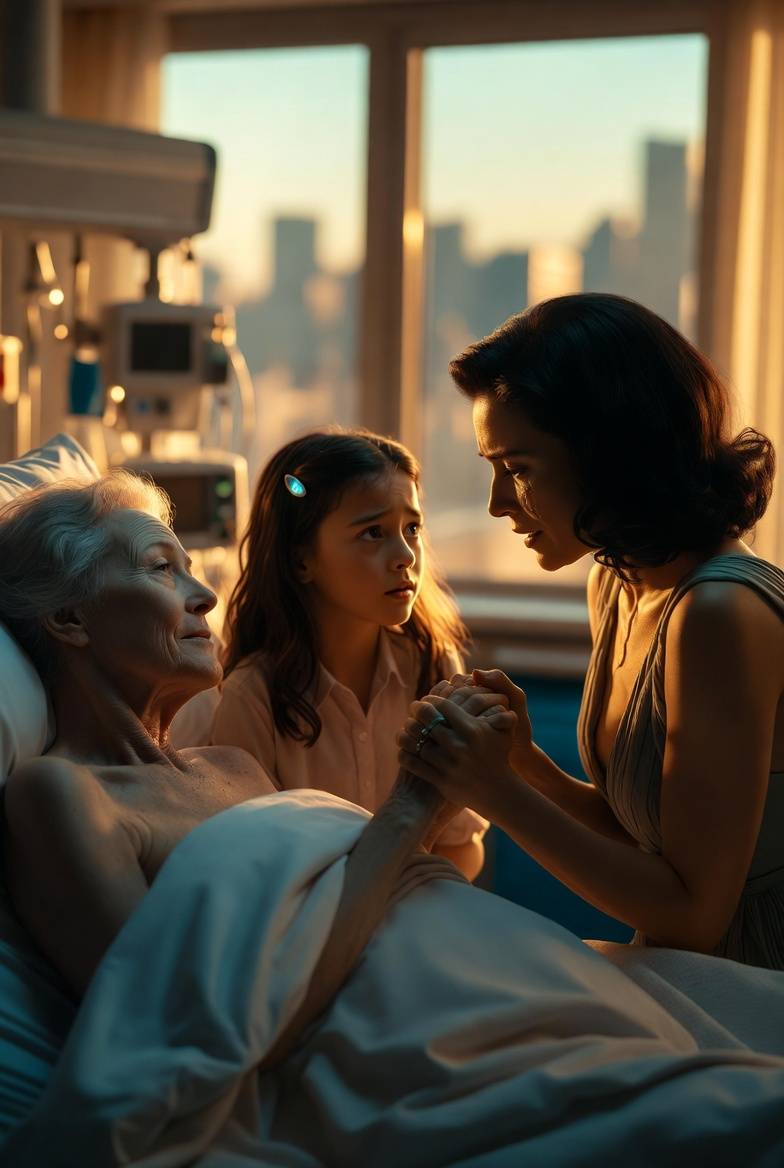
Vivienne swallowed hard. She began, voice low and cinematic, painting the attic with words—two girls hiding from their father’s rules, dreaming of lives bigger than marble halls. Lila listened, curled close. The machines softened their alarms, as if the story itself bought time.
But time was a thief.
Arthur arrived unannounced, flanked by lawyers and one remaining loyal shadow. The agents allowed it—barely—under heavy escort. He stood in the doorway, impeccably tailored, face carved from the same stone as the estate floors. His eyes found Celeste first. Something ancient flickered there. Regret? Or simply the calculation of a man watching his last asset fade.
“Celeste,” he said quietly. “You always were the difficult one.”
She didn’t have the strength to sit up, but her voice carried. “And you were the monster we both tried to love.”
Arthur turned to Vivienne. “This doesn’t have to end in ashes. Graves is finished. I can still pull strings. Immunity. The family name restored. Lila raised with every advantage.”
Lila looked up, small voice fierce. “I have advantages. I have them.”
Vivienne stepped between them, shielding the bed. “Get out, Father. The only strings left are the ones tying you to a cell.”
Arthur’s gaze lingered on her—pride and pain braided tight. “You were my masterpiece. I only ever wanted to protect what we built.”
“You built cages,” Vivienne said. “We’re choosing doors.”
Security moved him then. He went without fight, but at the threshold he paused. “Your mother… when she wakes, tell her I kept her safe in my own way. The world would have destroyed her.”
The door closed. The room exhaled.
Celeste’s hand found Vivienne’s again. “He believes that. That’s what makes him dangerous. Even now.”
The monitors shifted rhythm. A nurse slipped in, concern etching her face. “We need the room.”
Vivienne and Lila stepped back, but not far. Through the glass, they watched the controlled frenzy—doctors, IVs, quiet commands. Celeste’s eyes found them one last time. She lifted her hand in a faint wave. The moonstone clip caught the light from the window—blue fire, steady and true.
Then the curtain drew.
Hours blurred. Coffee burned Vivienne’s tongue. Lila dozed against her side. Elena brought updates: Graves in custody. The mother—Eleanor Vale—being transferred under federal protection, lucid enough to give statements. Arthur detained for questioning, his empire fracturing in real time.
But in Room 412, the fight continued behind closed doors.
When the doctor finally emerged, his face was careful. “She’s stabilized. Again. It’s… remarkable. She keeps asking for her family.”
Vivienne rose, legs unsteady, and led Lila back inside.
Celeste was awake. Barely. But her smile when she saw them was full—radiant with the kind of light that survives everything.
“We have time,” she whispered. “Not much. But enough for you to bring your mother here. Enough for me to see my girls together.”
Outside the window, dawn broke clean over New Haven. The city stirred, forever changed by the truths spilled in marble halls and hospital rooms.
Vivienne sat on one side of the bed. Lila on the other. Hands linked across the sheets—three generations of Vale women, scarred and surviving, the moonstone resting between them like a shared heartbeat.
But as phones buzzed with news of Eleanor’s impending arrival, a final message came from an unknown secure line.
Arthur.
One last truth, my bright girl. The car accident that took your mother? Celeste was driving. Ask her before it’s too late.
The words landed like a final bullet.
Vivienne looked at her sister. Celeste’s eyes met hers—stormy, loving, and suddenly guarded.
The veil between them, already threadbare, trembled once more.
Chapter 10: The Last Blue Fire
The accusation hung in Room 412 like smoke after a gunshot. Celeste was driving. Vivienne’s hand tightened around her sister’s, the monitor’s steady beep the only sound breaking the sudden, suffocating quiet. Lila looked between them, small brow furrowed, the moonstone clip in her hair catching the morning light like a question mark made of fire.
Celeste didn’t flinch. She simply closed her eyes for a long moment, breath shallow, then opened them with the weary clarity of someone who had carried too many stones for too long.
“It’s true,” she whispered. “I was sixteen. Drunk on rebellion and a boy who didn’t matter. Mother found out about the first transfers—small ones, my stupid initiation into Father’s world. She tried to take me away that night. I was behind the wheel. The crash… I walked away with bruises. She didn’t. Arthur made it disappear. Said it was better if the world thought her dead. Cleaner. Safer for the family name.” A tear slipped down her temple. “I begged him to let me tell you. He said you’d never forgive me. That you’d choose him anyway.”
Vivienne felt the floor tilt beneath her chair. The old terrace rain, the erased sister, the mother reduced to elegant photographs on mantels—all of it spun from the same poisoned root. She waited for rage to rise, hot and righteous. Instead, something quieter came: a deep, aching sorrow for the girl her sister had been, terrified and cornered, and for the woman she herself had become in the shadow of all those convenient lies.
“I forgive you,” Vivienne said. The words left her lips raw but certain. She leaned in, pressing her forehead to Celeste’s. “For the crash. For running. For every night I hated you instead of him. We were both children in his house.”
Lila’s small voice broke in, fierce and clear. “We’re not children anymore.”
Celeste’s smile bloomed weak but genuine, her hand finding her daughter’s. “No. We’re not.”
The door opened again. This time, the woman who entered was flanked by federal agents and a nurse. Eleanor Vale—tall where age had not stooped her, black hair now threaded with silver, eyes the same stormy gray that had passed to both her daughters. She moved slowly, as if the world outside her private facility still felt too sharp, too loud. But when she saw the bed, when she saw her daughters and granddaughter linked by hands and secrets, something ancient and unbroken lit behind her gaze.
“Celeste,” she breathed. “Vivienne.”
The room became a cathedral of held breath. Eleanor approached the bed, one trembling hand reaching out. Celeste took it. Vivienne took the other. Lila completed the circle, small fingers bridging generations.
“I missed the light in you two,” Eleanor said, voice hoarse from long silence. “Arthur told me you were better off without a broken mother. I almost believed him, toward the end.” Her eyes found the moonstone clip. Recognition softened her face. “You kept it.”
Hours unfolded in fragments of story and healing. Eleanor spoke of the early days—the ambition that blinded her, the slow horror as she realized the true cost of the empire. Celeste filled gaps with her flight, her life as a nurse, the birth of Lila under a different name. Vivienne offered the pieces she had guarded: the boardrooms, the balls, the slow poisoning of believing the lies.
Outside, the world kept turning. Arthur faced formal charges in a sealed room downtown—Graves had turned, singing for leniency. The networks Vivienne once commanded now ran the story without her blessing, headlines screaming redemption and ruin in equal measure. The Harrington Foundation was frozen, its gleaming halls empty.
But in Room 412, time slowed.
Celeste weakened as afternoon light slanted through the blinds. Her voice grew softer, but her grip never faltered. “Take the clip, Lila. Keep the fire. And Vivi—raise her loud. Unafraid. The way we should have been.”
Lila nodded, tears falling freely now. “I will, Mama.”
Vivienne felt her sister’s pulse flutter under her fingers. She leaned close, voice breaking. “We’re all here. The whole broken, stubborn family. You don’t have to hold on alone anymore.”
Celeste’s eyes drifted, but the smile stayed. “I never was. Not really.” The monitors slowed, then steadied—one final act of will. She looked at each of them in turn, the storm in her eyes clearing. “The truth was always ours to carry. Now it’s yours to live.”
She slipped away as dusk painted the room in gentle golds and violets. Not with drama or machines screaming, but with the quiet grace of a woman who had finally set down her stones. The moonstone clip, passed to Lila’s small hands, seemed to glow brighter for a moment, blue fire reflecting off tears and new beginnings.
Vivienne held her sister’s hand long after. Eleanor stood behind her, one palm on her shoulder. Lila curled between them, the clip pinned safely in her hair.
Later, on the hospital rooftop under a sky streaked with city lights, Vivienne stood with her mother and niece. The wind carried the distant hum of Manhattan—her city, once ruled by diamonds and certainty, now forever altered.
Arthur would face trial. The empire would fracture and perhaps reform cleaner. Graves and the others would fall. But the real victory was here: three generations breathing the same night air, no more shadows between them.
Lila looked up, moonstone catching the lights below. “What happens now?”
Vivienne knelt, brushing a strand of hair from the girl’s face. “Now we write new stories. Louder ones. Honest ones. With room for mistakes and second chances.”
Eleanor’s hand found hers. “And we remember the ones who carried the fire first.”
The city glittered beneath them—indifferent, alive, full of new velvet ropes waiting to be crossed. Vivienne felt the weight of loss and the lift of possibility in equal measure. The ice queen was gone. In her place stood a woman carved from truth, blood, and blue fire.
She took Lila’s hand. Eleanor took the other.
Together, they walked back inside, carrying Celeste’s light forward into whatever chapters came next.
The End of Part One