The slap landed like a gunshot in the cavernous mess hall—sharp, final, reverberating off the cinder-block walls painted that institutional gray that sucked the soul out of every fluorescent bulb overhead. Two hundred soldiers froze mid-bite, forks hovering, coffee cups halfway to lips. The air thickened with the smell of overcooked eggs, burnt toast, and sudden, electric tension.
Cruz stood there, chest heaving under his crisp fatigues, palm still raised like a threat that hadn’t quite landed the way he’d intended. Veins throbbed at his temples, his neck a corded map of barely contained rage. Captain Marcus Cruz, they called him behind his back—the Bull—a man who’d clawed his way up through desert sand and political favors, convinced every stripe on his sleeve was a divine right.
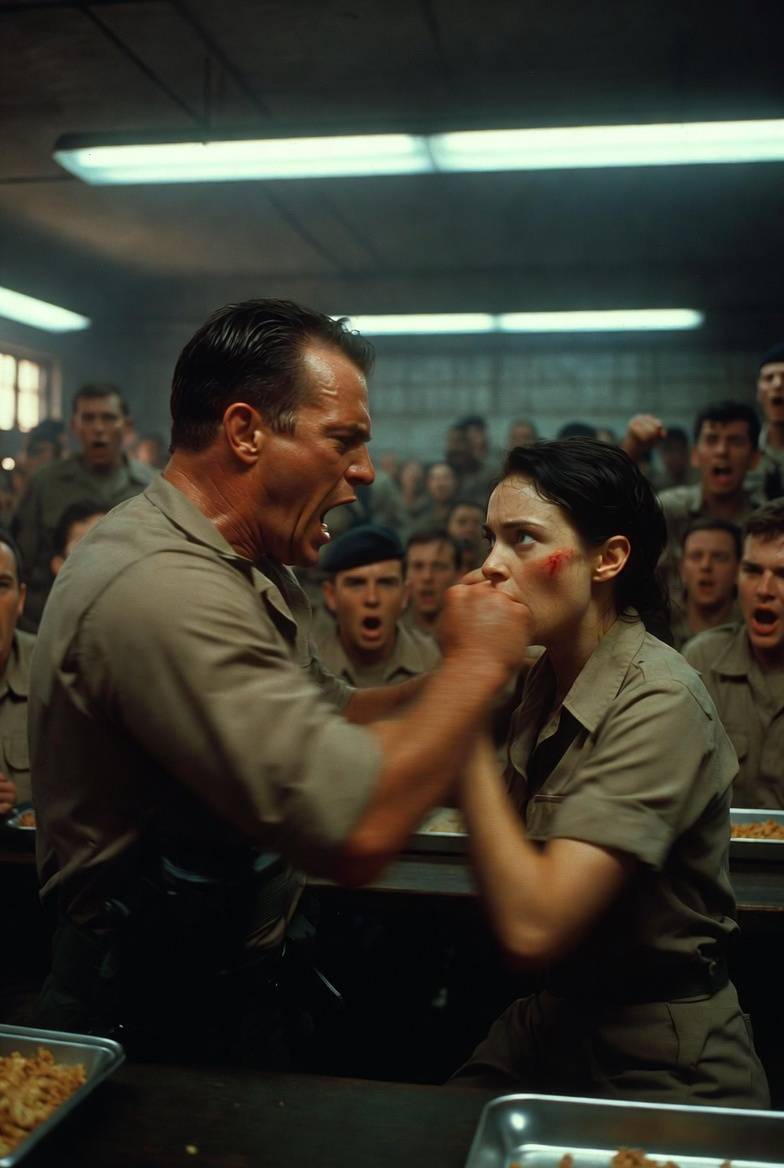
The woman didn’t flinch. She didn’t cry out. She simply turned her head back to him with eyes like still water—deep, unreadable, the kind that had seen worse and decided it wasn’t worth the energy. A faint red bloom spread across her cheek, but she wiped the corner of her mouth with the back of her hand, slow and deliberate, as if brushing away a crumb rather than the sting of authority. No fear. Just that calm, which somehow made the silence heavier.
“You don’t belong here,” Cruz hissed, spittle catching the light. “You don’t wear rank. You don’t salute. This is my house.”
She held his gaze without blinking. Her voice, when it came, was low and steady, carrying just enough to reach the nearest tables. “That won’t be necessary, sir.”
Then she turned. Boots—scuffed, practical, nothing flashy—clicked measured steps across the linoleum. Every eye tracked her: the straight line of her shoulders under a plain civilian jacket, the way her dark hair was pulled back tight enough to reveal the faint scar tracing her jawline like a secret. She didn’t hurry. She didn’t look back. The double doors swung shut behind her with a pneumatic sigh, and the mess hall detonated.
Whispers erupted first, then outright chatter. A sergeant at the end of the nearest table let out a low whistle. “Holy shit. Who the hell was that?”
Cruz’s fist slammed the table, rattling trays. “Back to your goddamn chow! Show’s over!”
But it wasn’t. Not by a long shot.
Outside, the desert wind whipped across Fort Liberty’s sprawling grounds, carrying the faint tang of jet fuel and sagebrush. Elena Voss didn’t stop walking until she reached the shadow of the admin building, where the sun baked the asphalt into shimmering waves. She leaned against the warm concrete, pressing two fingers to her throbbing cheek. Not to soothe it—to remember.
You don’t belong here.
The words echoed in her chest like an old wound reopening. She’d heard variations of them her entire life. From foster homes that smelled of cigarette smoke and regret. From drill instructors who thought breaking a girl meant building a soldier. From the ghosts that still whispered in her sleep.
At thirty-eight, Elena had built walls thicker than any cinder block on this base. She was here under a Defense Department contract that didn’t exist on paper—the kind that came with clearances higher than Cruz’s pay grade and nightmares deeper than his ego. A consultant, they called her. Truth was, she hunted fractures in the system before they became fractures in the world. Leaks. Compromised assets. Men like Cruz who mistook volume for leadership.
Her phone buzzed in her pocket. She pulled it out, the screen’s glow harsh against the midday glare.
Unknown: He always was a bully. You okay?
She typed back one word: Fine.
But she wasn’t. The slap wasn’t the problem. It was the way it had cracked something open inside her—the old rage, the old promise she’d made to a younger version of herself in a rain-soaked alley outside basic training: Never again. Never smaller.
She pocketed the phone and scanned the horizon. Somewhere out there, beyond the razor wire and watchtowers, a storm was building. Intel she’d been sent to verify: shipments rerouted through this base that weren’t going to allies. Weapons. Cash. And Cruz’s name threaded through all of it like barbed wire.
Back in the mess hall, Cruz stormed into his office, slamming the door hard enough to rattle the framed photos on the wall—him shaking hands with generals, him in dress blues, him pretending the world bent to his will. He poured three fingers of bourbon into a coffee mug, the liquid sloshing over the rim.
“Goddamn civilian bitch,” he muttered, downing half in one gulp. The burn did nothing to quiet the whispers still crawling under his skin. He’d seen her type before—consultants who swept in with their laptops and superior attitudes, questioning his command. But there was something about her eyes. Too steady. Too knowing.
His desk phone rang. He snatched it up.
“What?”
“Sir, it’s Ramirez. That woman—Voss—she’s got a meeting with General Harlan in twenty. Sealed room. No aides.”
Cruz’s grip tightened until the plastic creaked. Harlan. The one man on base who could still make him feel like that scared kid from the South Side. “Keep eyes on her. Anything she touches, I want to know.”
He hung up and stared at the bourbon. The slap had felt good in the moment—necessary, even. But now doubt gnawed at him, cold and persistent. What if she wasn’t just another paper-pusher? What if she was the fracture he’d been trying to patch?
Elena stepped into the briefing room exactly on time, the air inside chilled and sterile, smelling of fresh printer ink and old secrets. General Harlan sat at the head of the table, silver hair cropped close, eyes sharp as ever despite the years. He didn’t stand. He simply nodded, a man who measured respect in results, not salutes.
“Ms. Voss. Heard you had a welcoming committee.”
She took the seat across from him, folding her hands on the table. No notes. No tablet. Just memory and the scar on her cheek that was already fading to a dull heat. “Captain Cruz has strong opinions about chain of command.”
Harlan’s mouth twitched—the closest he came to a smile. “Cruz has strong opinions about everything. That’s why he’s here. And why you’re here.” He slid a thin folder across the table. Classified stamps bled red across the cover. “Three shipments in the last month. Manifests don’t match the cargo. And the money trail… it loops back through accounts with his digital fingerprints.”
Elena opened the folder. Photos spilled out: crates in the dead of night, blurred faces, bank transfers. Her pulse didn’t quicken. She’d seen worse. But the last image stopped her—a young soldier, barely twenty, face down in the dirt somewhere far from this desert. Collateral, the report called it.
She closed the folder. “You want me to confirm it.”
“I want you to end it,” Harlan said quietly. “Quietly. Before it becomes a headline that buries all of us.”
She met his gaze. The weight of it pressed on her—the lives already lost, the ones that would follow if she failed. Her greatest strength had always been this: the ability to walk into the fire and come out carrying the ashes of what needed burning. Her weakness? The part of her that still believed people like Cruz could be reasoned with. That part had the scar to prove otherwise.
“Understood.”
As she stood to leave, Harlan’s voice followed her to the door. “Voss. Watch your back. He’s not the only one who doesn’t like outsiders.”
She paused, hand on the knob. “Neither am I, General.”
Night fell hard over the base, the kind of desert dark that swallowed stars and amplified every footstep. Elena moved like smoke through the motor pool, her civilian clothes swapped for borrowed fatigues that smelled of someone else’s sweat. She’d learned long ago that blending in meant borrowing edges from the world around you.
Cruz’s private warehouse loomed at the edge of the perimeter—officially for “sensitive logistics,” unofficially the place where questions went to die. She picked the lock with tools that cost more than most soldiers made in a month, slipping inside. The air was cooler here, heavy with the metallic tang of gun oil and something sweeter. Cash?
Her flashlight beam danced across crates. One was pried open just enough. Rifles—high-end, untraceable. Not standard issue.
A sound behind her—boots on concrete.
She killed the light and melted into the shadows between pallets. Heart steady. Breath controlled. This was the part she hated and craved: the moment when the mask slipped and the real game began.
Cruz’s voice cut through the dark. “I know you’re in here, Voss. Come out before I make this official.”
She stepped forward slowly, hands visible. The beam of his own flashlight caught her face, highlighting the faint bruise. His expression twisted—triumph mixed with something uglier. Fear, maybe. Or recognition.
“You should’ve stayed in the mess hall,” he growled, drawing his sidearm. “Should’ve learned your place.”
Elena didn’t move. “And what place is that, Captain? The one where good men die so you can line your pockets?”
He laughed, but it rang hollow off the metal walls. “You think you know me? You think you understand what it takes to keep this machine running? The world isn’t black and white, lady. It’s red. With blood and ink.”
She saw it then—the tremor in his hand, the way his eyes darted to the crate behind her. He wasn’t just greedy. He was cornered. A man who’d started with ideals and let them rot under the weight of too many deployments, too many compromises. His scar ran deeper than hers: a dead brother in Fallujah, a wife who’d left when the drinking started, the gnawing belief that no one else could do what he did.
But belief didn’t excuse bodies in the dirt.
“Put the gun down,” she said softly. Not a command. An offer. “We both know how this ends if you don’t.”
For a heartbeat, the warehouse held its breath. Then Cruz’s finger tightened on the trigger.
The shot cracked louder than the slap ever had.
Chapter 2: Fractured Allegiances
The gunshot tore through the warehouse like a betrayal made audible—sharp, intimate, final. Elena felt the impact before the pain registered, a white-hot punch to her left shoulder that spun her sideways into a stack of crates. Wood splintered. Her flashlight clattered across the concrete, its beam slicing wild arcs through the dust-choked air. The metallic scent of blood bloomed instantly, mixing with gun oil and the faint, sickly sweetness of whatever illicit cargo filled the shadows.
She hit the ground rolling, instincts forged in places far uglier than this desert outpost kicking in before conscious thought. Breathe through it. Move. Her right hand found the grip of the concealed pistol at her ankle—standard issue for ghosts like her, the kind that didn’t officially exist.
Cruz stood frozen in the flashlight’s dying spill, his face a mask of raw shock. The Bull, they called him. But bulls could be bled. His sidearm trembled in his grip, the barrel still smoking. “Shit,” he whispered, the word cracking like dry earth. Not triumph. Not even anger. Just the hollow dawning of a man who’d pulled a trigger and realized the world didn’t reset afterward.
“You… you made me do this,” he snarled, but the conviction wavered. His free hand pressed against his thigh, as if steadying himself against an invisible tide. Elena saw the fracture lines: the sweat beading at his hairline despite the cool night air seeping through the vents, the way his eyes flicked not to her but to the open crate behind her—the one exposing rows of pristine, un-serialed rifles destined for shadows that swallowed countries whole.
She pushed up to one knee, blood warm and slick down her arm, soaking the borrowed fatigues. Pain lanced through her with every heartbeat, but she locked it away. Pain was an old companion. It reminded her she was still alive. “Made you?” Her voice came out steady, laced with that same unflinching calm from the mess hall. “No one makes a man pull the trigger, Captain. That’s all you.”
Outside, distant shouts rose—boots on gravel, the low growl of a Humvee engine turning over. Time was fracturing. She could end this now: one clean shot to center mass. But endings weren’t her mission. Fractures were. And Cruz was the fault line running straight through Fort Liberty’s rotten core.
He took a step closer, boot crunching on spent brass. The warehouse lights—harsh sodiums flickering to life on motion sensors—painted his face in sickly yellow. Up close, he looked smaller than in the mess hall. Forty-five years old, broad-shouldered from years of enforced PT, but the paunch of too many desk nights and bourbon lunches strained against his uniform. His eyes, bloodshot, held the ghosts of decisions that had once seemed necessary.
“You think you’re better?” he spat. “Parading in here with your fancy clearances, no rank, no chain. I’ve bled for this flag. Lost men—boys—in holes you couldn’t find on a map. And for what? So suits like you can sell us out piece by piece?”
Elena rose slowly, ignoring the fire in her shoulder. She showed him the pistol but didn’t aim it. Not yet. Show, don’t force. Let him see the choice. “Your men in the mess hall this morning? They froze because they know the difference between command and fear. Those rifles?” She nodded toward the crate. “They’re not going to allies. They’re feeding the very holes you lost those boys in. Tell me, Marcus—who’s really selling who out?”
The use of his first name hit like another slap. He recoiled visibly, jaw clenching, the veins in his neck bulging again. For a second, the warehouse held only their breathing—hers measured, his ragged. Then he laughed, a bitter bark that echoed off the rafters. “You don’t know shit about me, Voss. You don’t know what it’s like to watch your little brother come home in a box because some politician changed the rules mid-fight. To have your wife look at you like you’re already dead inside.” His gun hand lowered an inch. “The money… it was supposed to be for the families. For the ones they leave behind. A network. Off-books. Necessary.”
Necessary. The word hung there, poisoned honey. Elena’s mind flashed to her own ghosts: a rain-slicked night in Kabul, years back, when she’d made her own “necessary” call. A source who’d trusted her. A building that shouldn’t have exploded. The scar along her jaw itched in memory. No one was clean. Not her. Not him. But some stains spread until they drowned everyone.
The doors at the far end rattled. Voices—Ramirez and a squad, by the sound. Cruz’s head snapped toward the noise, panic flashing raw across his features. “They can’t find you here like this. Not with me holding the gun.”
“Drop it,” Elena said, softer now. An offer still. “We walk out together. You tell Harlan everything. The network unravels from the top.”
His eyes met hers—desperate, calculating, haunted. The Bull was cornered, but cornered animals had teeth. He lunged, not with the gun but with his bulk, slamming her back against the crates. Pain exploded in her shoulder, vision whitening at the edges. The pistol flew from her grip, skittering into darkness. His forearm pinned her throat, close enough that she smelled the bourbon on his breath, felt the tremor in his muscles.
“I can’t,” he whispered, almost pleading. “They own me now. More than the uniform ever did.”
Her knee drove up hard. He grunted, doubling, but didn’t release. They grappled in the narrow aisle—two broken people fighting not for victory but for the illusion of control. Her fist connected with his ribs. His elbow glanced her temple. Blood—hers, his?—smeared between them.
The squad burst in just as she wrenched free, gasping. Flashlights blinded. “Captain! Drop your weapon!”
Cruz staggered back, gun still in hand but pointed at the floor now. His face crumpled—not rage, but something worse: the collapse of a man watching his house of cards catch fire. “She’s the threat,” he rasped. “Unauthorized entry. Attacked me.”
Lies flowed easy. Too easy.
Elena pressed a hand to her bleeding shoulder, meeting the soldiers’ eyes one by one. Young faces. Confused. Some she’d seen in the mess hall, forks frozen. “Check the crates,” she said, voice cutting through the chaos. “Then decide who the real threat is.”
Ramirez hesitated, his rifle barrel dipping. The air crackled with indecision—the kind that got people killed.
Then the general’s voice boomed from the entrance, calm as deep water. Harlan. Flanked by MPs, his presence sucked the oxygen from the room. “Stand down, all of you.”
Cruz’s shoulders sagged. The fight drained out of him in a single, shuddering exhale. But as the MPs moved in, cuffing not her but him, his eyes locked on Elena’s. A promise. Or a warning. “This isn’t over, Voss. You opened the door. Everything behind it… it’s coming for you too.”
They dragged him out into the night. Harlan approached her slowly, assessing the damage with a medic’s efficiency and a commander’s detachment. “Hospital wing. Then my office. We’ll get that looked at.”
She nodded, but her gaze followed Cruz’s retreating back—the man who’d slapped her hours ago now broken by his own hand. Victory tasted like copper and regret. Because she knew the truth in his words. Networks like his didn’t die with one arrest. They had roots. And roots had teeth.
As the medics loaded her into the Humvee, the desert wind howled across the base, carrying whispers from the barracks. Soldiers watching from doorways. Phones already lighting up. The story spreading like blood in water.
Elena leaned her head back against the seat, eyes closing against the stars. Her greatest fear—the one that kept her moving, always moving—wasn’t death. It was becoming like him: convinced her scars justified the blood on her hands.
But in the darkness behind her eyelids, another image surfaced. The young soldier from the file. Face down in foreign dirt. And the question that clawed at her chest: How many more before the machine finally broke?
Chapter 3: Echoes in the Wire
The Humvee’s tires chewed gravel as it cut through the predawn dark, each rut in the road jarring Elena’s shoulder like a fresh accusation. The medic beside her worked in silence—gloved hands cutting away fabric, packing the wound with quick, competent pressure. Blood soaked the gauze dark, but the real ache lived deeper, somewhere behind her ribs where trust used to sit. She stared out the armored window, watching the base blur past: razor-wire fences glowing under floodlights, the low silhouettes of barracks where men and women she’d never know were already waking to a world tilted one degree off true.
Harlan rode up front, his profile carved against the dashboard glow. Silver hair, ramrod posture, the kind of stillness that commanded rooms without raising a voice. He hadn’t spoken since the warehouse. Just that single order to get her patched. Now, as the vehicle slowed at the hospital wing’s rear entrance, he turned slightly. “You’re lucky it was a through-and-through. Clean exit. No bone.”
Lucky. The word tasted like ash. Elena managed a nod, jaw tight. The medic finished taping, and she shrugged into a fresh shirt—too big, smelling of starch and someone else’s laundry. As they helped her inside, the antiseptic bite of the corridors hit her like a memory: too many field hospitals, too many times she’d watched life leak out under harsh lights while someone in command decided which losses were “acceptable.”
They put her in a private room, curtained off from the night shift’s murmur. Harlan waited by the window, hands clasped behind his back, staring at the empty parade ground where dawn was just beginning to bleed pink across the horizon. “Cruz is in holding,” he said without turning. “Singing already. Names, accounts, half a dozen intermediaries. But he keeps circling back to one thing.”
Elena eased onto the edge of the bed, testing her arm. Pain flared, hot and insistent, but she welcomed it. Pain kept her sharp. “Me.”
Harlan glanced over, eyes unreadable. “You. Claims you planted evidence. That your clearances are forged. That you’re the one running the real pipeline.” A pause, heavy as incoming artillery. “He’s desperate. Men like him always are when the walls close in.”
She studied the general’s face—the faint lines at the corners of his eyes, the way his shoulders carried decades of salutes and funerals. Her pulse ticked up. The encrypted message burned in her mind: Watch Harlan. Was the source protecting itself, or pointing at the only man who could bury this quietly?
“You believe him?” she asked, voice low.
“I believe results.” Harlan crossed to her, pulling a chair close. The scrape of metal on tile echoed too loud. Up close, she smelled his aftershave—something clean, cedar and citrus, the scent of a man who still believed order could hold chaos at bay. “Your file, Voss, is a black hole. Foster kid who vanished into the system at sixteen, reappeared with skills that make our best operators nervous. You fix fractures. But sometimes you create them. Tell me why I shouldn’t cuff you next to Cruz and sort this at dawn.”
The challenge hung there. Elena met his gaze without flinching. Show, don’t break. She reached into her pocket—slow, deliberate—and pulled out a small drive, the one she’d palmed from the warehouse crate before the lights came on. “Because I have this. Routing data. Not just money. Destinations. One loops through a shell company registered to a name that matches your late executive officer’s widow. Small deposits. Consistent. Started six months after his funeral.”
Harlan’s hand stilled mid-reach. For the first time, something cracked in that iron composure—a flicker behind the eyes, like a match struck in a dark room. Grief? Guilt? Or the calculation of a man whose house had just shown its first foundation crack?
“My EO died in a training accident,” he said flatly. “Heart gave out on a run.”
“Convenient timing,” Elena replied. She didn’t soften it. Couldn’t. “The deposits match the discrepancies in those shipments. Small enough to hide. Big enough to matter. Someone’s using his death as cover. Or he was in it, and the network didn’t want loose ends.”
The general took the drive, fingers brushing hers—callused, steady. He plugged it into a secure tablet from his jacket. Data spilled across the screen in green code. Elena watched his face as the patterns emerged: not just Cruz. Layers beneath. Suppliers with ties to foreign actors who didn’t care about flags, only profit. And threaded through it, Harlan’s own signature on logistics approvals that should have raised red flags months ago.
He set the tablet down slowly. The room felt smaller, the air thicker with the scent of impending rain from an approaching desert storm. “You’re good, Voss. Too good.” His voice dropped. “But good people still bleed when they get too close. My EO… he was like a son. If this touches his name—”
“It already has,” she cut in. Not cruel. Necessary. “The question is whether you’ll let it touch yours.”
Silence stretched. Outside, the base began to stir—distant bugle notes, the clatter of mess hall trays, soldiers trading rumors like live grenades. Elena’s mind wandered to her own fractures: the foster mother who’d taught her silence was safer than truth, the first handler who’d told her emotions were liabilities in this line of work. She’d believed it until the night in Kabul, when that source’s trust had cost him everything. The scar on her jaw itched again. Never smaller. But standing here, blood still drying on her skin, she wondered if she’d only traded one cage for another.
Harlan stood abruptly, pocketing the drive. “Rest. Two hours. Then we move together. I want eyes on every node Cruz named. If my signature’s tainted, I’ll burn it out myself.”
He left without another word, the door clicking shut like a round chambered. Elena lay back, staring at the ceiling tiles. Trust was a blade with two edges. Harlan’s grief felt real—the way his voice had roughened on “son”—but real didn’t mean innocent. She closed her eyes, letting exhaustion pull at her, but sleep brought fragments: Cruz’s desperate eyes in the warehouse, the young soldier’s photo from the file, Harlan’s steady hands on that tablet.
Her secure phone vibrated on the side table. Unknown number. She answered without speaking.
A voice, distorted, female, edged with static. “Voss. You’re poking the wrong wound. Harlan isn’t the source—he’s the shield. Drop this, or the next bullet won’t miss your shoulder.”
Click.
Elena sat up fast, pain be damned. The voice was familiar in a way that chilled her blood—not the words, but the cadence. Someone from the old network. Someone who knew her real name, the one buried deeper than any clearance.
She dressed quickly, ignoring the medic’s protests, and slipped out a side exit. The storm clouds gathered low on the horizon, wind whipping sand across the tarmac. Her boots carried her toward the holding cells, where Cruz waited. If Harlan was the shield, then Cruz might be the crack she could widen.
But as she approached the security gate, alarms began to wail across the base—sharp, piercing, the sound of containment failing. MPs sprinted past her. Radios crackled: “Breach in holding! Cruz is down—multiple stab wounds. Witness says a woman in civilian clothes—”
Elena froze mid-step. Her mind raced. She’d been in the hospital. But who would believe that now?
The voice on the phone echoed: Drop this, or the next bullet won’t miss.
Footsteps behind her. She turned to see Ramirez, rifle raised, face pale with confusion and duty. “Ma’am… General Harlan wants you in cuffs. Now.”
The desert wind howled louder, carrying the scent of rain and ruin. Elena raised her hands slowly, the wound in her shoulder throbbing in time with her heart. Trust had just shattered again. And somewhere in the wire, the real player was smiling.
Chapter 4: Blood on the Shield
The handcuffs bit into Elena’s wrists like cold judgment, the metal still warm from the last soul who’d worn them. Ramirez kept his rifle steady but his eyes darted—young, maybe twenty-four, the kind of soldier who still believed orders came from on high and morality followed close behind. Sand whipped across the open lot between the hospital wing and the stockade, stinging like accusations. The storm had arrived early, thunder growling low over the mountains as if the desert itself disapproved.
“Easy, Sergeant,” Elena said quietly, letting her shoulders drop to show compliance. No sudden moves. Not here. “I was in medical. Check the logs.”
Ramirez didn’t answer. His jaw worked, the way Cruz’s had in the mess hall—loyalty and doubt wrestling under the skin. He marched her past the gate where MPs swarmed like hornets whose nest had been kicked. Inside the holding block, the air hung thick with the copper reek of fresh blood and the sharper bite of fear-sweat. Cruz lay slumped against the far wall of his cell, eyes open but empty, a jagged tear across his throat still leaking slow. Not a clean kill. Personal. Messy. A message carved in flesh.
Harlan stood in the corridor, hands clasped behind his back again, but this time the knuckles showed white. The cedar-and-citrus aftershave was overpowered now by the slaughterhouse smell. He looked at Elena as they brought her forward, and for a heartbeat the general’s mask slipped. Not suspicion. Something closer to grief layered over exhaustion—the look of a man watching his carefully ordered world bleed out onto concrete.
“Cut her loose,” he ordered.
Ramirez hesitated. “Sir, the witness—”
“I said loose.” Harlan’s voice didn’t rise. It didn’t need to. The cuffs clicked open. Elena rubbed her wrists, feeling the phantom burn where they’d been. She stepped closer to the cell bars, ignoring the MPs who tensed like coiled springs.
Cruz’s blood had pooled in the shape of a crooked question mark. Elena crouched, eyes tracing the wound. Not a guard’s blade. Too hesitant, too many slashes. Someone who wanted it to hurt before it ended. “The woman on the phone,” she murmured, half to herself. “She knew I’d come here.”
Harlan moved beside her, close enough that their shoulders nearly brushed. “What woman?”
She told him—distorted voice, the warning, the intimate knowledge of her past. As she spoke, his face hardened into lines she recognized: the same ones she saw in the mirror after Kabul. Calculation. Loss. The slow acceptance that the people you protected could still bury you.
“My EO’s widow,” Harlan said finally, so low only she could hear. “She called me an hour ago. Hysterical. Said someone was following her. Demanded protection. Then went dark.” He turned, signaling the MPs to clear the block. “This isn’t about shipments anymore, Voss. It’s cleanup. Someone’s erasing the middlemen. Cruz was loud. Visible. Useful until he wasn’t.”
Elena straightened, the wound in her shoulder pulling tight under fresh bandages. Pain sharpened her focus. She saw Cruz again—not the bully from the mess hall, but the broken man in the warehouse confessing about his brother, about the money for widows and orphans. Necessary. The word tasted like his blood now. Her own scar along the jaw throbbed in rhythm with distant thunder. Foster homes had taught her early: survival meant becoming necessary to someone. But necessity had a way of devouring the necessary.
Outside, rain began to hammer the metal roof. They moved to Harlan’s office—a Spartan space heavy with the smell of old coffee and gun cleaning solvent. Maps covered one wall, pins marking supply routes that now looked like veins in a dying body. Harlan poured two measures of bourbon into metal cups, sliding one across the desk without asking. Elena took it, the liquid burning a clean line down her throat.
“Your turn for truth, General.” She set the cup down. “Why does a woman who lost her husband to a ‘training accident’ have my private number and my real history?”
Harlan sank into his chair, suddenly older under the desk lamp’s harsh circle of light. The rain lashed the window behind him, turning the glass into a shifting mirror. “Because I asked her to watch you when you first arrived. Background. Insurance. She has… connections in the community of widows and contractors. People who talk when the official channels go silent.” He rubbed his eyes. “I thought Cruz was the leak. I didn’t see the rot underneath. Now she’s gone dark, and he’s dead. You’re the only one left standing in the middle.”
Elena felt the pull—the old hunger to believe someone higher up still had the map. But belief had cost her sources before. She leaned forward, the bourbon warming her veins. “Then we go to her house. Tonight. Before whoever killed Cruz decides the widow knows too much.”
Harlan studied her. The silence stretched, filled by rain and the low hum of the base generators fighting the storm. Finally, he nodded. “My vehicle. No escort. We do this quiet.”
The drive out beyond the perimeter took them through sheets of rain that turned the desert into a river of mud. Harlan drove, knuckles white on the wheel. Elena rode shotgun, her borrowed pistol heavy in her lap. The widow’s house sat at the end of a gravel road on the edge of town—modest adobe, lights off, one shutter banging in the wind like a warning.
They approached on foot, boots sucking at the soaked ground. Elena took the rear, moving like smoke despite the fire in her shoulder. The back door hung ajar. Inside, the air smelled wrong: copper again, faint but unmistakable, mixed with lavender air freshener and something burnt—papers, perhaps.
Harlan cleared the front rooms, his breathing tight. Elena found the widow in the small office at the back. Slumped over the desk. Throat cut. Same jagged signature as Cruz. A laptop screen flickered nearby, files deleting in real time. She killed the process, but the damage was done. On the desk, a single photo lay untouched by blood: Harlan’s EO in uniform, arm around his wife, both smiling the way people did before the world taught them better.
Harlan stepped in behind her. The sound that escaped him wasn’t a sob. It was smaller. A crack in the foundation. He picked up the photo with shaking fingers, rain dripping from his coat onto the carpet. “Maria… she knew. After he died, she started digging. I told her to stop. For her own sake.”
Elena watched him—really watched. The way his thumb traced the dead man’s face. The genuine fracture in the man who commanded thousands. Her emotional engine revved: pity, suspicion, the addictive ache of watching another wall crumble. “She left something,” Elena said, pointing to a half-burned notebook under the desk. Pages of names, dates, transfers. And one line circled in red: Harlan knows the source. Ask him about Kabul.
Kabul. Elena’s breath caught. Her own ghost. The explosion that had cost her source and left her with the scar. She looked up at Harlan, the pistol suddenly heavier in her grip.
The general met her eyes. Rain hammered the roof. “It wasn’t an accident, Voss. Your source in Kabul… he was mine too. We were trying to shut the same network down. But it was already inside the wire. Inside us.”
Lightning flashed, illuminating the truth in his face. Not the architect. But complicit. Carrying the same necessary stains she did.
Before she could speak, headlights swept the front windows. Multiple vehicles. Boots hitting gravel. A amplified voice cut through the storm: “General Harlan, Ms. Voss—come out with your hands visible. The base is locked down. You’re both wanted for questioning in the murders.”
Trap sprung. Elena’s mind spun. The woman on the phone? Or someone wearing Harlan’s authority like a second skin?
Harlan looked at her, the photo still clutched in his hand. “I didn’t order this.”
But in the driving rain, with sirens closing in, belief felt like another luxury they could no longer afford.
Chapter 5: Ghosts of Kabul
Lightning clawed across the sky as Elena and Harlan burst out the back door of the widow’s house, rain lashing their faces like punishment for every secret kept too long. Mud sucked at their boots. The amplified voice from the front yard grew sharper, closer—MPs fanning out, flashlights slicing through the downpour like searchlights hunting prey. Harlan gripped the photo of his dead EO like a talisman, knuckles pale, while Elena kept her pistol low, heart hammering against the fresh bandages on her shoulder.
“Truck’s around the side,” Harlan growled, voice barely carrying over the storm. No hesitation now. The general who had commanded from polished desks was gone; in his place moved a man cornered by his own ghosts. They sprinted low, shadows among shadows, the adobe wall providing scant cover. A spotlight swept past, missing them by inches. Elena’s breath came ragged, pain flaring hot with every stride, but she pushed through—muscle memory from nights when running meant living.
They reached the general’s unmarked vehicle just as boots pounded closer. Harlan slid behind the wheel. Elena dove into the passenger seat, slamming the door as the engine roared to life. Tires spun in the mud, fishtailing before catching. Gunshots cracked behind them—warning shots or lethal, it didn’t matter. The rear window spiderwebbed as a round punched through.
“Hold on!” Harlan yelled, wrenching the wheel. They bounced onto the gravel road, headlights off, navigating by the faint glow of distant base lights and the storm’s electric fury. Rain hammered the roof like incoming mortar fire. Elena twisted in her seat, watching pursuers pile into vehicles behind them. The chase was on.
Inside the cab, the air was thick with wet wool, blood, and unspoken blame. Harlan’s hands were steady on the wheel, but his jaw clenched rhythmically—the same tell Cruz had shown before everything shattered. “Kabul wasn’t just your operation,” he said through gritted teeth, eyes fixed on the flooded road. “I greenlit the meet. Your source—Ahmad—was feeding us intel on the same arms ring. We thought we could cut the head off. Instead…”
“Instead the building blew with him inside,” Elena finished. Her voice was steel, but inside, the old wound tore open. She saw it again: the dusty street, the boy selling tea on the corner, Ahmad’s trusting eyes as she’d walked away to take the overwatch position. The blast had thrown her into a wall, shrapnel kissing her jaw. She’d woken in a medevac with more than a scar— a conviction that trust was the deadliest weapon of all. “You pulled me out after. Why?”
Harlan didn’t answer immediately. The truck hydroplaned around a curve, fishtailing dangerously close to a ditch. “Because I owed it. To him. To the ones we lost. But the network adapted. Moved stateside. Used men like Cruz as cutouts. Maria—his widow—started connecting dots after her husband died. She reached out to me. I told her to stay quiet.” His voice cracked, barely audible over the rain. “I thought I was protecting her.”
Elena glanced at the rearview. Headlights gaining. “Protecting or silencing?”
The question landed heavy. Harlan’s eyes flicked to her, raw with the kind of pain that didn’t need volume. “Both. God help me, both. Necessary, right? That’s what we tell ourselves.”
Necessary. The word tasted like Cruz’s blood, like the bourbon they’d shared, like every compromise that had led them here. Elena’s greatest strength—her ability to walk through fire—felt like a curse now. Her weakness, the quiet hope that someone in the chain still had clean hands, was bleeding out faster than her shoulder. She reached over, gripping his arm briefly. Not forgiveness. Recognition. Two ghosts driving through a storm they’d helped create.
The truck burst onto a service road paralleling the base perimeter. Ahead, a checkpoint loomed, lights flashing red through the curtain of rain. Harlan killed the engine momentum, letting the vehicle coast into a stand of scrub brush. “We go on foot. Old access tunnel under the wire. Used for maintenance. If we can reach the motor pool, I have a contact there who owes me.”
They abandoned the truck, plunging into the brush. Rain soaked them to the bone. Elena’s boots slipped on wet rock as they descended toward a culvert half-hidden by overgrowth. Harlan led, surprisingly agile for his age, the photo still tucked inside his jacket like a fragile heart. Behind them, search teams shouted, dogs barking faintly over the thunder.
Inside the tunnel, darkness swallowed them. Elena clicked on a small penlight, its beam revealing rusted pipes and dripping concrete. The air smelled of mold and diesel. Their footsteps echoed too loud. Harlan’s breathing grew labored—not from the run, but from the weight he carried.
“Tell me about the source,” she pressed as they pressed deeper. “The one who called me. The woman.”
Harlan paused at a junction, wiping rain from his face. Water streamed down the walls like tears. “Maria had a sister. Ex-Agency. Bitter. Lost her own husband to the same game years ago. She warned me you were getting too close. I didn’t listen.” He turned, eyes haunted in the penlight’s glow. “She’s the one cleaning house now. Erasing every thread that leads back to the core. And the core, Voss… it’s not foreign. It’s us. Procurement officers. Logistics. People who decided the war never really ended—just moved to balance sheets.”
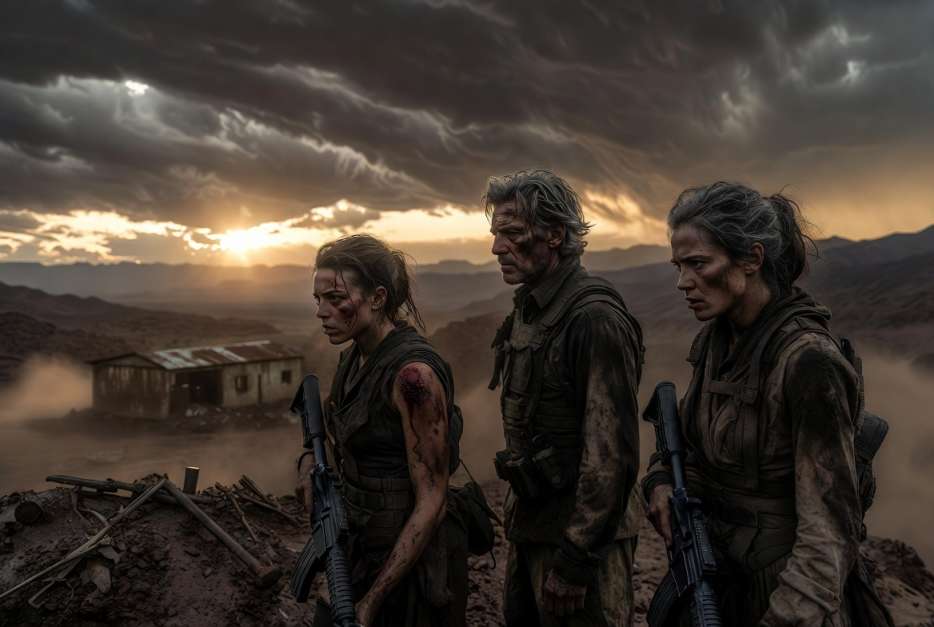
A distant clang echoed from the tunnel mouth. They were being followed. Elena’s pulse spiked, the Emotional Engine driving higher: fear laced with grim purpose, the addictive rush of cornered prey turning hunter. She pushed Harlan forward. “Keep moving. Motor pool’s our only shot.”
They emerged near the edge of the vehicle bays, rain still pounding. The contact—a grizzled mechanic named Ruiz—waited in the shadows of a half-stripped Humvee, face pale. “General, this is suicide. Whole base is lit up. They’re saying you two killed Cruz and the widow.”
Harlan pressed a set of keys into the man’s hand. “Old cargo truck. Load us in the back. Get us off-base. I’ll make it right later.”
Ruiz hesitated, eyes darting between them, then nodded. Loyalty, even fractured, still meant something. They climbed into the cargo bed, surrounded by crates that smelled of oil and canvas. The truck rumbled to life, rolling toward the main gate.
As they bounced along, Elena leaned close to Harlan. “Your EO. He wasn’t just a son to you. He was part of it, wasn’t he? The early diversions.”
Harlan stared at the photo, now smeared with rain and mud. A single tear mixed with the water on his cheek—raw, unashamed. “He started it to help the widows. Small. Then it grew. I covered for him. Until I couldn’t. Kabul was supposed to end it. Instead, it followed us home.”
The truck slowed at the gate. Voices outside—challenging Ruiz. Tension coiled tight in the dark cargo space. Elena gripped her pistol, shoulder screaming. Harlan’s hand found hers briefly, a silent pact between two scarred souls.
Then the truck lurched forward. Cleared. For now.
But as they gained distance, Elena’s secure phone vibrated in her pocket. Another message, unknown: You can run, but the ghosts know the way back. Kabul wasn’t the beginning. It was the test. Come find me if you want the truth. – M.
Maria’s sister. The cleaner.
Harlan saw the screen. His face drained of color. “She’s drawing us out. Bait.”
Elena pocketed the phone, the storm easing to a drizzle outside. The desert stretched endless ahead, but the real storm was the one inside—the one that asked whether they would become the monsters they hunted in order to stop her.
The truck carried them into the night, but every mile felt like surrender to a deeper trap. And somewhere out there, the woman with the distorted voice waited, holding the threads of every scar they carried.
Chapter 6: The Baited Blade
The cargo truck rattled over pitted backroads long after the base lights had faded into the storm’s rearview, each pothole jarring Elena’s wounded shoulder like a persistent interrogator. She sat wedged between crates in the dim, canvas-scented dark, the general beside her a silent bulk of regret and resolve. Rain had softened to a relentless drizzle that drummed on the roof like distant small-arms fire. Ruiz drove without complaint, but the mechanic’s occasional glances in the rearview mirror carried the weight of a man who knew he’d just bet his career on two ghosts.
Harlan hadn’t spoken since the message. He clutched the smeared photo like a dying man with last rites, thumb tracing the smiling face of his EO over and over. The motion was hypnotic, tragic— a hardened commander reduced to the raw ache of paternal failure. Elena watched him, her own scar burning along her jaw in sympathy. Kabul had taken more than a source from her; it had taken the last illusion that the game had rules.
“We can’t run forever,” she said finally, voice low enough to blend with the engine’s growl. “M—Maria’s sister—she’s not just cleaning. She’s herding us. Wants us isolated. Exposed.”
Harlan looked up, eyes red-rimmed but sharp. The cedar aftershave had long since washed away, replaced by sweat, mud, and the faint metallic tang of fear. “She lost everything too. Blames the system. Blames me for not stopping it sooner. If she has the core ledgers…” He trailed off, staring at the swaying canvas. “We go to the old safe house outside Tucson. Neutral ground. I’ll reach out. Set the meet.”
Elena’s hand tightened on her pistol. Trust was a blade she’d been cut by too many times, yet here she was, shoulder to shoulder with the man whose signature had greenlit the mission that nearly killed her. Show, don’t break. She nodded once. “We set the terms. No more necessary sacrifices.”
The truck dropped them at a dusty crossroads before dawn, Ruiz disappearing back toward the base with nothing but a curt “Good luck, sir.” They hiked the last miles through scrubland that smelled of creosote and wet earth, the sky lightening to a bruised purple. The safe house was a forgotten cinder-block relic from some forgotten border op—barred windows, reinforced door, a single generator humming to life when Harlan flipped the switch.
Inside, dust danced in the beam of their flashlights. A rickety table, two chairs, a cot in the corner. Harlan fired up an old satellite phone while Elena cleared the perimeter, every sense stretched taut. The desert wind whispered through cracks in the walls, carrying the faint scent of sage and distant exhaust. Her mind replayed the widow’s house: the jagged throat wounds, the deleting files, the photo that had cracked Harlan open. Necessary. The word haunted her like the distorted voice on the line.
When she returned, Harlan was seated, the photo propped against a canteen like an altar. “She agreed. One hour. Alone. But she wants you there too. Says the truth needs both of us to hear it.”
Elena sat across from him, the table between them feeling like miles of mined ground. “Why me?”
“Because Kabul wasn’t random.” Harlan’s voice dropped, heavy with the kind of confession that reshaped lives. He leaned forward, elbows on scarred wood. “Your source, Ahmad—he wasn’t just feeding us intel. He was family to her. Distant cousin. When the building went up, she lost the last blood tie she had left in the game. She’s convinced I ordered the hit to cover our own diversions. That I sacrificed him—and you—to protect the network.”
Elena’s breath caught. The room seemed to shrink, the generator’s hum loud as a heartbeat. She saw the Kabul street again: the tea boy, Ahmad’s nod, the moment she’d stepped away. Not random. Personal. Her greatest fear—the one that kept her moving through every contract, every fracture—had always been becoming the expendable piece. Now it stared back at her in the general’s weary eyes.
She reached across the table, not for comfort, but for truth. Her fingers brushed the photo. “Then we tell her the truth. Together. End the cycle.”
Harlan’s hand covered hers briefly—callused, trembling. A spark of something human passed between them: not romance, but the desperate clasp of two survivors recognizing their shared wreckage. His strength had always been command; hers, endurance. Together, perhaps enough to face the cleaner.
The hour crawled. They waited in silence broken only by the wind and the occasional creak of settling concrete. Elena’s shoulder throbbed in time with rising tension. She cleaned her pistol at the table, movements deliberate, while Harlan stared at the door like it might spit out his dead EO any second.
A vehicle approached at the fifty-eight-minute mark—headlights cutting through the dawn haze. One set. Solitary. Elena positioned herself by the window, pistol ready. Harlan stood at the door, unarmed, the photo in his breast pocket like armor.
The woman who stepped out was smaller than expected—mid-forties, dark hair streaked with premature gray, movements precise as a surgeon’s. She wore civilian clothes dusted with road grit, eyes sharp and unyielding behind wire-rimmed glasses. Maria’s sister. The cleaner. She carried no visible weapon, but the air around her crackled with lethal intent.
She entered without knocking, closing the door behind her. Her gaze swept the room, landing on Elena first. Recognition. Resentment. Grief. “You survived Kabul. He didn’t.”
“None of us did,” Elena replied, voice steady. Show the scar. She turned her head slightly, letting the light catch the line along her jaw. “Not really.”
The woman—let’s call her Reyes—smiled thinly, but it didn’t reach her eyes. “Harlan. You brought the girl who walked away. Poetic.” She moved to the table, setting down a small drive. “Everything. The ledgers. The accounts. Your EO started the diversions to fund real aid for widows. Noble. Then it became greed. You covered. Cruz executed. I cleaned. But the core? It’s bigger than all of us. Senators. Contractors. People who profit while boys die in holes.”
Harlan stepped forward, voice rough. “Then why kill Maria? She was trying to help.”
Reyes’s face twisted—the first real emotion cracking her composure. Pain, raw as an open wound. “She was going to expose you to the wrong people. The ones who would bury everything, including the good we tried to do. I made it quick. Kinder than they would have.”
Elena felt the emotional tide surge: sorrow for the widow, rage at the cycle, the addictive pull of understanding the enemy’s logic. Reyes wasn’t a monster. She was them—scarred, convinced her blade served justice. “And now?” Elena asked. “You draw us here to kill us too?”
Reyes looked between them, the penlight beam catching the glint of tears she refused to shed. “No. To recruit you. Help me take down the core. Or walk away and let it consume everything left.”
The offer hung in the charged air. Harlan’s hand drifted toward his pocket, toward the photo. Elena’s finger rested near the trigger. Outside, the desert woke fully—birds calling, sun breaking the horizon in blood-red streaks.
But before either could answer, the distant thump of helicopter rotors cut the dawn. Multiple. Closing fast. Reyes’s eyes widened. “You were followed.”
Harlan cursed. Elena moved first, grabbing the drive. “Decision time. Together, or we all die here.”
Reyes pulled a weapon from under her jacket—small, suppressed. Not aimed at them. At the door. “I didn’t come alone either. But they’re not mine.”
The first explosion rocked the safe house foundation—breaching charge on the perimeter. Dust rained from the ceiling. The three of them, fractured souls drawn together by the same ghosts, raised weapons toward the threat outside.
The real network had arrived to silence its loose ends.
Chapter 7: Ashes and Oaths
The explosion ripped through the safe house perimeter like divine judgment, the blast wave slamming the reinforced door inward on twisted hinges. Dust and smoke choked the air, thick with the acrid bite of C4 and desert sand. Elena moved on instinct, shoving Reyes behind the table while Harlan kicked over a metal locker for cover. Gunfire erupted outside—suppressed bursts at first, then the raw chatter of automatic weapons chewing through cinder block.
“Three teams, flanking!” Elena shouted, voice cutting through the chaos. Her shoulder screamed as she dropped to a knee by the shattered window, pistol steady despite the fire spreading down her arm. Blood seeped through the bandages again, warm and insistent, but pain was just another ghost now. She’d danced with enough of them.
Reyes fired back with clinical precision, her suppressed pistol coughing death into the dawn. “They’re not base MPs. Private contractors. The core’s cleaners.” Her voice held no panic—only the cold calculus of a woman who’d buried too many. Grief for her sister still etched her face, but it fueled her now, a blade sharpened by loss.
Harlan, unarmed except for a scavenged rifle from the locker, laid down covering fire. His shots were measured, economical—the general reduced to a soldier again, protecting the fragile alliance with everything he had left. “The drive!” he barked. “Get it out if we don’t!”
Elena palmed the small black rectangle, slick with sweat and blood. Kabul’s ghosts pressed close: Ahmad’s trusting eyes, the tea boy vaporized in the blast, her own body hurled against rubble. She had walked away that day. Today, she refused to leave anyone behind. Not Harlan with his paternal scars. Not even Reyes, whose rage mirrored her own so perfectly it terrified her.
A shadow darted across the open ground. Elena squeezed off two rounds. The figure dropped. Another grenade sailed through the window gap. Harlan lunged, batting it back outside where it detonated in a roar of dirt and shrapnel. The safe house shuddered, a section of roof collapsing in the back room with a groan of failing concrete.
“We can’t hold!” Reyes yelled, reloading with practiced fury. A round grazed her arm, drawing a hiss but no retreat. She met Elena’s eyes across the table—two women forged in the same unforgiving fire. “The tunnel under the generator room. Old escape route. You two take it. I’ll draw them.”
“No,” Elena snapped. Show, don’t abandon. She grabbed Reyes’s shoulder, grip firm despite the pain. “We go together. No more necessary sacrifices. That ends here.”
Harlan nodded once, face streaked with dust and blood from a cut above his eye. The photo of his EO was still in his pocket, a silent oath. They moved as one—broken pieces somehow interlocking in the storm of bullets. Elena laid suppressive fire while Harlan and Reyes dragged the generator aside, revealing a rusted hatch. The tunnel smelled of earth and decay, a narrow throat into darkness.
They dropped in one by one. Gunfire chased them, rounds pinging off the metal lip. Elena went last, firing upward until the slide locked empty. She slammed the hatch shut, plunging them into blackness broken only by the penlight clamped between her teeth. The tunnel forced them to crawl, shoulders scraping walls, knees grinding into dirt. Harlan led, wheezing from the strain. Reyes followed, her breathing steady but laced with quiet curses for the sister she’d lost twice—once to death, once to the lie that had justified her blade.
The emotional weight pressed heavier than the earth above them. Elena’s mind raced with every scrape and echo: the slap in the mess hall that had started this, Cruz’s desperate confession, Maria’s blood on the desk, Harlan’s tear in the rain. No one was clean. But in this tunnel, clawing through the dark together, they were choosing something better than necessary. They were choosing each other.
The tunnel ended at an old storm drain half a mile out, spilling them into a wash still running with last night’s rain. They emerged gasping, soaked in mud and sweat, the rising sun painting the desert in brutal golds and reds. Distant rotors still thumped—search continuing—but the immediate storm had passed.
They collapsed against the bank, chests heaving. Reyes pulled out a burner phone, fingers trembling for the first time. “I have a contact in Tucson. Can get us new IDs. Transport. But the drive… it names senators, CEOs. We release it right, or they bury us deeper.”
Harlan sat up slowly, pulling the photo from his pocket. It was ruined now—creased, bloodstained, muddied. He stared at it long, then looked at the two women who had every reason to hate him. “I started this cover-up to protect his memory. Ended up protecting the rot. No more.” His voice broke, but he met their eyes. “I’ll testify. Public. Whatever it takes.”
Elena felt the shift inside her chest—the addictive surge of hope piercing the scar tissue. Her greatest weakness had always been the fear of standing smaller. Here, in the mud with these two fractured souls, she stood taller. She handed Reyes the drive. “We do it together. No more ghosts dictating the terms.”
Reyes took it, her thin smile carrying the weight of tentative alliance. “Maria would’ve liked that.”
They moved out as the sun climbed, three shadows against the vast desert. But as they crested a rise toward the distant highway, Elena’s instincts prickled. A glint on a far ridge. Sniper scope? Or just the sun on rock?
Her phone—the secure one that shouldn’t have signal—vibrated once. A final message: Well played. But the core was never the ledgers. It was the three of you, united. Welcome to the real game. – The Architect.
The ground felt less solid beneath her boots. Harlan and Reyes turned at her sudden stop, faces questioning. Elena slipped the phone away, forcing a nod toward the road. “Let’s move.”
But in her chest, the new question burned hotter than any wound: Who had been playing them from the very first slap in the mess hall?
To be continued…