A nearly 30-year-old murder case that has divided public opinion and sparked fierce legal battles is back in the spotlight today as Texas authorities acknowledge new forensic developments while Darlie Routier remains on death row for the killing of her two young sons. The mother, who has always maintained her innocence, now faces a pivotal moment as a wave of fresh DNA testing and previously overlooked evidence threatens to upend the narrative that led to her conviction in 1997.
The case began on June 6, 1996, when a frantic 911 call from a home in Rowlett, Texas shattered a quiet suburban night. Darlie Routier, then 26, told dispatchers that an intruder had broken in, attacked her, and murdered her sons, 5-year-old Devon and 6-year-old Damon. She was found covered in blood, barely able to speak, while her youngest child, Drake, slept unharmed upstairs.
But from the moment police arrived, doubts crept into the investigation. The broken window in the garage appeared suspiciously clean, with little glass scattered outside. Blood spatter patterns inside the house did not match her account of a violent struggle.
And a bloody sock discovered 75 yards from the home contained the blood of both boys but none from Darlie.
Forensic experts testified that Darlie’s own injuries appeared inconsistent with a random attack, suggesting they could have been self-inflicted. No foreign fingerprints or DNA were found at the scene, and the prosecution argued that Darlie staged the crime in a desperate attempt to cover up a murder driven by financial motives. They pointed to mounting debt and a life insurance policy on the children.
The trial’s most damaging evidence, however, was not physical but visual: footage taken days after the funerals showed Darlie laughing and playing with silly string at her sons’ graveside. The video, replayed endlessly on national news, painted her as a cold, unfeeling mother. The jury deliberated only a few hours before convicting her of capital murder.
Now, more than two decades later, that conviction is under renewed scrutiny. Advances in forensic science have allowed investigators to revisit evidence that was either ignored or mishandled during the original trial. In recent months, DNA testing on materials from the crime scene has yielded inconclusive results but has opened the door to the possibility of another individual’s involvement.
Perhaps most striking is a fingerprint found on a coffee cup inside the home that does not belong to Darlie or any known family member. That single piece of evidence, overlooked for years, has become a rallying point for her defense team and advocacy groups who argue that the case was never properly investigated.
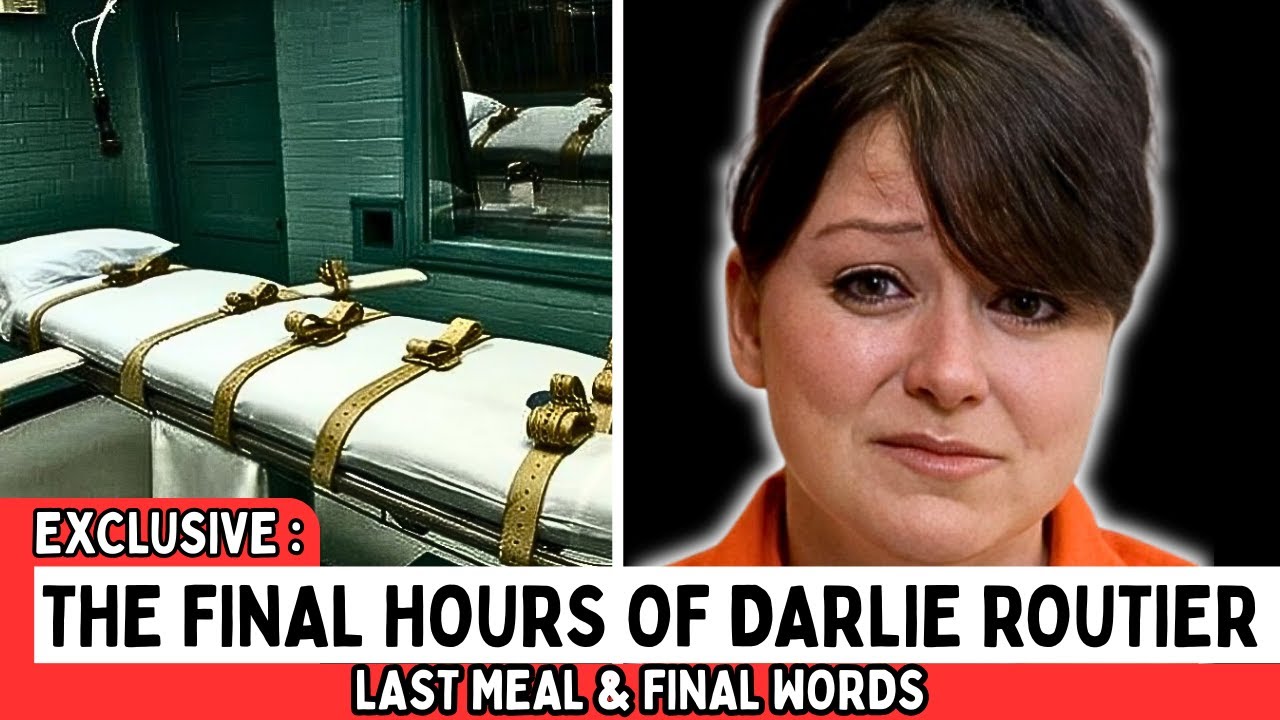
Darlie Routier, now in her mid-50s, sat for an interview from death row where she expressed a mixture of hope and defiance. “I can’t say what the future is going to hold,” she said, her voice steady. “I can tell you that I’m very hopeful.
I’m very positive with the investigation and testing that’s happening right now that I will be exonerated.” When asked if she was more frightened now than at the beginning of her incarceration, she answered without hesitation. “I’m less frightened.

I’m at peace with myself. I didn’t do this. I did not murder my children.
I did not attack myself. If they choose to 𝓀𝒾𝓁𝓁 me, they’ll have to answer to that. That’s my innocent blood that will be on their hands.”
Her words carry weight in a state that has executed hundreds of inmates since the death penalty was reinstated. Texas remains one of the most active death penalty states in the nation, and Routier’s case has become a flashpoint for debates about the reliability of forensic evidence, the influence of media bias, and the fairness of the justice system. Supporters argue that the silly string video, which continues to be a subject of intense debate, was a misunderstood moment of shock and grief rather than proof of guilt.
They note that Darlie’s behavior at the graveside was not unusual for a mother in deep psychological distress, and that the prosecution exploited it to sway the jury.
The legal battle has been long and grueling. Routier’s appeals have been repeatedly denied, but her defense team has not given up. They are pushing for a full reexamination of all physical evidence, including the blood spatter analysis and the origin of the mysterious fingerprint.
New petitions have been filed with the Texas Court of Criminal Appeals, and advocacy groups such as the Innocence Project have taken an interest in the case. The state has not yet agreed to a retrial, but the growing body of alternative evidence has forced prosecutors to acknowledge that the case is not as airtight as once believed.
Rowlett, a quiet suburb of Dallas, remains haunted by the tragedy. Residents remember the shock of that June night, the sight of ambulances and police cars lining the street, the image of a mother covered in her children’s blood. Many still believe she is guilty, pointing to the lack of any credible intruder theory.

But others have begun to question whether the investigation was too hasty, too focused on the most obvious suspect, too willing to ignore evidence that didn’t fit the preferred narrative.
The question of what really happened inside that house on the night of June 6, 1996, has never been fully answered. Could there have been an intruder? Did the police miss crucial clues in their rush to close the case?
Or did Darlie Routier, overwhelmed by financial pressure and emotional turmoil, commit an unthinkable act and then try to cover it up? The evidence is contradictory, the arguments are polarizing, and the stakes could not be higher. If she is exonerated, it would be a stunning reversal of one of Texas’s most infamous convictions.
If she is executed, her supporters will forever argue that an innocent woman was put to death.
The case now sits in a legal gray area, with no immediate execution date set but no clear path to freedom either. The Texas Court of Criminal Appeals has the authority to order a new trial or further hearings, and the growing public pressure may eventually force a decision. In the meantime, Darlie Routier waits on death row, her fate suspended between the past and the future, between guilt and innocence, between life and death.
Her story continues to challenge the boundaries of what we think we know about justice, truth, and the limits of forensic science.
As new evidence emerges, the debate over her guilt or innocence shows no signs of cooling. The silly string video still circulates online, each viewing reigniting old arguments. The bloody sock, the clean broken window, the missing intruder, the fingerprint on the coffee cup all remain pieces of a puzzle that refuses to come together.

For every expert who says the original investigation was flawed, there is another who insists the conviction was sound. For every advocate who believes Darlie is a victim of a rush to judgment, there is a family member of the victims who wants to see justice served.
The only person who knows the full truth is Darlie Routier herself, and she has never wavered in her claim of innocence. Her voice, recorded from inside prison walls, carries a quiet but firm conviction that the world has yet to hear the whole story. “I did not murder my children,” she repeats, as if saying it enough times will somehow rewrite history.
Yet the legal system operates on evidence, not belief, and the evidence is still being evaluated.
Texas has moved forward, but the doubts cling to this case like a stubborn shadow. The public’s fascination with the Routier story endures because it touches on so many uncomfortable truths: that the justice system can make mistakes, that media narratives can shape verdicts, that a mother’s grief can be weaponized against her. In an era of true crime obsession, where every miscarriage of justice is dissected online, Darlie Routier’s ordeal has become a cautionary tale about the dangers of certainty.
Whether she will ever walk free remains unknown. The appeals process is slow, the legal hurdles are immense, and the political climate in Texas is not favorable to death row inmates who challenge their sentences. But for the first time in years, there is a palpable sense that something could change.
New testing, new eyes on old evidence, a shifting public opinion all of it adds up to a moment of possibility.
For now, the story of Darlie Routier continues to unfold. The question that hangs over everything is simple but devastating: Was she wrongfully convicted? Or is there a darker truth that has yet to be uncovered?
The answer may come in the form of a court ruling, a DNA match, or a confession that never comes. Until then, the case remains open, a wound that refuses to heal, a mystery that refuses to be solved.