Avery’s world narrowed to the rifle’s weight in her hands, the familiar curve of the stock against her shoulder like a secret finally spoken aloud. Dust coated her tongue, metallic and bitter, but the stillness inside her held. No panic. No roar of blood in her ears. Just the valley unfolding in clean, merciless geometry: the ridgeline two hundred and forty meters up-slope, the commander’s silhouette flickering between boulders, the machine-gun nest pulsing with heat haze.
She did not think I can do this. She simply became the shot.
The first round left the barrel before Sullivan’s nod had fully registered. The rifle kicked like an old friend, not a stranger. Downrange, the Taliban gunner’s head snapped back in a spray of red mist. The machine gun fell silent mid-burst.
Marcus’s voice cracked over the chaos. “Avery? What the—cover me!”
She was already moving, low and smooth, dragging Sullivan’s rifle with her as she slid into the shallow depression beside the wounded sniper. Sullivan’s eyes were glassy but locked on hers. Blood bubbled at the corner of his mouth.
“Zero’s off by a hair,” he rasped. “Wind’s swirling left to right. You feel it?”
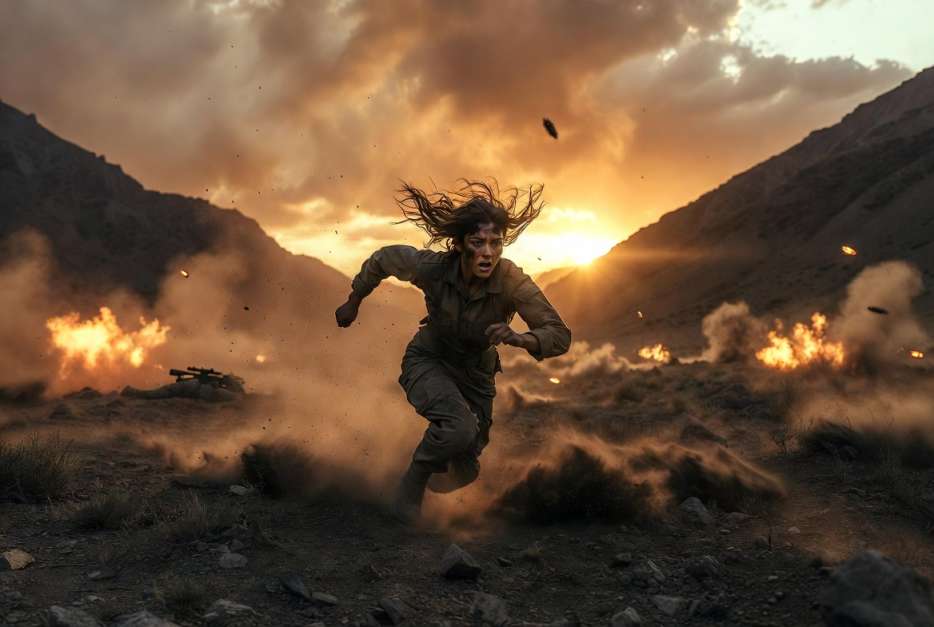
She did. The air tasted different on this side of the rocks—hotter, carrying the burnt-plastic stink of expended casings and the copper bloom of blood. She adjusted the optic a fraction, muscle memory from those forbidden dusk sessions with Morse guiding her fingers.
Another Taliban fighter rose on the ridge, shouting orders. Avery exhaled half a breath and squeezed. The man dropped without a sound.
Sullivan let out a wet, broken laugh that turned into a cough. “Supply girl. Goddamn.”
“Shut up and stay alive,” she whispered, not looking at him. Her voice sounded like someone else’s. Calmer. Older.
Marcus reached them, dragging a combat casualty blanket. He worked fast, hands slick with Sullivan’s blood, eyes flicking to Avery every few seconds as if he expected her to vanish like a mirage. “You beautiful, crazy bastard,” he muttered. “Keep them off us. I’ve got him.”
The valley answered with renewed fury. Bullets chewed the ground inches from her elbow. Rock fragments stung her cheek. But the rhythm was hers now. She read the wind the way other people read faces—how it bent the dry grass along the slope, how it carried the echo of panicked Pashto commands. Each shot she took carved away a piece of the trap closing around them.
She was not a hero in that moment. Heroes felt things. Avery felt only the math: distance, drop, breath, trigger. And beneath it, the old terror her father had seen in her eyes on that Montana fence line—the quiet certainty that she could end lives without the world breaking in return.
Hours later, or maybe minutes—the valley had eaten time—the medevac birds finally clawed their way in under covering fire from the surviving SEALs. Avery stayed on the rifle until the last casualty was loaded. Only when the rotors faded did the stillness inside her crack.
Her hands began to shake. Not from fear. From the sudden absence of purpose.
Lieutenant Hayes found her sitting against a shattered Humvee tire, Sullivan’s rifle across her knees like a sleeping child. The lieutenant’s face was streaked with grime and something close to awe.
“Specialist Cole,” he said, voice rough. “You just saved my entire team.”
She looked up. Hayes was younger than he sounded in briefings—thirty-three, maybe, with the kind of square jaw that belonged on recruitment posters. But his eyes were old. They had seen too many quiet people do loud things.
“I issued the rounds,” she said simply. “Figured I should make sure they got used.”
Hayes studied her the way Morse once had. “We’re going to need a statement. And probably a medal you’ll hate.”
Avery’s laugh was small and bitter. “I’d rather have my clipboard back.”
But the valley had already taken that option away.
Back at Forward Operating Base Griffin, the story spread like smoke. The supply clerk who picked up a dead sniper’s rifle and turned an ambush into a turkey shoot. They looked at her differently now. The invisibility she had spent years cultivating was gone.
Marcus found her that night in the supply tent, surrounded by the familiar smell of cardboard and gun oil. He carried two MREs and a bottle of something that definitely wasn’t regulation.
“You gonna tell me how a girl from Montana shoots like that?” he asked, sliding down beside her.
Avery peeled open the MRE without enthusiasm. “My dad taught me to count bullets before I could count money. Then he got scared of what he saw.”
Marcus waited. He was good at that—twenty-eight years old, broad-shouldered, with a scar along his jaw from a previous tour that he claimed came from a bar fight in San Diego. In truth, it was shrapnel. He never corrected the lie because it made people smile.
She told him about the fence line. About Morse. About the way the world went quiet when she held a rifle, as if everything else—her mother’s early death, her father’s slow unraveling into the bottle, the lonely years of trying to be small—finally made sense in the crosshairs.
Marcus listened without pity. When she finished, he bumped her shoulder gently.
“Some people run toward the noise,” he said. “You ran into the quiet. Different kind of courage.”
She wanted to believe him. But two nights later, the nightmares started. Not of the valley. Of Sullivan’s blood on her sleeve and the way his eyes had sharpened with recognition right before he nodded. Recognition of what she was.
The weeks that followed brought a fragile peace.
Sullivan survived. Barely. He was medevaced to Germany, then stateside. Before he left, he asked to see her. In the hospital tent, pale and wired to machines, the SEAL looked smaller than she remembered.
“You didn’t have to do that,” he said. His voice was hoarse, but the quiet danger in it remained.
“I know.”
He reached out, slow and deliberate, and closed his hand over hers. Calluses met calluses. “I owe you more than a thank you, Avery Cole. When this is over… you ever want to talk about what it costs to be that good at something you hate? I’ll listen.”
She pulled her hand back, not unkindly. “I might take you up on that. Or I might disappear back into the ledgers.”
But the war had other plans.
Intelligence reports began filtering in. The ambush hadn’t been random. Someone had fed the Taliban precise coordinates and timings. Someone inside the wire.
Avery found herself pulled into briefings she had no business attending. Morse showed up one evening, older and grayer, pulling her aside near the perimeter.
“They’re looking at logistics trails,” he said quietly. “Your name’s on half the requisitions that went missing before Valkyrie. You’re either the leak… or the one who can find it.”
She felt the old stillness rising again. This time it tasted like dread.
“I didn’t ask for any of this,” she whispered.
Morse’s smile was sad. “Nobody ever does, kid. The dangerous ones never do.”
As the sun bled out over the Afghan mountains, Avery Cole stood at the edge of the base, Sullivan’s rifle—now officially hers—leaning against her leg. The valley was miles away, but she could still feel it breathing.
Somewhere out there, a traitor was counting on her staying invisible.
She was done hiding.
Night at FOB Griffin was never truly quiet. The hum of generators, the low growls of dogs beyond the wire, and the desert wind hissing through canvas tents served as constant reminders that this desert forgave no weakness. Avery sat in the corner of the supply tent, flickering fluorescent light casting harsh shadows across her face as it illuminated stacks of crates rising to the ceiling. In front of her lay a pile of blurry photocopied documents. Every page carried her signature on the receipt line.
She was not the traitor. But the paperwork didn’t care about the truth.
Marcus stepped inside, his broad shoulders filling most of the doorway. He carried two mugs of thick black coffee, the acrid smell of instant powder spreading through the air. “You’re not sleeping?”
Avery didn’t look up. “Sleep for what? To keep dreaming about the valley?”
Marcus set a mug beside her and dropped heavily onto an ammo crate. His gaze lingered on the rifle Avery had meticulously cleaned, placed neatly like an old friend. “Hayes is under pressure. Command wants a scapegoat. And your name keeps floating to the top… as the easiest target.”
She gripped the edge of the paper until it crumpled. “I was just doing my job. Then suddenly I’m a hero one day and a suspect the next.”
“Not a hero,” Marcus corrected, his voice low and steady. “You’re a survivor. And out here, surviving is sometimes more dangerous than dying.”
She looked at him. Marcus Vaughn wasn’t the type to speak empty words. The scar along his jaw caught the light, a pale reminder that he too had lain in the kill zone, that he had listened to his own heartbeat slowing while his hands kept working to save others. He was a medic, but his eyes sometimes viewed the world like a sniper—calculating, waiting, and ready to pull the trigger if necessary.
“Do you believe me?” she asked, her voice so soft it nearly dissolved into the generator’s drone.
Marcus didn’t hesitate. “I watched you run through gunfire to save Sullivan. If you were a spy, you would’ve let us all die.”
His words tightened something in Avery’s chest. Not from relief, but from a new kind of fear—the fear that someone was truly seeing her, and starting to expect things. Just like her father once had. Like Morse. Like Sullivan with that sharpened gaze before he was evacuated.
She stood, shrugging on her tactical jacket. “I need to check the old weapons cache. Something’s off with the ammo lot the Valkyrie team received before departure.”
Marcus raised an eyebrow. “Now? Alone?”
“Not alone,” she replied, picking up the rifle. “You coming or not?”
They slipped out into the night, two shadows melting into the darkness between tents. The air was biting cold, carrying the scent of dust and jet fuel. Searchlights from the guard towers swept across the base, making Avery’s heart skip every time the beam passed near them. They reached the old weapons cache—a rusted metal container tucked behind coils of concertina wire.
The door was unlocked. That was the first warning sign.
Inside, the smell of gun oil hung thick. Avery swept her flashlight across the shelves. Several ammo crates had been shifted, some security seals clumsily peeled back. She knelt, her fingers tracing a thin layer of dust on the floor.
“Someone’s been here,” she whispered. “And it wasn’t the perimeter guards.”
Marcus stood behind her, pistol ready. “What are you thinking?”
“Not thinking,” she said. “I’m reading.” Her voice was calm, but inside, that old stillness was rising—the same stillness that let her hit targets in swirling winds. She spotted a small clue: a scrap of paper with radio frequency coordinates. Frequencies reserved for high-level logistics only.
She clutched the fragment. “Someone in logistics. Higher up than me.”
Before Marcus could respond, footsteps sounded outside the container. Light. Professional. Not a standard patrol.
Avery killed her flashlight instantly. Darkness swallowed them. Her heart pounded so hard she feared the intruder would hear it. Marcus pulled her into the corner, his body shielding hers, his warm breath brushing her hair.
The container door creaked open. A silhouette appeared, flashlight beam sweeping gently. Avery held her breath. She recognized the posture—slightly hunched shoulders, cautious movement. Not a stranger.
It was Callahan Morse.
The retired sniper instructor paused, sniffing the air like a hunting dog. His light swept across the exact spot where they hid, only meters away. Avery’s finger tightened on the trigger, trembling slightly against the cold metal.
Morse muttered to himself, voice hoarse: “Little girl… don’t dig too deep.”
Then he turned and vanished into the night.
Marcus exhaled sharply. “He…”
“Not him,” Avery cut in, though her voice lacked conviction. “But he knows something.”
They left the cache in silence. On the walk back, the desert wind grew stronger, carrying distant echoes that sounded like the Taliban commander’s cruel laughter from that day. Avery could feel it—the invisible noose tightening around her neck. Someone was playing this game, and they had chosen her as the pawn.
Back at the tent, her satellite phone buzzed. A message from an unknown number.
“You shoot well. But don’t shoot the wrong person. Sullivan is on his way back. Ask him about the night before Valkyrie.”
Avery stared at the screen. Her hands turned ice-cold.
Marcus read over her shoulder, his face darkening. “This isn’t an investigation anymore. This is a trap.”
She closed the phone, her gaze fixed on the darkness beyond the desert. The rifle felt heavier on her shoulder, a reminder that the stillness she had once fled was now dragging her back in.
And this time, it would not let go.
The C-130 touched down in a roar of engines and swirling dust, its ramp lowering like the jaw of some mechanical beast. Avery stood at the edge of the landing zone, rifle slung across her back, the desert sun beating down on her neck. She hadn’t slept. The anonymous text still burned behind her eyes.
Sullivan emerged first, moving slowly on crutches, his left leg wrapped in fresh bandages. He looked thinner, the sharp edges of his face more pronounced, but those quiet, dangerous eyes were the same. When he spotted her, something shifted in his expression—recognition, gratitude, and something heavier she couldn’t name.
“Cole,” he said as he approached, voice rough from the flight. “Didn’t expect a welcoming committee.”
“I’m not here for pleasantries,” she replied. The wind whipped strands of hair across her face, but she didn’t brush them away. “Someone sent me a message. Told me to ask you about the night before Valkyrie.”
Sullivan’s jaw tightened. He glanced around, checking for ears. Marcus stood a respectful distance away, arms crossed, watching like a man ready to pull someone off a ledge.
“Not here,” Sullivan muttered. “My tent. Ten minutes.”
Inside the dimly lit tent, the air felt thick with unspoken truths. Sullivan lowered himself onto a cot with a grimace, waving off help. He pulled a battered notebook from his pack and tossed it to her.
“Read the last entry. Then decide if you still trust me.”
Avery opened it. The handwriting was Sullivan’s—precise, almost artistic. The final page detailed a late-night conversation with a logistics officer named Captain Reyes. Reyes had asked questions about the strike team’s exact route and timing. Casual, he’d claimed. Just covering bases. But Sullivan had written one line that stopped her cold:
“Reyes smiled too much. Like a man who already knew the answers.”
“I didn’t think anything of it at the time,” Sullivan said quietly. “We were all on edge. But after the ambush… I started piecing it together. Reyes had access. He could’ve fed the coordinates.”
Avery closed the notebook, her fingers lingering on the cover. “Why didn’t you say anything before you left?”
“Because I was half-dead and doped up on morphine. And because I didn’t know who to trust.” His gaze locked on hers. “Until I saw you pick up my rifle like it was an extension of your soul. You’re not part of this, Avery. You’re the one trying to stop it.”
The words landed like a bullet finding its mark. For the first time in days, the stillness inside her wavered—not from fear, but from the dangerous warmth of being truly seen.
Marcus stepped forward. “We need proof. Confronting Reyes without it will get us all killed.”
Before anyone could answer, the tent flap burst open. Lieutenant Hayes stood there, face grim. “Cole. Sullivan. With me. Now. We’ve got movement on the ridge—same pattern as the last ambush. Command wants a small recon team. You two are on it.”
Avery felt the pieces snap together. This wasn’t coincidence. This was bait.
The patrol moved out at dusk, four shadows slipping through the cooling desert. Sullivan limped but kept pace, rifle adapted to a sling that let him shoot from a seated position if needed. Marcus stayed close to Avery, his presence a silent anchor. The air smelled of dry earth and distant smoke. Every footstep felt too loud.
They reached a narrow pass when the first shot cracked the twilight.
Not at them—at a decoy position behind them. The enemy was trying to draw them in.
Sullivan dropped to one knee, scanning. “Two o’clock, 180 meters. Spotter.”
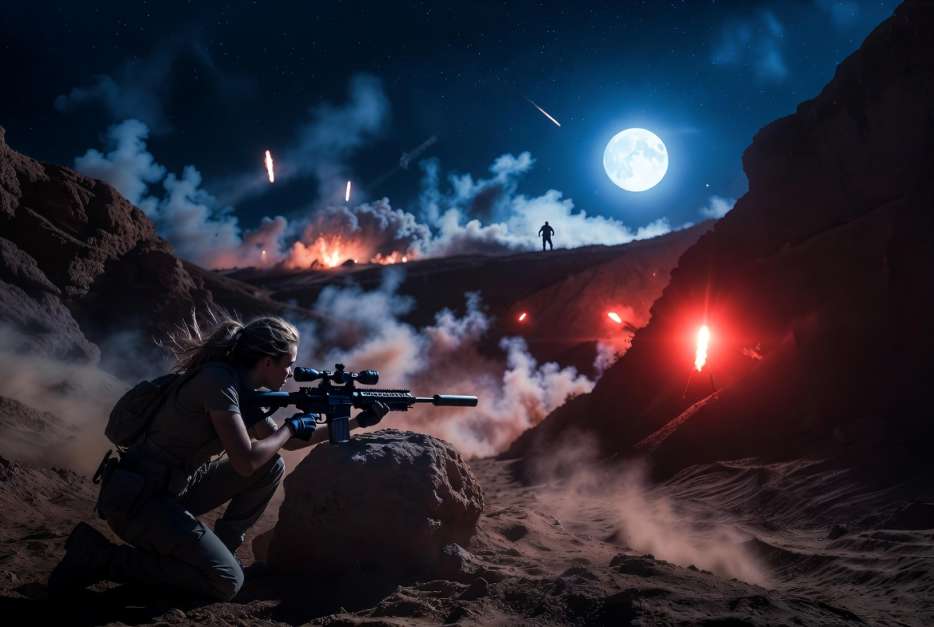
Avery raised her rifle, the world narrowing to that clean, merciless geometry again. Wind: light, left to right. Drop: minimal. She exhaled and fired. The spotter crumpled.
But it was too easy.
“Contact left!” Marcus shouted.
Fire erupted from the rocks. Bullets zipped past, kicking up sand. Avery rolled behind a boulder, heart hammering. In the chaos, she saw a figure moving on the far ridge—not Taliban irregulars. This one moved with military precision.
Reyes.
He wasn’t firing. He was watching. Waiting for her to expose herself.
Sullivan’s voice cut through the noise. “Avery—don’t take the shot! It’s a trap!”
But the stillness had her now. She lined up the crosshairs on Reyes’ silhouette. One breath. One squeeze.
The rifle bucked. Reyes jerked, but didn’t fall. He dove behind cover, blood visible even at distance.
Then the real ambush sprang.
Explosions rocked the pass. A hidden IED chain detonated, cutting off their retreat. Dust and smoke swallowed the sky. Avery coughed, ears ringing, scrambling to find Sullivan and Marcus.
She found Marcus first—wounded but conscious, a graze across his ribs. “Go,” he gasped. “They’re closing in.”
Sullivan was twenty meters ahead, pinned behind a rock as enemy fire walked toward him.
Avery moved without thinking. Low, fast, reading the chaos like wind and distance. She slid in beside him, laying down suppressive fire.
“You shouldn’t have come back,” she said between shots.
Sullivan managed a pained grin. “Couldn’t let the supply girl steal all my glory.”
Another explosion. Closer this time. The ground shook violently.
Through the smoke, Avery saw Reyes again—limping away but turning back for one last look. Their eyes met across the kill zone.
He smiled.
Then the radio in her ear crackled with Hayes’ urgent voice: “Cole, extraction is compromised. You’re on your own. And… we just lost contact with Morse. He’s missing.”
The desert wind howled as night fully claimed the sky.
Avery gripped the rifle tighter, blood on her hands—Marcus’s this time—and felt the old curse settle over her like a second skin.
The quiet life was over.
Now only the killing remained.
The smoke refused to clear. It clung to Avery’s skin, mixed with sweat and the metallic tang of blood—Marcus’s blood on her hands, warm and sticky. The desert night had turned blacker than any she remembered, stars hidden behind dust and the afterglow of explosions. Her ears still rang, a high-pitched whine that made every shout sound distant.
“Move!” Sullivan barked, dragging himself up despite the fresh pain tearing through his leg. He fired two controlled shots into the darkness, forcing the enemy to duck. “We can’t stay pinned. They’ll flank us.”
Avery nodded, the rifle an extension of her will once more. She popped up, found a fleeting gap in the enemy fire, and sent three rounds downrange. One found flesh—a Taliban fighter screamed and tumbled down the rocks. But her eyes kept returning to that limping silhouette in the distance. Reyes. Still alive. Still watching.
Marcus leaned heavily on her shoulder as they retreated toward a narrow ravine. His breathing was labored, but his voice stayed steady. “Don’t worry about me. Just get us out of this meat grinder.”
“You’re not dying on my watch,” she snapped, the words sharper than she intended. Something fierce and protective surged in her chest—the same instinct that had made her run into the open back in the valley. She wouldn’t lose another person she cared about. Not tonight.
They slipped into the ravine, boots sliding on loose shale. The walls rose steep on either side, offering temporary cover but also trapping them like a corridor of death. Sullivan took point, limping ahead, while Avery covered their rear. Every shadow looked like a threat. Every whisper of wind sounded like footsteps.
Halfway through, Sullivan suddenly stopped. “Wait.”
Avery froze. She heard it too—a low click, mechanical and wrong.
“Tripwire,” Sullivan whispered. “Two meters ahead.”
The stillness inside her expanded, cold and precise. She handed Marcus off to Sullivan, then eased forward on her belly, knife drawn. Her fingers found the thin wire stretched across the path, connected to what looked like a cluster of grenades. Carefully, she cut it, sweat dripping into her eyes. One wrong move and they would’ve been shredded.
As she stood, a new sound cut through the night—rotors. Distant but approaching fast.
“Extraction?” Marcus asked hopefully.
Sullivan shook his head. “Wrong direction. That’s not ours.”
They pushed harder. The ravine opened into a small bowl-shaped depression littered with ancient boulders. Perfect defensive ground, but also a perfect kill box if the enemy sealed the exits.
They took positions. Avery behind the largest rock, optic scanning the ridges. Sullivan to her left. Marcus behind them, weapon ready despite his wound.
Minutes stretched into eternity.
Then the attack came from above.
Ropes dropped from a blacked-out helicopter—no markings. Figures fast-roped down, moving with trained efficiency. Not local fighters. These were operators.
“Reyes brought friends,” Avery muttered.
The first assailant hit the ground and opened fire. Bullets sparked off stone inches from her face. She returned fire, the rifle kicking rhythmically. One man dropped. Another screamed as Sullivan’s shot found its mark.
But they kept coming.
In the chaos, Avery caught movement on the far lip of the depression—Reyes, now with a fresh bandage on his shoulder, directing the assault. Their eyes met again across the distance. He raised a hand, almost in salute, then pointed directly at her.
Avery’s finger tightened on the trigger. The shot was perfect—wind read, distance calculated, breath held at the exact moment. The rifle cracked.
Reyes spun and fell.
But as he dropped, he triggered something. A flare shot into the sky, bathing the entire bowl in harsh red light.
“Ambush complete,” a voice crackled over a speaker somewhere in the rocks. “Target acquired.”
More explosions—smaller this time, flashbangs and smoke grenades. The world turned white and chaotic. Avery felt hands grab her from behind. She fought, elbow connecting with a jaw, but a cloth pressed over her mouth—chemical, sweet, overwhelming.
The last thing she saw was Sullivan lunging toward her, face twisted in fury and desperation, before the darkness swallowed everything.
When consciousness returned, it came in fragments. Cold concrete floor. Chains on her wrists. A single bare bulb swinging overhead. Her head throbbed, and the taste of blood filled her mouth.
She was in a small underground room—probably an old Soviet-era bunker repurposed by whoever was running this shadow war. Reyes sat in a chair across from her, pale but alive, arm in a sling. He smiled that same too-easy smile from Sullivan’s notebook.
“You’re even better than the reports said, Specialist Cole,” he said calmly. “The quiet ones always are. Your father knew it. Morse knew it. Now we do too.”
Avery lifted her head, eyes burning with defiance. “Where are the others?”
“Safe. For now.” Reyes leaned forward. “We don’t want them. We want you. The one who can read the wind. The one who can make impossible shots. Join us, or watch them die one by one—starting with your medic friend and that stubborn sniper.”
The stillness inside her cracked wide open, replaced by something hotter. Rage. Fear. And a terrible, clear understanding.
She had spent her life hiding this gift. Now it was the only thing that could save the people she cared about.
A distant door slammed. Footsteps approached.
Reyes stood. “Think quickly, Avery. The desert doesn’t wait.”
Outside, somewhere in the night, she could almost hear the wind shifting—carrying the faint promise of a shot not yet taken.
The bare bulb swung lazily, casting long shadows that danced like ghosts across the concrete walls. Avery tested the chains on her wrists—cold steel, tight but not impossible. Her mind raced, not with panic, but with that dangerous clarity she had tried so long to bury. Distance. Angles. Weak points. She had read wind and bullet paths her whole life. Now she would read this room.
Reyes paced slowly, favoring his wounded shoulder. Sweat beaded on his forehead despite the underground chill. “You think this is about money? Ideology?” He laughed softly, a tired sound. “It’s simpler. Power. The kind that comes from controlling the chaos. A few well-placed leaks, a few impossible shots stopped before they happen… and entire wars bend.”
Avery said nothing. Silence was her weapon now.
Footsteps echoed again. The door opened, and two guards dragged in a battered figure—Sullivan. His face was bruised, leg re-bandaged roughly, but his eyes burned when they found hers. Behind him, Marcus was shoved forward, clutching his side, blood seeping through his shirt.
“Team’s all here,” Reyes said with mock warmth. “How touching.”
Sullivan strained against the guards holding him. “Touch her and I’ll kill you slow, Reyes. I swear it.”
Reyes waved a hand. The guards stepped back but kept weapons trained. “No need for dramatics. Specialist Cole is going to make a choice. Work with us—train our people, take the shots we need taken—and your friends walk. Refuse…” He let the silence finish the threat.
Marcus met Avery’s gaze. His usual steady warmth was still there, even through the pain. “Don’t do it for us,” he said quietly. “You’ve already given enough.”
But Avery felt the weight of every choice she had ever run from. The Montana fence line. The range with Morse. The valley where she picked up the rifle. Hiding had cost her nothing. Acting had cost everything.
She looked at Sullivan. The man whose rifle had become hers. The man who had nodded in the dust, trusting her with his life and his weapon.
“I’ll do it,” she said.
Sullivan’s face twisted. “Avery—no.”
Reyes smiled wider. “Smart girl.”
“But on my terms,” she continued, voice steady as a held breath. “You release them now. I stay. And if you break your word, I will read every wind, every distance, every heartbeat in this godforsaken desert until I put a bullet through yours.”
The room went still. Even the guards shifted uneasily.
Reyes studied her for a long moment, then nodded. “Deal. But remember—you belong to the quiet now.”
The next hours blurred. Sullivan and Marcus were blindfolded and taken away under the promise of safe passage back toward friendly lines. Avery watched them go from the bunker entrance, the desert wind tugging at her clothes like it wanted her to follow. Sullivan turned once, just before disappearing into a waiting vehicle. His lips moved silently: Come back.
Then they were gone.
Alone with Reyes and a handful of his shadow operators, Avery was given a new rifle—top-tier, suppressed, optics that cost more than she made in a year. They took her to a makeshift range carved into the rocks.
“Show us,” Reyes said.
She settled behind the weapon. The world narrowed. Wind: 8 knots, shifting southeast. Target: a steel plate 650 meters out, barely visible in the moonlight. She didn’t think. She read. The shot cracked, clean and final. The plate rang.
The operators murmured. Reyes looked almost reverent.
“You’re wasted on the Americans,” he whispered.
But as she took the next shot, and the next, Avery felt something else stirring beneath the stillness. A plan. Small pieces clicking into place. The frequency scrap she had found earlier. Morse’s strange warning. The way Reyes kept checking his watch, nervous.
Midnight came with a new tension in the camp. A radio message arrived—garbled, urgent. Reyes listened, face paling.
“Change of plans,” he snapped at his men. “We move the asset tonight. Cole, you’re with me.”
They loaded into unmarked trucks, racing across the desert under starlight. Avery sat in the back, rifle across her lap, chains replaced by a watchful guard. But her mind was free. Calculating. Waiting for the wind to shift in her favor.
Hours later, the convoy slowed near an old ravine—the same one where the ambush had nearly killed them. Reyes ordered a stop.
That was when the first distant shot rang out.
Not from their side.
A guard beside Avery jerked and fell. Chaos erupted. Bullets rained from the high ground—precise, disciplined fire.
Sullivan.
Marcus.
And, impossibly, Morse—emerging from the rocks like a ghost from her past, rifle steady in his hands.
Reyes spun toward her, betrayal twisting his features. “You—”
Avery moved faster than thought. She slammed the rifle butt into the nearest guard, seized his sidearm, and put two rounds into Reyes’ good shoulder. He dropped, screaming.
The battle swallowed the night once more.
She ran toward her people—toward the ones who had come back for her. Sullivan met her halfway, pulling her into a fierce, desperate embrace amid the gunfire.
“You came back,” she breathed against his chest.
“Never left you,” he rasped. “Not really.”
But as Morse covered their retreat, laying down fire with the calm precision of an old instructor, a final shot echoed from the darkness. Morse staggered, blood blooming across his back.
He fell to one knee, eyes finding Avery’s across the smoke.
“Use it,” he gasped. “The gift… don’t let it own you.”
Then the desert claimed him.
They dragged him to cover as enemy reinforcements closed in. Avery took the rifle again, the weight familiar and terrible. Tears cut clean lines through the dust on her face, but her hands stayed steady.
The quiet inside her roared.
The desert night had become a living thing—howling wind, stinging sand, and the relentless crack of gunfire that refused to end. Avery knelt beside Morse in the shallow cover of a rock outcrop, her hands pressing desperately against the wound in his back. Blood flowed warm and steady between her fingers, soaking the sleeves of her tactical jacket. The same sleeves that had carried Sullivan’s blood days earlier.
“Don’t you dare die on me,” she whispered fiercely. “Not after everything.”
Morse’s breathing came in ragged gasps. His weathered face, lined by decades of war, looked almost peaceful in the moonlight. “Told you… the dangerous ones understand the cost.” A weak smile tugged at his lips. “You always did, kid. Now finish it.”
Sullivan laid down suppressive fire from her left, his movements precise despite the pain in his leg. Marcus worked frantically on Morse from the other side, tearing open an emergency trauma kit with blood-slicked hands.
“Extraction window is closing,” Marcus said, voice tight. “We have maybe ten minutes before they overwhelm us.”
Avery looked up. The enemy—Reyes’ remaining operators and the Taliban fighters they had bought—were closing in from three sides. Reyes himself was still alive somewhere out there, wounded but directing the hunt like a man with nothing left to lose.
She made her choice.
“Take Morse,” she told them. “Get him to the rally point. I’ll buy you time.”
Sullivan’s head snapped toward her. “Like hell you will.”
“This is what I’m good at,” she said, meeting his eyes. The connection between them felt raw, electric—two quiet souls who had seen too much. “Trust me. Like you did in the valley.”
For a heartbeat, the battle seemed to fade. Sullivan reached out, gripping her arm hard enough to bruise. “You come back to me, Avery Cole. That’s an order.”
Then he was moving, helping Marcus lift Morse’s limp form. They disappeared into the night, swallowed by the rocks.
Avery was alone again.
She settled behind the rifle, the suppressor cool against her cheek. The world narrowed to pure geometry: wind direction shifting northeast, distances etched in her mind like old friends. She became the stillness.
The first shot dropped a fighter trying to flank left. The second silenced a machine gun nest on the ridge. Each trigger pull was a conversation with the wind, with gravity, with every lesson Morse had ever taught her.
But they kept coming.
A bullet grazed her arm, burning like fire. She barely felt it. Another shattered the rock near her head, sending shards into her face. Blood trickled into her eye, but she kept shooting—calm, methodical, relentless.
Then a voice crackled over a captured radio beside her.
“Cole.” It was Reyes, weak but venomous. “You think this changes anything? I already sent the coordinates. More are coming. You can’t win.”
Avery keyed the mic, her voice steady as stone. “Watch me.”
She spotted him then—limping along a distant ledge, silhouetted against the stars. The shot was long, nearly eight hundred meters, with treacherous crosswinds. Any other shooter would have called it impossible.
Avery exhaled.
The rifle spoke.
Reyes dropped.
The enemy fire faltered, then surged again in rage. But the momentum had shifted. In the distance, she heard the blessed thunder of approaching Black Hawks—real extraction birds this time, drawn by the chaos.
She covered the team’s withdrawal until the last possible second, then ran.
Legs burning, lungs screaming, she sprinted across open ground as bullets chased her heels. A round slammed into her vest, knocking the air from her lungs. She stumbled but kept going.
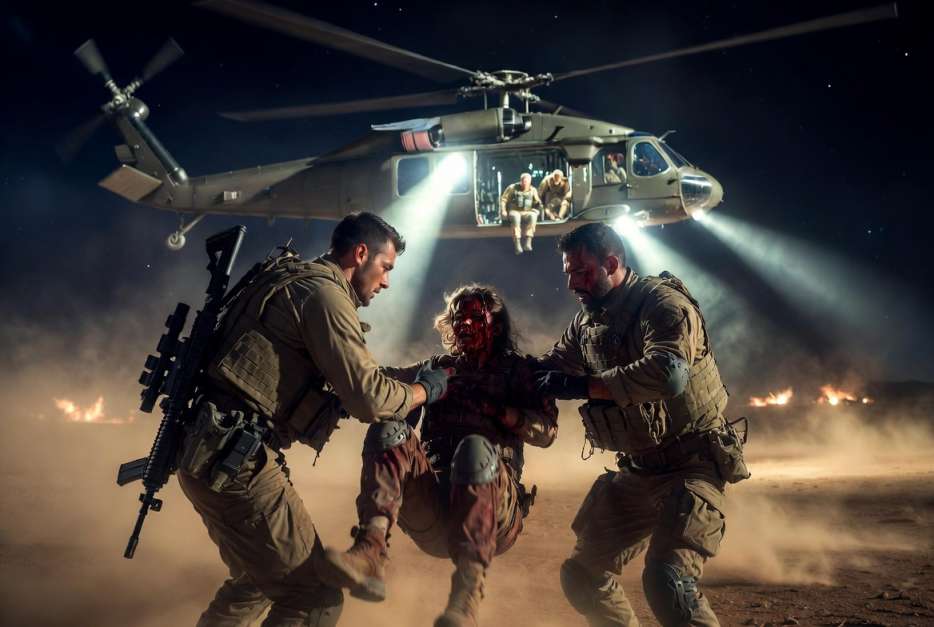
Strong hands caught her at the edge of the landing zone—Sullivan and Marcus, dragging her aboard the hovering bird as Morse was already being loaded, IV lines trailing like lifelines.
The helicopter lifted off in a roar, climbing hard into the night sky. Below them, the desert continued its ancient war, indifferent to the lives it had claimed.
Avery leaned back against the bulkhead, exhausted, bleeding, but alive. Sullivan sat beside her, his shoulder pressed to hers. Marcus worked on her wounds with gentle efficiency, though his eyes kept flicking to her face with something deeper than professional concern.
“You did it,” Sullivan said quietly, voice barely audible over the rotors. “You saved us.”
She closed her eyes, feeling the weight of Morse’s last words. The gift. The cost. The quiet that would never fully leave her again.
“I saved us tonight,” she whispered. “But this isn’t over. Whoever Reyes worked for… they’re still out there.”
Marcus finished bandaging her arm and squeezed her hand. “Then we face it together. No more hiding.”
As the Black Hawk carried them toward the lights of the forward operating base, Avery allowed herself one small, fragile moment of peace. She rested her head against Sullivan’s shoulder, feeling his quiet strength, while Marcus kept watch on her other side.
The war had changed her. The desert had forged her. But for the first time, she wasn’t facing the stillness alone.
To be continued…