The Weight of Promises
Esther’s bare feet pressed against the packed earth floor of the mud hut, the thin mat beneath her offering no warmth against the damp chill of dawn. Her deep brown eyes fluttered open to the sound of Auntie Arma’s voice slicing through the quiet like a rusted machete. “You think food cooks itself, lazy girl? Get up before I drag you out!”
She bolted upright, heart hammering, the familiar knot of hunger twisting in her stomach. At eighteen, Esther moved with the quiet grace of someone who had learned early that noise invited trouble. Five years had passed since her parents’ accident on the flooded road to the market—five years of Arma’s sharp reminders that an extra mouth was a curse, not family.
“Yes, Auntie,” Esther whispered, smoothing her faded wrapper. She hurried to the hearth, striking flint to coax flames from dry palm fronds. The smoke stung her eyes, but she blinked it away. Outside, the lively Garan Village stirred: roosters crowing, women calling greetings across compounds, the distant rhythm of pestles pounding fufu. Life moved on, indifferent to the girl in the crumbling hut at its edge.
Arma stood in the doorway, stout and unyielding in her late forties, hands planted on wide hips. “Fetch water first. My bones ache from carrying your weight all these years.”
Esther lifted the heavy clay pot onto her head, the rim already digging into her shoulder. The stream was a thirty-minute trek through dew-wet grass and twisting paths. By the time she returned, her arms burned, and sweat traced lines down her dust-streaked face. Still, she knelt and began the palm nut soup, mashing the fufu with steady, aching strokes while her own belly growled in protest. Not a single bite until Arma had eaten. That was the rule.
The only light in her shadowed days was Kelvin. Tall and strong from years at the shoemaker’s bench, his cheerful face could chase the clouds from her heart. That morning, after the chores, she slipped away to the mango tree shading his workspace. He looked up from stitching leather, his grin wide and bright as the rising sun.
“Esther! You look like you carried the whole stream on that pretty head again.” He set the shoe aside and pulled her close, his calloused hands gentle.
She chuckled softly, leaning into him. “Something like that. But I’m here now.”
Kelvin’s eyes narrowed with that familiar determination. “One day, I’m taking you away from her. A real house. No shouting. No more breaking your back before the sun’s even up.” He held her hand, thumb tracing her palm. “I’m saving every coin, Esther. Soon I’ll marry you. We’ll have our own family.”
Her cheeks warmed. For a moment, under the sweet scent of ripening mangoes, the world felt possible. “You always say that.”
“I mean it,” he said, voice low and fierce. “You’re my future.”
His mother, Mama Grace, reinforced the dream. The kind widow in her fifties kept a neat compound nearby. When Esther arrived that afternoon to help sweep, Mama Grace’s smile was warm as fresh bread.
“Esther, my dear. Come in, come in. You make a fine wife for my Kelvin. God sees your heart.”
The simple hut felt like a palace compared to Arma’s—clean mats, the faint smell of herbs drying in the rafters. Esther bent to her task, hiding her blush, clinging to these stolen moments of belonging.
But Arma watched from her wooden stool, lips curled in private satisfaction. “Let her chase that poor shoemaker’s boy,” she muttered, cracking groundnuts between strong teeth. “The sooner they marry, the sooner I’m rid of her burden.”
The village had its own currents, unseen until they pulled you under.
Kelvin’s life shifted the day his master sent him to the city with a precious delivery—fine shoes for a big company. “Don’t mess this up, boy,” the old man warned. Pressure sat heavy on Kelvin’s shoulders, but ambition flickered in his chest.
In the humming streets of Accra, amid towering buildings and the ceaseless honk of taxis, he met Natasha. Wealthy, sharp-eyed, owner of the company. Her sleek dresses and confident laugh turned heads. She noticed Kelvin immediately—his rugged build, quiet charm, the way his hands moved with honest skill.
“You’re too handsome to waste away fixing shoes in some village,” she teased one afternoon, pressing an expensive watch into his palm. “Stay. I can open doors you’ve never dreamed of.”
Kelvin smiled politely, thinking of Esther’s soft eyes. “Thank you, but I can’t accept this.” He tried to pull away, but Natasha was relentless, visiting the village soon after in her flashy car, drawing stares and whispers.
Mama Grace saw opportunity. “Kelvin, don’t be a fool. That girl can give you the life we deserve. Love won’t fill your belly or put a roof that doesn’t leak.”
“But Esther—” he started.
“Esther will survive,” Mama Grace cut in sharply. “Think of your future.”
Doubt crept in like evening shadows. Natasha’s gifts, her promises of ease—they chipped at his resolve. Under the mango tree one evening, Esther sensed the change in his distant gaze.
“Kelvin? You’ve been so quiet lately.”
He sighed, avoiding her eyes. “Esther… we can’t do this anymore. I’m going to the city with Natasha. I need to think about my future. She can give me what you never could.”
The words landed like stones. Esther’s heart cracked open. “After everything? The promises? I love you—”
“It’s over,” he said coldly, standing. “Don’t hold me back.”
He left the next day. The village buzzed with the news. Arma’s sneer cut deepest: “What did you expect? A nobody like you?”
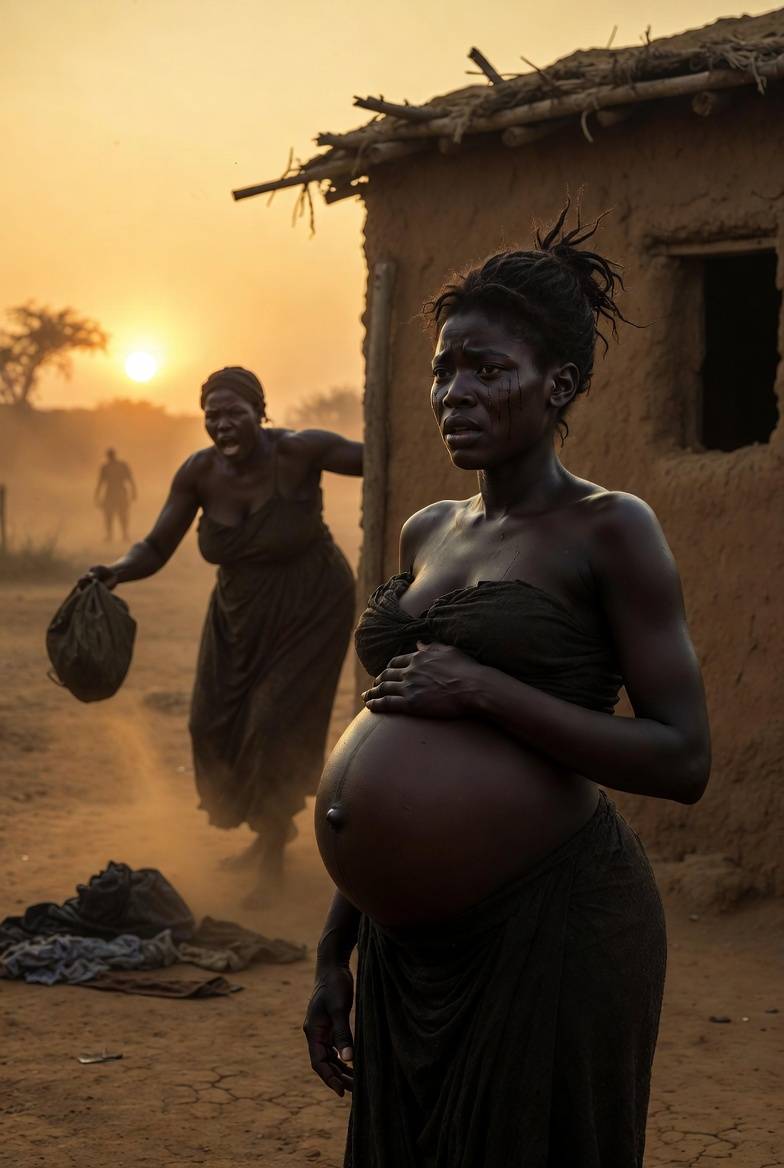
Months blurred into exhaustion. Esther threw herself into endless chores, but her body betrayed her. One morning, Arma’s eyes narrowed at the subtle swell of her belly.
“Pregnant? In my house? Shameless girl! Pack your things.”
Esther pleaded, but the door slammed shut behind her, her few belongings scattered in the dust. Desperate, she went to Mama Grace.
The widow’s face hardened. “Pregnant with my son’s child? Lies. Get out and stop embarrassing yourself.”
The door closed again. Esther wandered until her legs gave out beneath a sprawling baobab tree, tears carving tracks through the dust on her cheeks. An elderly woman, Nana Effia, paused, her kind eyes piercing the despair.
“Child, what troubles you so?”
Through sobs, Esther poured out the story. Nana Effia pressed a small bundle of money into her hands. “The world is harsh, but you carry new life. Stay strong. Every storm passes.”
That kindness was a fragile lifeline. With it, Esther left Garan for the city, the money buying a cramped room in a slum where garbage festered and rats skittered at night. She sold sachet water under the merciless sun—“Pure water! Ice cold!”—her voice growing hoarse, feet blistering, back aching. Each night she curled around her growing belly, whispering, “I’ll protect you, little one. No matter what.”
One fateful evening, crossing a chaotic street, a sleek black car bore down on her. The honk froze her. Trays crashed. The world spun.
She woke in a hospital bed, the driver—a tall, well-dressed man named Benjamin—sitting nearby, worry etching his features. “I’m so sorry. Are you alright?”
His kindness unraveled her. No one had asked with such genuine care since her parents. When he learned of her slum room and her pregnancy, his jaw tightened. Memories of his own late mother, a struggling single parent, stirred something deep.
“You can’t stay there,” he said firmly. “Come to my home. It’s big enough. You can help with cooking, keeping things in order. A partnership.”
Esther hesitated, pride warring with exhaustion. “I don’t want to be a burden.”
“You won’t be.”
His spacious house, with its quiet neighborhood and clean linens, felt like another world. Esther worked diligently—meals prepared with care, flowers arranged on the table. Over dinners of jollof rice and grilled chicken, conversations flowed. Benjamin, often lost in his work, began looking forward to her presence.
“You’re strong, Esther,” he told her one night, eyes soft. “Don’t let anyone dim that.”

Labor came suddenly, pain ripping through her like fire. Benjamin drove her to the hospital, gripping the wheel, murmuring reassurance. The cry of her newborn son filled the room. “John,” she whispered through joyful tears. Benjamin stood beside her, smiling. “Welcome, little man.”
From that day, he became more than a rescuer. He rocked John to sleep, sang silly songs, bought toys. Esther watched from doorways, her heart stirring with a feeling she thought had died—warm, tentative love. His big hands cradling her son so gently. His steady support as she enrolled in sewing classes, her fingers dancing over fabric with growing confidence.
“You have a gift,” her teacher said.
With Benjamin’s encouragement, her small workshop blossomed. Customers praised her fusion of traditional patterns and modern elegance. On the day of her first fashion show, the hall pulsed with energy. Models glided down the runway in her vibrant creations. Applause thundered. Backstage, Esther wiped tears as one design earned a standing ovation.
Benjamin approached with flowers. “You were incredible.”
That evening, at a candlelit dinner, he fidgeted, then met her eyes. “Esther, you’ve brought joy back into my life. Watching you with John, seeing your strength… I love you. Will you marry me?”
Tears spilled as she nodded. “Yes. A thousand times, yes.”
Their garden wedding was simple and radiant. Esther in a gown of her own design, little John as ring bearer, toddling proudly. Vows exchanged under blooming flowers, Benjamin’s kiss sealing a future built on resilience and chosen love.
Six years later, in a distant prison cell, Kelvin stared at concrete walls. Natasha’s fraud had unraveled everything—luxury cars, parties, the illusion of invincibility. Arrested, tried, sentenced to life. Mama Grace, once strutting with ill-gotten gifts, suffered a stroke in her empty grand house, pride having burned every bridge.
Kelvin regretted it all too late. The village had turned its back. The promises he broke had cost him everything.
Esther, meanwhile, stood on her porch one evening, John’s laughter mixing with Benjamin’s deep chuckle. She squeezed her husband’s hand, the city lights twinkling like distant stars.
“I never imagined this,” she said softly.
Benjamin kissed her temple. “You deserved it all along.”
In the quiet strength of their home, the girl who once carried water and broken dreams had forged a life of love, creation, and unbreakable hope. The storms had passed, leaving clearer skies.