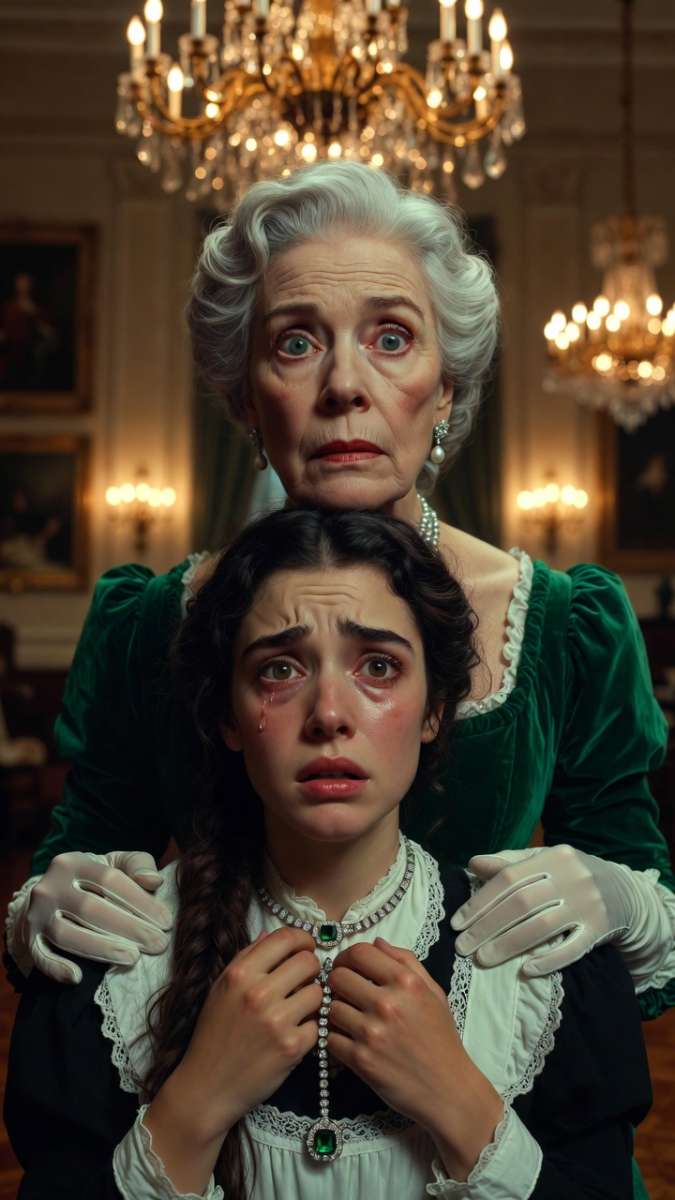
Inside the shadowed heart of the Ashford Estate, where the air hung heavy with the scent of aged oak and fading lilies, Eleanor Ashford’s fingers dug into the maid’s narrow shoulders like talons. Golden chandeliers cast trembling pools of light across the grand salon, their crystal prisms fracturing into a thousand accusing eyes. Heavy velvet drapes framed tall windows that looked out on rain-lashed gardens, the kind of place where secrets had roots deeper than the ancient oaks outside.
The maid—barely twenty, with ink-black hair slipping from its pins and wide, doe-like eyes—trembled beneath the older woman’s grip. A simple silver chain glinted at her throat, its pendant a modest teardrop emerald framed by tiny diamonds that caught the light with treacherous familiarity.
“Where did you get this necklace?” Eleanor’s voice was low, almost a growl, but it carried the weight of decades of command. Her silver-streaked hair was pulled into a severe chignon, yet one loose strand betrayed the tremor in her hands. At sixty-eight, she still moved with the lethal grace of a woman who had buried two husbands and outlived every scandal the tabloids could throw at her.
The girl’s lips quivered. Tears spilled hot down her flushed cheeks, leaving tracks that glistened like dew on porcelain. “A nun gave it to me,” she whispered, the words fracturing into quiet sobs. “At St. Agnes orphanage, on my sixteenth birthday. She said… she said it was all I had from my mother.”
Eleanor’s face drained of color. The anger cracked open, revealing something rawer—fear, sharp as shattered glass. Her eyes, the same stormy gray as the portraits lining the hall, widened until the whites showed. “Who?” she demanded, the single word echoing off the coffered ceiling like a gunshot. “Who gave it to her?!”
The maid could only shake her head, too terrified to speak.
Without another word, Eleanor seized the girl’s wrist—hard enough to leave faint bruises—and dragged her through the mansion’s labyrinthine corridors. Their footsteps rang against marble floors, past suits of armor that seemed to watch with hollow eyes, past rooms sealed since the night the old patriarch died. They stopped before a tall antique cabinet inlaid with mother-of-pearl, its surface scarred by time and secrets.
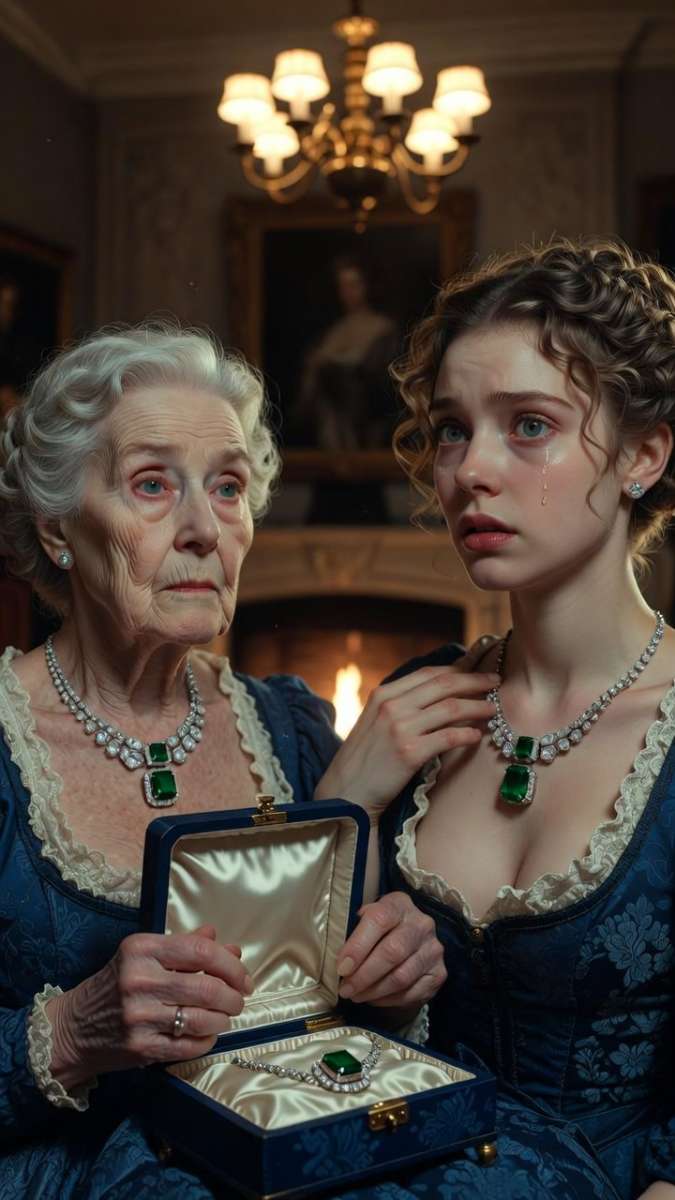
Eleanor’s hands shook as she produced a small brass key from the chain at her waist. The lock clicked. Inside, nestled on blue damask, lay a jewelry box the color of midnight. She lifted the lid.
The room fell deathly still.
A magnificent necklace rested within—identical in every facet. The same delicate chain, the same teardrop emerald flanked by diamonds that now seemed to pulse with malevolent recognition. Rain lashed the windows harder, as if the storm itself held its breath.
The maid stared, lips parted in disbelief. Her fingers rose unconsciously to the pendant at her own throat. Two identical necklaces. One worn by a servant who should never have set foot beyond the kitchens. The other hidden away like a body in a locked crypt.
Eleanor’s breath came shallow. For the first time in thirty years, the matriarch of the Ashford empire looked truly old. “My God,” she whispered. “You’re her.”
The girl’s name was Clara Vale, and until that moment she had believed her life was a small, manageable tragedy. Orphaned at birth, raised on thin porridge and stricter prayers, she had arrived at Ashford Estate six months earlier with nothing but a cardboard suitcase and a desperate need for wages. The other servants whispered she was too pretty for her own good—wide green eyes that reminded the older staff of someone they couldn’t quite name, a quiet dignity that made her seem out of place polishing silver.
Now that silver felt like chains.
Eleanor released her wrist as though burned. The jewelry box lid snapped shut with finality, but the image remained seared behind Clara’s eyelids. “Sit,” the older woman ordered, pointing to a velvet settee that probably cost more than Clara would earn in ten years. Clara obeyed, knees weak, the necklace suddenly heavy as an anchor around her neck.
Eleanor did not sit. She paced before the cold marble fireplace, her long black skirt whispering accusations with every step. Lightning flashed outside, illuminating the sharp angles of her face—the high cheekbones inherited from robber barons and the ruthless jaw of a woman who had clawed an empire from her late husband’s indifferent hands.
“You were never meant to come here,” Eleanor said finally. Her voice had lost its edge; now it carried exhaustion, the kind that settles into bones after decades of guarding the truth. “I paid the convent good money to keep you hidden. To keep her hidden.”
Clara’s heart hammered against her ribs. “Her?”
Eleanor stopped. She turned, and for a fleeting second the matriarch’s mask slipped entirely. Grief—raw, unfiltered—twisted her features. “Your mother. My daughter, Lydia.” She laughed, a bitter sound that cracked in the middle. “The one who was supposed to inherit everything. The one who ran away with a worthless musician and died in a gutter in Paris before she could ruin us all.”
The words landed like stones in still water. Clara felt the room tilt. She had spent her life imagining a mother who was kind, perhaps poor but loving. Not this. Not this.
“I don’t understand,” Clara breathed. Her fingers tightened around the emerald pendant until the metal bit into her palm. “If she died… why do I have this? Why do you have the same one?”
Eleanor crossed to a mahogany desk and poured two fingers of amber liquid into a crystal glass. She didn’t offer any to Clara. “Because there were two made. One for Lydia on her eighteenth birthday—the day she was to be presented to society as the rightful heir. The other…” She took a long swallow. “The other was to be buried with her. But when they found her body, the necklace was gone. I thought it lost forever. Or stolen by whoever killed her.”
Clara’s stomach twisted. Killed. The word echoed louder than the thunder outside.
A soft knock at the door made both women freeze. The handle turned before Eleanor could answer.
In stepped a man who looked carved from the same cold marble as the fireplace. Victor Ashford, forty-two, Eleanor’s only surviving son. Tall, impeccably tailored in charcoal wool, with silver threading through dark hair and eyes the color of winter seas. He carried the quiet authority of a man who had spent years waiting for his mother to die so he could finally rule. A thin scar traced his left jaw—souvenir from a sailing accident he claimed, though the staff whispered darker origins.
His gaze flicked from his mother to Clara, lingering on the necklace with clinical interest. “Mother. I heard shouting. Is everything—”
“Leave us, Victor,” Eleanor snapped.
But Victor didn’t move. A slow, dangerous smile curved his lips as he took in Clara’s tear-streaked face, the matching emerald. “Well, well. The prodigal ghost returns.” His voice was velvet over steel. “Hello, little sister. Or should I say… cousin?”
The floor seemed to drop from beneath Clara. Lightning split the sky again, illuminating the three of them—matriarch, heir, and the girl who had just inherited a war she never knew existed.
Victor closed the door behind him with a soft, decisive click.
The storm had not let up by the time Clara found herself alone in the servants’ quarters that night. The small room under the eaves smelled of damp wool and lavender sachets meant to mask mildew. She sat on the narrow bed, still wearing her uniform, the necklace now tucked beneath her collar like contraband.
Her mind spun. Victor’s words had opened a door she couldn’t close. Cousin? Sister? The implications clawed at her: Lydia Ashford hadn’t died childless in Paris. She had given birth—to Clara—then been silenced before she could claim her rightful place. And someone in this house had made sure of it.
A soft creak outside her door pulled her from her thoughts. She held her breath. Footsteps, light and deliberate, paused just beyond the threshold. Then a folded note slid beneath the gap.
Clara waited until the footsteps retreated before snatching it up. The handwriting was elegant, feminine, and unfamiliar.
Midnight. The east conservatory. Come alone if you want to live.
No signature. Only a small doodled lily—the same flower embroidered on the handkerchiefs in Eleanor’s private rooms.
Clara’s pulse thundered in her ears. She had no allies here. No money. No power. But she had the necklace. And now she had a question burning hotter than fear: Who was she really, and what price would the truth demand from the Ashford empire?
Outside, the rain kept falling, washing away footprints but never the stains beneath them.
The east conservatory was a glass cathedral trapped in eternal night. Rain hammered the arched panes overhead, turning the world beyond into a blurred watercolor of storm and shadow. Inside, tropical ferns dripped with condensation, their leaves heavy and glistening like secrets too long held. The air smelled of wet earth, night-blooming jasmine, and the faint metallic tang of fear.
Clara slipped through the side door at five minutes past midnight, her maid’s uniform exchanged for a plain gray dress that still carried the scent of lye soap from the laundry. Her heart beat so violently she was certain it would echo off the iron framework. One hand clutched the emerald necklace beneath her collar; the other gripped a small paring knife she’d stolen from the kitchens. She was no fool. Not anymore.
A single lantern burned low on an iron table, casting long, distorted shadows across the tiled floor. A figure waited beside it—slender, cloaked in a dark shawl, face half-hidden by the hood. As Clara approached, the woman turned.
It was Mrs. Hargrove, the head housekeeper. Sixty if she was a day, with iron-gray hair pulled back so tightly it looked painful. Her eyes, usually flat and watchful, now burned with something close to desperation.
“You came,” the older woman whispered. “Good. There isn’t much time.”
Clara stopped just beyond arm’s reach. “You sent the note. Why?”
Mrs. Hargrove’s gaze dropped to the faint outline of the necklace at Clara’s throat. “Because I was there the night your mother died. Not in Paris. Here. In this house.”
The words landed like ice water down Clara’s spine. She felt the conservatory tilt, the ferns suddenly too close, the rain too loud.
“Lydia was twenty-three,” Mrs. Hargrove continued, voice barely above the drumming rain. “Beautiful. Wild. She had already given birth to you in secret and was ready to expose everything—Victor’s forged documents, Eleanor’s quiet poisoning of her own husband, the way they planned to cut Lydia out of the will entirely. She had evidence. Recordings. Letters. Enough to burn the Ashfords to the ground.”
Clara’s mouth went dry. “And they killed her for it.”
Mrs. Hargrove nodded once, sharp. “Victor did the deed himself. I saw him carry her body down the back stairs. Eleanor made it look like a runaway gone wrong in Europe. They paid the convent to take you and keep silent. But the necklace… Lydia managed to press it into my hand before she took her last breath. I was supposed to destroy it. Instead, I gave it to the nuns with instructions to pass it to you when you turned sixteen. A small act of defiance. The only one I’ve ever managed.”
Lightning flashed, illuminating the fear etched deep into the housekeeper’s face. Clara stepped closer, voice trembling with rage and something sharper—grief for a mother she had never known.
“Why tell me now? After all these years?”
“Because Victor knows.” Mrs. Hargrove’s hand shot out and gripped Clara’s wrist. Her fingers were cold as the rain. “He saw the necklace tonight. He won’t let you live long enough to claim what’s yours. The will your grandfather left—the real one—names Lydia’s bloodline as primary heir. You. Not Victor. The old man changed it weeks before he died, and Eleanor has been hunting that document ever since.”
A soft footstep sounded behind a cluster of palms.
Both women froze.
Victor stepped into the lantern light, rain still glistening on the shoulders of his tailored coat. He moved with predatory calm, a half-smile playing on his lips that didn’t reach his winter-sea eyes.
“Touching story, Hargrove,” he said softly. “Almost as touching as the one where a loyal servant suddenly develops a conscience after thirty years of silence.”
Mrs. Hargrove paled. Clara instinctively moved between them, the little knife suddenly heavy in her pocket.
Victor’s gaze slid to her, slow and appraising. “Little sister,” he murmured, the word dripping with mockery and something darker—curiosity, perhaps even reluctant fascination. “You have her eyes. And her foolish courage. Tell me… how does it feel to discover your entire life was a lie constructed to protect a fortune you were never meant to touch?”
Thunder rolled overhead, shaking the glass walls.
Clara lifted her chin, refusing to let her voice break. “It feels like the beginning of the end for you.”
Victor laughed quietly, a sound that sent chills racing across her skin. He reached into his coat and drew out a small revolver, its silver barrel catching the lantern light like a promise.
“Brave words,” he said, cocking the hammer with a soft click. “But bravery has never been enough in this house.”
Mrs. Hargrove moved first—lunging for the lantern, plunging the conservatory into sudden darkness. A gunshot cracked through the storm.
Clara ran.
She crashed through wet leaves and overturned pots, thorns tearing at her arms, rain now pouring through a shattered pane where the bullet had struck. Behind her, Victor’s voice echoed, calm and deadly:
“You can’t hide forever, Clara. Blood always finds its way home.”
She burst out into the night, soaked to the bone, lungs burning, the emerald necklace burning like a brand against her skin. The mansion loomed behind her, its windows glowing like watchful eyes.
Somewhere in its walls lay the real will. Somewhere in its shadows lay the truth of her mother’s last moments. And somewhere in the darkness, Victor Ashford was already hunting.
Clara didn’t stop running until the tree line swallowed her whole.
Clara ran until her lungs screamed and her bare feet bled against the gravel paths that wound through the Ashford grounds. Rain lashed her face like punishment, turning the world into streaks of black and silver. Behind her, the mansion glowed like a predatory beast, every lit window a watchful eye. She could still hear the echo of that single gunshot cracking through the conservatory glass, still feel Victor’s calm, lethal voice chasing her into the night.
She veered toward the old boathouse at the edge of the private lake, a decaying structure half-swallowed by ivy and memory. The door hung crooked on rusted hinges. Inside, the air smelled of mildew, motor oil, and the faint brine of the lake beyond. She collapsed against a stack of weathered rowboats, chest heaving, the emerald necklace clutched so tightly in her fist that the setting left red indentations in her palm.
A shadow moved in the far corner.
She was on her feet in an instant, the stolen paring knife raised.
“Easy,” a low voice said. “I’m not here to hurt you.”
The man stepped into a sliver of moonlight filtering through a cracked window. Jonah Hale. Thirty-eight. The estate’s head groundskeeper and mechanic—broad-shouldered, dark-haired, with a quiet intensity that had always made the younger maids whisper. A faded scar cut through his left eyebrow, and his hands bore the calluses of a man who worked with engines and secrets alike. He had arrived five years ago with nothing but a battered truck and eyes that seemed to carry their own ghosts.
“I heard the shot,” Jonah said, voice rough as gravel. He kept his distance, palms open. “Saw you running like the devil himself was behind you. Figured the boathouse was the only place they wouldn’t look right away.”
Clara didn’t lower the knife. “Why should I trust you?”
Jonah’s gaze dropped to the necklace still glinting in her hand. Something flickered across his face—recognition, pain, and a flash of old anger. “Because your mother trusted me. Lydia… she was my friend. The only real one I had in this cursed place.”
The knife trembled in Clara’s grip. “You knew her?”
He nodded slowly, stepping closer but still careful. “She used to sneak out here at night. We’d talk for hours. She told me about you—how she’d hidden the pregnancy, how she planned to run with you once she had the proof she needed. The recordings. The real will.” His jaw tightened. “The night she died, she was supposed to meet me here. She never showed. I found blood on the dock the next morning. Victor’s boat was missing.”
Clara’s legs gave out. She sank onto an overturned boat, the fight draining from her body, replaced by a grief so vast it threatened to swallow her whole. Jonah crouched in front of her, not touching, but close enough that she could feel the steady heat of him cutting through the damp cold.
“I’ve been waiting five years for someone like you to show up,” he said quietly. “Someone with her eyes. Her fire. I kept copies of what I could—letters she wrote me, photos, a flash drive she hid in the engine of my old truck. It’s not everything, but it’s enough to start tearing their world apart.”
Outside, the rain eased into a whisper. For the first time since the confrontation in the salon, Clara felt something dangerously close to hope. But hope in this house was a blade with two edges.
Jonah reached into his coat and pulled out a small waterproof pouch. Inside was a faded photograph: Lydia, young and radiant, laughing beside a much younger Jonah on this very dock. Behind them, the mansion loomed like a warning. Lydia wore the matching emerald necklace.
Clara traced her mother’s face with a trembling finger. The resemblance was undeniable now—the same wide green eyes, the same defiant tilt of the chin. Tears mixed with the rain still clinging to her lashes.
“Why didn’t you go to the police?” she whispered.
Jonah’s laugh was bitter. “Victor owns half the force in this county. Eleanor owns the other half. I tried once. Woke up two days later in the hospital with three broken ribs and a warning carved into my truck door.” He met her gaze, steady and intense. “But I never stopped looking for you. When you arrived as the new maid… I knew. I just didn’t know how to tell you without getting you killed.”
A distant shout echoed from the direction of the mansion—Victor’s men beginning their search.
Jonah stood, offering his hand. “We can’t stay here. There’s a safe path through the woods to an old hunting cabin. I have supplies there. From there… we fight.”
Clara took his hand. His grip was warm, calloused, and strangely grounding. As they slipped out the back of the boathouse and into the dripping forest, she felt the first stirrings of something deeper than alliance—something electric and terrifying in the way his shoulder brushed hers, in the protective way he kept her behind him when branches cracked nearby.
They had just reached the tree line when headlights sliced through the darkness.
Victor’s black Range Rover tore across the lawn, mud flying. He wasn’t alone. Two security guards flanked him, flashlights cutting through the rain like searchlights.
Jonah cursed under his breath and pulled Clara deeper into the underbrush. “Run,” he whispered fiercely. “I’ll lead them off.”
“No,” Clara hissed, gripping his arm. “We do this together.”
But Victor’s voice carried clearly over the wind, cold and mocking:
“Come out, little sister. Mother wants to have a family meeting. And she doesn’t like to be kept waiting.”
A second gunshot shattered the night—this one closer, splintering bark from a tree just feet away.
Clara and Jonah sprinted deeper into the ancient woods, hearts pounding in unison, the emerald necklace bouncing against her chest like a second heartbeat. Behind them, the hunters closed in.
Somewhere in the darkness lay the hunting cabin. Somewhere beyond that lay the real will, the recordings, and the truth that could destroy the Ashford empire.
But first, they had to survive the night.
To be continued…