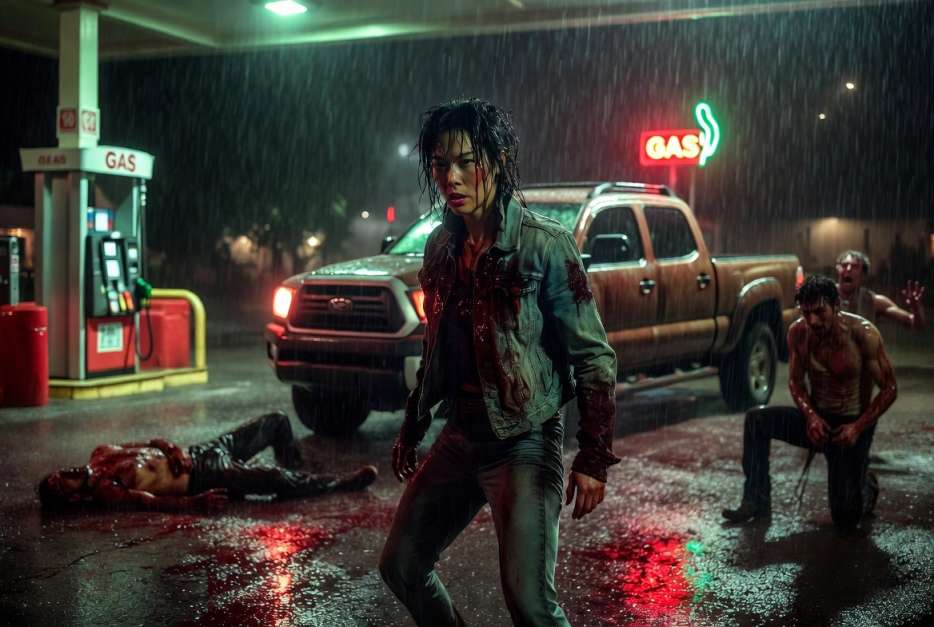
Chaya Jennings stood in the flickering neon haze of the gas station lot, the concrete cold and unyielding beneath her boots. The air hung thick with the residue of summer rain—petrichor mixed with diesel and the sickly sweetness of spilled soda from a nearby trash bin. Her 2011 Tacoma waited like an old warhorse, rusted but faithful, its quarter panel still warm from the long drive that had brought her nowhere in particular. She peeled the wrapper from a stale turkey sandwich with mechanical precision, each crinkle of plastic a small defiance against the silence that pressed in from all sides.

No roar of engines. No bone-rattling catapult launch. Just the distant sigh of tires on wet asphalt and the metallic hum of a dying streetlamp. Her jaw clicked with every bite, a ghost of that aborted launch six months ago off the USS Nimitz. The pain was familiar now, almost comforting. Civilian life draped over her like wet wool—suffocating, heavy, wrong.
Movement in the shadows. Three men. Peripheral vision, honed by years tracking bogies against empty skies, caught them before her mind fully registered. Average builds. Drunk. Fanning out with the sloppy instinct of predators who’d done this before. The leader’s voice cut through the night, slurred and cocky. “Hey. Long night?”
Chaya swallowed the gummy bread. She didn’t look up immediately. “Stores close in five.”
They didn’t care about the store. They saw a woman alone. 5’7”. Faded denim. Easy. They didn’t see the thousands of hours pulling Gs, the survival courses where instructors tried to break her in every way that mattered. They didn’t see the woman who had delivered death from thirty thousand feet and lived to carry the weight of it home.
The leader closed the distance. Cheap body spray and liquor rolled off him in waves. “Didn’t ask about the store, sweetheart. Asked about you. Nice truck. Keys?”
Her sigh came from the marrow. Not fear—annoyance. The bone-deep exhaustion of knowing what came next: paperwork, questions, the endless explaining to people who would never understand. She met his eyes. Flat. Still. “I’m not lost. I’m leaving. Back off.”
He chuckled, that wet, ugly sound. His friends flanked wider. The twitchy one balled a fist in his hoodie pocket. The heavy one stared at her keys like they were already his.
Chaya’s voice dropped, stripped to the officer’s edge. “Last warning.”
He lunged.
Violence wasn’t a movie. It was a car crash—awkward, sudden, smelling of copper and bad decisions. She stepped inside his reach, palm driving up into the soft cartilage of his nose with clinical force. The crunch echoed wetly. He dropped like meat hitting pavement.
The second man charged, head down, desperate tackle. She pivoted, elbow hammering between his shoulder blades. Metal groaned as his face met the Tacoma’s fender. Then the ring on his finger caught her cheek—hot flash of pain, blood on her tongue. Anger spiked, sharp and unwelcome. Sloppy.
She controlled it. Knee to groin. Leg sweep. He folded, whimpering.
The third man froze, eyes wide with the sudden realization that the enclosure he’d entered held something far more dangerous than prey. “Keys,” he stammered, hands up. “We don’t want the keys.”
Chaya spat blood onto the asphalt near his boot. “Get them out of here. If I see you in my rearview, I won’t use my hands next time.”
They dragged their broken friend away like dogs with a carcass. Taillights bled into the highway glow. Only then did the adrenaline crash hit—knees like wet sand, hands shaking, the hollow crater opening in her chest.
She pressed a crumpled tissue to her cheek and climbed into the truck. The cabin smelled of old leather and cheap vanilla. Safe. Confined. Like a cockpit. But no throttle. No afterburners. Just the squeak of dying wipers and the replay in her head: I dropped my guard. Sloppy. What kind of person wants the fight?
The drive blurred. Gravel crunched under tires as she pulled into Patterson Automotive. The garage smelled of burnt oil, ozone, and familiarity. Andrew Patterson stood under a hoisted Silverado, a mountain of a man in grease-stained coveralls. Ex-Fleet Marine Force Corpsman. He didn’t flinch at the blood on her face.
“You’re tracking mud onto my clean floor, Jennings.”
“Your floor hasn’t been clean since the Bush administration, Art.”
He patched her up without questions at first. Alcohol wipe bit deep. Butterfly bandage pressed firm. Then the words came out of her in a whisper: “Three of them. Gas station. I overreacted.”
Andrew’s pale blue eyes held hers. “Did they give you a chance to walk away?”
“No. But I wanted it. Wanted a reason to hit something.” Her voice cracked. “What kind of person does that make me?”
“A soldier without a war,” he said quietly, sliding burnt coffee across the desk. “You can’t flip the switch, Chaya. Ten years wiring your brain for threats. Honorable discharge doesn’t unwire it.”
The coffee burned her palms. She felt like a ghost haunting her own life.
Then the cruiser rolled in. Sheriff Teddy Brody filled the office doorway, hat dripping, face etched with twenty years of small-town rust. He’d known her since she was a kid dreaming of wings. He’d seen the footage. He knew the rap sheets of the men she’d dismantled.
“You’re clear legally,” he said. “But you didn’t just defend yourself, Chaya. You went to war. This town isn’t a combat zone.”
The words landed like ordnance. Manslaughter. The line she’d nearly crossed. Pity in his eyes hurt worse than the cut on her cheek.
“The war’s over, kid. You won. Stop fighting.”
He left. The silence returned, broken only by Andrew’s wrench and the distant freight train. Dawn bled purple across the horizon. Chaya sat in that cracked leather chair, mug warm in her hands, breathing in oil and coffee instead of jet fuel and fear.
For the first time in six months, the falling sensation eased. She wasn’t flying. She wasn’t crashing. She was simply here—grounded, aching, alive in a way that didn’t require violence to prove it.
But the night had left its mark. And somewhere in the bruised purple sky, a new question whispered: What now, when the only thing that ever felt like home was the fight?