CHAPTER I: THE NORTH AMERICAN DREAM AND THE FIRST FOOTSTEPS
1.1 The Ambitions of the Queen and Sir Walter Raleigh
In the late 16th century, England under the reign of Queen Elizabeth I was eager to expand its influence into the New World (North America) to compete with the vast wealth of the Spanish Empire. The man entrusted with this monumental task was Sir Walter Raleigh—a brilliant courtier, poet, and explorer.

After a few preliminary reconnaissance voyages, Raleigh decided in 1587 to establish a permanent agricultural colony near the Chesapeake Bay. He did not merely send soldiers; he sent entire families—carpenters, farmers, women, and children—with the hope that they would take root and build a “New England.” The leadership of this group was handed to John White, a skilled artist and cartographer who was appointed Governor.
1.2 The Misguided Stop at Roanoke Island
The journey met with complications from the very beginning. Instead of taking the settlers to the intended destination of the Chesapeake Bay, the stubborn and arrogant ship captain, Simon Fernandes, forced the 115 colonists to disembark on Roanoke Island (located in present-day North Carolina) in July 1587, so that he could rush back to hunt Spanish treasure ships.
Roanoke Island had previously been the site of a bloody military conflict between an earlier English expedition and the native local tribes. Being abandoned on an isolated island with poor soil, surrounded by hostile factions, was an indirect death sentence for this colonial “character.”
CHAPTER II: THE FIRST CHILD AND THE FATEFUL FAREWELL
2.1 Virginia Dare – The Child of the New World
Amidst the anxiety and harsh realities of the untamed wilderness, a glimmer of hope emerged. On August 18, 1587, Eleanor Dare—daughter of Governor John White—gave birth to a baby girl. The infant was named Virginia Dare.
Virginia Dare became the very first English child born on American soil. Her arrival symbolized life, continuity, and the future of the Lost Colony. Tragically, the lifespan of this child would prove to be as brief and mysterious as the fate of the colony itself.
2.2 The Governor’s Journey of No Return
As the autumn of 1587 approached, food supplies dwindled rapidly and tensions with the local tribes escalated. Desperate, the colonists begged Governor John White to return to England to secure emergency provisions and reinforcements.
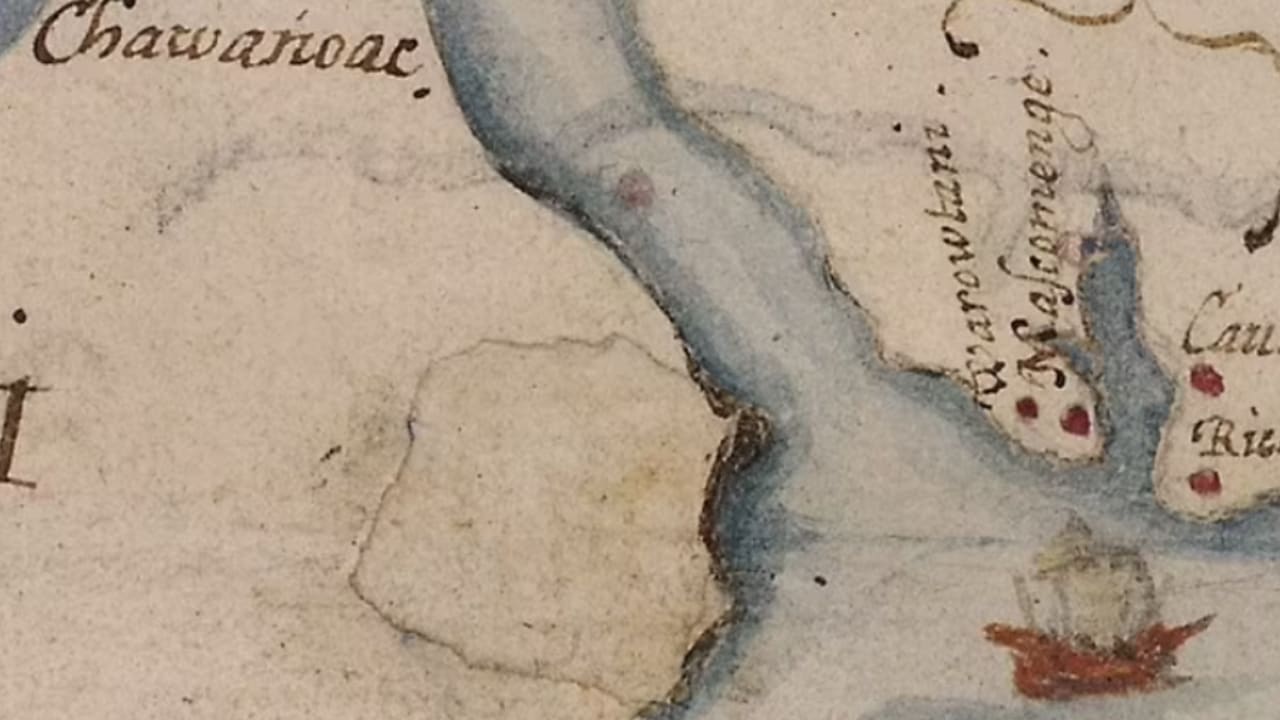
John White hesitated but ultimately agreed, tearing himself away from his daughter and his newborn granddaughter, who was only a few weeks old. Before boarding the ship, he gave the settlers strict instructions: If you are forced to relocate due to danger, carve the name of your destination into a tree trunk or post. If you leave in distress or under attack, carve a Maltese cross ($+$) above the name.
He had no way of knowing that this would be the last time he would ever see his family and fellow countrymen.
CHAPTER III: “CROATOAN” – THE CODE ON THE TREE AND THE VANISHING
3.1 Delayed by the Fires of War
When John White finally arrived back in England, political chaos erupted. The Anglo-Spanish War reached its peak with the launch of the Spanish Armada. Queen Elizabeth I issued a decree impounding all English vessels for the war effort. John White found himself trapped in England for three grueling years, his heart burning with anxiety for the 115 souls abandoned across the sea.
3.2 A Desolate Settlement
It was not until August 1590 that John White was finally able to return to Roanoke Island. As he stepped ashore, a haunting scene awaited him and his search party: the colony was completely deserted.
There was not a single sign of life, yet there were no traces of a massacre, no human bones, and no blood. The houses had been systematically dismantled. On a prominent wooden post at the entrance to the palisade, they discovered a single word carved in capital letters: “CROATOAN”. On another nearby tree, the letters “CRO” were etched.
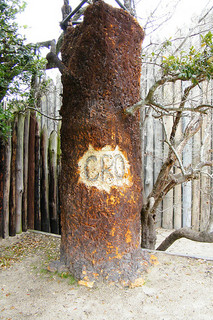
Crucially, there was no cross carved anywhere. This indicated that the colonists had moved deliberately and were not overtaken by a sudden assault. “Croatoan” was the name of a neighboring island (modern-day Hatteras Island) and also the name of a friendly Native American tribe living there under the leadership of Chief Manteo.
However, a fierce storm began to brew, snapping the rescue ship’s anchors. Facing a severe shortage of fresh water and food, the crew forced John White to abandon the search. He returned to England in absolute despair, passing away a few years later without ever learning the fate of his daughter and granddaughter.
CHAPTER IV: CENTURY-OLD THEORIES AND ARCHEOLOGICAL CLUES
For over 400 years, the riddle of the Lost Colony has captured the imagination of millions, giving rise to numerous theories ranging from the plausible to the fantastical:
-
Integration into Indigenous Communities (The Most Widely Accepted Theory): To survive starvation and isolation, the colonists likely relocated to Croatoan Island or moved further into the mainland, blending into Native American tribes. Decades later, early Jamestown explorers traveling inland reported encountering indigenous children with blue eyes, light hair, and a rudimentary understanding of the English language.
-
Massacre by the Powhatan Tribe: Some historical accounts suggest that Chief Powhatan (the father of Pocahontas) later claimed to have slaughtered the survivors because his priests prophesied that an empire arriving from the East would overthrow his kingdom.
-
Environmental Catastrophe: Modern tree-ring analysis of ancient bald cypress trees in the Roanoke area revealed that the period between 1587 and 1589 was plagued by the most severe mega-drought in 800 years. Extreme famine and lack of clean water may have fractured and decimated the colony.
CONCLUSION: THE LEGACY OF A LEGENDARY BEGINNING
The Lost Colony is not merely a tale of tragic failure; it is a foundational “character” in the grand narrative of American colonization. It was through the painful, costly lessons of Roanoke that the English learned the harsh realities of the New World, enabling them to successfully establish their first permanent settlement at Jamestown in 1607.

Today, the “Lost Colony” and the figure of “Virginia Dare” remain deeply embedded in American pop culture, inspiring plays, horror folklore, and modern DNA tracking projects. This collective historical character serves as a stark reminder of the immense cost of exploration, where human courage confronted an untamed wilderness, only to be swallowed by the mysterious currents of time.