CHAPTER I: THE REBEL OF KANSAS
1.1 An Unconventional Childhood
Amelia Mary Earhart was born on July 24, 1897, in Atchison, Kansas. From her earliest years, Amelia refused to be confined to the traditional, gentle mold of a turn-of-the-century “young lady.” Instead of playing with dolls, she preferred climbing trees, hunting rats with a BB gun, and collecting insects.

In 1904, with the help of her uncle, a seven-year-old Amelia constructed a homemade ramp attached to the roof of the family toolshed. After launching herself downward—shredding her dress and leaving herself bruised and scraped—Amelia excitedly shouted to her younger sister: “Oh, it felt just like flying!” This was her very first intuition of the sky.
1.2 The Call of the Open Air
Despite her inherent passion for speed and adventure, it was not until the Christmas season of 1920 that Amelia’s life took a defining turn. During an aerial meet in Long Beach, California, her father paid $5 for Amelia to take a ten-minute joyride.
“By the time I had got two or three hundred feet off the ground, I knew I had to fly.” – Amelia Earhart later recalled.
To pay for her flying lessons, she worked a series of odd jobs, including as a file clerk, a truck driver, and a photographer. By 1921, she had saved enough money to purchase her first airplane—a secondhand, bright yellow Kinner Airster biplane, which she affectionately nicknamed “The Canary.” Only a year later, she set her first world record, becoming the first woman to fly to an altitude of $14,000\text{ feet}$ (approximately $4,300\text{ m}$).
CHAPTER II: “LADY LINDY” AND THE RECORDS THAT SHOOK THE WORLD
2.1 The Transatlantic Crossing of 1928
In 1927, Charles Lindbergh became the first person to fly solo across the Atlantic Ocean, triggering a global wave of aviation enthusiasm. A year later, sponsors sought a woman to achieve a similar feat. Amelia Earhart was chosen.

On June 17, 1928, she alongside two male pilots took off from Trepassey Harbor, Newfoundland, and landed safely in Burry Port, Wales, after a flight of more than 20 hours. Although Amelia’s role on this flight was strictly limited to keeping the logbook—she self-deprecatingly described herself as being merely “like a sack of potatoes”—the journey propelled her to international stardom. The media quickly dubbed her “Lady Lindy” due to her slender build and short hair, which bore a striking resemblance to Lindbergh.
2.2 Reclaiming the Skies Alone (1932)
Refusing to remain just a “famous passenger,” Amelia resolved to prove her true capabilities. Exactly five years after Lindbergh’s historic flight, on May 20, 1932, Amelia Earhart took off alone from Harbour Grace, Newfoundland, at the controls of her red Lockheed Vega 5B.
This solo flight was a grueling ordeal: she encountered severe north winds, heavy ice sheeted across the wings, and a mechanical fracture in the engine that caused a fuel leak. Nevertheless, utilizing her exceptional skill and nerves of steel, she landed safely in a pasture at Culmore, Northern Ireland, after 14 hours and 56 minutes.

With this milestone, she became the first woman (and only the second person in the world) to fly solo across the Atlantic Ocean. For this achievement, she was decorated with the Distinguished Flying Cross by the United States Congress and named a Knight of the French Legion of Honor.
CHAPTER III: A FEMINIST ICON AND THE QUEST FOR EQUALITY
Amelia Earhart did not live solely for personal accolades; she used her immense celebrity to pave the way for women in all professional fields.
-
Co-founding the Ninety-Nines: In 1929, she co-founded and served as the first president of The Ninety-Nines, an international organization composed of 99 licensed female pilots, designed to provide mutual support and career opportunities for women in an aviation industry heavily dominated by men.
-
A Modern Vision of Marriage: Upon marrying the prominent publisher George P. Putnam in 1931, she delivered to him a remarkably candid letter. In it, she refused to hold him to traditional marital codes, requested that both retain their personal freedom, and stated explicitly that she would not abandon her flying career. She also retained her maiden name instead of adopting her husband’s.
-
Fashion and Academia: She designed a functional line of clothing tailored for active women and served as a technical consultant in aeronautics at Purdue University, where she actively encouraged female students to pursue careers in science and engineering.
CHAPTER IV: THE FINAL FLIGHT AND THE MYSTERY OF THE CENTURY
4.1 Global Ambitions
In 1937, as she neared her 40th birthday, Amelia Earhart set her sights on the ultimate challenge: becoming the first person to circumnavigate the globe following the line of the equator—the longest and most grueling route possible, spanning roughly $29,000\text{ miles}$ ($47,000\text{ km}$).

She chose a twin-engine Lockheed Electra 10E for the journey and partnered with an exceptionally skilled navigator, Fred Noonan. By June 1937, they had completed three-quarters of the journey, hopping from Miami across South America, Africa, India, and Southeast Asia to arrive in Lae, New Guinea.
4.2 Vanishing Into the Vast Void
On July 2, 1937, Amelia and Noonan took off from Lae to undertake their most perilous leg: a flight toward Howland Island, a tiny, flat sliver of land stranded in the middle of the vast Pacific Ocean, some $2,556\text{ miles}$ away.
Due to a combination of overcast weather, navigation errors, and intermittent radio transmissions, the Electra failed to locate the island. The final radio signals received from Amelia at 8:43 AM carried an increasing sense of urgency:
“We are on the line 157-337… We are running north and south… We are flying at an altitude of $1,000\text{ feet}$… Fuel is running low…”
Following that transmission, the airwaves fell entirely silent. Amelia Earhart and Fred Noonan vanished without a trace.
4.3 The Fruitless Search and Enduring Theories
The United States government launched the largest and most expensive naval search rescue operation in aviation history at the time, deploying dozens of ships and aircraft, but failed to discover a single piece of wreckage. In 1939, Amelia Earhart was officially declared deceased.
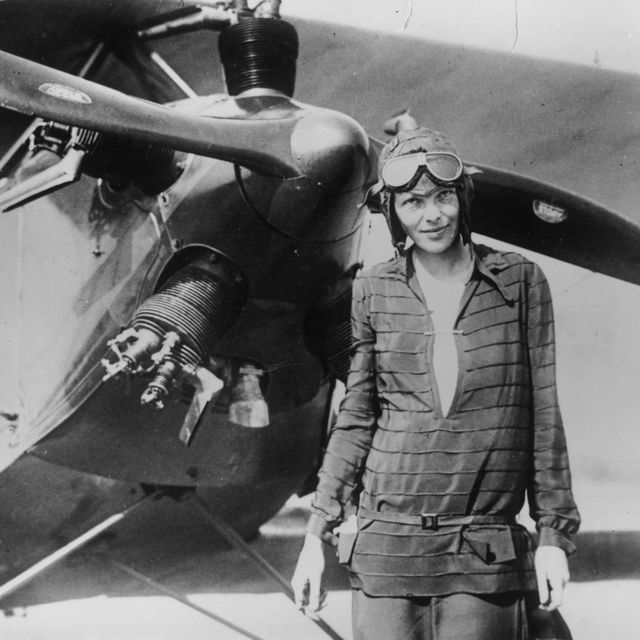
For nearly a century, her disappearance has generated countless theories:
-
The Crash-and-Sink Theory: The aircraft exhausted its fuel supply and plunged into the deep waters of the Pacific Ocean. This remains the most widely accepted scientific explanation.
-
The Castaway Theory (Nikumaroro): She and Noonan made an emergency landing on the remote coral reef of Nikumaroro island and lived out their final days as castaways before succumbing to dehydration and starvation.
-
The Spy/Captive Theory: She was captured by Japanese forces after wandering into their territory, either by accident or because she was conducting a clandestine reconnaissance mission for President Franklin D. Roosevelt’s administration.
CONCLUSION: AN ENDURING LEGACY ON THE WINGS OF FREEDOM
Though the life of Amelia Earhart concluded behind an impenetrable veil of mystery, her legacy has never been eclipsed. She demonstrated to a skeptical world that the sky holds no boundaries, and that the artificial limitations imposed upon women by society are illusions that can be shattered by human courage.

She left behind an immortal philosophy of life, articulated beautifully in a letter written to her husband before her fateful journey:
“Please know I am quite aware of the hazards. I want to do it because I want to do it. Women must try to do things as men have tried. When they fail, their failure must be but a challenge to others.”