I never thought I’d be the kind of man who ends up in a hospital bed wondering if the person sitting next to him wants him dead. But there I was, 71 years old, recovering from a fractured hip, listening to my only son explain why he’d turned off my oxygen. Her name is Dorothy. She’s been my wife for 42 years, and she is the kind of woman who still leaves a cup of coffee on my workbench in the mornings even now that I’m retired, even when I forget to thank her for it.
She never once asked me for more than I could give. She never once took more than her share. I need you to understand who she is before I tell you the rest, because everything that happened comes back to the fact that she is the one person in my life who never disappointed me. Then there’s our son, Derek.
And for most of his life, I’ll be honest with you, I gave him more. Not because I loved him more—I didn’t. I loved him and his sister equally. But because he asked more, and I didn’t know how to say no.
He needed help with a car, with a rent payment, with a start-up idea that never materialized, with credit card debt that somehow kept finding him. And I always said yes, because he was my son, because I thought that’s what fathers were supposed to do. I don’t know the exact total I gave him over the years. Dorothy did.
She kept track in a little notebook she never showed me until last year. Derek never paid back a single dollar. Nora, our daughter, never asked for a single dollar. That was the shape of things, and you need to understand that before I get to what happened in February.
It was 6:00 in the morning, still dark. I went down hard on my left hip on the back porch, on ice I’d been meaning to salt and never did. I lay on the frozen wood trying not to move because every time I shifted, the pain went white. Dorothy found me, made the call, got me to the hospital.
Fractured hip, not fully broken, but serious enough that I needed surgery and then weeks of inpatient rehabilitation. I’d broken bones before, so I knew what was coming: pain, physical therapy, the slow ugly crawl back to normal. What I didn’t know was that the hospital room was about to become a stage for something I’d never expected. Derek came to the hospital the first evening.
He brought flowers, which surprised me, because Derek isn’t really a flowers kind of person. He sat in a chair beside my bed, and we talked for a while. About the surgery. About the recovery.
About the ice on the porch I’d been meaning to salt and never did. He seemed genuinely worried. I remember thinking maybe I’d misjudged him, maybe there was more depth to him than I gave him credit for. But then, about 40 minutes in, something shifted.
Derek never does anything directly. He circled around things, spoke in code, always careful. He said he just wanted to understand the plan. What was going to happen with the business, with the Crestview building, with the house.
He asked who handled my estate, and when I told him James Whitfield, he nodded like he was filing the name away for later. He made a joke about how I’d probably written a will that cut him out entirely, embarrassing me into reassuring him that no, of course not, everything was set up to take care of both children. He left shortly after that, and something sat wrong with me after he walked out. I couldn’t name it then.
I just knew there was a weight in the room that hadn’t been there before, and it wasn’t from the morphine. Dorothy and Nora visited the next day. Nora lives about 3 hours away and had driven down that morning. She brought my reading glasses from home, the book I’d been in the middle of, and a container of Dorothy’s chicken soup that she’d quietly driven over to get before coming to the hospital.
She sat close, held my hand, and asked how I was really feeling. Not about the hip, but about everything else. That’s who Nora is. Over the next 2 weeks, the pattern became clear.
Derek came almost every evening, always at the same time, always after visiting hours began to wind down, always with flowers I didn’t need or a paper he didn’t want. And each visit, sooner or later, circled back to the same territory. The business. The building.
The will. He needed to know the details, he said, because he was the son, because he had a right to know, because he was worried about the tax implications and wanted to make sure things were handled properly. I didn’t think he could do the things I was beginning to suspect he was capable of. And I want you to understand that, because it makes what happened next harder to tell.
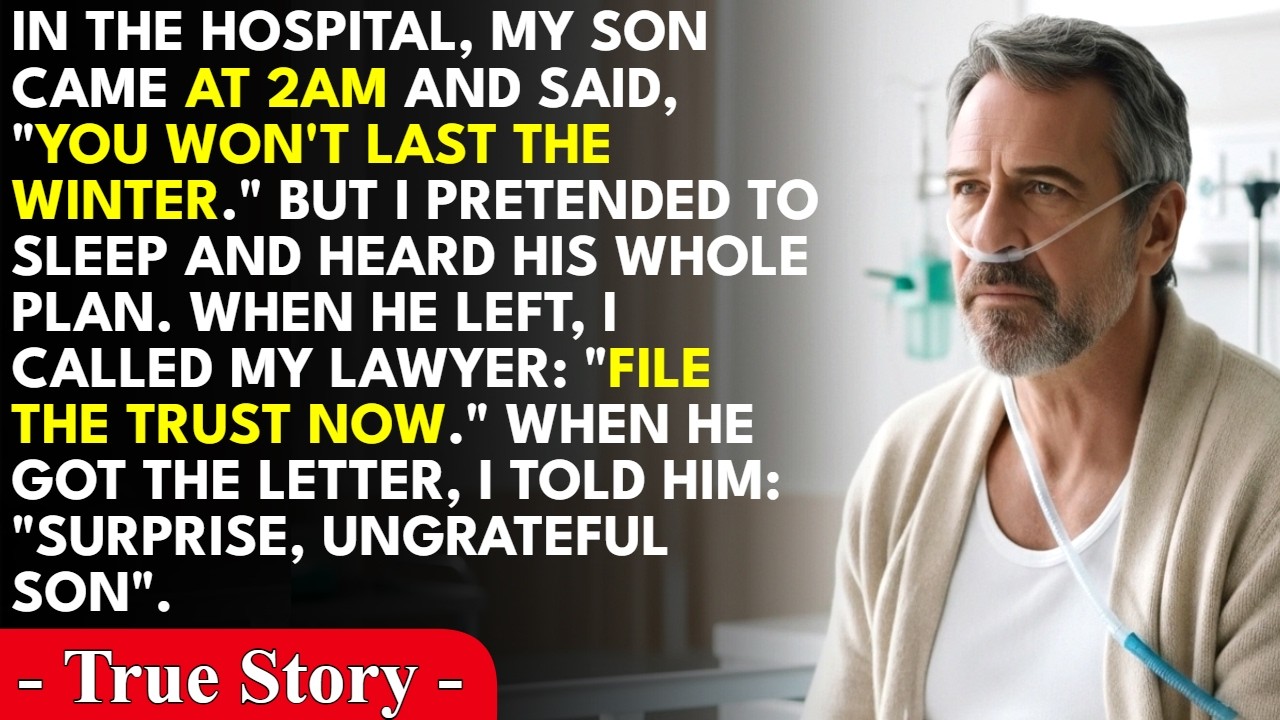
On the night I’m going to tell you about, I was sleeping poorly, as I had been since the surgery. The nurse on duty was a man named Otto, and he was busy with another patient down the hall. My oxygen tube had slipped partway out of my nose, which happened often with the nasal cannula. I was lying very still in the dark, half awake, when I heard the door open.
I assumed it was Otto, checking on me, so I didn’t move. But then I saw the shape of him in the doorway, and I knew it wasn’t Otto. It was Derek. He came in very quietly and stood beside my bed for a long moment, looking down at me.
I kept my eyes closed and tried to breathe evenly, the way you do when you’re trying to look asleep. I think some part of me suspected even then. He moved to the side of the bed near the equipment, where the oxygen machine hummed and clicked next to the heart monitor. And then I felt his hand close around the oxygen tube near my face, and I felt it being pulled slightly away from my nose.
Just a fraction. Just enough to make my breath catch. And then the flow slowed. I heard the soft hiss of air change, and I realized he’d reached down and turned the oxygen valve down.
Not off completely, but down. Low. Low enough that under the rest of my condition, I’d begin to struggle. I didn’t move.
I didn’t open my eyes. I just felt the room get very distant and my heart start to pound inside my ribs in a panic I couldn’t show. He stood there for what felt like minutes but was probably only 30 seconds or a minute, and then he turned the valve back up. Just before he did, he leaned close to my face.
I could smell his cologne, the same expensive one he’d worn for a decade, and his breath was faintly sour from the coffee he always carried. He moved back to the middle of the room, and I heard him sit down heavily in the chair. And then he started talking, not loudly, quietly, the way a man talks when he thinks he is alone. He said he’d waited long enough.
He said that I’d never really understood what he was dealing with, that Nora had always been the favorite, even though he was the one who called more and visited more, and that I’d never noticed. He said the business had always been meant to be his, that I’d built it for him, and that I’d betrayed him by planning to leave it to Nora. He said I was old, and tired, and that I’d probably been keeping secrets from him because I was afraid of him. And then he said, and this is the part I still hear some nights when I wake up before dawn: "And honestly, at your age, that’s not even a crime.
"
He stayed in the chair for a long time. I lay in the dark and listened to him breathe, and I understood that he was waiting. Waiting to see if I would die. He didn’t say anything else, and eventually he stood up, walked out, and closed the door softly behind him.
When the door clicked shut, I heard my own breath come out in a rush. I reached over with one hand and turned the oxygen valve back to where it had been. I lay there in the dark for a long time, shaking, trying to make sense of what I already knew was true. And then I pressed the call button for the nurse.
When she came in, I told her I’d been having trouble breathing and asked her to check my settings. She couldn’t have known what I was really doing: getting a record, getting a witness, making sure that when I told the rest of the story, someone would remember that the oxygen had been changed. In the morning, I didn’t call Derek. I called James Whitfield, my attorney, who I’ve known for over 20 years.
I told him I needed to make some changes and asked him to come see me. Then I had Dorothy bring me my checkbook and the little notebook she’d kept, the one that listed every dollar Derek had taken and never repaid. She looked at me for a long moment and then did what she always does: she complied, quietly, efficiently, without asking a single question. James came the next day.
I told him everything, including what had happened in the hospital room. He listened without interrupting, his face perfectly still, and when I was done, he said, "Is there any possibility you misunderstood what you saw? "
"I did not misunderstand anything," I said. "Then let’s find out what else there is.
"
Over the following 3 weeks, while I worked through my rehabilitation and prepared to come home, James and a private investigator named Sylvia began pulling at threads. He told me later that he’d had a feeling about Derek for a long time, that some clients are transparent to people who know how to look. They found things: business accounts I didn’t know about, dormant ones Derek had been siphoning from for years, business accounts he had opened in my name using my signature, which he’d practiced from old checks I’d signed without looking. He’d forged my name on loan documents.
He’d sold off pieces of equipment from the machine shop and pocketed the cash. He’d represented himself to a few people with authority over the property, prospective buyers of the Crestview building, pretending to be acting on my behalf. There was an account I had stopped actively using after retirement, one Dorothy and I had kept for "emergencies," and the amounts Derek had been taking from it over 14 months were not enormous individually, but they totaled just over $47,000. It hadn’t been one act, one moment of weakness.
It had been a campaign. A long, quiet, patient campaign built on the assumption that I would never look, that I would never ask, that I would never notice. And he was right. I hadn’t noticed.
Dorothy had known something was wrong, of course. She reads my silences better than most people read plain speech. But even she hadn’t known the full extent of it, not until she found the notebook she showed me last year and told me, gently, carefully, that our son had been taking from us for over a decade. The first time I called Derek after that, he accused me of being confused, of misremembering, of being influenced by outsiders.
He said, "Dad, you’re not thinking clearly. " He suggested I take a break from the hospital, that I should talk to a doctor about the memory problems I was having. He almost sounded convinced. I said, "Derek, I have the receipts.
I have the bank statements. I have the notebook. "
He said, "What notebook? "
I said, "The one your mother kept.
"
There was a long pause on the other end of the line, and then he said, very quietly, "You’re going to regret this. "
I said, "I already do. "
I asked James to set up a meeting with the District Attorney’s office. I gave them everything Margaret had found, including the bank records, the forged signatures, the lies about the property.
I told them I wanted to press charges. I was 71 years old, and I was accusing my own son of a felony. I didn’t take that decision lightly, but I understood something in that moment that I hadn’t been able to see before: my silence had always meant he could keep doing this. My silence had let him believe there would never be consequences.
And what had changed wasn’t the hospital, what had changed was that I had finally realized the price of looking the other way was too high—not for me, but for everyone else I loved. Dorothy and I sold the house we’d lived in for 38 years and moved into a small condominium. The house was too big for just the two of us anyway. We gave the money to James to hold in trust, and we used some of it to pay for the surgery and the rehabilitation that I’d needed ever since the fall.
We weren’t rich, but we had enough. That was the thing I kept coming back to: we had enough. We didn’t need Derek’s kind of money. We never had.
The District Attorney’s office opened a formal investigation 6 weeks after James filed the report. Derek was charged with financial fraud and unauthorized use of business funds. His attorney, a man named Charles who I’d known briefly at the country club, tried to paint me as a senile old man manipulated by a scheming daughter. He tried to make it about Nora—about how she’d always been the favorite, how she’d turned me against my own son.
It almost worked. I remember sitting in his office, listening to him describe me as a fragile, confused old man, and thinking how easy the lie would be to live, if I chose to believe it. In the end, Derek took a deal. He would repay what he’d taken, with interest, over a structured period.
He received a suspended sentence and 3 years of probation. He wouldn’t go to prison, but he would have to face the consequences. I don’t know if that counts as justice. I don’t know if anything could.
Dorothy and Nora came to the sentencing. Nora held her mother’s hand and watched her brother with an expression I couldn’t quite read. She didn’t say much on the drive home. Finally, in the car, she said, "Dad, you didn’t have to do that.
"
"Yes, I did," I said. She didn’t argue. Derek called me once, about a week after the sentencing. He didn’t apologize.
He wanted to know if I’d consider helping him with the restitution payments, since the payments were coming out of his new job’s salary and he claimed he couldn’t afford them on top of everything else. He said he was worried about his family, about his wife and kids, about losing his house. He said he was worried about what people would think. I said, "Derek, you have to make things right.
That’s how it works. "
He said, "I can’t make things right. I don’t have the money. "
I said, "Money was never the problem.
"
He didn’t understand. I’m not sure he ever did. I’m 72 now. I’ve been home for 6 months.
The grass isn’t green in the hospital room anymore, but the lessons I learned there have stayed with me. I still wake up at dawn, but now it’s not because I’m afraid. It’s because I want to drink my coffee on the back porch and watch the sun come up over the neighborhood I’ve lived in for 20 years, the one I never once paid attention to because I was always looking somewhere else. Dorothy still leaves coffee on my workbench.
I always drink it now. I think about what it means to be a good man. I thought the hardest thing I’d ever do was start a business from nothing, to build something that could support a family and give them a life. I was wrong.
The hardest thing was knowing when my own son had turned into someone I didn’t recognize, and then loving him anyway, and then letting him face the consequences of what he’d done. I don’t tell this story to make Derek a villain. That’s not the point. The point is that I spent two decades confusing money with love, and I almost lost the two people who actually loved me in return.
Every time I gave him what he asked for, I was telling myself it was because I was a good father. But it wasn’t. It was because I was afraid that if I said no, he would finally see me for what I was: a man with enough money to keep trying to buy the impossible, the love of a son who didn’t know how to love me back. I can’t tell you it all worked out, because I’m not sure it did.
But I’m here. I’m still here. And I’m learning, at 72 years old, that it is never, ever too late to do right by the people who showed up.