At 11:12 PM, my phone rang. A police officer told me they found my missing wife alive. I lowered the phone and looked at the bed beside me. The woman who had been my wife for eight months slept peacefully.
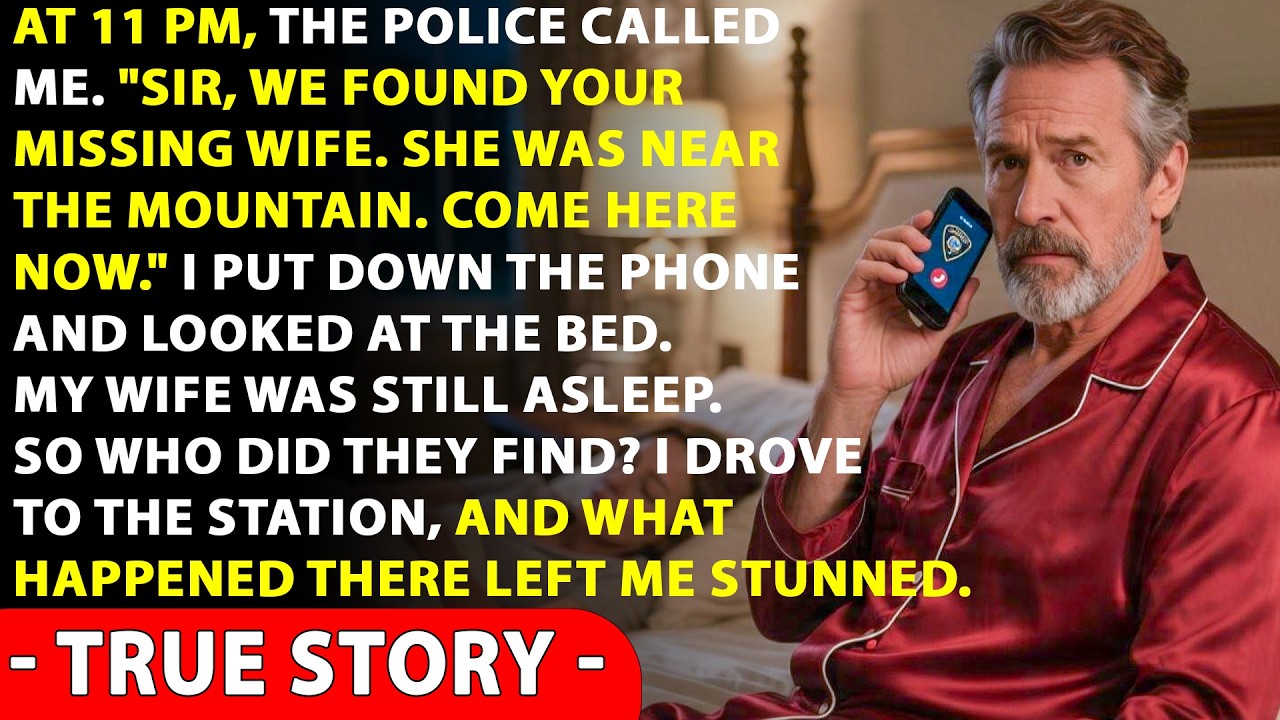
My heart froze. If my wife was beside me, who had the police found? I drove alone into the night, and what I discovered changed everything. Sixteen hours earlier, Clare set tea in front of me.
That small kindness had been my undoing since October, when my wife Evelyn vanished. The story I believed involved her wandering off during a bad spell, but the official search ended cold. Clare helped at the shop and brought tea to my workshop. Frank, my friend, pushed me to hire a private investigator.
I hesitated, insisting we had done everything right. But Frank persisted, and eventually a private investigator named Karen Pellegrino took the case. Karen found nothing on Evelyn’s phone or bank cards — no activity at all after the disappearance. That was strange, but not proof of anything.
Weeks passed. I convinced myself Evelyn had walked out during confusion and would come back. Clare kept bringing tea, kept listening, kept telling me we would find Evelyn. She even found a map in Evelyn’s handwriting near the park, coordinates marked.
I clung to that as hope. I didn’t want to see what was right in front of me. Then Karen called. The map handwriting didn’t match Evelyn’s.
Clare had been alone with Evelyn’s things weeks before the disappearance. And Clare had a reason to want her gone. Clare was not just my assistant — she was my partner in more than the shop. Evelyn knew about the affair.
Clare knew Evelyn knew. Karen checked Clare’s phone records. Calls to a number in Hempstead. A property rental in Hempstead.
Then she showed me the security footage from a gas station near my home. A woman matching Clare’s build, in Evelyn’s coat, filling a car with gas. The woman turned to the camera. It was Clare.
I sat in my truck outside my own house and felt the ground shift. Clare came through the door that evening with tea and a warm expression. I asked her about the gas station. She denied it.
When I mentioned the number in Hempstead, her face changed. She insisted Evelyn had left on her own. I told her to come with me to the police station. She stalled, tried to touch my arm, reminding me how much she had done for me.
Then I saw it — the fear behind her eyes. She knew more than she would ever say. The police search warrant came quickly after Karen’s file. Officers found traces of Evelyn’s medications in Clare’s bathroom cabinet and a digital scale in the basement.
They found a burner phone in Clare’s car. Then they found Evelyn. She was alive, locked in a rented house in Hempstead, medicated into fog. Clare had watched Evelyn’s life from the inside — the shop, the routines, the passwords — and she had carefully dismantled it, piece by piece, while she made herself indispensable to me.
That night at the police station, Clare folded completely. She confessed to drugging Evelyn and staged the disappearance. She wanted Evelyn’s place. She admitted to a scheme Sandra Briggs had orchestrated — a woman who ran a network that preyed on families by targeting vulnerable spouses and caretakers.
Sandra had given Clare instructions, paid her from hidden accounts, and planned to drain my assets through the shop. Clare was not the mastermind. She was a pawn, but she was a willing one. Evelyn was hospitalized for a week.
I visited her every day. She was weak, confused, and furious. She wanted to know how long I had been with Clare. I told her the truth.
She stared at the window for a long time and then said she needed time to decide what came next. She asked why I had hired a private investigator only after Frank pushed me. I had no good answer. Sandra Briggs was arrested two weeks later.
The federal investigation uncovered years of similar schemes. Marcus Webb, her enforcer, was also taken into custody. Daniel, Clare’s older son, had been working with Sandra for months. He had provided access to bank records and helped route money through offshore accounts.
He had also known about his mother’s involvement in the kidnapping and said nothing. When he learned — years too late, he told me — that Evelyn had been drugged and held against her will, he went to federal investigators and gave them everything. He cooperated fully. His testimony helped convict Sandra and Marcus.
In March, Evelyn came home. Daniel was sentenced to probation, not prison, because of his cooperation. I sat in my truck after his hearing and wanted to be angry. Evelyn had said the words that ended my anger at Daniel: “It’ll take time, but he’s still our son.
”
May came to Queens. Evelyn walked into my workshop with two mugs of coffee. She looked like herself again — color restored, the stillness gone. She noticed the piece of white oak I had started before everything changed, the one I finished in the spring.
I told her it waited a long time. She said it was beautiful. She told me Daniel called, that he had a job in Flushing, and he asked if he could come for dinner Saturday. I said yes.
She nodded and said nothing more because we had been married 38 years and some things do not need words. That evening, I sat in my workshop with the smell of sawdust and the sound of a mockingbird outside. I thought about how close I came to losing everything — not to a stranger, but to my own silence. I had let grief make me easy to lead.
I stopped asking questions because the answers might hurt. Evelyn lost eight months because I didn’t want to see what was in front of me. I picked up my coffee. Still warm.
Mockingbirds don’t repeat themselves. Neither, I decided, would I.