The crystal flutes clinked like shattering ice—a chilling melody that heralded the social execution of my existence—while the woman I had called daughter for a decade smiled as she signed my life away over a glass of vintage champagne. I stood in the shadows of the upstairs landing, my fingers trembling as they gripped the mahogany railing of the house I had essentially bought with the sweat of my own brow. Downstairs, Beatrice Thorne laughed a sharp, metallic sound that cut through the smooth jazz playing in the foyer. She told her friends with a nonchalance more terrifying than any scream that my sun-drenched room was needed for a new executive home office, and that at 82 I was little more than a piece of antique furniture that no longer fit the minimalist aesthetic of their social-climbing lives.
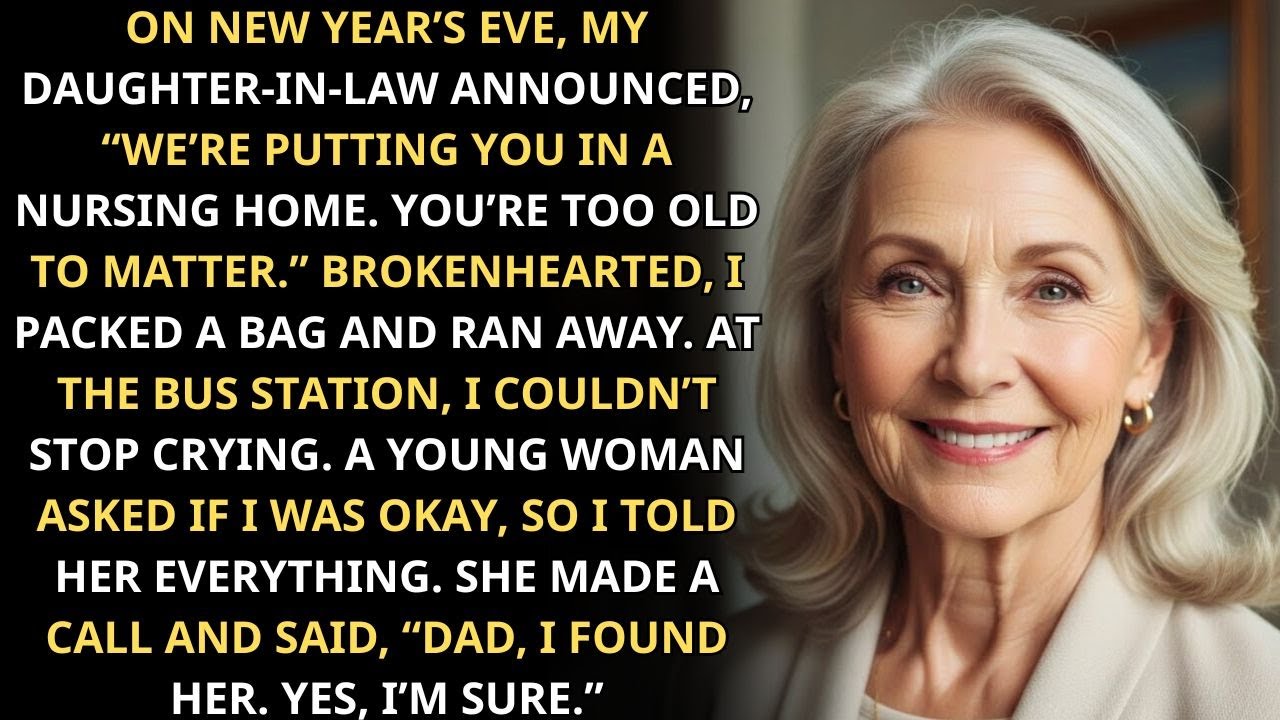
She didn’t whisper. She didn’t look around to see if the ghost of the woman who cooked her meals, laundered her silk blouses, and raised her two sons was listening from the rafters. She simply stated that the paperwork for the Shady Pines assisted living center was already processed, and that my presence at their New Year’s Eve gala would be an unnecessary complication to their image. My son Julian, the boy I had carried against my heart through the coldest winters of my youth, stood beside her swirling his amber drink, watching the bubbles rise with a vacant stare.
His silence was a more devastating betrayal than any physical blow could ever be. He didn’t defend me. He didn’t remind her of the years of care I provided. He simply nodded and muttered that it was for the best—that I would be happier among people of my own vintage, as if I were a bottle of wine being relegated to a dusty cellar because the label had begun to peel.
I retreated to my room, a space that had shrunk with every passing year until it felt less like a sanctuary and more like a holding cell for a prisoner whose only crime was outliving her perceived usefulness. I pulled out a tattered floral suitcase from beneath the bed, its leather cracked and weathered like the skin on my own hands, and began to pack the fragments of a century into its small hollow belly. My name is Evelyn Thorne. For 42 years, I was the pulse of the Oak Creek Public Library and the guardian of a thousand stories.
Yet here I was, being edited out of my own family’s narrative like a typo on a page. I remembered the day Julian was born—a day when the world seemed to expand with the sheer force of his first breath. And I remembered the long, grueling years I spent working three jobs after his father passed away, just to ensure he never felt the cold bite of poverty or the sting of being less than his peers. But in this house built of marble, glass, and lies, I was merely an inconvenience to be managed.
As the sounds of the party grew louder below—a cacophony of laughter from people who didn’t know my middle name—I realized I had become a ghost before I was even dead. But as I tucked a faded photograph of my parents into the side pocket of my bag, a spark of something long dormant and fierce flickered in the center of my chest. It was the memory of a heavy brass key hidden in a velvet-lined box at the bottom of my jewelry chest. A key to a place they had forgotten existed.
A place where I was still someone, not just a burden to be discarded. The move to the sprawling estate in Emerald Heights had been framed as an act of profound love—a way for us to be together in my twilight years. But looking back through the lens of this final betrayal, I saw it for what it truly was: a calculated, slow-motion theft of my independence. Julian had convinced me to sell my charming, sun-drenched cottage in the valley, arguing with practiced concern that the stairs were a hazard to my brittle bones and the garden upkeep was too much for a woman of my advanced age.
He promised me a suite, a place of honor in his new life, a role as the matriarch of the household. But the moment the check from the sale of my home cleared and was funneled into the down payment for this cold monument to his ego, the walls began to close in on me. Beatrice began to replace my sturdy oak furniture—pieces that held the memories of my marriage—with minimalist, sharp-edged furniture that felt cold to the touch and offered no comfort. She donated my extensive library to a local thrift store, claiming the old paper harbored dust and allergens that were bad for the boys.
She relegated my meals to the kitchen island while they dined in the formal room, claiming the adult conversation would be too fast-paced or depressing for me to follow. I had allowed myself to be diminished inch by inch, believing that the price of proximity to my grandchildren was the slow erasure of my own identity. But that night, as the clock ticked toward a new year, I wasn’t meant to see from this house. The weight of their betrayal became a catalyst for a desperate, quiet escape.
I didn’t leave a long, weeping letter filled with the accusations they deserved. I wrote three simple, searing sentences on a piece of cream-colored stationery that Beatrice had once tried to throw away. I told them I was not a piece of furniture to be moved when the decor changed. I told them I was taking back what remained of my life.
I told them not to look for me, because they would never find the woman they had tried so hard to break. I stepped out of the back service entrance, the cold December air hitting my face like a splash of mountain water—a shocking and welcome reminder that I was still capable of feeling the world in all its harshness. The bus station was a three-mile walk through the silent, sleeping suburbs, a distance my doctor would have told me was impossible for my aging hips. But rage is a powerful lubricant for old joints.
I walked past manicured lawns and silent expensive cars, a shadow moving through the night, carrying nothing but a suitcase and the sudden, terrifying, and exhilarating realization that for the first time in 60 years, I owed no one anything. The station was a cathedral of neon and desperation, a transient space filled with travelers heading toward new beginnings or running away from old endings with equal fervor. I sat on a hard blue plastic bench, the vibrations of the massive idling engines thrumming through the soles of my boots, and watched the digital clock count down the minutes to the 11:15 bus to Willow Creek—a place I hadn’t visited in decades. It was a small, forgotten patch of land my parents had left me in their will: a cabin that sat on the edge of a lake so still it looked like a mirror for the winter stars.
Julian and Beatrice didn’t even know I still held the deed. They had assumed I had sold every asset to fund their upward mobility. As I sat there, the initial rush of adrenaline began to fade, replaced by a hollow, crystalline ache in the center of my chest. I thought of my grandsons, who had slowly stopped visiting my room because their mother told them I needed rest or that I was confused.
I thought of the years of birthdays where my thoughtful gifts were tucked away into back closets because they didn’t fit the aesthetic of a modern childhood. A sob escaped me—a jagged, ugly sound that I tried to swallow back down, but it was too late. The dam had broken. I wept for the woman who had spent her entire life building bridges for others, only to find herself stranded on a crumbling, lonely island of her own making.
“Are you okay, ma’am? ”
The voice was soft, melodic, and held a note of genuine, unhurried concern that I hadn’t heard in longer than I cared to admit. I looked up through a thick blur of tears to see a young woman in a dark blue medical coat, her hair pulled back in a practical tight bun, her eyes wide and deeply empathetic. I tried to wipe my face with a trembling hand, my pride flaring up like a dying ember in the wind.
I told her I was fine, just waiting for my bus, my voice cracking like dry parchment. She didn’t move. She didn’t offer a polite nod and walk away to her own life. She sat down next to me on that cold plastic bench, leaving a respectful distance but offering a presence that felt like a warm wool blanket.
“My name is Elena,” she said quietly. “I just finished a double shift at the city hospital, and I’ve seen that look on many faces, Mrs. Thorne. It’s the look of someone who has been carrying the weight of the world on their shoulders and just realized the world isn’t carrying them back.
”
I don’t know why I did it. Perhaps it was the anonymity of the fluorescent-lit station or the sheer bone-deep exhaustion of the night. But the story spilled out of me in a torrent. I told her about the library, about Julian’s childhood, about the marble floors I had scrubbed on my hands and knees until they shone, and about the champagne toast that had been my social execution.
I told her I was going to Willow Creek to a house that was likely falling apart, with nothing but $3,000 I had hidden in a hollowed-out copy of *Great Expectations* and a heart that felt like it had been put through a meat grinder. Elena listened with a stillness that was profound and rare. She didn’t offer empty platitudes or tell me it would all be okay in the morning. She simply held my hand, her skin warm and vital against my cold, papery fingers.
When I finally went silent, my chest heaving with the effort of the confession, she stood up and walked a few yards away, making a quick phone call in a hushed but urgent tone. My heart hammered against my ribs like a trapped bird. Was she calling the police? Was she calling Julian to report a wandering elderly woman?
I started to stand, my instinct to flee returning with a vengeance. But she was back before I could even pick up my suitcase. “Please don’t be afraid,” she said softly, her eyes shining with a strange, sudden light. “I just called my father.
He’s been looking for a specific woman for a very long time, and I think you might be the person who saved his life 40 years ago when the rest of the world chose not to see him. ”
I stared at her, utterly confused. My name didn’t mean anything to her, but when I told her I had been a teacher at the old Mill Elementary before moving to the library, she had frozen in place. Her father, she explained, was a man who had grown up in the shadows of poverty—a boy who had been written off by every authority figure until one teacher saw the brilliance beneath the hunger and the holes in his shoes.
Before I could even begin to process her words, a black SUV pulled up to the curb with a quiet hum, and a man stepped out into the cold night. He was tall, with silver hair and a face that bore the lines of a man who had worked incredibly hard for every ounce of his success. But his eyes were unmistakable. They were the eyes of a seven-year-old boy named Marcus Sterling—the boy who used to sit in the very back of my classroom and draw intricate, beautiful diagrams of machines he wanted to build.
The boy who arrived every winter morning without a coat and with shoes held together by layers of gray duct tape. He walked toward me with a look of pure, unadulterated reverence, as if he were approaching a holy relic or a long-lost map to his own soul. “Mrs. Thorne,” he whispered, his voice thick with an emotion that vibrated in the air between us.
I looked at him, the decades peeling away in my mind like old wallpaper. Marcus, the boy who loved the stars. He dropped to one knee, right there on the dirty, gum-stained linoleum of the bus station floor, and took both of my hands in his, ignoring the stares of the other travelers. “I have spent 20 years trying to find you to thank you,” he said, his voice breaking.
“You bought me that blue parka in the winter of 1984. You told me that my mind was a kingdom that no one, no matter how rich or powerful, could ever take away from me. You gave me the books that taught me how to be an engineer when I thought I was destined for the scrap heap. And you never told anyone it was you.
You just let me believe in magic. ”
The world seemed to tilt on its axis. The boy I had helped—the child for whom I had quietly skipped my own lunches so he could have a sandwich without the shame of charity—was now a man of immense stature. A man who looked at me with more genuine love and respect than my own son had managed in a decade.
He saw my suitcase. He saw my tear-stained face, and he didn’t need to ask what had happened. “Elena told me everything on the phone,” he said, his jaw tightening with a controlled, righteous fury that reminded me of the young boy who used to protect the smaller children on the playground. “You are not going to a bus station, and you are never going to be alone or discarded ever again.
You are coming with us. ”
I tried to protest, the old ingrained habit of not wanting to be a burden rearing its head one last time, but Marcus wouldn’t hear a word of it. He told me about the Sterling Foundation he had started—a massive charity that provided resources and scholarships for underprivileged students, all named in my honor, though he had never been able to find me after I moved and changed my name back to my maiden name following my divorce. He told me that his home had a guest cottage that was empty and waiting, a place filled with light and books, a place where I could rest until we decided together what the next steps of my life would be.
As we drove away from the neon glow of the station, the city lights fading into the rearview mirror, Marcus spoke with a quiet legal intensity that I had never encountered before. He was one of the state’s most prominent attorneys, now specializing in elder law and civil rights—a career path he had chosen specifically because of the injustices he had witnessed as a child and the dignity he had seen me fight for in my classroom. He asked me about the house I had sold, about the bank accounts Julian managed, and about the specific way I had been treated since moving to Emerald Heights. As the details emerged—the isolation, the removal of my property, the psychological pressure—his professional demeanor sharpened into something formidable.
“Mrs. Thorne, what they did to you isn’t just a family dispute or a lack of kindness. It’s a form of systemic predatory abuse. They coerced you into selling your primary assets, isolated you from your support systems, and were now attempting to institutionalize you without a shred of medical or legal consent to further seize your remaining resources.
This is not how your story ends, Evelyn. This is where we start the rewrite. And I promise you, the ending will be on your terms. ”
For the first time in years, the crushing physical weight in my chest began to lift, replaced by a strange, buoyant hope.
I wasn’t just a grandmother being discarded like an old coat. I was a client, a friend, and a human being with rights that were about to be enforced with the full weight of the law. The Sterling estate was nothing like the Thorne house. Where Julian’s home was a cold, echoing monument to his own ego and social standing, Marcus’s home was a living, breathing space filled with the warmth of a family that actually liked one another.
His wife Clare greeted me at the door at 2 in the morning, not with a polite nod or a look of annoyance, but with a hug that smelled of lavender and genuine heartfelt welcome. They didn’t put me in a back room and tell me to stay out of the way so as not to embarrass them. They sat me at a large hand-carved wooden table, served me hot tea and homemade soup, and listened with rapt attention as I spoke about my life, my books, and my dreams. I realized then that Beatrice had spent years gaslighting me into believing I was senile, that my stories were boring, and that my opinions were obsolete.
But in this house, my words were treated like gold, and my presence was seen as a blessing rather than a chore. The next morning, the battle for my life truly began. Marcus sat in his sun-filled study, the light glinting off his glasses and the rows of legal tomes behind him, and placed a call to Julian. I sat in a comfortable armchair nearby, my heart racing like a hummingbird’s, but Marcus’s calm, steady presence gave me a strength I didn’t know I still possessed.
The conversation was brief, clinical, and absolutely devastating. Marcus didn’t shout. He didn’t need to. He simply stated facts as if he were reading a weather report.
He informed Julian that he was now representing me in all legal and financial matters, that a full forensic audit of the sale of my previous home was being initiated, and that any attempt to contact me or proceed with the involuntary nursing home placement would be met with an immediate restraining order and a high-profile lawsuit for elder financial abuse and psychological coercion. I could hear Julian’s voice over the speaker, a frantic mixture of shock, arrogance, and crumbling confidence. “Who is this? You can’t just take my mother.
This is a family matter,” he yelled, his voice sounding thin and weak compared to Marcus’s. Marcus smiled a cold, sharp expression that I had seen on his face when he was a boy standing up to a bully. “I’m the boy she saved when you were too busy being a child of privilege to notice her sacrifice, Julian. And I’m the man who is going to make sure she gets back every cent, every book, and every ounce of dignity you stole from her.
”
The long silence on the other end of the line was the most satisfying sound I had heard in 20 years. Over the next few months, the transition of my life was like a long, slow, and beautiful sunrise after a decade of polar night. Marcus and his team of investigators discovered a trail of betrayal that was even deeper than I had imagined. They found that Beatrice had been systematically siphoning my social security checks into a private account for her own maintenance, and that she had even forged my signature on a power of attorney document while I was recovering from a bout of the flu a year prior.
They didn’t just get my money back. They held a magnifying glass up to Julian’s life until he was forced to see the hollow, cruel monster he had become under his wife’s influence. But more importantly than the recovery of funds was the restoration of my own spirit. I didn’t stay in the guest cottage forever, though Marcus and Clare would have let me stay as long as I lived.
With the funds Marcus recovered—nearly $400,000 once the interest and the full value of my stolen assets were calculated—I was able to fully restore the cabin at Willow Creek. We turned it into a sanctuary: a small, sturdy house filled with light, with a wide porch that looked out over the shimmering water and a library that was open to every child in the surrounding village. I became the woman I was always meant to be: an elder of the community, a master storyteller, and a woman who knew her worth to the very penny. The most difficult day of that entire transition was the day Julian arrived at my door in Willow Creek, six months after the legal settlement had been finalized and the dust had settled.
He looked ten years older, his expensive Italian suit wrinkled and ill-fitting, the arrogance and polish drained from his face like water from a cracked vase. Beatrice had left him the moment the money stopped flowing and the scandal of the legal audit began to touch their elite social circles. He sat on my porch, looking out at the lake for a long time without saying a single word. “Mom, I honestly didn’t know how bad it was,” he finally whispered, his voice cracking with a shame that seemed genuine.
I looked at him, and for the first time in my life, I didn’t feel the maternal urge to rush over and comfort him, to tell him it was all okay. I felt a profound, quiet sadness for the man who had traded his mother’s soul for a marble floor and a sense of belonging among people who didn’t love him. “You did know, Julian,” I said, my voice firm and steady. “You knew every time you watched me eat a cold sandwich alone in my room while you hosted parties.
You knew every time you let her speak to me as if I were a ghost. You didn’t lose your way. You chose a path that didn’t include me as a human being—only as a resource to be exploited. ”
He wept then—a bitter, honest crying that he hadn’t done since he was a small boy who had fallen off his bicycle.
I didn’t kick him out, but I didn’t invite him to move in. We are rebuilding our relationship now, slowly, painfully, on a foundation of harsh truth rather than convenient obligation. He has to learn who I am all over again. And more importantly, he has to learn who he is when he isn’t trying to impress the world.
My life now is measured not by the years I have left on a calendar, but by the depth and clarity of the breaths I take. I wake up every morning to the haunting, beautiful sound of the loons on the lake, not the sharp, condescending command of a daughter-in-law who viewed my existence as clutter. I spend my afternoons at the local elementary school reading stories to children who look at me with the same wide-eyed wonder Marcus Sterling once did. I have learned a lesson that I wish I could scream from the rooftops to every person who feels themselves being pushed to the margins: Dignity is not a gift given to us by our children, our government, or our society.
It is a sacred fire we must tend ourselves, even when the wind is howling and the wood is wet. We are told by a thousand subtle voices that as we age, we should become smaller, quieter, and less demanding of the world’s space and time. We are taught that our value is tied strictly to our economic utility, and that once our hands are too shaky to work or our eyes too dim to lead, we should move gracefully to the edges of the story and wait for the end. But that is a lie designed to make the world more convenient for the young and the selfish.
Our value is in our essence, in the hard-won wisdom we carry, and in the fierce refusal to be erased by the comfort of others. Sometimes the world needs to be reminded that the roots of the oldest, gnarled trees are exactly what hold the earth together during the most violent storms. I am Evelyn Thorne, and I am no longer a ghost haunting the hallways of a house that didn’t want me. I am the architect of my own ending.
And I promise you, it is a masterpiece of resilience and quiet justice. The legacy we leave behind isn’t found in the houses we buy, the titles we accumulate, or the marble floors we polish until they reflect our own vanity. It is found in the people we’ve touched with a hidden kindness, the children we’ve encouraged when they felt invisible, and the strength we found to stand up for our own souls. When the people who were supposed to love us tried to trade us for a home office, Marcus Sterling came back for me because I saw him when he was a hungry boy with duct-taped shoes.
And in doing so, he made me visible when the rest of the world had decided to close its eyes and wait for me to disappear. As the sun sets over the mirrored surface of Willow Creek, casting long golden shadows across my garden, I think about that paper plate and that champagne. I don’t feel anger anymore. Anger is a heavy, poisonous burden for an old woman to carry, and I have far more precious things to pack into the remaining chapters of my heart.
I feel a peace that passes all understanding. A peace rooted in the knowledge that I am finally, irrevocably free. For a long time, I lived under the shadow of a lie that said my worth was tied to my ability to serve others without complaint. I thought that by making myself smaller, I was being a good mother and a good woman.
But I have learned that true goodness requires strength, and true love requires boundaries. If you find yourself in a room where you are being told you are no longer useful, walk out of that door. Do not wait for permission to exist. Do not wait for someone else to recognize your value before you claim it for yourself.
The world is full of people like Beatrice who see only the surface. But it is also full of people like Marcus and Elena who remember the light you once shared. Trust in that light. Trust in the quiet, steady beat of your own heart.
Being old is not a tragedy. It is a victory. It is a badge of honor that says you have survived the storms and the droughts, the betrayals and the losses, and you are still standing. Do not let anyone take that victory from you.
Do not let them turn your years of experience into a reason for exclusion. Your story is not a footnote in someone else’s biography. It is a grand, sweeping epic that deserves to be told with a loud and steady voice. Julian comes to visit every Sunday now.
He helps me in the garden, and we sit on the porch and talk. He is learning to listen—really listen—for the first time in his life. He told me last week that he finally understood why I loved the library so much. It wasn’t just about the books.
It was about the belief that every person’s story matters. I watched him as he spoke, and I saw a glimmer of the boy he used to be before the world told him that success was measured in marble and glass. There is hope for him yet, just as there was hope for me. We are all works in progress, even at 82.
The road to Willow Creek was long and winding, and it was paved with more tears than I ever thought I could cry. But it led me home. And home isn’t a place you’re put into. It’s a place you build with the people who truly see you.
If you are watching this, or listening to this, and you feel like you are being pushed into the shadows, remember Evelyn Thorne. Remember that the bus to your own Willow Creek is always waiting, and that you have the key to a life they can never take away. Stand tall, speak your truth, and never, ever let anyone tell you that you are too old to be extraordinary.