The Sunday night call came at 7 while I was reconciling a client’s payroll. My mother has a voice she uses for unpleasant errands, and she used it now. “Honey, about Thursday. Brooke is hosting this year and she’s been under so much stress.
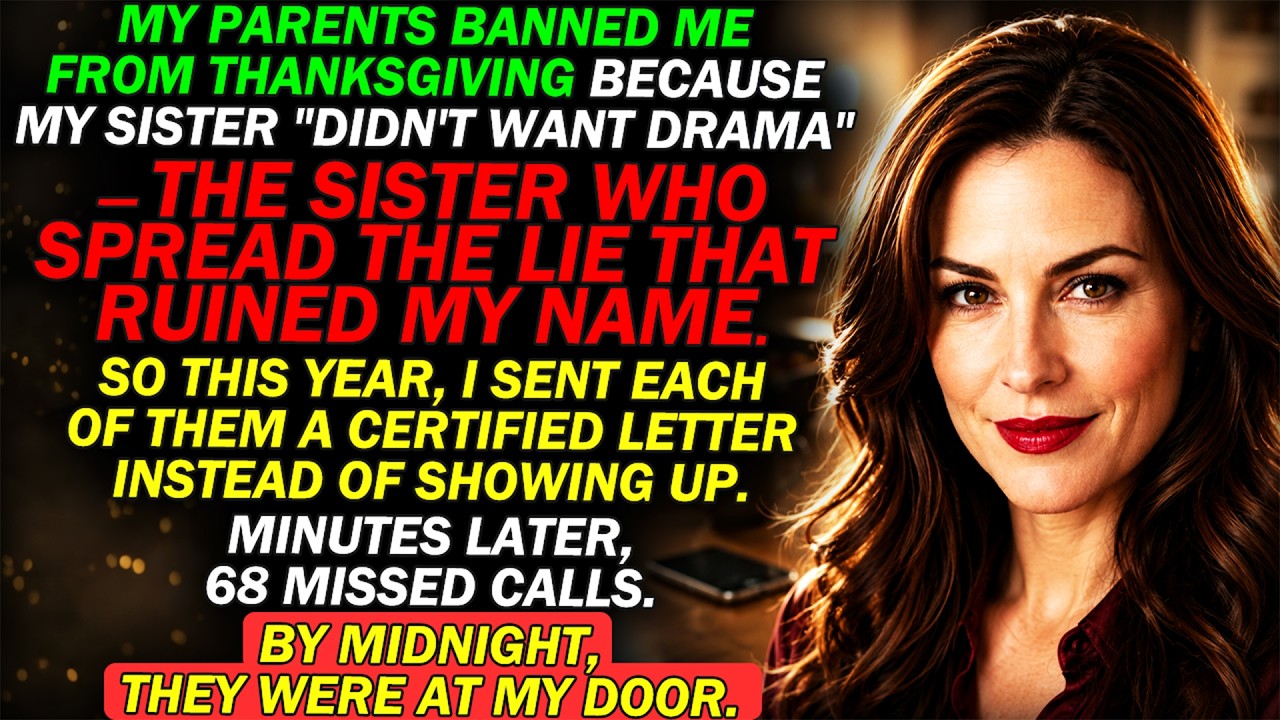
She doesn’t want any drama at the table. So we all think it’s best if you sit this one out. ”
“Mom, what drama would I bring? Name one thing I’ve done at one holiday.
” The silence stretched so long I could hear their television in the background. She couldn’t name a thing because there wasn’t a thing to name. What she finally said was, “Keep it pleasant, Thea. ” Then softer, like she was doing me a kindness: “And don’t make this about the other thing.
”
She hung up before I could ask which thing she meant. Because in my family there were two. There was what everyone whispered about me, and there was what nobody ever said out loud. One of those things ruined my name.
The other was about to ruin their evening. I’m a CPA. I own a small accounting firm on Main Street in Maple Falls, Ohio. My name on the glass.
I did night classes for my license while working full days, opened my firm at 29, and paid off my own house by 34. My family rounds to the nearest story. Four years ago, my father’s heart gave out. Triple bypass, 11 days in the hospital, and a stack of bills on top of a mortgage they had quietly stopped paying.
By October, the bank was using words like foreclosure. My parents never asked for help. They just talked loudly about losing the house at Sunday dinner until I did what I always did. I drained my savings and wrote them a check for $52,000.
And because I’m who I am, I did it properly. A promissory note, notarized, modest interest, $400 a month. My family laughed about it for a year. Only Thea would make her own parents sign paperwork.
But my dad signed at my kitchen table with his reading glasses on. For 13 months, the payments came, steady as a metronome. Then three years ago, the checks just stopped. And nobody in my family ever mentioned the loan again.
You should ask me why they stopped. The answer starts with my grandmother. Nana Eileen was the only person in our family who ever looked at me like I was more than a service department. She lived her last four years at an assisted living place two towns over.
Her choice, made with a straight back. Her hands had a small tremor by then, so she asked me to hold her power of attorney and manage her accounts. Not my mother. Not my aunt Pam.
Me. “You’re the only one in this family who can read a spreadsheet without getting a nosebleed,” she said. “You’re the only one who says what the numbers say. ”
Nana Eileen died on a Wednesday.
The funeral was on a Saturday. Nobody mentioned the letter I found in my office safe on Tuesday. The one with her signature, dated six months before she died. The one that named me executor and left me the bulk of her estate.
That was Nana. She planted things and let them come up in their own season. I didn’t tell anyone. I didn’t have to.
Aunt Pam found out anyway. Three weeks after the funeral, Aunt Pam stood in my kitchen with her coat still on and accused me of something vague and ugly. She said I’d taken advantage of an old woman. Pam doesn’t argue.
Pam annihilates. By the time she left, she’d burned through every kind word I’d ever had for anyone and left the ashes on my floor. The story spread through my family like a flu. I didn’t try to defend myself because it should have been obvious.
There was a paper trail a mile wide. Audited bank statements. Balanced ledgers. The entire history of every dollar that ever moved through Nana’s accounts.
It was all right there. They deliberately looked away. My father called one night to say I should stop being so stubborn and apologize to Pam. “Just make it right, Thea.
” Funny. Nobody asked what right meant. Nobody looked at a single document. I was convicted in a kitchen that wasn’t mine, by people who never once asked me one question.
The week after that, the calls started trickling in. The kind of calls that made me pick up the phone and find no one on the other end. A month later, Madison showed up at my office after school. She was 12 then, all braces and nervous hands.
She asked if she could have some of Nana’s recipe cards. Just the cookie ones. Her voice shook a little and she wouldn’t meet my eyes. I gave her every card in the box.
She took them without saying thank you and left. I waited until she was down the block before I closed the door and stood there with my hands flat on the glass. So I understood the shape of things three years ago. I wasn’t just accused.
I was sentenced. Not by a court. By a family that had decided the story was more convenient than the truth. The money was the story and the story was the money.
My name was just a page in a ledger they needed to zero out. Between the accusation and the silence, I sent exactly one certified letter. I remember the small satisfaction of watching it land in the mailbox. The contents were precise.
A schedule, payments totaling the full amount of the loan, plus accrued interest still outstanding. A polite note asking them to resume payments or discuss a new arrangement. The letter came back two weeks later with a refusal to sign the acknowledgment. No explanation.
No offer. Not even a phone call. That was the winter my name went into the ground. And my mother called it drama.
Three years later, I was still paying their homeowner’s insurance out of habit. $1,900 a year. Four years running. I kept the receipts in a box in my office, the same way I kept everything.
It was Jess, my office manager, who first asked me straight out. She stood over my desk with a pencil held like a cigar. “You know you’re still paying it, right? ” I told her I knew.
She said, “Don’t you ever get tired of being the only one who does math? ”
I never answered. But the Monday before Thanksgiving, I stood at a post office counter in my little Ohio town with four flat envelopes and a line of holiday shippers behind me. I mailed them all before I could think about it.
One certified. Three by ordinary first-class, with a note in each one saying copies had been sent to the county clerk’s office for reason of public record. I marked the post office receipt and put it in the box with all the other receipts. Not one of those envelopes contained a word of anger.
They contained photocopies of the notarized loan agreement, the payment schedule, the insurance premium records, the ledger from Nana’s accounts with Aunt Pam’s name on the line that mattered, and a summary sheet with the total outstanding balance. My aunt’s name wasn’t a headline. It was a line item in a transaction. I remember thinking, out of every phrase in the English language, the one that matters most is “let’s look at the records.
”
By 9 that night, my parents’ phones were burning up. 68 missed calls. My voicemail filled with 31 messages in 3 hours. I didn’t answer any of them because I didn’t need to.
The letters existed. The letters were true. The letters would do what no one in my family had ever done: they would say what actually happened. The last voicemail of the night came at 9:40, and it was Brooke.
My sister’s voice had a crack straight down the middle of it. Short. No script. “Thea, call me before they see the rest.
Please. ”
Not “it’s not true. ” Not “how could you? ” Her first instinct was inventory.
What else does she have? At 11:52, headlights swept across my front curtains. A car door, then two more, and then my doorbell, which almost never rings after dark, rang twice. I opened the door but not the storm door.
Then I thought better of it and stepped out, stood on my own porch in my cardigan with my arms folded against the cold. Three of them under the yellow porch light. My father in his good coat. My mother with a tissue already crumpled in her fist.
My sister half a step behind like a campaign manager at a bad press conference. Kyle stayed in the car with the engine ticking, a silhouette behind glass, watching, not listening. Jess slipped past them to her car with a nod. Nobody returned it.
My father started at full volume because volume has always been his opening position. “Family, blood, we raised you. Lawyers at the holidays. What kind of person?
” I let it land around me like weather. When he stopped to breathe, I said the first thing I’d said, and I kept it level. “You’re on my porch at midnight, Dad. I’ve been outside the door for three years now.
We’ve all stood in the cold. ”
That took something out of him. He looked at my mother, then down at my welcome mat. When he spoke again, his voice had bargaining in it.
“Look, tear up those letters, and come Thursday, and we will all forget this ever happened. ”
There it was. Not an apology. An offer.
They hadn’t driven 20 minutes at midnight to say sorry. They’d come to negotiate. My mother stepped forward, reaching for my hands. But before she could speak, Brooke stepped into the light.
The porch bulb is unkind. She looked tired the way plaster looks tired. “You think I wanted Nana’s money? ” she said quietly.
“Kyle was out of work 11 months. We were two missed payments from losing the house. And nobody knew because nobody was ever going to know. You want to know what I did with it?
Groceries, the mortgage, Madison’s braces. ”
She wrapped her coat tighter, and the next part came out like a creed. “I keep this family looking like a family. The cards, the tables, the photos, the church, all of it.
That’s me. That is my whole job and nobody pays me for it. You wrote checks. I wrote the story.
And the story needed the money to have gone nowhere. It needed quiet. You were already the one they wondered about, the one with the accounts. And it just went to you.
You have no idea what the story costs. ”
I stood there in the cold. And for one honest moment, I understood my sister completely. The same house that taught me to buy my place with checks had taught her to buy hers with appearances.
She stole quietly for the same reason I paid quietly. Because in our family, needing something out loud was the one unforgivable act. Understanding is not absolution. She let my name burn for three years to keep her story warm.
But I finally knew what I was standing across from. Not a monster. A bookkeeper of a different ledger. My mother took my hands then, mine were freezing, and I let her hold them while I said what I had never once said out loud.
In an even voice, the way I’d deliver an audit finding to a client who wasn’t going to like it. “Let’s do the numbers since nobody else in this family will. $52,000 four years ago so you’d keep the house. Signed, notarized, witnessed.
13 payments came back. $5,200. The check stopped the same winter my name went into the ground. And still I kept paying your homeowner’s insurance.
$1,900 a year. Four years running. Ought to pay. While I sat at the kids table and then the dessert shift and then nowhere at all.
$9,400 left Nana’s account through her own checkbook. I found it. I reported it. I asked for an independent audit.
And this family looked at me like I’d tracked mud on the carpet. A judge stamped every transaction I ever made. And none of you turned past the cover page. ”
I looked at Brooke.
“You told me once I’m better with numbers than with people. You were right. Those are the numbers. There’s one more line item and it doesn’t have a dollar sign.
My name in a town where my clients share a pew with Aunt Pam. That one’s not in the letters because no one can pay it back. ”
Nobody spoke. My father was looking at the porch boards.
My mother squeezed my hands and I watched her gather herself. And I knew that whatever she said next was the real reason they had come. “Honey,” she said. “Come Thursday.
You can have it all back. Your chair is still there. Nobody’s touched your chair. Brooke will tell everyone it was all a misunderstanding.
A bank error. All cleared up. Nobody’s fault. People forget, sweetheart.
They do. By Christmas, it will be like none of it ever happened. All you have to do is tear up the letters. That’s all.
Family doesn’t need paper. ”
I want to be honest about this part because the easy version skips it. I wanted to say yes. I wanted it so badly my teeth ached.
36 years of wanting it stood up inside me all at once. I saw myself at seven, carrying plates nobody asked me to carry, glowing every time somebody said, “What would we do without Thea? ” There it all was, gift-wrapped, one signature away. And then the words did what words do when an accountant finally holds them still.
A bank error. My name would come back clean, laundered through one more lie. This time peace purchased again with somebody’s name. The coin didn’t change, only whose face was on it.
And the chair had been mine as long as I paid the note and the premium and the piper. They were not offering me my place back. They were offering to sell it to me. I took my hands back gently.
“No,” I said, and the word came out quiet and whole, like a stamp coming down. My mother’s face began to crumple and I held up my hand, not hard, just steady. “Here’s what happens instead. I am not tearing up the letters.
The debt is real, so it stays. But hear the rest, Dad. $400 a month, same as your own signature promised, starting December. No lawsuit.
No lien. I’m not taking the house. ”
I looked at my father until he looked at me. “I’m not you.
I don’t take roofs from family. I just stopped donating mine. ” Then to my mother: “The insurance is yours now. It always should have been.
”
And to Brooke: “Your letter goes out by December 1st to every person who got the other version. The true one. Not a bank error. The truth in your handwriting, or Sandra Voss files everything in that envelope into a public record instead of a Christmas card.
Your choice. It was always your choice. ”
My mother was crying now, the careful tears gone messy at last. And she said the thing mothers say when the price finally lands on their own side of the table.
“Why are you doing this to us at Thanksgiving? Why can’t you just… ”
She didn’t finish. Because we both heard the next words coming and neither of us could bear them twice.
Keep it pleasant. “Pleasant,” I said, “was the most expensive thing this family ever bought. And I kept the receipts. ”
The porch went very still.
Somewhere down the street, a dog barked twice and gave up. “You can have the peace,” I told them. All three, each in turn, ending on my mother. “You can have the quiet, the story, the drama-free table.
Take all of it. I’m keeping my name. ”
My mother straightened her spine, wiped her eyes with the crumpled tissue, and turned into someone polite. “Well,” she said.
And she took my father’s arm, and she chose him and the story and the car. I stood on my porch and let her. The car doors closed, one then another, soft as commas. The engine turned over and Brooke didn’t move.
She stood on my bottom step with her arms crossed, looking out at the street like it owed her money. “You could have just paid it quiet,” she said finally, not even angry, almost curious. “You’d have been back at the table by Easter. That’s how it works.
”
“I know,” I said. “That’s why it had to be certified. ”
She looked at me then, really looked. And I watched the professional in her do the math.
The one kind of math she’s genuinely good at. The math of standing and audience and cost. Whatever total she reached, it settled her shoulders half an inch. She nodded.
The small nod one bookkeeper gives another across a closed account. She went down the steps and at the bottom she stopped, her back still to me, breath showing in the headlights. “The letter will go out Monday,” she said. That was all.
Not sorry. Not “you were always the strong one. ” But a commitment with a date on it, that from Brooke was a signature. She got in the car, and my family backed out of my driveway and drove off to salvage their pleasant holiday.
I stood there until the tail lights turned at the corner. Then I went inside and closed the door and turned the deadbolt. The sound it made was small and enormous. 12:47, said the kitchen clock.
I wasn’t even slightly tired. Here is what I did in the first hour of my new life. I took Nana’s roasting pan off the table and set it on the stove where it has always belonged. I took the recipe card from the bottom of the records box.
Salt, brown sugar, orange peel. Her handwriting faded pale, but leaning honestly to the right. And I made the brine at 1:00 in the morning in my quiet kitchen, in the pan they had scheduled for pickup at the back door. Steam rose.
The house smelled like every good November of my childhood. Except this time, nobody was going to hand me a coat and a casserole and the long drive home. Then I picked up my phone and answered the one message that had deserved an answer all along. Madison, is it true?
I typed, deleted, typed again. In the end, I sent her the plainest thing I had because 15 deserves plain. “It’s true, sweetheart, and you are always welcome at my table. Always.
”
She wrote back in four seconds, the way only teenagers can. A heart. And then I knew it. I sat down at my table with the steam ghosting up behind me and I finally let myself understand what I’d actually bought that night and what I’d actually paid.
For 36 years, I had believed somewhere under the spreadsheets that steady payments equaled steady love. That if I just kept every account in this family current, someday the statement would come back marked “Paid in Full. Beloved. ” Brooke believed the same thing about her stories.
Two frightened bookkeepers, one house, different ledgers. She was right about me in the end. I am better with numbers than with people. Numbers told the truth the whole time.
Numbers never once lied about me. Tomorrow there would be a turkey and a table, mine, and whoever sat at it would sit there for free. Thanksgiving came up clear and cold. I roasted a 14-pound bird in Nana’s pan for a table of five.
Jess and her husband. Mrs. Alvarez from next door, who’s been alone since spring. Me.
And one empty chair I sat on purpose, because you never know. At 2:00 the doorbell rang. And there on my porch, cheeks red, breath steaming, a grocery bag clutched like contraband, stood Madison. “Mom thinks I’m at Hannah’s,” she said.
“I brought rolls. ”
The empty chair had an owner by 2:05. She ate two platefuls, told Mrs. Alvarez about her braces coming off, and washed the roasting pan afterward without being asked, standing at my sink in her socks.
And if you think I made it through that without stepping into the pantry once to collect myself, you overestimate accountants. The Monday after, Brooke’s letter went out exactly as promised. I got my copy Wednesday. Two cold lines, no apology anywhere in them.
“The questions about Nana’s accounts were not Thea’s doing. I was responsible for the withdrawals, and I am repaying the estate. Signed, Brooke. ” As a document, it was a masterpiece of minimalism.
As a correction, it was enough. Certified, as it were, in her own hand, to every mailbox that got the original lie. The first week of December, an envelope arrived from Sandra Voss’s office. My parents had signed the schedule, and enclosed was the first check in three years.
$400. The memo line was blank. My father used to write “house” on everyone back when he still wrote them. The blank line was its own small message, and I chose to read it as a beginning.
Mid-December, the Hendersons came back, sheepish, carrying their shoebox of receipts like a peace offering. The wife said only, “We heard. ” Well, we heard. That’s how it goes in a town like mine.
The wind doesn’t apologize. It just changes direction. Aunt Pam has said nothing to me. Not so much as a hello.
Though I’m told she stopped saying things about me, which from Pam is practically a sonnet. My mother sent a Christmas card. “Mom and Dad,” printed, signed, no note. The politest surface in the world and nothing underneath it that either of us is ready to say.
I put it on the mantel anyway. She’s still my mother. The truth is still the truth. Those two facts live in different houses now, and I have finally, at 36, stopped trying to make them split the rent.
Some Sundays the phone doesn’t ring at all, and I won’t dress it up for you. The quiet costs something. I paid for my name with my mother’s voice. And there are evenings I stand at the stove and feel the exact size of that bill.
But here’s what I noticed more. Nobody at my table this year was paying to be there. Nobody was performing. Madison texts me her algebra grades and her outrage about the cafeteria.
And in the spring, she wants to learn how the firm works, because somebody in this family should know where money actually goes. The pan lives at my house. The debt is being paid on schedule. And my name, my quiet, boring, notarized name, is mine.
Free and clear. No co-signers. Here is what three years and four certified envelopes taught me. Peace that has to be purchased isn’t peace at all.
It’s a debt, collecting interest in somebody’s name. And the family ledger only balanced on the night I stood on my own porch in the cold and said quietly to the people I love most, “You can have the peace. I’m keeping my name. ”
Four green receipts.
68 missed calls. A turkey brining in Nana’s pan at 1:00 in the morning. That was the price of my name.
And it was worth every cent.