The ballroom at the Sunridge Country Club glowed under two crystal chandeliers my late father-in-law had installed back in 1978. On the night of my 70th birthday, I stood beneath them holding a glass of champagne that was supposed to kill me. I didn’t know it yet. Not for sure.
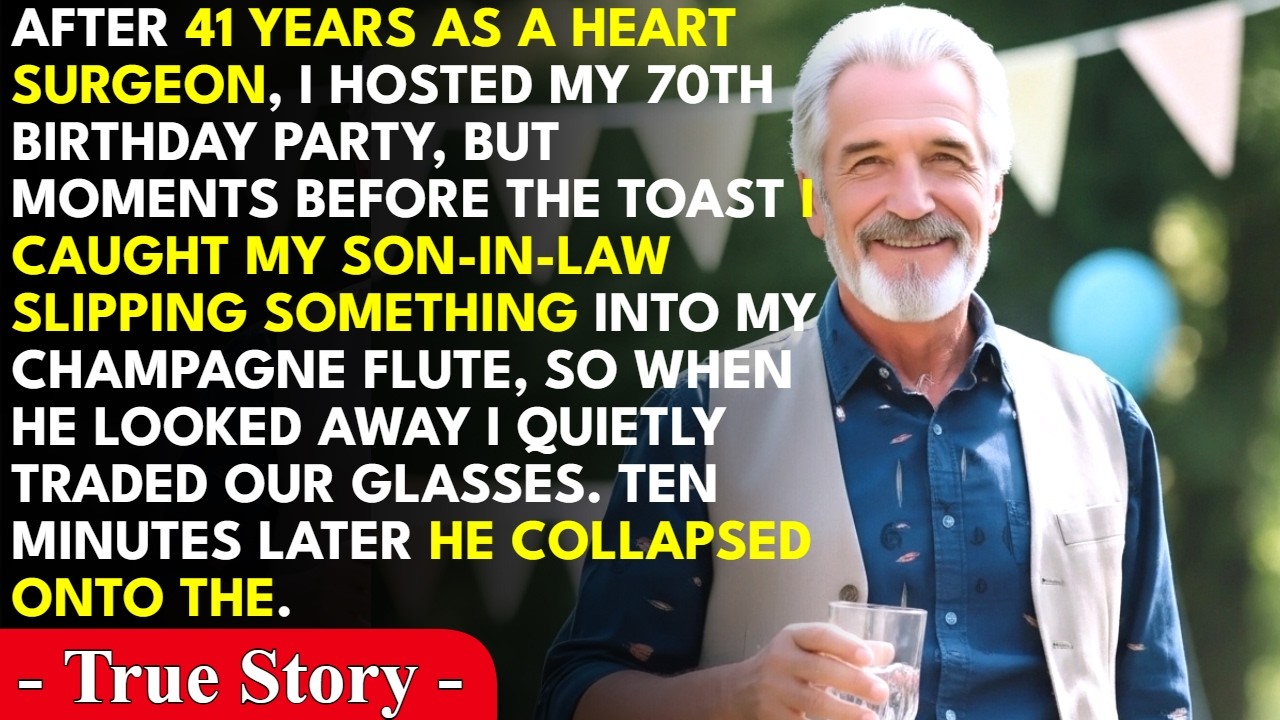
But I’d been a cardiothoracic surgeon for 41 years. You don’t spend four decades opening chests without learning to feel when something’s wrong. My name is August Merryweather. That night, 212 people came to celebrate.
My wife, Rosalie, counted them three times because she was nervous about the seating chart. She’d been planning this party since spring. She wore a pale gold dress, and her hair was done by a girl named Tessa who’d been styling it for years. Rosalie kept touching my arm, the way she does when she’s happy, trying not to show how happy she was.
She’s a Vermont woman. They don’t broadcast their feelings. Our daughter, Linden, was there. Everyone calls her Lynn.
She’s 38 now, with her mother’s cheekbones and my stubborn jaw. She married a man named Cassius Ortega when she was 29. I walked her down the aisle on a snowy October morning, and I cried like a fool through the whole ceremony. I’m telling you this because I need you to understand something: I loved my son-in-law.
Cassius was a tax attorney. He played squash with me twice a month for nine years. He brought my daughter flowers every Friday. He called me Pop, and I secretly liked it more than I let on.
The party started at six. My wife had hired a string quartet from Boston. There was a long table by the bay windows piled with shrimp and crab cakes and the stuffed mushrooms Rosalie loves. Photographs of my life sat on easels around the room: me at 12 on a horse, me in my navy uniform, me with my brother Theron before he died, me in scrubs after my first heart transplant.
At 7:30, dinner was served. Filet mignon, wild rice pilaf, asparagus with hollandaise. At 8:45, my brother-in-law Pollard, a retired judge, stood to toast. He talked about how he’d watched me court his sister back in 1979, how he hadn’t liked me at first, how I’d proven him wrong.
He raised his glass. Everyone raised theirs. I drank. Three minutes later, I noticed my son-in-law watching me.
His eyes kept flicking to my hand, to my glass, to my face. He was waiting for something specific to happen. I didn’t react. I’d been trained not to react.
But my heart was hammering. I began running through everything that had happened in the last 20 minutes: the way he’d insisted on getting me a fresh glass before the toast, the way he’d brought it over himself instead of letting the waiter do it, the small gesture he’d made with his thumb across the rim. I excused myself to the men’s room. In the stall, I dipped the corner of my handkerchief into the champagne and touched it to my tongue.
Bitter. Faintly metallic. Wrong. Champagne isn’t bitter.
This was champagne plus something else. Something I’d tasted before, decades ago, when I was a resident rotating through psychiatry, drawing up doses for patients in acute distress. My hands were shaking. I want you to know I was not calm.
I was a 70-year-old man in a tuxedo, standing in a country club bathroom, trying to understand why my daughter’s husband had just poisoned me. But I made myself think. If I called the police now, what did I have? A handkerchief, a bitter taste.
He’d deny it. He was an attorney. He’d lawyer his way out before sunrise. And my daughter—what would happen to her?
Would she stand by him? Would she think I’d gone senile? Was she part of this? That last thought hit me so hard I had to sit down.
I came out of the bathroom and went straight back to the ballroom. Cassius was standing near the bar with my wife. He’d set his own glass down on a high cocktail table. Untouched.
I walked over, slipped my arm around Rosalie’s waist, and asked if she was having a good time. She turned to me and smiled the smile that has been the central fact of my life for 46 years. Then I pretended to stumble. I have a bad knee.
Everyone knew about my bad knee. I lurched sideways into the table, and my hand went out to steady myself. In the motion of catching my balance, I made the switch. His glass for mine.
Mine for his. It took less than two seconds. “Easy there, Pop,” Cassius said, smiling. He reached for what he thought was his glass.
He drank. Within four minutes, he set the glass down too carefully, the way drunk people do when they’re compensating. Within seven, he was sweating. Within ten, he was confused.
He looked at my wife and tried to say something, and the words came out wrong. Then he collapsed against the dessert table. A tray of petit fours went everywhere. Someone screamed.
My daughter came running across the ballroom. And I will never forget the look on her face. It wasn’t the look of a woman who’d just discovered her plan was failing. It was the look of a wife.
Heart-stopping terror. She didn’t know. I knelt beside him, went into surgeon mode. Pulse, breathing, pupils.
I shouted for someone to call 911. I gave him compressions when his breathing went shallow. I worked on my son-in-law for nine minutes on that ballroom floor before the paramedics arrived, and the whole time my daughter was begging me: “Daddy, please save him. ”
I saved him.
He was alive when they loaded him into the ambulance. I rode with him to St. Catherine’s Hospital, where I’d worked for 36 years. The ER doctor was a woman I’d trained myself.
When I handed her my handkerchief and told her the truth, her face went perfectly still. She ran the toxicology panel without telling anyone in my family why. Three hours later, the report came back. The substance was a benzodiazepine analog mixed with a beta-blocker.
In the dose I’d been served, it would have caused a fatal cardiac event in a 70-year-old man with my medical history. It would have looked like a heart attack. An autopsy might not have caught it unless someone knew to look. I sat in that hospital chair and felt something hollow out inside me.
The next two days were a blur. Cassius came out of his coma, disoriented and frightened. He refused to speak to me. My daughter sat by his bed and held his hand.
My wife asked me, finally, what I wasn’t telling her. I told her everything. Rosalie listened until I was done. Then she said, “August, I need a minute,” and walked out.
Twenty minutes later, she came back with red eyes and a steady face. “What do we do now? ” she asked. We hired a private investigator named Baudry Lassiter.
Ex-FBI, 64 years old, the most expressionless face I’ve ever seen. He asked me three questions. “Does your son-in-law stand to inherit? ” Yes.
A substantial trust was set up for Lynn, and Cassius had access. “Has anyone in your family asked about your finances recently? ” I remembered: six months earlier, at Easter, Cassius had asked about my estate planning over coffee. Casual.
I’d told him my lawyer had it handled. “Is there anyone else in his life who might benefit? ” I had no answer. Baudry found one three weeks later.
Her name was Marizette Vaughn. A 31-year-old paralegal at Cassius’s firm. She’d been having an affair with him for two and a half years. She’d been to our house for family barbecues.
She’d been at our daughter’s baby shower. Lynn was four months pregnant the night her husband tried to kill me. But it was worse than an affair. The texts went back eight months.
They discussed me by name. My heart history. What would happen after. They discussed Marizette moving in.
They discussed Lynn being “handled” once the inheritance came through. And the baby. Cassius had written that he intended to push for sole custody after Lynn’s breakdown—which he planned to engineer. He didn’t actually want the child, but it would help in court.
He wrote about my daughter like she was an obstacle to be moved out of the way. I sat in Baudry’s small office in West Hartford, holding those printouts, and for the first time in my life, I understood why some men kill other men. I didn’t do it. But I understood it.
We went to the police. We went to the district attorney. The evidence was enough to walk through any door in the state. The arrest happened on a Tuesday morning in early November.
Cassius was walked out of his office in handcuffs. Marizette was arrested four hours later. Here’s the part that’s hard to tell. My daughter didn’t believe it at first.
She loved him. She’d loved him for 12 years. She was carrying his child. To her, he was the victim.
She accused me of being confused. Paranoid. She said maybe my own medications were affecting my judgment. It was Baudry who saved us.
He sat my daughter down at our kitchen table and laid the evidence out in front of her piece by piece. He didn’t speak. He just let her read. When she got to the texts about the baby, she made a sound I never want to hear again as long as I live.
The trial was in March. Cassius’s lawyers tried everything. Tainted toxicology. Planted evidence.
A suggestion of paranoid thinking. Baudry had anticipated all of it. The country club’s security cameras had captured Cassius bringing me the glass, the slight motion of his hand over the rim, the way he watched me drink. And Marizette flipped.
She testified against him in exchange for a reduced sentence. She told the jury everything. The poison had been her idea. Her brother was a pharmacist.
They’d spent 18 months planning the night of my 70th birthday, because it would be public, and no one would suspect. Cassius was convicted of attempted murder, conspiracy, and three other charges. He got 28 years. He’ll be 69 when he gets out, if he gets out.
He’ll have missed his child’s entire childhood. My grandson was born in May. His name is Theron, after my brother. He has my daughter’s eyes and my stubborn jaw.
When I first held him, I cried for an hour. Lynn moved back in with us for a while. She and the baby took the upstairs guest room. She filed for divorce two weeks after the trial.
She’s working again, part-time. She’s seen a therapist. She’s healing the slow, ugly, real way healing happens. Some nights she comes downstairs after the baby is asleep and sits with me on the back porch.
We don’t say anything. We watch the lake. There are loons that come back every spring. I want to tell you what I learned.
I learned to listen to the small voice. I almost didn’t switch those glasses. I almost talked myself out of it. The cost of being wrong felt enormous.
If I’d let it go, I’d be dead. My daughter would have been driven to a breakdown by a man pretending to grieve her father. My grandson would have been a pawn. My wife would have been alone.
The other thing I learned is who is really there. When my son-in-law collapsed, 200 people stood frozen. But three of my old surgical residents ran toward him. Baudry, a man I’d never met, took a case no one else would touch.
Dr. Pellingham dropped everything to protect me. My wife never wavered. Not once.
You find out who people are. You find out the hard way. I’m 71 now. There’s a small scar in my heart where my son-in-law used to live.
I don’t know how to forgive him, and I’m not sure I’m required to. But I know how to love my daughter, my grandson, my wife, and the loons on the lake. Last week, I went up to the attic and opened the wrong box first. It was full of photographs from Lynn’s wedding day.
There was one of me dancing with her, and one of me standing with Cassius, both of us laughing. I sat on the attic floor and looked at that picture for a long time. Then I put it back, closed the lid, and carried the right box down the stairs. I went out to the porch to sit with my wife.
She had a cup of coffee waiting for me. She always does. “You all right? ” she said.
“I’m all right. ”
The sun was going down over the water. The loons were calling somewhere past the dock. My daughter was inside with my grandson, and I could hear her singing to him through the open kitchen window.
I’m still here. That’s the part I keep coming back to. After everything, I’m still here. And so are the people I love.
If there’s a quiet wrongness in your life right now, a feeling you can’t quite name, a person whose eyes won’t quite meet yours—listen to it. Listen hard. It might be the only thing standing between you and what comes next.