The smell hit me first—burnt coffee and wood polish, that scent every courthouse in America seems to share. My father’s voice rose above the hallway murmur, loud enough to make the bailiff at the door turn his head. He pointed at me like I was a stain he wanted to scrub off the family portrait. “She hasn’t held a real job in fifteen years.
And everyone in this room knows exactly what kind of daughter I raised too, anyway. ”
A few relatives laughed the way people laugh when they want to be seen siding with someone powerful. My sister Claire stared at her shoes. My mother wasn’t there to witness it.
She’d been gone eleven months, and my father had used every one of them to chip away at me. I didn’t answer him. I set my bag on the seat beside me, the brass latches catching the light, and checked my watch. Fourteen minutes until the hearing.
Fourteen minutes until a man in this room would learn something about me I’d never spoken aloud at twenty years of family dinners. My father had no idea what he’d just started. I grew up in Millhaven, Kentucky, in a house that smelled of lavender and old books, where my mother kept the porch light on for anyone who might still be trying to find their way home. My father ran the hardware store downtown, the man everyone shook hands with at church and quoted at the diner.
Everyone in Millhaven thought they knew Frank Whitfield. Only the people who lived inside his house knew the difference between the man on the street and the man at the dinner table. Claire was born first, and her arrival was easy. Good grades without much effort, homecoming queen, a fiancé from a family my father approved of before he even shook the man’s hand.
I came second, and I arrived with questions no one wanted to answer. I remember being nine years old, bringing home a ribbon from the science fair. Blue. First place.
I set it on the kitchen table like it was something precious. My father looked at it just long enough to say, “Claire’s recital is Thursday. Don’t forget to wear the yellow dress. ” He put the ribbon in a drawer.
I don’t think he ever mentioned it again. There was a kind of silence he was good at. Not angry silence—directed silence. I’d say something and the conversation would simply continue as if I hadn’t spoken.
When I got early admission to a military academy at seventeen, I told them during Sunday dinner, my hands shaking as I held the acceptance letter. My father read it, folded it once, and set it beside his plate. “You’ll fail and be back within a month,” he said. “You’ve never finished anything hard in your life.
” Then he asked Claire about her college entrance exam prep. My mother was the only one who looked at that letter twice. She found me on the back porch that night, sat beside me without saying a word for a long time, then reached over and brushed my hair back the way she did when I was small and feverish. “I don’t understand half of what’s in that letter,” she said.
“But I understand you, and I have never doubted for a moment that you would be someone extraordinary. ” She never told my father she said that. That was the kind of love that stays silent—the same kind I would learn to follow. There was another memory I carried longer than I wanted to.
I was thirteen, having spent a month building a radio from a kit I’d bought with lawn-mowing money, soldering the connections myself at the kitchen table under a desk lamp until my eyes burned. The night it finally picked up a signal from three counties away, I ran into the living room to show him. He was watching the evening news and didn’t turn his head. “Turn that thing off before it messes up the TV,” he said.
I unplugged it and carried it back to my room, and I remember sitting on the edge of my bed listening to static through one earbud, thinking that whatever I was, it clearly wasn’t something of value in that house. My mother found me there an hour later. She didn’t say anything about the radio. She just sat with me until the static turned into a station playing a slow tune, and we listened together without talking.
The porch light glowed faintly through my window like it always did. I left for the academy three weeks after my eighteenth birthday. One suitcase, no farewell party. My father shook my hand at the bus station like I was a business partner he was mildly disappointed in.
I didn’t cry until the bus crossed the county line. That was the day I stopped waiting for his approval. I didn’t stop loving him. I just stopped organizing my life around earning something he’d already decided he would never give me.
The years that followed weren’t about him at all, and that was the point. I remember the heat of the forward base outside Kandahar, suffocating enough to feel like a hand pressed against my chest. Fine dust like flour getting into everything. That metallic taste at the back of my throat.
I remember being twenty-six, making a decision under fire that rerouted a convoy away from a position we didn’t know was exposed. A decision made in eleven seconds, which analysts later spent eleven pages explaining. No one back home heard anything about it. No ceremony, no headlines.
There was a debriefing room with bad coffee and a colonel named Reyes who looked at me afterward and said, “Whitfield, in fifteen years, I’ve met maybe four officers with the same read on things you have. Don’t let anyone change your conviction about who you are. ” I didn’t tell my father about that either. There wasn’t a version of that sentence he would have wanted to hear.
There was another night, years later, in a briefing room that smelled of cold metal and burnt coffee, when I was handed an assessment no one else wanted to sign. A decision that would either save three months of fieldwork or expose an entire team to a risk we couldn’t fully estimate. I remember the weight of the pen in my hand, the hum of the fluorescent lights overhead, the way the room went quiet while everyone waited to see if I’d hesitate. I didn’t.
I signed it, and I was right. And no one outside that room ever knew my name was attached to that decision. That was the shape of my entire career. An invisible burden carried flawlessly, credited to no one but the mission.
I preferred it that way. It meant no one took credit they didn’t deserve, and no one gave me a compliment I hadn’t actually earned. I missed my mother’s sixtieth birthday because of a mission extension. I missed Claire’s engagement party because of a training exercise I couldn’t talk about.
I don’t say that with bitterness. That’s simply the cost of the work, and I paid it willingly, the way you pay for anything you’ve decided matters more than attending the version of your life that would have made your family comfortable. Everything I trained for, survived, and carried in silence was preparation for a room I hadn’t entered yet. My mother got sick the spring I became a major.
Pancreatic cancer—the kind of diagnosis that leaves no room for negotiation. I came home on emergency leave and sat with her through the chemo that bought her four extra months. The smell of antiseptic and the steady hiss of the IV pump became the soundtrack of that spring, and the winter light through the hospital window that never seemed to warm anything. My father visited on Sundays, brought flowers, told the nurses how proud he was of his family.
I sat with her at three in the morning when the pain was worst, holding a plastic basin, learning the rhythm of her breathing when the medication finally kicked in. She never once asked me about my military rank. She asked if I was eating enough. She asked if I still loved lavender.
Three weeks before she died, she gave me a small tin box and made me promise not to open it until I needed it. I didn’t ask what she meant. I just promised. She died on a Tuesday in October.
My father gave the eulogy and never mentioned my name once. The quiet humiliations that had always been there started getting louder after that. As if her absence had removed the last person holding him to his own decency. During the reading of the will, he made a comment in front of the lawyer about how some of us choose career over family while others show up.
Claire looked away. I said nothing. At Thanksgiving, he introduced me to a new neighbor as his daughter who was floundering in life, while Claire’s fiancé got a fifteen-minute explanation of his consulting firm’s quarterly numbers. At Christmas, in front of eleven relatives, he asked if I’d finally gotten serious about a real job, and when I didn’t answer, he said loud enough for everyone to hear, “Some people simply aren’t cut out for responsibility.
”
No one corrected him. I touched the edge of my coat pocket, where the folder had been sitting, unopened, for three weeks. I looked at my phone once, at a number I’d already memorized, then set it aside again. I wasn’t ready yet.
But I was getting closer. The insults kept escalating after that. At a neighborhood gathering that spring, in front of a dozen people I barely knew, he told a story about raising two daughters. One who made her life count, and another who was still finding herself.
Everyone gave that easy laugh people reserve for a man they respect. I stood near the drinks table holding a glass I never sipped from, and I said nothing. Though I noticed the folder was already in my car that day, three weeks before I’d need it, because part of me had already decided this wasn’t going to stay buried any longer. The lawsuit was his idea, and it was the loudest thing he’d ever done.
My mother’s estate included a modest property in town that her family had held for three generations, and her will had a buried clause he hadn’t expected. She’d left the property, along with the contents of a safety deposit box, directly to me. He contested the will publicly, in open court, in front of relatives, claiming she lacked mental capacity, that I’d exerted undue influence, that I’d manipulated a dying woman. He hired a lawyer who used the word “absent” to describe me four times in his opening statement.
My father sat at the plaintiff’s table in a jacket he’d bought specifically for the occasion, telling anyone who would listen that this would finally reveal who had really been taking care of that woman. When he shouted in the hallway that morning, I didn’t say a word. When his lawyer threatened to subpoena my employment records to prove I had no steady income, I simply opened my bag and placed a file on the table, still sealed, and waited. When my father took the stand and said, in front of the judge, in front of Claire, in front of everyone, “My daughter has spent her entire life running from responsibility instead of pursuing it,” I didn’t raise my voice.
I stood, buttoned my jacket, and said one sentence. “You don’t have the security clearance for this conversation. You never have. ”
The silence in the courtroom was unlike anything I’d ever heard.
Somewhere behind me, a chair scraped against the floor. That was the only sound. The judge, a woman named Ortiz who had watched every kind of family collapse in that room, asked me to explain my statement. I opened the file.
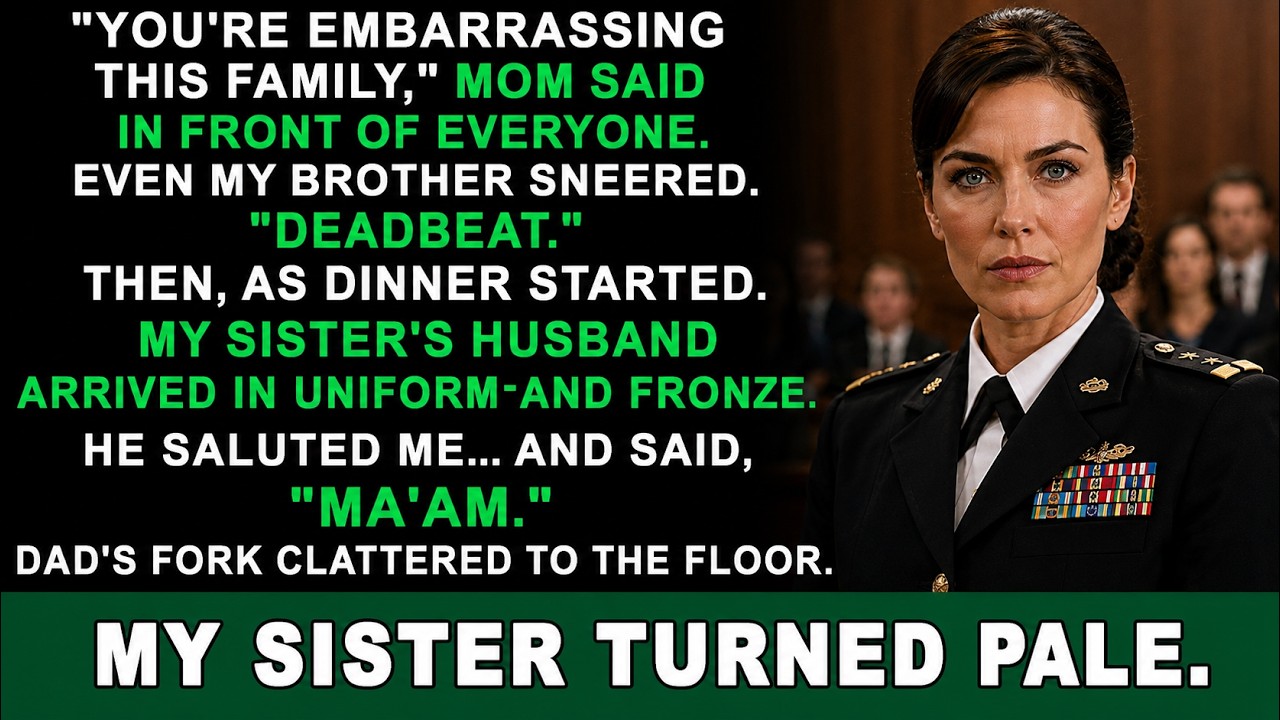
Inside were my duty orders, redacted where the law requires, but clear enough to make the point. My current rank: lieutenant colonel. A division that appears in no public directory. A security clearance level that made the court clerk stop mid-keystroke.
My mother’s lawyer, an old family friend named Harmon who’d known me since I was nine with a blue ribbon no one wanted, looked at the documents, then at my father, and said quietly, “Frank, she’s spent the last decade doing work most of us will never be cleared to understand. And she never once asked you to notice. ”
That one sentence did more for me than I could have said in my own defense. My father’s face didn’t collapse all at once.
It happened in small pieces. His hand, still resting on the table, began to tremble slightly. When he tried to speak again, his voice was thinner than before. He muttered about not being informed, about no one telling him anything anymore, and the judge, without raising her voice, reminded him that this was not the place for such remarks.
Then came the second envelope. My mother’s lawyer produced it as if it were an afterthought, a formality related to the estate—a sealed letter she’d left with him the same week she gave me the tin box, to be opened only if the will was contested. In it, in her own handwriting, she wrote that she had watched her youngest daughter build a life of value in complete silence for twenty years; that she had always known the nature of my work, even though I never told her directly, because a mother notices what a father refuses to see. She wrote that she was leaving me the house not as a reward, but as an apology for every dinner table where I’d been made small in a home that was supposed to be safe.
She wrote that she loved my father, and that that love had never stopped her from seeing him for what he was. The letter ended with a line everyone in the courtroom heard when the lawyer read it aloud, his voice cracking mid-sentence. “She never needed anyone’s permission to be extraordinary. I only wish someone had told her that at the dinner table instead of on a porch at midnight.
”
No one spoke for a long moment. My father sat perfectly still, staring at his hands. The judge dismissed his claim within the hour. I didn’t smile.
I didn’t look at him the way you look at someone you’ve beaten. I gathered my file, closed my bag, and walked out of the courthouse into a cold gray rain that had just started falling in the early afternoon. The kind of rain that softens every hard edge in a town you grew up trying to leave. I sat in my car for a long time before turning the engine on.
I wasn’t crying. I wasn’t triumphant. I was just calm. The feeling you get after setting down something heavy you’d carried so long you’d forgotten it had weight.
My father didn’t go to prison. He didn’t lose the hardware store, or his place at church, or his seat at the town diner. What he lost was quieter than that, and in its own way, heavier. Claire told me months later that he sat alone most Sundays now, that fewer people stopped by the store to talk, that the courtroom story had spread through Millhaven the way stories spread in small towns.
The people who used to admire him now greeted him with a wary distance—the distance you put between yourself and someone when you realize what they’re capable of. He called me once in December. He didn’t apologize. He just asked if I was okay.
I told him I was fine. He said, “I didn’t know. ” The same three words Claire had used months earlier. I told him that was the problem.
We haven’t spoken since, and I’ve made peace with the possibility that we never will. Two weeks after the hearing, I finally opened the tin box my mother had given me. Inside were photographs I didn’t know existed. Me at nine with my blue ribbon, a copy she’d kept without my knowledge.
Me in uniform at a ceremony my father hadn’t attended. A photo I never sent her, but she’d obtained somehow. And a stack of letters—one for every year I’d been away, written and never sent, because she mentioned in the first one that she didn’t want to distract me from my work. Every letter ended the same way.
“I see you. I’ve always seen you. ”
I read every one of them twice, sitting alone in the kitchen of the house that was now mine. The smell of lavender still lingered somehow, after all these years.
And for the first time since she died, I let myself cry. Not from grief—from something closer to relief. For a long time, I thought love was something you earned by being impressive enough, quiet enough, patient enough for someone to finally decide you were worth it. Service taught me otherwise.
It taught me that the people who see you clearly are never the ones you have to convince. My mother saw me at nine with a blue ribbon no one wanted. She saw me at every dinner table where I was pushed aside. She saw me through eleven months of her own dying, and she never needed a file or a courtroom to prove what she already knew.
If you’ve spent your life being treated like something decisions are made about instead of asked, and if you’ve ever watched someone reduce your entire story to a single word that fits their narrative instead of your truth, I want you to know this. The people who love you properly were never confused about who you are. The rest just weren’t paying attention. I still do the same work.
I still walk into rooms where no one uses their full name, where the work speaks a language most people will never be cleared to hear. I no longer need my father to understand any of it. I have a house with a porch light I leave on, the way my mother did, for anyone who might still be trying to find their way home. I have letters in a drawer I reread on hard days.
And I have a peace that didn’t come from winning that trial. It came from finally letting go of the weight of trying to be seen by someone who had already decided not to look.