It was Christmas Eve, and my sister leaned across the ham and said, loud enough for the whole table to hear, “35 and still single? Wow, Christmas must get pretty lonely. ”
Everyone laughed. My father laughed hardest.
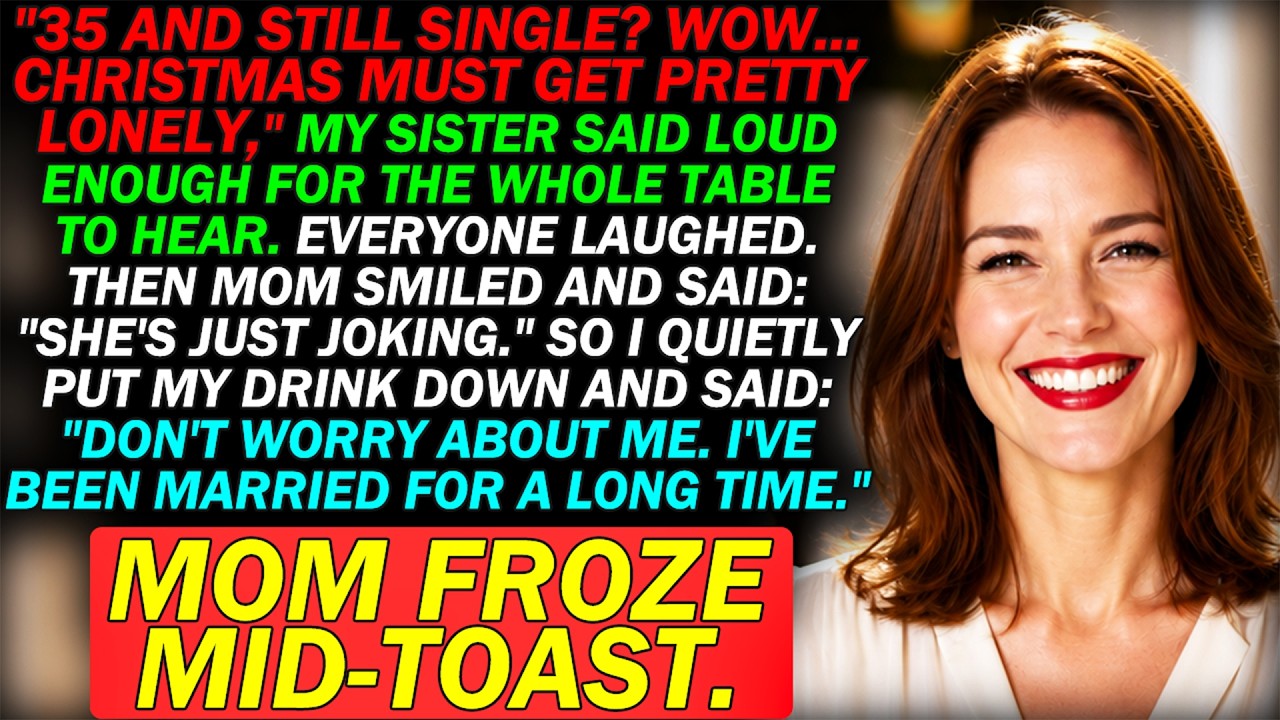
My mother, holding her wine up for the toast she’d been about to make, smiled that soft smile of hers and said, “Oh, she’s just joking. ”
I set my drink down. I didn’t say anything yet. But here’s what none of them knew.
I hadn’t flown home to Ohio to be laughed at over dinner. I’d flown home because a week earlier, a folder had crossed my desk with my own name signed at the bottom of a contract I had never seen—in handwriting that was not mine. You should know who I am before I tell you what I did, because the two things don’t match the way my family tells it. I’m an acoustician.
I design rooms that hold sound the way a good cup holds coffee. No spill, no echo, nothing lost. Recording studios, lecture halls, a children’s hospital where the machines beep softer now because I taught the walls to eat the harshness out of them. People fly me across the country to make their silence sound right.
My family knows none of this in any way that counts. To them, I’m the daughter who left, the one who never married on schedule, the one whose life is a punchline between the mashed potatoes and the pie. I hadn’t been back to Columbus in two years. Then Dale, an old technician who still worked the Bennett Acoustics floor, called me on a Tuesday and said, real quiet, “Mia, they’re about to close a deal on the panel line.
Investors. Big money. And your dad keeps telling them the design’s clean. All signed over.
All in the family. ” He paused. “But I never saw you sign anything. Did you?
”
I hadn’t. That’s when I booked the flight. Not for the ham, not for the toast, but for a sentence in a document I needed to see with my own eyes before I let anyone tell me I was imagining things. Because a signature is a small thing until it’s yours.
And it’s yours until someone decides it belongs to the family, too. But that was still all folded up inside me at the dinner table. And my family had no idea. Chloe was on a roll.
My little sister runs marketing for the firm, which mostly means she’s good at deciding what version of a story people are allowed to hear. “I’m just saying,” she went on, spearing a carrot, “some of us made choices. Some of us built things. Mia went off to—what is it again?
Making rooms quiet. ”
More laughter. My father set his fork down and did the thing he always does, the thing that used to make me feel chosen when I was small. He spread his hands like he was blessing the whole room and said, “Now, now.
This family built something real. Fifty years of the Bennett name on that building. ” He looked around, warm and certain. “Whatever any one of us does, we do it for the name.
The name comes first. It always has. ”
Everyone nodded like scripture had been read. My mother refilled glasses and murmured, “Let’s not make the meal about all that”—which is what she says whenever anything true tries to get up off the floor.
I felt the old pull to shrink, to laugh along, to make myself smaller so the evening could stay smooth. Fifteen years I’d been doing that from a distance. Fifteen years of being the quiet room where nobody had to hear the hard thing. I looked at my glass.
I looked at my mother, poised and glowing. And for the first time in a very long time, I did not shrink. I just set my drink down on the tablecloth, gently. The way you set down something you’re finally done carrying.
“Don’t worry about me,” I said. My voice came out even, almost kind. “I’ve been married for a long time. ”
The table did not so much go quiet as go vacuum sealed.
I know silence professionally. I can tell you the difference between a room that’s empty and a room that’s holding its breath. This was the second kind. My mother’s wine glass stopped in the air, tilted mid-toast.
Her smile stayed on her face a half-second too long. Chloe’s fork clicked against her plate. “You’re what? ”
“Married,” I said.
I folded my hands. “Six years, actually. ”
My father’s eyebrows climbed toward a hairline that had been retreating for a decade. “Six years,” he said slowly, like a number that wouldn’t add up.
“You’ve been married six years and you never told your own family. ”
And there it was, before the plates were even cleared. The pivot. Not “Are you happy?
” Not “Who is he? ” But “How could you keep something from us? ” As if the keeping were the crime. My mother finally lowered her glass without drinking.
Her hand was not quite steady. “Mia,” she said, and her voice had gone thin. “Why would you hide that? ”
I looked at all of them.
These people who had spent a decade turning my life into a joke they told at dinner. I thought about how to explain that you don’t hand your happiness to someone who’s shown you exactly what they do with the things you love. But I didn’t say that. Not yet.
I just said, “Because I wanted one thing that was only mine. ”
The questions came all at once. What’s his name? What does he do?
Why isn’t he here? Is he ashamed of us? That last one was Chloe, and she meant it to sting, and it would have once. I gave them almost nothing.
His name is Adrien. He’s away on business. No, he isn’t ashamed. Yes, it’s real.
There are rings and a lease and a life. My father leaned back and studied me with a new expression, one I couldn’t read yet, one that would make terrible sense later. “Well,” he said. “Full of surprises.
”
My mother reached over and touched my wrist. For one dangerous second, I almost softened. “We just want to be part of your life, sweetheart,” she said. And I wanted to believe her so badly it frightened me.
But I had not flown in from Chicago to be part of anyone’s life. I had come for a document. And sitting there, with my mother’s hand on my wrist and my sister’s laughter still hanging in the air like smoke, I understood something clean and cold. They thought tonight’s surprise was the biggest one in the room.
It wasn’t. The biggest surprise was in a manila folder three meters away, with my name forged at the bottom. And I was the only person at that table who knew it was there. Let me take you back eleven years, because you can’t understand the folder without understanding the panel.
When I was 24, Bennett Acoustics was three months from closing. I’d already left home at 20. Left the noise, left the smallness. But I still came back on weekends then.
Still believed a family was a thing you could repair with enough of your own hands. The firm made ordinary sound panels, the gray kind you’ve seen in a thousand office ceilings, and nobody was buying them anymore. So I sat in the back workshop for a winter and designed something new. A layered baffled core tuned so a room could stay warm without going muddy.
A panel that didn’t just kill sound but shaped it. I built the first one myself. I signed the inside of the frame where nobody would ever look, the way a luthier signs the belly of a violin. My initials and a line I believed in: *The room where you can finally hear yourself think.
*
That panel saved the company. The orders came back. The Bennett name stayed on the building for another decade because of a design a 24-year-old girl built in the cold. And then, slowly, the story got retold without me in it.
It became the Bennett panel. It became Dad’s turn. I let it. I told myself credit didn’t matter.
I told myself letting them have it was a kind of love. That was the lie I’d been living inside, smooth as a sealed room. And now that same panel—my panel—was the crown jewel of a deal worth more money than my father had ever seen. And somewhere in a folder, my name was pretending to have agreed to give it all away.
The next morning, I drove out to the firm and told everyone I just wanted to see the old place decorated for the holidays. That part was even a little true. Bennett Acoustics looked prosperous in a way it never had when I was a kid. Fresh paint, a glass conference room, a brass plaque by the door with my father’s name embossed like a coat of arms.
There were visitors, men in good coats, a woman with a leather portfolio. The unmistakable careful politeness of people deciding whether to spend a great deal of money. My father was in his element, walking them past the display wall, his voice carrying. “Everything you see, we own outright,” he was saying.
“Every patent, every design, all of it assigned to the company. Clean as a whistle. Signed and sealed years ago. We keep it in the family.
”
The buyers nodded. The woman wrote something down. And I stood by a rack of holiday cards, feeling the floor tilt very slightly under me, because I knew that at least one of those signatures had never been given. If you’ve ever walked back into a house that shrank you the second you crossed the threshold, you already know the sound I mean.
A room full of confident talk you’re not part of, about a thing you made. I watched my father shake a buyer’s hand. I watched him say the word *clean* again. And I decided, standing there with a snowflake melting on my sleeve, that I was going to read that document before I let anyone sell my name.
I asked casually if I could look at the IP paperwork. I framed it as professional curiosity, one designer admiring how a clean assignment gets structured. Nothing more. Chloe intercepted me before the sentence was fully out of my mouth.
She’d always had good instincts for exactly the wrong moment. “Why would you need to see that? ” she said, arms folded, smile bright and hard. “You don’t really work here, Mia.
You haven’t in years. It’s kind of not your business anymore. ”
I said I was only interested. She tilted her head.
“See, this is the thing about you. ” Her voice climbed just enough for the room to catch it. “You disappear for fifteen years. You show up with a secret husband, and now you want to poke around the deal that’s going to set this whole family up for life.
People might think you’re jealous. ”
She laughed, light, performing for the two employees within earshot. My mother, passing with a tray of cookies for the guests, heard the tail of it and said without even slowing down, “Oh, she’s just joking. Mia, don’t make a face.
”
There it was again. The little phrase that turns every knife into a joke and every joke into your fault. *She’s just joking. * I’d heard it my whole life.
It’s a spell, that sentence. It disappears things. It had disappeared my hurt for 35 years, and it was about to be asked to disappear a felony. But I smiled, and I let it go.
And I said something about needing air, because I had realized that asking permission was a mistake. You don’t ask the people who forged your name whether you may see the forgery. So I stopped asking, and I started looking on my own. Dale found me by the loading dock, hands in his coveralls, breath fogging.
“You didn’t hear it from me,” he said, and led me to a side office where a due diligence binder sat out on the table, tabbed and photocopied for the buyers to review. “Nobody’s in the room. ” He stood in the doorway watching the hall while I turned to the tab marked *Intellectual Property Assignments*. And there it was.
A one-page assignment agreement transferring all rights, title, and interest in the chambered baffle design from the inventor to Bennett Acoustics Incorporated. Dated five years ago. Signed on the line that said: *Inventor: Mia Bennett. *
My whole body went still in the particular way it does when your professional brain takes over because the rest of you can’t.
I looked at the signature. I have signed my name maybe a hundred thousand times. I know its rhythm the way you know your own heartbeat. This was not it.
Close. Someone had tried. Someone had a sample to copy from. But the M was wrong, too round.
The tail of the final T crossed the wrong direction. And the whole thing sat too neatly on the line, without the slight downhill drift my hand has made since the fourth grade. Somebody had practiced. Somebody had sat down with an example of how I write my name and rehearsed it until it was good enough to fool a stranger.
Not good enough to fool me. I stood in that borrowed office with the December light coming gray through the blinds, and I felt something I had spent fifteen years refusing to feel about these people. Not sadness. Not even anger, not yet.
Just a cold, clean certainty. Someone in my own family had sat down and learned to be me. I did what I always do when the ground moves. I gathered data.
I photographed the page, both sides, in good light. Then I checked the date against my own life, because a signature is a claim about where a person was, and where a person was can sometimes be proven. Five years ago, the date on the assignment was in April. And in that April, I had not been in Ohio or anywhere near it.
I’d been in Rotterdam, giving a paper at an international acoustics conference. My name in a printed program. My face in a group photo on a stage. My passport stamped.
My hotel invoice to my own account. On the day this document said I sat in Columbus and signed away the best thing I ever made, I was 4,000 miles away in the rain, being taken seriously. This was not a filing error. Nobody misplaces a signature onto a page.
Nobody accidentally forges a date. This was a decision made by a person with a pen who chose to put my name where my consent should have been, because it was easier than asking me—or because they already knew what I’d say. I closed the binder exactly the way I’d found it. I thanked Dale with my eyes, not my mouth, because his job was in that building.
And I walked back out into the lobby where my father was laughing with the buyers. I smiled at him, and I thought, *I know now. I know. * And you don’t know that I know.
I let myself have that for a day, like a coal in a cold pocket. That evening, I helped my mother in the kitchen, because I needed to know how deep it went. My mother has never in her life been able to hold a thing she thinks is nice. I dried while she washed.
“It’s funny,” I said, keeping my voice at the temperature of small talk. “I don’t even remember signing anything over to the company back when. ”
Her hands slowed in the suds. “Oh, sweetheart, you didn’t have to worry about all that,” she said, warm, reassuring, the way you’d comfort a child about a nightmare.
“Your father took care of the paperwork for you. You were always so busy with your—your rooms. He said, ‘Why make a fuss over forms when it all stays in the family anyway? ‘ He handled it.
He handles everything. ”
She smiled at me, proud of him, entirely unaware that she had just confirmed it. My father had signed my name. My mother knew, in the soft way she knows everything and questions nothing.
And to her, it wasn’t a crime. It was a courtesy. A man taking a burden off his daughter’s shoulders. “The name comes first,” she added, drying her hands, echoing him without knowing she was quoting anything at all.
I finished drying the last plate and set it in the rack. There was no point circling anymore. If my father had done this thing and believed it was love, then I needed to hear him say so to my face, with no buyers watching. I found him in his study with a bourbon and the ledger he still keeps by hand.
I shut the door. I didn’t raise my voice. I’ve learned that the calmest voice in the room is the one people finally hear. “Dad,” I said.
“There’s an assignment in the buyer’s binder with my signature on it. I never signed it. You did. ”
He didn’t flinch.
He didn’t even pretend to be confused. He looked up at me with something that was almost pride and said, “So. You found it. ” Like I’d solved a puzzle he’d left for me.
“You made that panel under this roof, Mia. You were a Bennett using Bennett tools in a Bennett building. That design was always ours. All I did was finish the paperwork you were too busy to do.
That’s not stealing. That’s a father cleaning up after his kid. ”
“Forging a signature is a crime,” I said quietly. He waved the bourbon.
“Family isn’t a crime. You want to know a crime? Walking out and letting the company that raised you go under. ”
And then, for just a moment, the armor slipped, and I saw the wound underneath.
“My father did the same to me,” he said, staring at the ledger. “First panel line I ever drew. He put the company’s name on it and mine nowhere. I cried about it for a year.
Then I understood. That’s how a family survives. You feed the name, and the name feeds you. ” He looked up.
“I did you a kindness. Someday you’ll see it. ”
He believed every word. That was the worst part.
He wasn’t a villain twirling a mustache. He was a man who’d been robbed young and had decided the theft was a tradition worth passing down. I told him I wanted my name off the deal. I told him the assignment was void because I never gave it.
“That’s just the law,” I said. Not a threat. That’s when the warmth drained out of the room. My father is never colder than the moment you stop being useful to the story he’s telling.
“Off the deal,” he repeated. “Mia, do you have any idea what closes next week? Do you understand how many people’s jobs are riding on that panel line? Dale, the whole floor.
Your mother’s retirement is in this company. ” He stood up. “If you blow this up now over a signature, over your pride, that’s not me destroying this family. That’s you.
Everyone will know it was you. ”
And there it was. The oldest tool in the house, sliding into my hands whether I wanted it or not. The responsibility.
Make yourself small so the room can stay smooth. Carry the thing no one else will carry. I felt the pull of it in my chest like gravity, because I have always been the one who absorbs the cost so nobody else has to. That’s my wound.
Not that I trust too easily—I trust almost no one. It’s that I’ve believed my whole life that love means being the person who disappears so everyone else can stay comfortable. And standing in my father’s study, watching him hand me the blame for a crime he committed, I finally saw the shape of the machine I’d been feeding. It ran on me.
It had always run on me. And it was counting on the fact that I would rather burn quietly than let anyone else feel the heat. I didn’t answer him. I walked out of the study, through the dark house, and drove to the firm one more time that night.
I had a key from Dale, and I told the night guard I’d left a scarf. What I really wanted was to stand in front of the wall. Because in the lobby, mounted under a spotlight, framed like art, hangs the very first one. Panel 001.
The original. The one I built by hand in a cold workshop when I was 24. There’s a little brass card beside it now that reads *The Bennett Panel: The Design That Built Our Future*, with the company logo and my father’s name as founder. My name is nowhere on the card.
I stood there a long time. Then I did the thing I’d come to do. I lifted the frame off its bracket carefully—it’s heavier than it looks—and turned it over. And there, in the pale wood of the inner frame, in the small block letters of a 24-year-old who thought she was signing something only she would ever see, it still said what I’d written eleven years ago.
*MB. * And beneath it, *The room where you can finally hear yourself think. *
I ran my thumb over the letters. They were mine.
They had always been mine. The front of the panel belonged to the family, to the name, to the deal. But the back of it, the part that held everything up, the part that did the actual work of shaping the silence—that was me. Hidden.
Load-bearing. Uncredited. Exactly like the daughter. I stood there in the dark lobby and said it out loud to no one, quiet as a closed room.
“Forgiveness isn’t a signature. ”
I sat in the rental car in the empty lot with my phone in my hand and my husband’s name on the screen. And I want to be honest with you about what I almost did. Adrien is an investor.
He’s a partner at a fund. He moves money, and he moves the people who move money. And in the world where this deal was closing, he is not a small man. One phone call.
That’s all it would have taken. He could have made a quiet inquiry, leaned on the right relationship, and this entire deal could have simply evaporated before anyone signed a thing. Or he could have swept in and funded the company himself and bought my family’s gratitude for the rest of their lives. I could have made all of this disappear.
Or I could have made myself the hero who saved them. Either way, I’d have walked back into that house holding the one card that would finally make them see me. I sat there with my thumb over his name for a long time. I want you to remember that I could have.
Because what I did instead is the whole point of this story. I didn’t call to ask him to fix it. I put the phone in the cup holder. Because using Adrien to erase this—whether by killing the deal or by rescuing it—would have made me exactly what my father was: someone who solves a problem of truth by burying it under power.
And I did not fly home to become my father. I flew home to stop being his tradition. The next morning, before I decided anything final, I called an intellectual property attorney in Chicago I’d worked with years back. I laid it out plainly.
A design I created. An assignment I never signed. My father’s name on the pen instead of mine. A sale about to close on the strength of that page.
She listened, and then she gave it to me straight. “Mia, if you didn’t sign it, that assignment is void. Not weak. Void.
A forged signature transfers nothing. Which means legally, you never gave up that design. You still own it. ”
I asked what that meant for the deal.
“It means the company doesn’t have clean title to the thing they’re selling. When the buyer’s people do their diligence and ask the inventor to confirm the chain of title—and they will ask—you’d have to either ratify it or tell the truth. If you tell the truth, they can’t close. Not the way it’s papered now.
And the forgery itself,” she paused, “that’s a criminal matter in Ohio. But that part isn’t yours to prosecute or forgive. That part just is. ”
I thanked her and hung up and sat with it.
Here was the thing that changed everything. The power in this room had never been my husband’s money or my family’s name. The power was a single signature I had not given and would not give. Not a weapon I had to go find.
A weapon that was simply the truth of where I’d been and what I’d never agreed to. All I had to do to bring the whole “clean as a whistle” story down was refuse to lie. The quietest possible act. And the most expensive one.
They could tell something had shifted. Families like mine have antennae for the exact moment the quiet one stops being quiet. My mother started hovering, refilling my coffee before it was empty, asking if I was sleeping all right, if the marriage was all right, if I was all right. Each question a small hand, testing a door.
That afternoon, she sat beside me on the porch and took my hand and said the thing she’d clearly been sent to say. “Whatever you and your father are tangled up about,” she said, “please, sweetheart. Let’s keep it in the family. We don’t air these things.
We don’t let strangers into our business. That’s how we’ve always survived. ”
*Keep it in the family. * The grown-up version of *she’s just joking*.
Same spell, bigger stakes. The words we use to make sure the truth never gets past the front door. Chloe was different now, too. She’d stopped needling me.
That very evening, she brought me tea I didn’t ask for and sat on the arm of my chair and said sweetly, “You know I love you, right? However things shake out. ” She had never once said that to me sober. And that’s when I understood.
They had smelled the danger, and the whole house was rearranging itself around managing me. Softening me. Folding me back in before I could do anything that couldn’t be undone. My mother squeezed my hand.
“You’ve always been our strong one,” she said. And I sat there on the cold porch and felt the walls of the old house lean in. Warm and loving and absolutely determined to keep me exactly where I’d always been. Inside.
Quiet. Holding everything up. My father, it turned out, had called a family meeting for the morning before the closing. All of us together to decide, he said, what was best for everyone.
The family meeting was held at the long dining table where, three nights earlier, I’d been the punchline. Now I was at the head of the table without anyone admitting they’d put me there. My father opened like a man addressing a boardroom. “We’re at a crossroads as a family,” he said.
“There’s been a—a paperwork question. And we need to resolve it together, the way Bennetts always have. Quietly. Lovingly.
”
Then he slid a single page across the polished wood toward me, with a pen on top of it. It was a new assignment. Fresh. Clean.
Dated this week. Ready for a real signature this time. Mine. To paper over the fake one.
To make the lie retroactively true. To let the deal close as if none of it had ever happened. “All you have to do,” my father said gently, “is sign what you would have signed anyway. And it’s finished.
No mess. No strangers. Just family, taking care of family. ”
My mother was crying softly.
Chloe was watching me with an intensity that had nothing to do with love. Every person at that table was leaning toward me, waiting. And I felt the full weight of it. The whole house pressing me to do the smooth thing, the quiet thing, the thing I had done my entire life.
Sign and be the strong one. Sign and keep the peace. Sign and disappear again so everyone could stay comfortable. I looked at the pen.
I looked at the line where my name was supposed to go, willingly this time. And I understood that this was the trap the machine had been building toward all along. Not to forge me once, but to make me forge myself. To get me to volunteer for my own eraser and call it love.
I didn’t sign it that morning. I said I needed to think, and I took the page with me, which no one expected. The meeting broke up uneasy. But something else broke open that same day, and it came from Chloe.
My sister, who runs marketing, who is very good at finding out what version of a story is true, had spent the days since the dinner doing what I should have known she’d do. She’d looked into Adrien. She found him fast. His name is not a common one, and his fund is not invisible if you know where to look.
By that afternoon, Chloe knew exactly who my husband was. A partner at a firm with real weight in exactly the world where our family’s little deal was trying to close. She came to find me in the guest room, and her whole face had changed. The mockery was gone.
In its place was something I’d never seen aimed at me before. Calculation. And under it, hope. “Mia,” she said, breathless, sitting down without being asked.
“Your husband. Adrien. Do you know who he—of course you know who he is. He’s your husband.
” She laughed a little wild. “Why didn’t you say something? This changes everything. ”
And I watched, almost fascinated, as the story the family had told about me for 35 years—pitiable, single, lesser, the joke—dissolved in real time and reassembled into a new one.
I was not the punchline anymore. I was the connection. I was the exit. I was, suddenly and for the first time, worth being nice to.
And I knew with a sinking certainty exactly what they were about to ask me for. Not forgiveness. Not even my signature now. Something bigger and dirtier, dressed up in the language of family.
By that evening, the whole family knew, and the whole family had rearranged itself around the new information with a speed that would have been impressive if it hadn’t been so nauseating. My father poured me the good bourbon I’d never once been offered. My mother kept touching my hair. And then they made the ask.
All of them, in relay, so no single person had to own the whole ugly shape of it. Couldn’t I just have a word with Adrien? Couldn’t he make an introduction, smooth things over with the buyers? Maybe put in a little of his own money so the deal never even needed my messy signature at all?
Or Chloe’s idea, delivered brightly: Couldn’t Adrien just make the whole diligence problem go away, the way men like him make things go away? “You have this incredible resource,” my father said, spreading his hands like a benediction. “And you’d let the family sink rather than make one phone call? After everything?
” He shook his head, wounded, magnificent. “The name comes first, Mia. It always has. And right now, the name needs you.
”
And there it was. The third time I’d heard that line in a week, and the first time I understood it completely. *The name comes first* had never meant the family protects its own. It had always meant the family uses whoever it has to.
For fifteen years, the name had used me by making me a joke. Now it would use me by making me a savior. Same machine, same fuel. The only thing that had changed was the price tag on my head.
I looked at these people I loved and could not trust, holding out their hands for a rescue built on burying a crime. And I finally saw the whole tradition clearly enough to break it. I did call Adrien that night. But not to ask him to save anyone.
I stepped out into the cold backyard where the Christmas lights my father had strung blinked red and green in the snow, and I told my husband everything. The folder. The forged signature. Rotterdam.
The panel. The family meeting. The ask. He was quiet in the way that means he’s actually listening, which is one of the ten thousand small reasons I married him.
When I finished, he didn’t offer to fix it. He knows me better than that. “What do you want to do? ” he asked.
Not *what should we do*. What do *you* want? I told him I wanted to tell the truth and let the truth do whatever the truth was going to do. There was a pause.
“You should know something,” he said carefully. “If our fund has any connection to the buyer on this—and given the sector, it might—then the second your name is on anything, I have to recuse. Declare the conflict. I can’t touch it.
And I wouldn’t want to. ”
“Good,” I said. “That’s exactly right. ”
Because that was the whole difference, wasn’t it?
Standing in the snow between two houses I’d lived in. My family’s instinct was to use every relationship as leverage. My husband’s instinct was to step back from a table the moment his presence could bend it. One of them thought power meant making problems disappear.
The other thought integrity meant refusing to be the reason a problem stayed hidden. I stood in the yard a while after we hung up, watching my breath, watching the lights blink on my father’s careful, cheerful, dishonest little display. And I knew what I was going to do at the closing. I just had to survive the last night to get there.
I stayed up most of that night at the little desk in the guest room. And I did the least dramatic and most important thing of my life. I wrote a letter. Not to my family.
To the buyer’s counsel and the accountants handling the diligence. A short, factual statement, the kind I write for a living. No anger in it anywhere. *I am the inventor of the chambered baffle design.
I did not sign the assignment dated April of five years ago. On that date, I was in Rotterdam, and I can prove it. I do not ratify that assignment now. I hold the rights to the design.
*
I printed it. I signed it. My real signature. The one with the downhill drift.
The one that’s actually mine. And I sealed it in an envelope and set it by my keys. And I sat with what it meant, because I owed it to myself to look at the cost with my eyes open. Delivering that letter would not just embarrass my father.
It would stop the deal cold. There would be no clean closing, no lifeline of investor money. Maybe no company at all in the shape they’d built. Dale might lose his job.
My mother’s retirement might shrink. The Bennett name, fifty years on that building, might come off it. All of that would be traceable. If anyone wanted to trace it to one woman’s refusal to lie.
I did not pretend otherwise. I did not tell myself it would be fine. It would not be fine. This was the line.
And once I crossed it, there was no version of the morning where I got to be the good daughter again. I put my hand on the envelope in the dark. And I did not take my hand away. My mother came to me before dawn.
She must have heard me moving. Or maybe she just knew, the way she knows everything and names none of it. She sat on the edge of the guest bed in her robe, small in the gray light, and took my hand, and made her last appeal. And she aimed it, without knowing it, straight at the deepest part of me.
“You’ve always been our strong one,” she said. “Ever since you were little. The one who could carry things. The one who never needed as much.
Chloe falls apart. Your father’s all pride. But you—you were always the one who could hold the family up without complaining. ” Her eyes filled.
“Don’t become the one who breaks it. Please sign the paper. Make the call. Be who you’ve always been for us.
Just this once more. ”
And I understood that she was not being cruel. She was telling me the truest thing she knew. That my whole worth in this house had always been my willingness to disappear under the weight of everyone else.
That they loved me, in their way, precisely for how much of myself I was willing to give up. It was the most honest thing anyone had said to me all week. And it was breaking my heart. And I still could not do what she asked.
I held her hand and looked at her and said it gently, so she would know it wasn’t a slam of the door. “Mom. I forgive him. I forgive all of you.
But forgiveness isn’t a signature. ”
She didn’t understand. I watched her not understand, and I realized that the language I’d finally learned to speak was one my mother had spent her whole life making sure no one in this family could hear. After she left, I sat in the thin dawn and finally faced the thing I’d been avoiding my whole adult life.
I had told myself for fifteen years that my silence was generosity. That letting them have the panel, the credit, the story was a gift I gave out of love and strength. That staying away and staying quiet protected everyone. But sitting there with an envelope by my keys, I saw it for what it actually was.
My silence had never protected anyone. It had funded them. Every year I let the joke land without answering, I taught Chloe that dropping me was free. Every time I let my father tell the buyers the design was his, I taught him that taking from me carried no cost.
Every time my mother said *she’s just joking* and I smiled, I helped build the exact machine that had now forged my name and asked me to thank it. I had not been holding the family up. I had been holding the lie up. And *the strong one, the one who could carry things, the one who never needed as much*—that wasn’t a compliment.
It was a job description for a person they’d trained to absorb whatever the family didn’t want to feel. The cruelest trick wasn’t the forged signature. It was convincing me that my own eraser was a virtue. I watched the sky go from gray to a pale cold gold over the neighbors’ roofs, and something in me that had been clenched since childhood let go.
I didn’t want revenge. I want you to understand that because it matters. I didn’t want to burn them down. I only wanted to stop being the fuel.
And there is exactly one way to stop being fuel. It is to refuse out loud. To stop catching fire quietly. The closing was set for 10:00 in the glass conference room at the firm.
I walked in wearing my own coat, carrying my own envelope, and took a seat at the table without being offered one. The buyer’s team was there. The woman with the leather portfolio. Two lawyers.
An accountant with a laptop. My father sat at the head in his best suit, expansive, gracious, the founder about to be rewarded for fifty years. My mother sat against the wall with her hands folded. Chloe stood near the door, phone in hand, ready to spin whatever happened into whatever the family needed it to mean.
The papers were stacked and tabbed and beautiful. My father was in the middle of a story about the early days, the workshop, the vision. The buyers were smiling. It was all going so smoothly, so *clean as a whistle*, that for a moment I could see exactly how it would have gone if I’d never come home.
Then the accountant looked up from his laptop and said the thing I’d been waiting a week to hear. “Before we finalize the IP transfer,” he said. “Just routine. We need the inventor of the core design to confirm the assignment on the record.
Standard for the chain of title. ” He looked around the table. “Is the inventor available? ”
And every head in that room turned slowly toward me.
My father’s smile held, but his eyes came to mine with a warning in them, and a plea. And underneath both of those, the absolute certainty that I would do what I had always done. The room was so quiet I could hear the heating system breathe. I set my envelope on the glass.
And I understood that the next thing I said would decide who I had actually become. My father moved first, smooth as ever. “That’s my daughter. Mia.
The inventor. Yes, of course. ” He slid the fresh assignment across the table toward me. The clean one.
The retroactive one. The pen already resting on top. “She’s just confirming what she signed years ago. Go ahead, sweetheart.
”
His voice was warm and certain, and it filled the whole room. Everyone waited. My mother’s hands tightened in her lap. Chloe held her breath by the door.
All I had to do was pick up the pen. One signature, and the family would be saved. The deal would close. And I’d walk out of that room the hero who rescued everyone, finally, permanently loved.
I looked at the pen. I looked at my father. And I set the pen down deliberately on the glass and slid it back an inch toward him. “I’m not confirming it,” I said.
My voice didn’t shake. “Because I never signed it. ”
The words landed in that quiet room like a dropped tray. The buyer’s lawyer sat forward.
The accountant’s fingers went still on his keys. “The assignment in your binder is dated April of five years ago,” I went on evenly, professionally, the way I’d say a room’s reverb was too long. “On that date, I was in Rotterdam, presenting at a conference. I have the program, the photographs, the passport stamp, the hotel invoice.
I did not sign that document. Someone signed it for me. ”
I opened my envelope and laid my statement on the table where the buyer’s counsel could reach it. “I’m the inventor of that design.
I never assigned it. And I’m not going to ratify it now to make this deal easier. ”
My father’s face was doing something I had never seen it do in thirty-five years. And into that silence, calm as a sealed room, I said the sentence I’d been walking toward my whole life.
“I forgive you, Dad. I’m still not signing. ”
The family recovered faster than the lawyers did, because the family had a backup plan and the lawyers didn’t. Chloe was across the room in three steps, low and urgent in my ear.
“Mia. Call Adrien right now. Fix this. He can make this whole thing disappear.
One call. Please. ”
My mother was standing now, pale, saying my name like a question. And my father found his voice and pivoted the entire pitch in real time, turning to the buyers with a sorrowful, charming laugh.
“A family misunderstanding, that’s all. My daughter’s very well connected. Her husband’s fund. I’m sure we can restructure.
Bring in the right partners. ”
And I realized they were all still, in this exact moment, reaching for the same tool. Use the connection. Use the husband.
Use whatever power was nearest to make the truth go away. It would have been so easy. I could have picked up my phone. I could have let Adrien’s name enter that room and watched the whole thing bend around it.
The deal saved. My family grateful. The crime dissolved in money. And me at the center of it all.
Finally powerful. Finally seen. That was the offer. That had always been the offer.
And I said no. Not by making a call—by refusing to make one. “I’m not going to ask my husband to fix this,” I said, to the whole room, to my father, to the buyers. “He’s already recusing himself.
There may be a conflict, and he won’t touch it. And neither will I use him to bury this. If you want the design, you’ll license it from me in writing, honestly, on the record. And the company will have to answer for how my name got on a document I never signed.
”
I felt the win and the loss arrive together in the same breath, inseparable. I had my name back. I had my voice, my truth, a marriage I’d never have to hide again. And I watched my mother look at me across that glass table and choose, in her silence, the name over her daughter.
I let that cost land, because it was the price, and I had decided to pay it. My father lost the thing he’d held onto all his life: his composure. He came up out of his chair with his face gone red and his voice cracking open in front of the buyers, in front of everyone. “After everything this family gave you,” he said, too loud.
The founder’s polish gone. “You’d destroy it over a piece of paper. Over your pride. You always thought you were better than us.
Better than the name. ”
He slammed his hand on the glass, and the buyers flinched. “The name comes first! ”
And I let him finish it this time.
Let the line hang there in the ruined room. Then I answered it quietly, the way you end a sound by absorbing it instead of fighting it. “No, Dad. The truth comes first.
The name is just what you called it when you wanted us to stay quiet. ”
He had no answer. There isn’t one. Chloe had stopped moving, her phone dark in her hand, staring at me like she was seeing a stranger.
Or maybe seeing me for the first time. And my mother. My mother, who had said *she’s just joking* my whole life, who had asked me one more time to disappear for the family. My mother put her hand over her mouth and turned her face away from me and toward my father.
She chose, in the worst moment, with everything laid bare, she chose the man and the name and the comfortable lie over the daughter telling the truth. I had known she would. I had prepared for it all night. It broke my heart anyway.
Cleanly, all the way through, the way only the loss you saw coming can. The buyers were gathering their papers. The deal was over. And I stood up in the wreckage of my family’s careful story, feeling lighter than I had in fifteen years, and more alone.
Both at once. Here’s what I want you to notice about what happened next, because it’s the part that matters most. Nobody was crushed by anyone’s power. No fund swept in to punish my family.
No connected husband made a call. What happened was simply that the truth, once it was on the record, did what truth does. The buyer’s lawyers, professionals with a duty they couldn’t unknow, could not close on intellectual property with a broken chain of title. So they paused the deal to review it.
The accountant flagged the assignment in his notes. The buyer’s counsel advised, correctly, that the company needed to clean up its records—which meant acknowledging in writing that a signature had been forged, and by whom. My statement sat in the file, plain and factual, and impossible to argue with. And the law simply took it from there.
Slow and grinding and utterly indifferent to the Bennett name. There would be a civil reckoning over the forgery, most likely. That part was never mine to drive or forgive. That part just was, the way my lawyer had told me.
The design reverted to me, its actual owner, exactly as the law had always quietly held it did. And the great machine my father had built, the one that ran on my silence, sputtered and stalled the moment I stopped feeding it. Because it turned out it had never run on anything else. I didn’t do it with leverage.
I didn’t do it with money or a marriage or a threat. I did it by declining to sign my name to a lie. In a quiet room, in a calm voice. One time.
The smallest possible act. It brought the whole thing down, not because I was powerful, but because the whole thing had always been standing on the one word I finally refused to say. I’d like to tell you the family fell apart and everyone got what they deserved. But that’s the Reddit version, and this is the true one.
Bennett Acoustics did not vanish. It shrank. The big deal died, but a smaller, honest one came along months later once the records were straightened and the title was clean. The company survived at a size that matched what it had actually earned, instead of what it had pretended to own.
Dale kept his job. My father never once admitted he was wrong. To this day, he tells people, “She turned on the family over pride. ” And in his own mind, he is the wounded party, the founder betrayed by an ungrateful daughter.
Because the thing about a man who was robbed young and decided robbery was tradition is that he cannot afford to see it any other way. My mother and I speak now and then, carefully, across a distance that no longer pretends to be closeness. She has never said she was sorry. I have stopped waiting for her, too.
Chloe is the surprise. She hasn’t apologized either, not really. But she went quiet in a way that isn’t her usual quiet. And once, months later, she called me just to ask how the design licensing worked.
And she listened to the whole answer without a single joke. I don’t know what that becomes. Maybe nothing. Maybe something.
But for the first time in thirty-five years, my sister asked me a real question about my work and waited for the real answer. I stopped hiding Adrien. That was the first thing I did when I got home to Chicago. Not a grand announcement, just an end to the secrecy.
Because the reason I’d kept him hidden had finally dissolved. I’d hidden my marriage from my family for the same reason I hid in the back of the panel. I’d learned that anything I loved, if I let them see it, would be turned into either a joke or a resource. But I don’t live in that house anymore.
And I don’t have to protect my happiness by making it invisible. The other thing I did took longer. Chloe has a daughter. My niece.
Eight years old, sharp as a tack, already being told she’s “the dramatic one, the difficult one, the one who’s too much. ”
Last time I saw her, she asked me what I do. And instead of shrinking it into something small, I told her the truth. “I make rooms where you can hear yourself think.
” I showed her how a panel works, how you can shape a silence instead of just enduring it. And I watched her file that away. The idea that a woman can build something, put her own name on it, and not have to apologize for taking up space. That’s how you break a thing like this.
Not by winning a war. By making sure the next quiet girl in the family knows early that she never has to disappear to be loved. Panel 001 hangs in my studio now. When the deal collapsed and the assets were sorted, I bought back the original for almost nothing.
Nobody else wanted a single old panel, and my father couldn’t stand to look at it. It hangs on my studio wall in Chicago, and I turned it around. The front faces the wall now. The back faces the room, so that the first thing anyone sees when they walk in is the pale inner frame and the block letters of a 24-year-old who signed the only part of her work she thought no one would ever take.
*MB. * And beneath it: *The room where you can finally hear yourself think. *
Clients ask about it sometimes. I tell them the whole story, or the short version, depending on the day.
And here is the only wisdom I have to offer you after all of it. One sentence I’d carve on the back of every quiet woman’s life if I could. Forgiveness does not mean signing your name to the thing that erased you. Sometimes the most loving thing you can do for a family is refuse to disappear inside it.
That’s my story. A forged name. A quiet toast.
A signature I never gave and finally refused to give again.