Russell stood from the plaintiff’s table and pointed his finger at me like he was pulling a trigger. “She’s not a real veteran,” he said. The words landed heavy. My mother looked away.
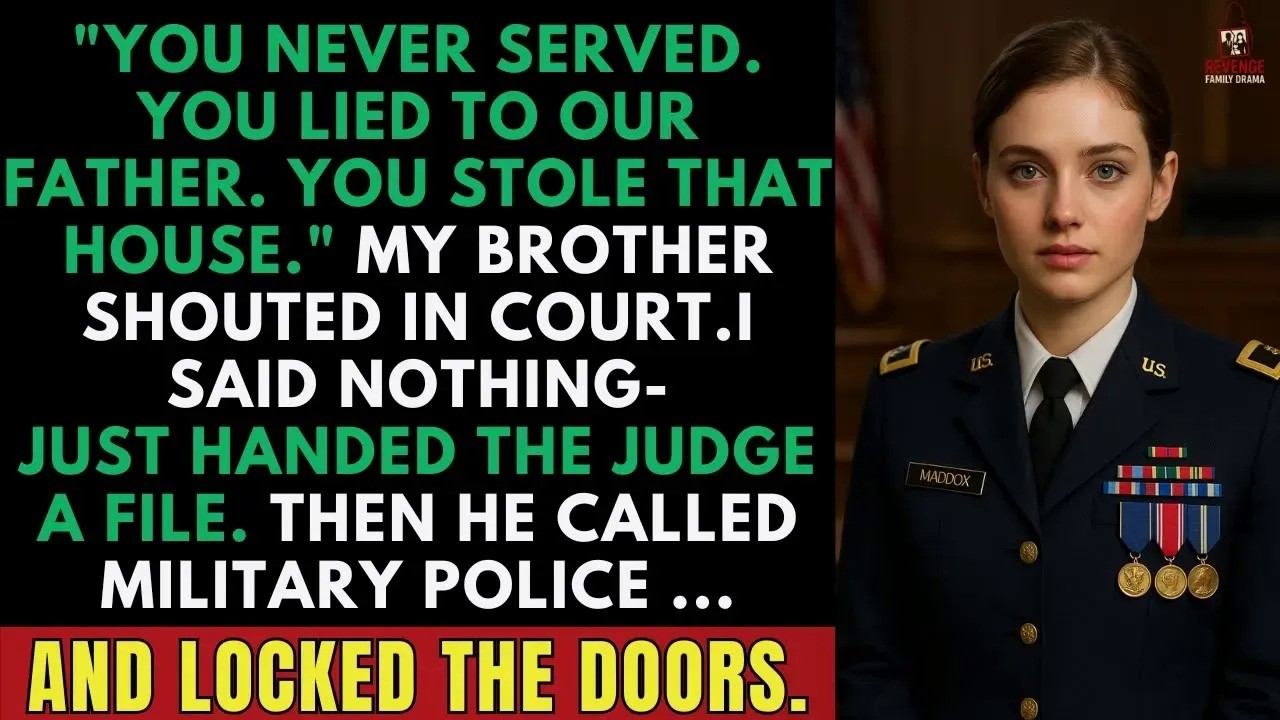
Eli, my youngest brother, stared at the floor. No one gasped. Just a silence so loud it rattled the brass nameplates. But I didn’t move.
I didn’t blink. I just reached for the tan folder beside me, the one I’d packed with every shred of proof they never thought I’d keep. My heels clicked against the floor as I walked to the judge’s bench. I placed the file down.
No speech, no plea. He opened it, read one page, then another, then another. Then he looked up, voice steady as steel. “Close the doors now.
”
And just like that, everything shifted. Not in the desert, not on the battlefield. In a courtroom with my name on the line. The house sat on the edge of a wind-beaten bluff facing the sea, like it had something to prove.
The porch was warped, the shutters hung crooked, and the salt air had long since stripped the paint bare. But it was mine. My father left it to me in his will. It wasn’t grand—three bedrooms, a fireplace that smoked too much, and floorboards that creaked under the weight of memory.
But after two decades of moving from tent to tent, from deployment to deployment, it was the only place in the world that felt still. Solid. I hadn’t even unpacked when the first sign of trouble came. The reading of the will had happened just three weeks earlier.
It was brief, civil, cold. Russell sat at the table in a pinstripe suit that probably cost more than my Jeep. Our mother sat beside him, her pearls perfectly spaced, hands folded like she was praying for a different outcome. Eli, our youngest, hovered in the back row like he was hoping to disappear.
When the attorney read the division, I knew before the words finished landing that something had cracked behind Russell’s eyes. The family business, Maddox Resorts and Coastal Holdings, went entirely to him. Eli was granted a trust fund, quietly structured, a payout he wouldn’t fight. And I?
I got the house. The last property our father ever renovated with his own hands. The one tucked against the cliffs outside Durance Bay. A place no one else in the family had wanted until it was no longer theirs.
Russell didn’t speak when the will was read. He just tightened his jaw the way he always had when told no. Our mother didn’t look at me, not once. And Eli kept his eyes low the way you do when you know something’s wrong but don’t have the spine to name it.
For a few weeks after that, it was quiet. I painted the porch railings, tore out the weeds from the garden, slept under the rafters listening to wind slam the shutters like it remembered me. For a moment, I thought maybe they’d let it go. Maybe this time there’d be no fight.
But that’s not how my family operates. Peace in our house is just a pause between offensives. The envelope came on a Tuesday. Heavy, cream-colored, formal.
Inside wasn’t a letter—it was a lawsuit. My own mother and brother were suing me, alleging I’d forged my military record, manipulated a dying man, and stolen what wasn’t mine. No call. No warning.
Just a neatly packaged attack delivered by courier. I set the papers down and walked to the window. The wind off the Pacific howled against the glass. So that was it.
I wasn’t just an outsider now. I was the enemy. I sat at the kitchen table with the lawsuit spread in front of me like a map of betrayal. Page after page, their language was clinical, precise, designed to wound without blood.
They claimed I’d misrepresented my military career, that I’d forged deployment records, that I’d manipulated my father during his final days to gain leverage over the estate. It wasn’t just about the house anymore. It was about erasing me entirely—from memory, from honor, from paper. There was no phone call, no family meeting, no attempt to talk like people who once shared breakfasts and birthdays.
Just signatures. Russell’s in that tight, aggressive script. Our mother’s in her flawless cursive, the same she used for Christmas cards and apology notes she never meant. I called Eli once.
He didn’t pick up. I didn’t try again. Instead, I cleared the table and spread out my own tools. Not weapons, not armor—documents.
Orders, citations, letters of recommendation from colonels whose names still meant something at the Pentagon. I printed out rosters, scanned award certificates, and pulled injury reports from the VA. I unearthed a photo of my unit in Basra, the one where we stood ankle-deep in floodwater, laughing like we weren’t scared. I printed that one, too.
I labeled everything. I cross-referenced every deployment, every commanding officer, every rank promotion. I checked digital timestamps, ink ages, file hashes. And somewhere around 3:00 in the morning, I found the first inconsistency.
A service entry had been misstated. Another was missing entirely. A commendation listed in one place but absent in the official database. It wasn’t random.
Someone had tampered with the record. Not sloppily—surgically. It was clean enough to raise doubt, but not enough to trigger flags. Whoever did it had access and motive.
I stared at the screen, my chest tight. Not from fear, but from a kind of cold clarity that only years of combat had taught me. This wasn’t just about money. This was about destroying the one thing I’d ever built that didn’t rely on them.
My name. I didn’t cry. I didn’t punch a wall or scream into the ocean. I made coffee.
I opened a fresh file folder, and I began planning a counterattack. At 0600, I submitted a formal request to the Department of Defense for a complete reissue of my record under FOIA. Then I started contacting people—former CEOs, NCOs, medics, aides. Anyone who remembered my time in.
Some responded with confusion, some with quiet support. One Lieutenant Colonel Ellery wrote back with a line I’d carry with me for weeks: “If they’re coming for you, they better bring more than paper. ”
But even as I built my case, the question burned behind everything I touched. Who did this?
And how far were they willing to go? The message came just after midnight. No contact name, no punctuation. Just five words glowing against the dark screen of my phone.
“We need to talk. Alone. ”
I stared at it for a long minute, thumb hovering over delete. But something in me—call it instinct or maybe just exhaustion—kept me still.
I typed one word. “When? ”
Fifteen minutes later, I was standing on the cliffs behind the house, jacket zipped high, the wind off the Pacific slicing through my sleeves. Eli was already there, his figure barely visible in the moonlight.
Shoulders hunched, hands jammed deep into his coat pockets, like they were hiding something heavier than fingers. He didn’t look at me when I approached. “I didn’t know it would go this far,” he said quietly. I said nothing.
The waves below us crashed in slow, relentless rhythm, like a clock ticking towards something none of us could stop. “They said it would just be a formal dispute. A delay. Nothing criminal.
Just leverage. ”
He pulled something from his coat pocket—a small flash drive—and held it out. “I shouldn’t have taken it,” he said. “But I did.
”
I reached for it without a word, my fingers brushing his, just long enough to remember we were blood. Back inside, I slid the drive into my laptop. It whirred softly, then opened. What stared back at me nearly buckled my knees.
Email threads. Dozens of them, between Russell and our mother, timestamped months before our father’s death. Discussions about estate revisions, false narratives, and digital manipulation. Conversations with a private tech firm contracted to sanitize my records in military databases.
Even drafts of press statements carefully crafted to preemptively discredit me should the story ever go public. They had planned everything. Down to the timing. Down to the language.
Eli had been left out of the details. But he’d been close enough to see the rot. “You were never supposed to win,” he said behind me. “Just fade.
”
I turned in my chair. He was leaning in the doorway now, eyes sunk in guilt, eating the edges of his voice. “Why now? ” I asked.
He hesitated. Then shrugged, like it hurt to say it. “Because you’re the only one who never asked me to pick sides. ”
We stood in silence for a while.
Not forgiveness, not closure—just two people staring at the same abyss from different cliffs. When he left, he didn’t say goodbye. He just gave me one last look, the kind that says, “Do something with this because I can’t. ” And disappeared down the hallway.
I stared at the screen again. My own mother. My own brother. Using my service, my scars, my silence as a weapon against me.
And they almost got away with it. Almost. The courthouse was built like it wanted to intimidate you. Columns too tall, walls too white, air too cold.
It smelled like old carpet and new fear. I arrived fifteen minutes early, not in uniform. I wanted them to see me as I was. No ribbons, no rank.
Just Harper Maddox. The woman they tried to erase. My attorney, Karen Briggs, met me on the steps. A calm, efficient woman with eyes like sharpened glass.
She didn’t waste time on pep talks. We’d been preparing for weeks. Every file labeled, every record verified, every inconsistency cross-examined. Inside, the courtroom was already filling.
Reporters lined the back row, their cameras tucked for now, but ready. Civil case, high-profile, family, military fraud allegations. Of course they came. Russell sat at the plaintiff’s table in a tailored gray suit, his tie a half shade too perfect.
He tapped a pen rhythmically against his folder. That smug business school smile anchored to his face like armor. Our mother sat beside him, spine straight, lips pursed. Her pearls matched the ones she wore at Dad’s funeral.
I wondered if she remembered. Eli sat two rows behind them. Alone. Silent.
The judge entered—Honorable Raymond Keener. No nonsense, no small talk. The room stood, then settled. Opening statements began.
Russell’s attorney led the charge. He spoke with measured concern, painting a portrait of a grieving family confused by the sudden reappearance of a daughter who’d long been absent. He used words like “irregularities,” “manipulation,” and “fabricated service timeline. ” He never raised his voice.
That wasn’t the strategy. They were building a story. One meant to seem reasonable. Doubtful.
Gray. Then Russell stood. He addressed the court like he was pitching an investment. Calm, polished, smiling just enough.
“My sister,” he said, “served some time, yes. But the record she presents today—it’s a reconstruction. A fiction. She came back into our lives only when there was property on the table.
We’ve uncovered alarming gaps in her claims. Some that border on fraud. ”
He turned to the judge. The room was silent now.
“And with all due respect, Your Honor, she’s not a real veteran. ”
That was the moment. The lie. Not the first, but the one that rang the loudest.
I didn’t flinch. I didn’t look away. I just stared ahead, hands folded, heartbeat steady. Karen stood beside me, her voice quiet but unwavering.
She began walking the court through the truth. My military career, my deployments, my commendations, my discharge records—all certified, timestamped, notarized. Then she paused. “Your Honor,” she said, “my client has one more item for the court’s consideration.
”
I rose. Picked up the tan folder from my briefcase. Walked it to the bench. No speech.
No anger. No defense. Just truth pressed between twenty pages and the weight of everything I’d never said out loud. The judge opened the folder slowly, like he already sensed what was inside would change the air in the room.
He read the first page, his brow furrowed. The second, his jaw clenched. By the third, his eyes had gone hard. Focused.
Then he looked up. “No one move,” he said, voice low but unmistakable. “Bailiff, close the doors. Lock them.
”
A murmur rolled through the gallery. Chairs creaked. A pen clattered to the floor. Before anyone could fully react, two officers from the military police stepped through the side doors.
Uniforms crisp, expressions unreadable. One moved to the back. The other approached the bench. The courtroom shifted suddenly.
Smaller. Quieter. Heavier. Russell froze mid-breath.
His lawyer dropped the pen he’d been nervously tapping. My mother gripped the arms of her chair like they were about to give way beneath her. And Eli—he didn’t move. But his hands, clasped in his lap, began to unclench.
The judge handed the folder to the MP nearest him. The officer flipped through the documents, nodding once, then whispered something to the judge. The judge leaned back, steadying himself before speaking again. “This court is now in possession of evidence suggesting multiple federal crimes may have been committed, including but not limited to willful fraud, tampering of military records, obstruction of official documents, and financial misconduct tied to veteran charity accounts.
”
The room inhaled at once, like the truth had sucked the oxygen out of it. “Effective immediately,” he continued, “this civil proceeding is suspended pending review by federal prosecutors. ”
Russell looked like someone had drained all color from his body. The mask was gone.
Beneath the tailored suit and tan skin was a man drowning in silence. His lawyer tried to rise, but the MP behind him raised a hand slightly. He stayed seated. My mother turned to the judge, lips parted as if to speak, but no words came.
She glanced toward Russell, then toward me, and quickly looked away. I didn’t speak. I didn’t smile. I didn’t even breathe too deeply, because this wasn’t a moment for triumph.
It was a reckoning. Page by page, the folder had undone everything they built. First, the emails outlining the strategy to discredit me—phrases like “narrative control” and “optics management” used like bullets. Then, the financial records showing money moved through shell accounts bearing my name, supposedly for veteran charities, but never reaching any real organization.
And finally, the will amended weeks before my father died, with signatures that didn’t match, notarized by a man who had never been licensed in our state. Every lie had a timestamp. Every manipulation, a digital footprint. They had built a machine to erase me.
And I had brought it to its knees. When the judge adjourned for recess, the gavel didn’t sound like wood. It sounded like closure. And somewhere between the turning heads and stiff silence, I realized something.
This time, they weren’t walking out first. I was. I stepped into the hallway. The heavy courtroom door clicked shut behind me like the seal on a vault.
For a moment, the sounds returned. Footsteps, murmurs, the distant rustle of paper from a clerk’s desk. But inside me, everything was still. I leaned against the wall, palms flat against the cool tile, and exhaled a breath I didn’t know I’d been holding for years.
My knees trembled—not from fear, but release. The kind that comes when your name is no longer under siege. Then I heard footsteps. Slow.
Familiar. I turned. Eli stood a few feet away. He wasn’t trying to hide anymore.
His hands were at his sides, his expression stripped of pretense. “I’m sorry,” he said, voice rough around the edges. I didn’t respond right away. I just watched him.
The boy who used to build model planes with me on the back porch. The man who had watched them lie and stayed silent. “You don’t have to be,” I said finally. “You did what mattered.
”
He looked down, swallowing hard. “I should have done it sooner. ”
“Maybe,” I nodded. “But you did it before it was too late.
That counts for something. ”
He nodded once. Just once. But in it was everything we hadn’t said since we were kids.
We didn’t hug. Didn’t cry. We just stood there in the soft noise of the courthouse hallway. Two people who had finally stepped out of someone else’s shadow.
Behind the courtroom walls, I imagined Russell pacing, flipping through a script that no longer worked. I pictured our mother still seated, clutching her purse like it could hold the fragments of her reputation together. Let them sit in it. Let them feel the weight of the silence they once used as a weapon.
I walked past the courtroom doors, down the hall, and out into the open air. The sun had risen higher while I was inside, and for the first time in months, I didn’t feel like I had to shield myself from it. No one waited for me. There were no reporters crowding the steps.
No applause. No speeches. And that was perfect. I didn’t need recognition.
I needed quiet. I got in my car and drove—not toward celebration, not toward revenge, but toward something smaller, older, more sacred. The house on the cliff. My house.
Where my father’s old jacket still hung by the door and the porch swing still creaked when the wind was just right. Where the ghosts didn’t haunt me. They stood guard. That evening, I brewed coffee and sat by the fireplace.
The tan folder rested on the mantel beside a framed photo of my unit in Baghdad. Their faces younger, their eyes tired. All of us bound by something deeper than family. I wasn’t a hero.
I wasn’t a victim. I was still standing. And finally, finally, I was seen. Almost a year has passed since that courtroom fell quiet and everything I carried was finally laid bare.
The investigation moved fast. Russell lost control of the business within weeks. His name vanished from guest lists and investor calls. Our mother retreated from the public eye.
No press statements, no apologies. Just silence. The kind they once used to keep me small. I didn’t watch it unfold.
I didn’t need the headlines. I already knew how it ended. Eli came by sometimes. He never said much about that day, but he always brought something—a newspaper, takeout, an old book of Dad’s.
We’d sit on the porch with the sea wind in our faces and say nothing at all. That was enough. One morning, I opened the chest in the attic. Inside was Dad’s field jacket from Vietnam, his mechanic’s patch still clinging to the sleeve.
Tucked into the inner pocket was a folded letter written in his square, shaky hand. He never sent it. Maybe he never intended to. But one line stayed with me.
“They’ll never understand what it takes to walk away with only your name. ”
But I do. I read it three times. Then I folded it back into the jacket.
That spring, I built a small memorial garden behind the house. Just lavender, smooth stones, and a bench I made with my own hands. On the backrest, I carved a single word: honor. Some nights, I sit there, mug in hand, letting the breeze carry what’s left of the past back out to sea.
I don’t dwell. I don’t ache. I simply exist. The house on the cliff still creaks when the wind gets mean.
The boards shift beneath my feet. But it doesn’t feel fragile anymore. It feels earned. They tried to erase me.
But they forgot I was trained for war. And sometimes, the strongest victory comes not from breaking your enemies, but from refusing to let them shape who you are. I never got revenge. I got something better.
Peace.