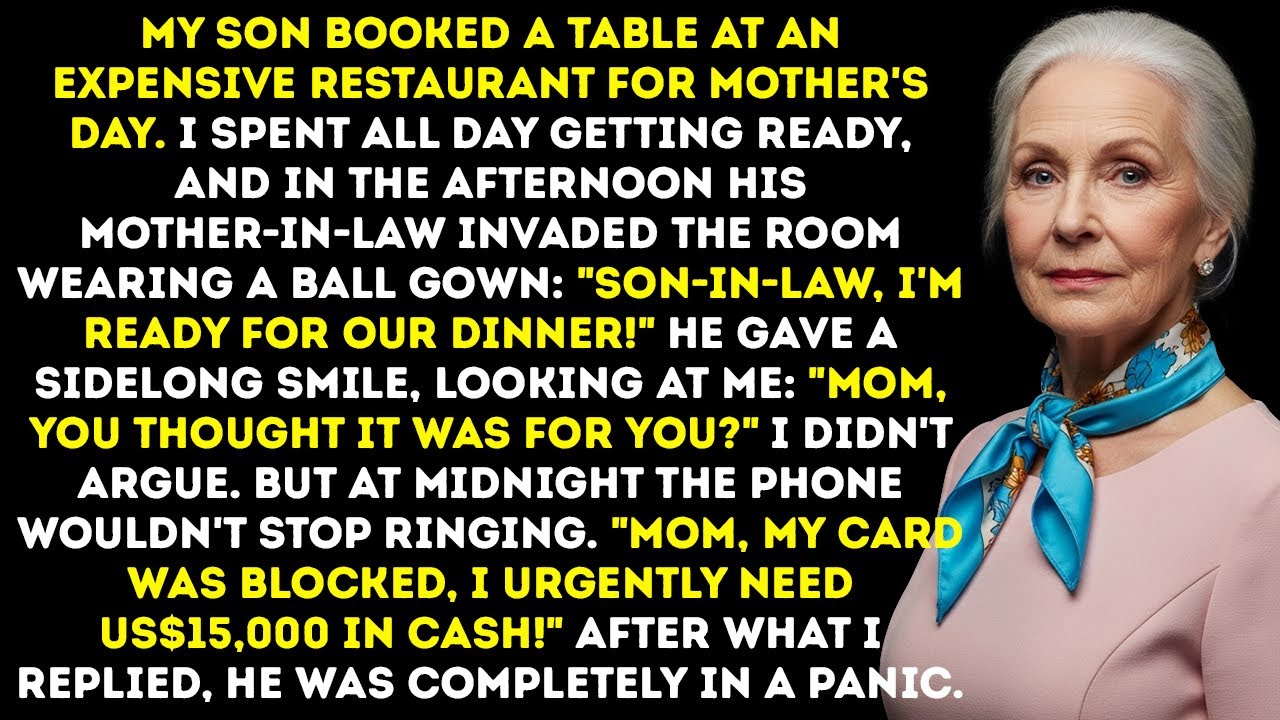
Sunday afternoon, 3:30. I was in front of my bedroom mirror, wearing a wine-colored dress I’d bought weeks ago, the pearl earrings my late husband gave me thirty years back. I’d spent the whole day getting ready. My son, Jason, had called me personally to say he’d booked a table at The Gilded Olive for Mother’s Day, that he’d pick me up at four.
For the first time in years, I believed him. At four-thirty, a car finally stopped outside. I grabbed my purse and hurried to the door, but I stopped when I heard laughter. It wasn’t just Jason.
His wife, Ashley, was there, and so was Victoria, his mother-in-law, wearing a gold, sequined, floor-length gown like she was headed to a gala. She climbed my porch steps, looked me up and down, and smiled with that smile that never reached her eyes. “Margaret. What a cute dress.
Very appropriate for staying at home. ”
She walked past me into my living room without an invitation. I looked at Jason. He was checking his phone.
“Son-in-law, I am ready for our dinner,” Victoria called out. Jason finally looked at me. He gave a crooked, almost mocking smile. “Mom, did you think this was for you?
”
The air left my lungs. He explained the reservation was for three: him, Ashley, and Victoria. He’d only come by to drop off some boxes in my garage, and he told me to dress up because he figured I might go out with friends. What friends?
I looked at him, the boy I raised alone while his father was sick, the boy I worked double shifts for, the boy who’d forgotten my birthdays and canceled our lunches for years. He was taking another mother out for Mother’s Day, and I was standing there in a new dress, holding my purse, watching him leave. They went down the steps together, three of them. Jason opened the car door for Victoria like a gentleman.
Ashley got in front. They drove off. I stood in the doorway for a long time. Then I closed the door quietly, took off my shoes, went upstairs, and sat on the edge of my bed in that dress, staring at the wall.
Let me tell you what my life had become. I get up at six every morning because my body no longer knows how to sleep in. I make coffee for one. I sit at a table meant for three.
I clean a house that’s already clean. I wait for the phone to ring, but it almost never does. The few times Jason called, it was always for something: watch the dog, store some boxes, lend me two thousand until payday. I always said yes, because it was the only way he’d remember I existed.
He visited Victoria every single Sunday. I know, because one day I saw him pruning her garden while I drove home alone from the market. He had time for her. He had time for everyone but me.
On my birthday, he forgot. Two weeks later, I saw photos of him throwing a huge party for Victoria’s birthday, with a cake and balloons. He was hugging her, smiling, singing. I closed my phone and sat on the bed, and something inside me broke a little more.
So when he called three weeks before Mother’s Day and said he’d made a reservation at The Gilded Olive, I let myself hope. I bought the wine-colored dress. I bought new shoes, a purse, a shawl. I told my neighbor Linda, “I feel like things are going to change.
” She said I deserved it after everything I’d done for him. That Sunday, I got ready slowly, carefully, like a woman who finally mattered. Then Victoria walked into my living room in that gold gown, and Jason said the words that should have destroyed me. Instead, they woke me up.
That night, I didn’t sleep. I stared at the ceiling and thought about everything clearly for the first time in years. My son didn’t love me the way I needed him to. He loved me the way you love a convenience.
And I had begged for that love, justified it, paid for it with my dignity. I decided I was done. The next morning, I opened my computer and logged into my bank account. I saw the joint account I shared with Jason, the one we’d opened years ago for emergencies.
Over the past six months, he had withdrawn nearly fifteen thousand dollars. My money. I closed that account, transferred the twenty thousand that was left into my private account, and canceled the credit card he had in my name. I changed all my passwords and set up notifications.
My accounts became mine again. Then I went to the garage and took out every box he’d stored there. Old books, clothes, trophies, things he hadn’t touched in years. I left them all in the driveway.
My garage was no longer his storage unit. Wednesday night, my phone started ringing and wouldn’t stop. Seven calls from Jason. I finally answered.
“Mom, they blocked my card. I need fifteen thousand dollars in cash, urgently. It’s for a business deal. If I don’t pay tonight, I lose everything.
”
Fifteen thousand. Exactly what he’d taken from me. “No, Jason. ”
Silence.
Then he said, “I am your son. How are you going to leave me like this? ”
“Do you remember Sunday, Jason? When you left me standing at the door while you took Victoria to dinner on Mother’s Day?
”
“It was just a dinner, Mom. You’re exaggerating. ”
I told him I was no longer going to be his bank, his storage unit, his mother of convenience. He got angry.
He said he never really needed me anyway. “That’s fine,” I said. “It’s a risk I’m willing to take. ” And I hung up.
He called again. Ashley sent desperate messages. I turned off my phone and slept better than I had in months. Thursday morning, I woke up different, lighter.
I blocked their numbers. I ate breakfast calmly. Then I heard a car outside. Jason stood at my door with red eyes and a tired face.
He pleaded, said he’d invested thirty thousand in a business deal that turned out to be a scam. He begged me for a loan, offered his car as collateral, promised he’d change. I looked at him and felt something I had never felt before: distance. A healthy kind.
“I don’t want your words, Jason. I want you to show me. When you have a real answer, we can talk. ”
He left angry, saying he’d never ask me for anything again.
The following weeks were silent, and I was okay. I joined a reading group. I enrolled in a painting class. Linda and I started walking in the afternoons.
I started remembering who I was beyond being his mother. Then, two and a half weeks later, he came back. He looked different, humbled. He sat in my living room and said, “I didn’t come to ask for money, Mom.
I came to tell you that you were right. About everything. ”
He lost all the money. The partners disappeared.
It had all been a scam. Ashley almost left him. And in that mess, he finally realized something: he had always run to me with his problems, but he never once asked how I was. Never saw if I was alone or sad.
Tears ran down his face, real ones. He said he knew he’d been a terrible son, especially since his father died. He remembered Sunday, seeing me standing at the door with my new dress and hopeful eyes, knowing he was doing something horrible, but doing it anyway because it was easier to disappoint me than to face Victoria and Ashley. He pulled an envelope from his pocket.
Inside was a handwritten letter, page after page, listing every forgotten birthday, every unreturned call, every broken promise. At the end, a commitment: lunch every Sunday, a call every Wednesday, real celebrations together. “I know this doesn’t make up for what I did, Mom. But I want to try.
If you still want me in your life. ”
I looked at this man, my son, and I made my decision. “You get one chance, Jason. But things will be different.
I won’t be the mother who accepts anything again. ”
He promised he understood. That he’d deliver this time. The following months weren’t perfect.
There were slip-ups. But when he forgot, I reminded him, and he apologized and tried again. He came to my painting classes, sat beside me, and painted horribly, but he tried. He called every Wednesday.
We had lunch every Sunday, sometimes at my house, sometimes at his. Ashley started treating me with respect. I never gave him the fifteen thousand, and he never asked for it again. A year after that terrible Mother’s Day, Jason showed up at my house early in the morning with flowers, a wrapped gift, and a reservation for two at The Gilded Olive.
“Mom, allow me to take you to dinner today. To make up for last year. To start a new tradition. ”
We sat at that table that should have been mine all along.
We ate, we talked, and we even laughed. And for the first time in years, I felt seen and valued, not out of desperation, but in a quiet, healthy way. I was no longer a mother begging for attention. I was Margaret Gonzales, a sixty-six-year-old woman who had finally learned to value herself.
And my son finally understood that when I set boundaries, I wasn’t losing him. I was finding myself. And that, in the end, was what saved us both.