TERRE HAUTE, Ind. — The federal government carried out its seventh execution since resuming capital punishment this summer, putting to death a 40-year-old Texas man who was 19 when he led a group of young men in the kidnapping, robbery, and murder of a married couple who had stopped to help them.
Christopher Andre Vialva was pronounced dead at 6:46 p. m. Eastern Time on September 24, 2020, inside the federal execution chamber at USP Terre Haute.
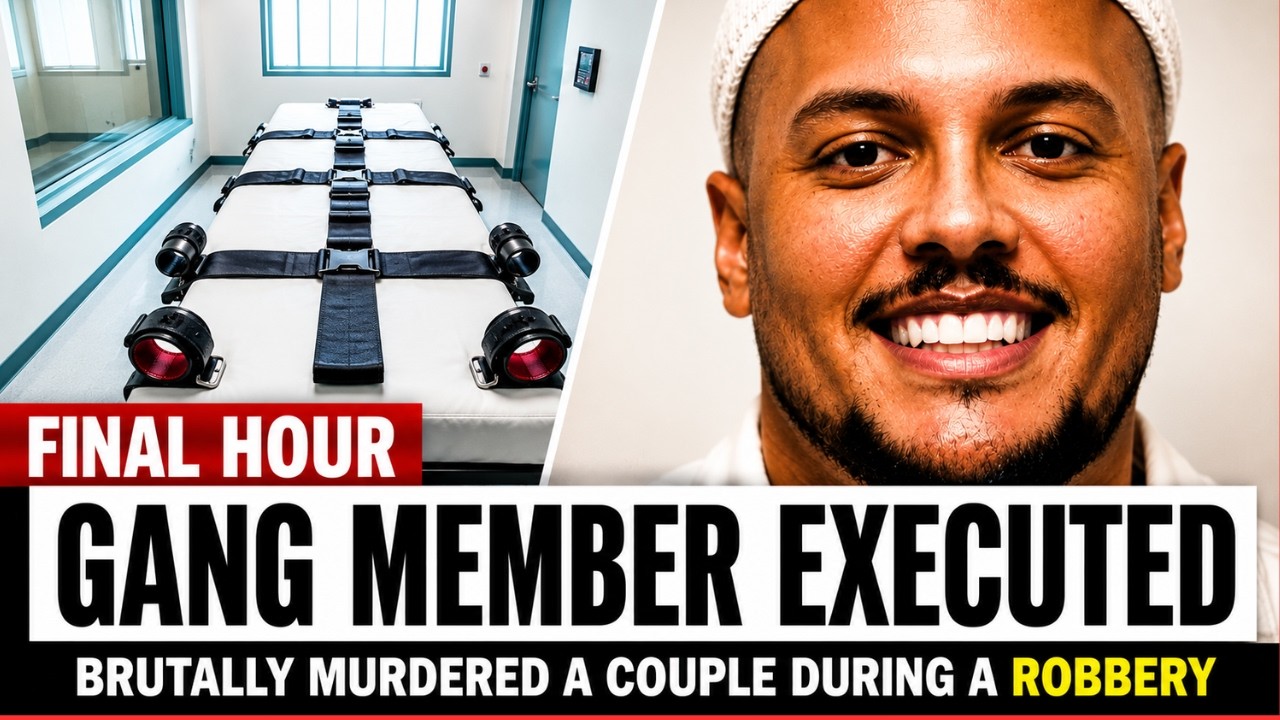 He had spent more than half his life on death row, condemned for a crime committed in June 1999 that took the lives of Todd and Stacey Bagley, a young Army veteran and his wife who had agreed to give a stranger a ride.
The execution proceeded after the Supreme Court rejected a last-minute appeal and the president declined to intervene, clearing the way for the first federal execution of a Black prisoner in the current series of resumed federal death sentences. Outside the prison walls, a crowd of protesters gathered, their candlelight vigil a stark counterpoint to the solemn procedure unfolding inside.
Vialva’s case had become a focal point for death penalty opponents, not only because of his age at the time of the crime but because of the dramatic transformation he underwent during his two decades of incarceration. His supporters argued that the government was executing a man who no longer existed, a remorseful and religious individual who had grown far beyond the angry teenager who committed an unforgivable act.
The crime that defined Vialva’s life began on June 21, 1999, when he and four other young men, several of them juveniles, were looking for a target. They had discussed robbing and carjacking a motorist, and they encountered Todd Bagley, 26, and his wife Stacey, 28, at a convenience store in Killeen, Texas. Todd and Stacey, known for their generosity and deep involvement in their church’s youth ministry, agreed to give some of the young men a ride.
That act of kindness placed them directly in the path of a plan that had already been set in motion. Once inside the vehicle, Vialva and the others produced firearms, took control of the car, and forced the couple into the trunk. For hours, they drove around, using the Bagleys’ bank card to withdraw money and attempting to dispose of their belongings, all while the couple remained confined in the darkness of the trunk.
The Bagleys, according to testimony presented at trial, spent those final hours pleading for their lives. They spoke about their faith, they prayed, and they sang hymns, desperately trying to reach the humanity of the young men who held them captive. They told their captors about forgiveness, a concept that would prove tragically insufficient in the face of the decision that was already taking shape.
Prosecutors argued that Vialva, as the leader of the group, made the calculated decision that the couple could not be left alive because they could identify their attackers. The vehicle was driven to an isolated section of the Fort Hood military reservation, a location chosen for its privacy and federal jurisdiction. There, the robbery transformed into a double homicide.
Evidence presented at trial established that Vialva shot both Todd and Stacey while they were still inside the vehicle. Brandon Bernard, another member of the group who was 18 at the time, later participated in setting the car on fire. Todd died from the gunshot wound.
Prosecutors maintained that Stacey, who had been wounded, was still alive when the fire began and died as a result of the flames.
The scene was not one of impulsive violence but the culmination of a series of decisions made over several hours, each one an opportunity to stop that was not taken. The couple’s final moments, their prayers and songs echoing from the trunk of their own car, became a powerful piece of testimony that would later shape how jurors understood the case. It revealed the kind of people Todd and Stacey had been until the very end, people whose faith was not merely spoken but lived, even in the face of imminent death.
Following the murders, the group scattered, but the crime had left a trail that investigators were able to follow. Financial records, witness statements, and physical evidence gradually pieced together the couple’s final movements. The fragile agreement among the five young men to remain silent began to fracture under the pressure of the homicide investigation, leading to plea agreements and testimony that provided an inside account of the crime.
 Christopher Lewis and Terry Brown, who were juveniles at the time, entered into plea agreements and agreed to testify against the others. Their statements, while subject to questions about their motives as cooperating witnesses, were corroborated by the movement of the victims’ money and property. The evidence painted a clear picture of Vialva’s central role in controlling the victims and carrying out the shootings.
In 2000, Vialva and Bernard went to trial in federal court in the Western District of Texas. The prosecution presented the case as a sequence of deliberate choices, each one made with time for reconsideration. Vialva had helped plan the carjacking, he had controlled the victims, and when they became witnesses, he had chosen to 𝓀𝒾𝓁𝓁 them.
The defense, facing an impossible task of proving innocence, instead focused on Vialva’s troubled childhood.
His mother, Lisa Brown, testified about her difficult pregnancy, the collapse of her relationships, domestic instability, and the racial rejection that surrounded their family. She described a childhood marked by a sense of not belonging, caught between two racial identities and rejected by members of her own white military family for marrying a Black man. The defense argued that this history of instability and rejection had shaped the angry young man who committed the crime.
The jury was tasked with weighing this mitigation evidence against the brutality of the crime itself. Prosecutors argued that hardship did not erase personal responsibility, noting that Vialva was 19, not a child, and that the crime had lasted for hours, providing ample opportunity to stop. The jury concluded that the circumstances of Vialva’s childhood did not outweigh the planning, leadership, and loss of two lives, and they sentenced him to death.
Vialva was approximately 20 years old when the formal sentence was imposed. He was transferred to federal death row at USP Terre Haute, where his world shrank to concrete walls and controlled movement. Visits with his family took place through glass, and physical contact became a distant memory.
For two decades, his existence was defined by the narrow routines of confinement, punctuated by legal filings and the slow grinding of the appeals process.
According to his mother and his legal team, Vialva was initially angry after arriving on death row, but over time, he began to change. He became deeply religious, embracing Messianic Judaism, and devoted himself to studying scripture and Hebrew. He reflected on the crime and expressed genuine remorse for the pain he had caused.
His supporters described him as peaceful, mature, and fundamentally different from the teenager who had entered the Bagleys’ vehicle.
Those who corresponded with Vialva during his years on death row described a man who spoke openly about the crime, who did not minimize his role in it, and who expressed a desire to somehow make amends to the Bagley family, even knowing that such a thing was impossible. This transformation was consistent and sustained over many years, not something that appeared only as his execution date approached. It raised a profound question that would follow his case to the very end.
 Does personal transformation matter after murder? Should punishment consider only the person who committed the crime, or also the person that offender eventually becomes? A justice system built around retribution might argue that the person who committed the crime is the person who must answer for it, regardless of who they later become.
A system oriented toward rehabilitation might ask whether continuing to punish someone who has genuinely changed serves any purpose beyond vengeance.
For supporters of the execution, Vialva’s growth was welcome but did not cancel the sentence. For his mother, every sign of change made the approaching execution more unbearable. She believed the government was preparing to 𝓀𝒾𝓁𝓁 a man who no longer resembled the teenager the jury had condemned.
The legal battle over his fate continued for two decades, with courts repeatedly rejecting appeals and upholding the original conviction and sentence.
As the execution date approached, Vialva’s attorneys presented a broader argument, pointing to modern research showing that the areas of the brain governing impulse control, long-term judgment, and resistance to peer pressure continue developing beyond age 18. They argued that the original jury had not received a complete understanding of Vialva’s childhood, psychological development, and racial identity. Death penalty opponents noted that this was the first federal execution in approximately 70 years for an offense committed by a teenager.
Race also became a point of debate in the case. Vialva was a young Black man convicted of killing a white couple. His defense argued that racial perceptions may have influenced how jurors interpreted his size, anger, leadership, and dangerousness.
However, no court found sufficient evidence that racial discrimination had legally invalidated his conviction or sentence. The Bagley family saw the matter differently, viewing the case as one that had already been thoroughly examined for two decades.
The clemency campaign presented two truths that could exist at the same time. Vialva had endured a deeply troubled childhood and may have genuinely changed. Todd and Stacey were still dead because of choices he made.
Both of these statements were true, and neither canceled out the other. The case arrived at a moment when the federal government, after nearly two decades without carrying out an execution, had resumed the practice in the summer of 2020.
The timing meant that Vialva’s individual case was being decided against a much larger backdrop, one in which the broader policy of resuming federal executions was itself the subject of intense public debate. On the final day of his life, Vialva was 40 years old. His last hours unfolded inside USP Terre Haute as his lawyers continued pursuing every remaining legal option.
 Outside, members of the Bagley family prepared to witness the sentence carried out.
For them, this day represented the end of a wait that had stretched across two decades, a wait defined not by anticipation but by the slow accumulation of court dates, appeals, and the persistent uncertainty of not knowing when or if the sentence would finally be carried out. Vialva reportedly requested food from Pizza Hut for his final meal. His final statement was not a declaration of innocence but an expression of remorse and a prayer for Todd and Stacey’s family.
He asked God to bring healing, comfort, and peace to the people whose lives had been permanently altered by his actions. Shortly before the execution began, he reportedly said, “I’m ready, Father.” He was the seventh federal prisoner executed after the government resumed federal executions in July 2020 and the first Black prisoner executed during that renewed series.
His death did not resolve the argument surrounding his case.
Some saw the execution as delayed justice for Todd and Stacey, a sentence imposed by a jury and upheld through years of appeals. Others saw it as evidence of a system unwilling to acknowledge that a damaged 19-year-old could become a remorseful and rehabilitated adult. Vialva’s childhood explains part of his journey.
It does not excuse the choice he made. His transformation may have been genuine. It could not restore the two lives he took.
The case leaves a question that has no comfortable answer. When a teenager commits an unforgivable crime but grows into a different man, which version of him should the law punish? The boy who made the decision or the adult who lived long enough to regret it?
Todd and Stacey Bagley never got the chance to grow into anyone else. They never got 20 more years or 10 or even one. They never got to see whether their marriage would produce children or what ordinary milestones the rest of their lives might have held.
Whatever conclusion each observer reaches about Vialva’s transformation, his punishment, or the fairness of the system that carried it out, that fact remains unchanged and unchangeable. The truest, simplest fact at the center of this entire story is that two people who stopped to help a stranger lost their lives in the most violent way imaginable, and the man who led the group that killed them was executed for it. The debate over whether that execution was just or whether it was the culmination of a flawed process will continue long after the chamber has been cleaned and the protesters have gone home.