“Trash belongs with trash,” Eleanor whispered, leaning close enough that her words were meant only for me. The chair was pushed against the wall, beside a large black trash can, at the back of my husband Daniel’s promotion reception. I had laughed at first, thinking she was joking. She wasn’t.
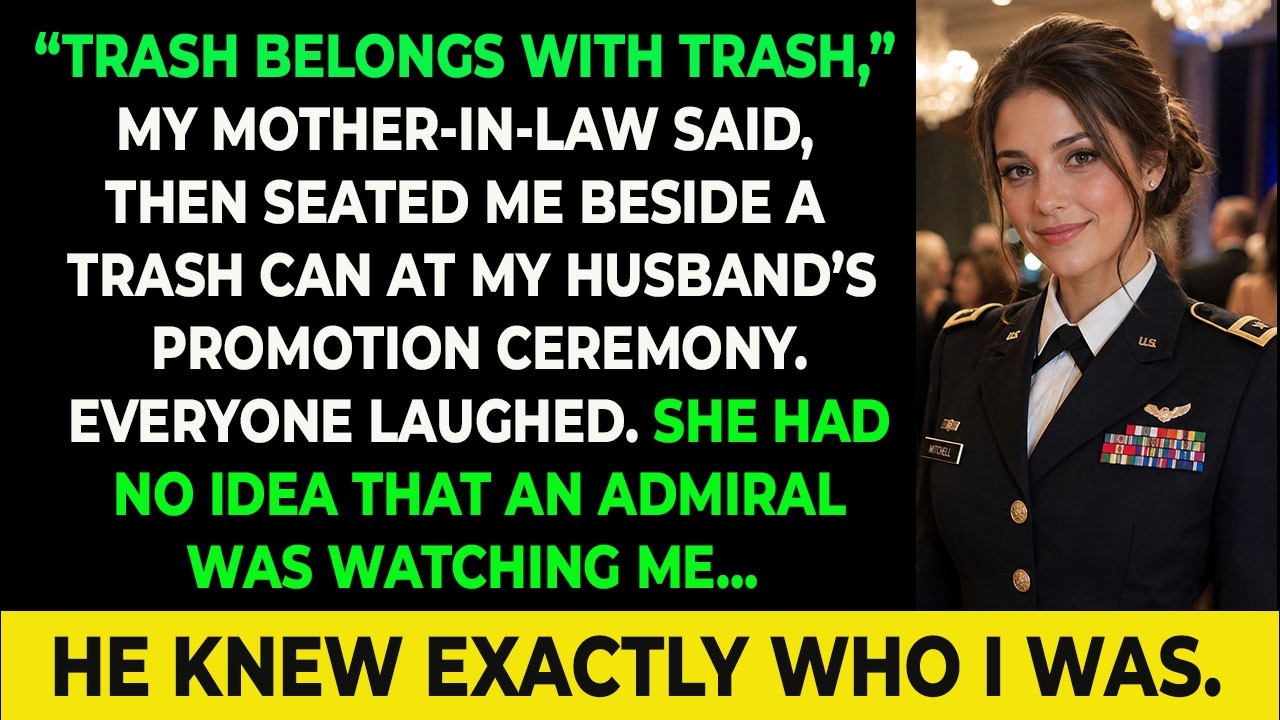
People nearby heard her. A man covered his mouth. A woman actually laughed. Then others joined in.
I sat down. Not because I accepted her insult, but because I wouldn’t give her the satisfaction of seeing me run. Across the room, Daniel saw me. Our eyes met.
I waited for him to cross the room, to say something, anything. Instead, he looked away. That was the moment something inside me changed. Not with an explosion, just quietly.
I had spent 25 years protecting Daniel’s comfort. He had spent those years allowing other people to destroy mine. I folded my hands in my lap and watched the ceremony begin. Then something strange happened.
A senior admiral near the front turned around and looked directly at me. I had never met him, at least not in the life Daniel knew. He looked away, then looked back. His expression changed.
He leaned toward another officer and said something I couldn’t hear. When Daniel received his new rank, the admiral stood. But he wasn’t looking at Daniel. He was looking at me.
He walked slowly across the room. The conversations faded. He stopped in front of me. “Commander Carter,” he said quietly.
“I never thought I’d see you sitting beside a trash can. ”
My heart stopped. Because there was only one reason he could have called me commander. And Daniel had never known about it.
Before I met Daniel, before Norfolk, before I became the woman who remembered her mother-in-law’s prescriptions, I had been someone else. I joined the Navy when I was 22. I worked hard, learned quickly, and found myself in assignments that required discretion. I earned promotions.
I received commendations. And somewhere along the way, I met Admiral Thomas Reynolds—then a senior officer with a reputation for being demanding but fair. He remembered people who did the right thing when nobody was watching. That’s why his presence at the reception frightened me more than it impressed me.
If he recognized me publicly, my carefully buried past was no longer buried. Daniel finally approached us. “Admiral,” he said, forcing a smile. “It’s an honor.
”
Reynolds shook his hand. “Congratulations, Captain Carter. ” Then he looked at me again. “How have you been?
”
“I’ve been well. ”
He nodded. “You disappeared. ”
“I thought that was the point.
”
He laughed. It was the first time that evening anyone had laughed without trying to hurt me. Daniel looked between us. “What exactly did you two do together?
”
Eleanor stepped forward. “I had no idea Maggie served. ” The way she said “served” made it sound ridiculous. I could have told her everything right there.
Instead, I said it was a long time ago. Daniel’s eyes narrowed. “You never told me you were a commander. ”
“I told you I served.
”
“You never said this. ”
I looked at him. “You never asked. ”
That silenced him.
The reception continued, but something had changed. People who had ignored me earlier now came over to introduce themselves. Eleanor disappeared toward the other side of the room. For the first time that evening, she looked uncomfortable.
I didn’t enjoy seeing it. I had expected satisfaction. Instead, I felt tired. Because none of this changed what had happened.
I had still been humiliated. Daniel had still watched. And the woman who had spent years calling me insignificant had only stopped because someone with more authority had recognized me. That bothered me.
I didn’t want respect because of a uniform I had worn decades ago. I wanted respect because I was a human being. After the reception, Daniel and I drove home in silence. Finally, he spoke.
“Why didn’t you tell me? ”
“Because I loved you. I didn’t want our marriage to become a competition. I was protecting a part of myself that belonged to me.
”
He frowned. “Were you hiding something from me? ”
“I was protecting a part of myself that belonged to me. ”
He didn’t understand.
He never had. When we got home, I went into the spare room and opened the bottom drawer of a wooden filing cabinet. Inside was a small blue box. Daniel stood in the doorway.
Inside were my old Navy ribbons, photographs, commendations, and a folded letter from Admiral Reynolds. Daniel stared at a photograph of me at 28, standing beside three other officers. I looked younger, stronger, certain. “You look different,” he said.
“I was different. ”
“Why did you leave? ”
That wasn’t the whole truth. There had been an investigation—a contractor, missing records, money moving through accounts that should never have been connected.
I had made a decision that put my career at risk. I walked away afterward because I wanted an ordinary life. A husband. A home.
I thought ordinary meant safe. I had been wrong. The next morning, Daniel and I talked for the first time in years. I told him about my work in maritime intelligence and security.
I told him about a young logistics officer named Michael Harris who had discovered something in shipping records and brought it to me because he trusted me. That decision changed both our lives. He was reassigned. His career never recovered.
I told him about the investigation that reached Admiral Reynolds. I testified. The investigation stopped a major contract and several people were disciplined. One contractor lost a lucrative agreement.
The Navy quietly changed some internal procedures. No press conference. No hero announcement. Just conference rooms with fluorescent lights and stale coffee.
“Why didn’t you ever tell me all this? ”
“I told you enough. ”
He rubbed his forehead. “I thought you left because you couldn’t handle military life.
”
“My mother said,” he added. I held up my hand. “Don’t. ”
She had told him I wasn’t ambitious.
She had told him I was lucky to have him. He had repeated her opinions so often they had become his own. Later that afternoon, Admiral Reynolds called. He apologized for not reaching out sooner.
Then his voice became serious. “Maggie, there is something you need to know. The investigation from all those years ago may not be as finished as we thought. Some records have resurfaced.
”
“Why are you telling me? ”
“Because your name is in them. ”
He paused. “Someone may have been protecting the wrong people.
”
That evening, Daniel came home carrying flowers. “I owe you more than an apology,” he said. I looked at him. “Then start with the truth.
”
His face tightened. He reached into his jacket and pulled out his phone. It was a series of text messages from a woman named Karen, who worked in his command. They were ordinary at first.
Then they changed—messages about missing each other, about hotel rooms during temporary assignments. I kept scrolling. My hands were perfectly steady. “How long?
” I asked. “About eight months. ”
“Your mother knew. ”
His silence answered me.
That hurt more than the affair. Daniel had allowed his mother to become a witness to something that should have remained between husband and wife. And she still put me beside that trash can. “You let your mother humiliate me,” I said.
“You cheated on me and kept both things from me while accepting congratulations for your promotion. ”
“Because I was ashamed,” he finally said. “I spent years feeling like I wasn’t good enough. You had your own career.
You had done things I could barely understand. I convinced myself that I needed to be the successful one. So I made you smaller. ”
I stared at him.
“Your mother thought I couldn’t compete with you. She didn’t know who you were. Neither did you. ”
He had no answer.
The next morning, I met with an attorney. I wasn’t filing for divorce that day. I just wanted to understand my rights. She said something that stayed with me: “Whatever you decide, make sure you’re making the decision from a position of knowledge, not fear.
”
That afternoon, Reynolds asked me to meet him privately. He slid a folder across the table. My original report had been requested from an old archive. A former senior official had requested access.
The folder’s third page made my breath catch. There was a signature I recognized. Someone I had trusted 25 years ago. Someone who had sworn the investigation was finished.
Someone who had told me to go home and forget everything. Richard Hail. A senior civilian official from the original investigation. The person who had been protecting the wrong people hadn’t disappeared.
He had been watching from the beginning. And now he knew I was back. I didn’t sleep that night. The internal review began a week later.
I answered every question I could. I provided copies of every document I had kept. I never exaggerated. I never guessed.
I had learned long ago that revenge built on lies eventually turns against the person seeking it. Daniel’s situation became more complicated. His affair wasn’t a criminal matter, but his failure to disclose it raised questions. His promotion was placed under review.
He could have blamed me. He didn’t. When someone asked him what had happened, he told them the truth: “I betrayed my wife. I made choices that damaged my judgment.
Whatever consequences come from that, I accept. ”
Eleanor came to see me again. She brought a small cardboard box of old photographs from the early years of our marriage. Daniel and I stood outside our first apartment, laughing.
Young. Happy. “He loved you then,” she said. “I know he still does.
”
I looked at her. “Love isn’t enough. ”
She nodded. Then she told me something I had never heard.
Daniel’s father had spent his entire career believing he had failed as a military man. Eleanor had spent decades making sure her son never felt that way. When Daniel married me, she believed my accomplishments would make him feel inadequate. “So I convinced myself that if I made you smaller, he’d feel bigger.
” Her voice broke. “I was wrong. ”
“I don’t expect you to forgive me,” she said. “I don’t.
”
She nodded. “But I hope someday you will. ”
I didn’t answer. Forgiveness wasn’t something I could give that afternoon.
It had to be earned. Weeks passed. Reynolds called. The review found significant evidence against Hail.
There would be further investigation. Then Daniel came into the kitchen. His promotion had been revoked. “I’m sorry,” I said.
He nodded. “So am I. But that’s not the worst part. I finally understand that I spent years chasing a rank because I thought it would make me worthy of the people I loved.
And I already had the thing that mattered. ”
For the first time since the ceremony, I reached across the table and took his hand. Not because everything was forgiven. Not because the marriage was repaired.
But because I could finally see the man underneath the uniform. Over the next several months, we worked through the wreckage slowly. Daniel learned to listen without defending himself. He learned that saying “I didn’t mean it that way” didn’t erase what someone experienced.
And I learned that forgiving someone did not require me to stop remembering, to pretend the past hadn’t happened, or to give up my boundaries. The old investigation continued. Richard Hail became the focus of a broader federal inquiry. The evidence showed that money from the original contract had been redirected through several companies over the years.
Some people were long gone from government service. Others had retired comfortably. There were subpoenas, interviews, financial records, lawyers, and months of paperwork. That was justice in real life—slow, careful, uncomfortable, but real.
Daniel started volunteering with a local veterans organization. One afternoon I saw him helping an older veteran carry boxes from his car. Nobody was watching. No cameras.
No promotion. He was simply helping. He wasn’t trying to become impressive. He was trying to become decent.
Eleanor changed too. She stopped calling every Sunday. Instead, she called once every few weeks and asked whether I wanted to talk. If I said no, she accepted it.
She never demanded forgiveness. She simply waited. One Saturday, she stood outside my door holding a pie. We ate at the kitchen table.
She finally said the most honest thing she had ever told me: “I was making Daniel feel small by teaching him to compare himself to you. ”
About a year after the promotion ceremony, Admiral Reynolds invited me to a small veterans recognition ceremony. No cameras. No reporters.
When my name was called, I walked to the front. Reynolds simply shook my hand. “Still the same Commander Carter. ”
I smiled.
“Just older, wiser. ”
Daniel was standing in the back, watching, proud. For the first time, I didn’t need him to defend me. I didn’t need Eleanor’s approval.
I didn’t need an admiral to recognize me. My worth had never depended on any of them. The woman sitting beside that trash can had already known who she was. She had simply forgotten for a little while.
A year after that night, I drove back to the same naval facility. Daniel sat beside me. We were attending a ceremony honoring veterans who had contributed to their communities after leaving active duty. Eleanor stood near the entrance, wearing a simple gray sweater.
“Good morning, Maggie,” she said. No insult. No sarcasm. Just my name.
Later, I was called to the front. Admiral Reynolds introduced me simply—that I had served with integrity and once made a difficult decision when doing the right thing was not the easy thing. I looked at the people in front of me. Veterans with gray hair.
Spouses who had waited through deployments. I thought about that trash can. “I’ve learned something about dignity,” I began. “Dignity isn’t something another person gives you.
And it isn’t something they can take away. You don’t have to become cruel just because someone was cruel to you. You don’t have to destroy someone to prove that they were wrong about you. And you don’t have to forgive before you’re ready.
Forgiveness isn’t permission. It’s not forgetting. For me, forgiveness meant putting down something heavy that I had been carrying for too long. ”
The applause was gentle.
Sincere. After the ceremony, Daniel and I walked outside. He asked if I ever thought about what would have happened if the admiral hadn’t recognized me that night. “I think I would still have left that chair,” I said.
He nodded. “Even without him. Especially without him. ”
“That night wasn’t about the admiral.
It was about me realizing I didn’t need anyone’s permission to respect myself. ”
He asked if I would ever completely forgive him. “I already have,” I said. “But forgiveness doesn’t mean I forget.
And it doesn’t mean we’re going back to the way we were. ”
“I don’t want to go back,” he said. “I think we can build something better. ”
Maybe we could.
Maybe we couldn’t. I had learned to judge people by what they did consistently, not what they promised during emotional moments. Daniel had spent the past year showing me who he wanted to become. So I gave him the chance to keep showing me.
Eleanor eventually became part of my life again. Not the center of it. Not the person whose approval I sought. But family.
Sometimes I think about that chair. A simple folding chair beside a black trash can. For years, I thought that was where my humiliation began. Now I realize it was where my life changed.
Everyone in that room thought they knew who I was. They were wrong. The most important thing I learned wasn’t that I had once been a commander. It wasn’t that an admiral remembered me.
It wasn’t that an old investigation eventually exposed people who had hidden behind power and money. The most important lesson was much simpler: never let someone else’s cruelty become the definition of your worth. I still remember sitting beside that trash can. But I don’t remember the laughter anymore.
I remember the moment I stood. I remember thinking, “I know who I am. ”
That was enough.