Aaron’s hand pressed flat against my chest. Then he pushed. It wasn’t violent. It was just enough to draw a line that could never be crossed again.
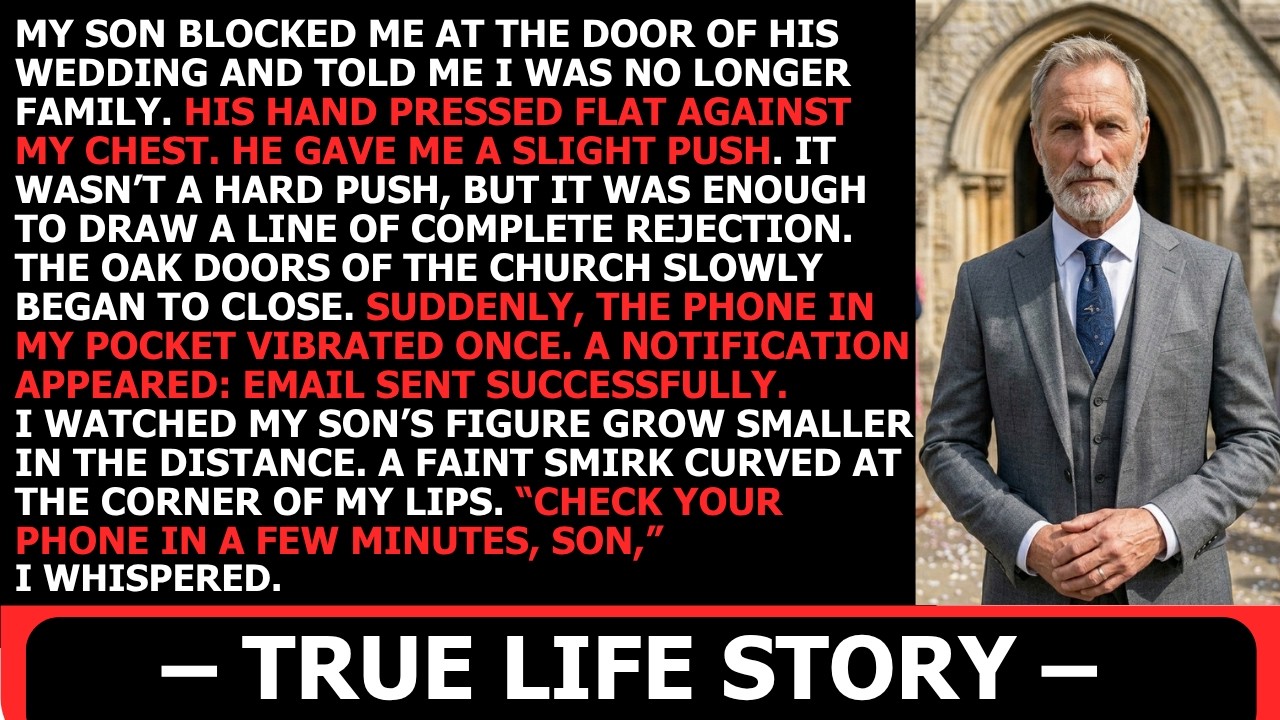
The heavy oak door of the church swung shut between us. At that exact moment, my phone vibrated once in my pocket. Email sent successfully. I watched his back disappear into the building.
“Check your phone later, son,” I whispered to myself, my voice calm as a frozen lake. Then I turned and walked down the stone steps. Behind me, the massive door slammed shut, sealing me out of my only son’s wedding. Aaron had forbidden me from attending.
His eyes had held no warmth, no trace of family—only suspicion and poorly disguised contempt. “The family has already decided, Dad. You’re not part of us anymore. ”
Every word landed with perfect clarity.
I saw hesitation flicker across his face for just a moment. Then blind pride won. He turned his back on me and walked into the sanctuary where Stephanie waited in a designer gown purchased with a credit card tied directly to my account. I didn’t beg.
I didn’t shout. Twenty years in business had taught me one lesson above all others: the person who wins never needs to raise his voice. I straightened my silk tie and took a slow breath. The scent of candles and lilies drifted from inside the church.
The irony was almost laughable. As the Mercedes engine came to life, my mind traveled back three years. Back to a hospital room saturated with antiseptic. Back to where Catherine took her final breaths.
My wife’s hand had become painfully thin. Blue veins stood out beneath her pale skin. She squeezed my hand weakly, yet her grip carried the weight of a thousand promises. She looked at me through eyes clouded by illness.
“Protect him, Gerald. Even if he has to hate you to grow up. He’s too emotional. He doesn’t see through people the way you do.
”
Then she was gone. Before her death, she left a confidential will prepared by attorney Patterson. None of her vast estate was transferred directly to Aaron. Three manufacturing plants, two prime commercial properties, and a portfolio of investments were all placed under my management.
I became the keeper of a treasure chest. Aaron believed I had stolen what rightfully belonged to him. What he didn’t understand was that freedom in the business world always comes with wolves lurking in the shadows. Catherine had used her fortune to create a brutal test of character for her son.
I promised to protect him, so I accepted the role of the cold, authoritarian father. Then Stephanie entered our lives. She didn’t arrive because she loved Aaron. She arrived for something far more dangerous.
She was the opening move in a perfectly executed takeover plan, and Aaron had no idea he was the target. I remember that Sunday afternoon at the family lodge as clearly as if it were yesterday. Stephanie wore an elegant cream-colored dress. A gentle smile never left her lips.
Everything about her was flawless—the way she walked, the way she spoke, the way she greeted people. Aaron looked at her with the devotion of a man hopelessly in love. He proudly introduced her as the woman he intended to spend the rest of his life with. But I wasn’t watching her smile.
I was watching her eyes. As she stepped into the living room, her gaze swept across the family oil painting above the fireplace. Then it paused for three seconds on the Ming Dynasty vase displayed on a shelf. There was no admiration in her expression.
No appreciation for history. No curiosity about art. It was the cold, calculating look of a property appraiser assessing value. She wasn’t seeing heirlooms.
She was seeing numbers. During dinner, Stephanie skillfully guided the conversation toward the family businesses. She asked about the factories. She asked about last quarter’s revenue.
She asked about the ownership structure. Aaron answered every question honestly, without hesitation, without suspicion. Watching my son’s innocence on full display sent a sharp pain through my chest. I set down my knife and fork.
The metallic clink against the china echoed through the dining room. Then I looked directly at Stephanie. The atmosphere at the table changed immediately. After dinner, I pulled Aaron into my study and shut the door.
“Aaron, that woman isn’t looking at you. She’s looking at this family’s bank statements. Wake up. ”
His reaction was instant.
He accused me of being judgmental, selfish, controlling. What he didn’t understand was that I had spent decades in business. I had met hundreds of people like Stephanie—people who wore the face of an angel while carrying the heart of a venomous snake. That night marked the beginning of the fracture between my son and me.
Stephanie noticed it immediately. She realized I was the single greatest obstacle standing between her and what she wanted. From that moment forward, the game changed. The snake had identified its enemy.
It began releasing its poison one drop at a time until my son was completely isolated from the only person still trying to protect him. She never argued with me. She never raised her voice. Instead, she used silence.
She used wounded expressions. She used carefully timed tears. And worst of all, she used Aaron’s love for her as a weapon. Every time I offered business advice, Aaron pushed back.
Every suggestion became an argument. Every concern became an accusation. His opinions no longer sounded like his own. One afternoon at the office, I finally asked him: “When did all your business decisions start with the words ‘Stephanie thinks’?
”
Aaron didn’t answer. He simply stared at me with growing resentment. Then he told me Stephanie felt unwelcome in this family. She felt disrespected.
She felt judged. Little by little, she had transformed me into a tyrant in my son’s eyes. The division between us happened quietly, but it was ruthless. Aaron slowly became a reflection of someone else.
He no longer made decisions independently. He merely repeated ideas that had been whispered into his ear the night before. The greatest pain a father can experience is not watching his child fail. It is watching his child willingly surrender his future to a deceiver.
I watched Aaron grow thinner. Dark circles formed beneath his eyes. Stress followed him everywhere. Yet he defended Stephanie with the blind devotion of a moth rushing toward a flame.
Then things became worse. Stephanie began controlling his communications. One day I discovered my number had been blocked on Aaron’s phone. Her explanation was simple—she claimed she was helping him reduce stress.
I sat alone in my study that night. On my desk sat a family photograph taken ten years earlier. Catherine’s smile shone brightly from the frame. Aaron stood beside her, younger and carefree.
I stood behind them both, believing our family would always remain intact. For the first time, doubt crept into my mind. Was I doing the right thing? Had my promise to Catherine gone too far?
But deep down, I already knew the answer. I couldn’t stop now. Wolves never walk away from a wounded target. They stay until there is nothing left.
Then the moment I had feared finally arrived. One evening Aaron returned to the house without warning. Stephanie stood beside him. In her hands was a thick stack of documents.
The moment I saw those papers, I knew they hadn’t come for a visit. This wasn’t a family gathering. This wasn’t a reconciliation. This was a negotiation.
Or perhaps a demand. For the first time, Stephanie made no effort to hide who she really was. The warm smile was gone. The gentle voice was gone.
The innocent mask had disappeared completely. What remained was the expression of someone arriving to collect a debt. They sat across from me at the kitchen table. Stephanie gently slid the folder toward my side.
I didn’t need to open it to know what it was. A property transfer agreement. She wanted me to sign over ownership of the family home and surrounding land to Aaron immediately. According to her, it was simply a practical step—a way to secure their future, a way to strengthen their marriage.
Her voice remained calm and pleasant. But beneath that polished tone lay unmistakable pressure. I didn’t look at the documents. Instead, I looked directly at my son.
“Is this what you want, Aaron? ”
The silence that followed was the most painful answer I had ever received. Aaron lowered his head. His fingers intertwined tightly in front of him.
He couldn’t meet my eyes. But he didn’t stop Stephanie either. In that moment, I realized how completely she had broken his independence. His silence cut deeper than any insult.
Inside my pocket, I clenched my phone so tightly my knuckles turned white. Anger surged through my chest—hot, relentless, dangerous. Yet my face remained perfectly calm. Years of negotiations had taught me how to hide storms behind still water.
Slowly, I rose from my chair. I picked up the agreement. For a brief moment, Stephanie smiled. She thought she had won.
Then I walked to the trash bin beside the counter and dropped the entire contract inside. The room went silent. Stephanie’s smile vanished instantly. The color drained from her face.
For the first time, I saw genuine anger flash across her eyes. Aaron looked up in shock. Then he exploded. “You’re being selfish.
You care more about your property than my happiness. ”
The words came faster after that. Sharper. Crueler.
Years of resentment poured out of him. Then came the ultimatum. “If you don’t sign, I’m done with you. You’ll never be part of my wedding.
You’ll never see me again. ”
Beside him, Stephanie reached for his hand. The gesture was perfectly timed, perfectly rehearsed. She played the role of the wounded fiancée while Aaron fought her battle for her.
I listened without interrupting. When he finally finished, I spoke only once. “Then you’ll have to live with what you just said. Nothing more.
Nothing less. ”
A few minutes later, they left. The front door slammed hard enough to shake the entire house. I stood alone in the darkness of the kitchen.
My chest ached—not because of the property, not because of the threats, but because I had just watched my son choose someone else’s voice over his own. Then the businessman inside me took control once again. Emotion stepped aside. Logic took its place.
I pulled my phone from my pocket and dialed a number I had known for years. Patterson answered on the second ring. “I need everything,” I said. There was a brief pause.
Then his voice turned serious. “You finally decided to move? ”
I looked out the window into the darkness. “The investigation starts tonight.
”
After another moment of silence, Patterson replied with two simple words: “Understood. ”
That night, an invisible net began tightening around the perfect woman my son believed he knew. For the first time, Stephanie was no longer hunting. She had become the prey.
The next morning I sat in a discreet office on the 18th floor of a downtown high-rise. Across the glass conference table sat Patterson and Patricia—the finest private investigator I had ever worked with. Without a word, I slid a photograph of Stephanie across the table. “I want everything behind this face.
No assumptions. No rumors. Only facts that can stand in court. ”
Patricia picked up the photograph.
She studied it briefly. Then she gave a single decisive nod. No questions. No promises.
She simply stood and walked out. In business, the winner is rarely the person who strikes first. The winner is the person holding the strongest evidence when the battle begins. Three days later, Patterson sent me an encrypted file.
I opened it in my study shortly after midnight. As the first pages appeared on the screen, a chill ran through my body. The woman calling herself Stephanie was not Stephanie at all. Her real name was Cheryl.
The identity she had presented to us was fabricated with remarkable sophistication. But that was only the beginning. The report revealed two prior convictions involving fraud and financial deception in another state. The pattern was unmistakable: find a wealthy and trusting man, gain his confidence, secure financial access, drain what could be taken, disappear, then repeat the process with someone new.
I stared at the screen for several moments without moving. But the next section was even worse. Patricia had uncovered evidence that Cheryl had already obtained significant control over Aaron’s finances. Two months earlier, my son had signed a series of authorization documents granting her extensive access to his accounts.
The transfers had started gradually—small amounts designed to avoid attention. But together, they formed a clear picture. Money was quietly being redirected into offshore accounts. The final transaction had not yet occurred, but the plan was obvious.
She was preparing for one last sweep—a complete extraction. The wedding appeared to be the final step before she vanished with everything she could take. Slowly, I closed the file. Part of me was furious.
Part of me was heartbroken. Aaron wasn’t greedy. He wasn’t malicious. He was simply blind.
My son was walking across a collapsing bridge and calling it a path to paradise. I rose from my chair and walked to the window. Far below, the city stretched into the darkness. Thousands of lives moved in every direction, and somewhere in that vast maze, my son was unknowingly racing toward disaster.
That was the moment I made my decision. Waiting was no longer an option. Cheryl believed she was days away from victory. She had no idea that every step she had taken was already being documented.
Every account. Every transfer. Every lie. Every false identity.
The trap was no longer being built. It was ready. And when the time came, it would close all at once. I knew Aaron too well.
If I walked into the church that morning and threw the evidence in front of him, he would never believe it. Not after months of manipulation. He would assume I had fabricated everything. Stephanie’s influence had sunk too deep into his mind.
I needed something stronger—something undeniable. A single decisive strike delivered at the exact moment Stephanie believed she had won. That evening, I made one final call to Patterson. Together, we reviewed every legal safeguard.
The ownership structures surrounding Catherine’s estate had been reinforced beyond challenge. Not a single dollar of her legacy could be touched. Patterson confirmed the second phase. The review of Aaron’s joint financial arrangements was complete.
The necessary legal filings were ready. Everything had been scheduled for tomorrow afternoon at 3:00—the exact hour Aaron and Stephanie planned to celebrate with family and guests at the church. That night on the eve of my son’s wedding, I never went to bed. Instead, I sat at my desk polishing an old silver pocket watch that had belonged to my father.
The rhythmic movement of the cloth across the silver surface helped calm my thoughts. Tomorrow, the empire of lies Stephanie had built would collide with reality. The truth would arrive carrying the full weight of the law. I was ready.
Ready to press send. Ready to release every document, every report, every piece of evidence. But fate had one final surprise waiting for me. Near midnight, a sudden pounding erupted from the front door.
Not a polite knock. A desperate pounding. Rapid. Urgent.
Unrelenting. I frowned and checked the clock. Who would come here at this hour? Slowly, I stood from my chair.
Something about the sound unsettled me. It sounded like someone running out of time. I unlocked the deadbolt, turned the handle, and opened the door. What I saw standing on the porch instantly changed everything.
It wasn’t Aaron. It was Patricia. She arrived carrying one final piece of information. Stephanie had purchased a one-way international plane ticket scheduled to depart at 8:00 the following evening.
There was no return flight, no explanation, no reason that made sense for a newly married woman supposedly planning a future with her husband. The meaning was obvious. She intended to disappear. The moment the wedding was over, she planned to take whatever she could and leave the country.
I listened quietly. Then I nodded. Every piece was finally in place. The board was set, and the game was over.
The following afternoon at exactly 3:00, I stood outside the church and endured my son’s rejection. Aaron placed his hand against my chest, pushed me away, and closed the door to his life. The heavy oak doors slammed shut. For two minutes, I remained standing alone in the cold wind.
Then I reached into my pocket and removed my phone. 3:10 in the afternoon. Right on schedule. I looked at the screen, took a breath, and pressed send.
In an instant, a PDF containing the complete investigative file was delivered. Court records. Financial reports. Identity documents.
Photographic evidence. Everything. The file went directly to Aaron. It went to Stephanie’s parents.
It went to several business associates attending the wedding. It went to every person who needed to see the truth. Through a narrow stained glass window, I saw the first signs of chaos unfolding inside. The wedding music abruptly died.
Conversations erupted. Confusion spread across the sanctuary. Aaron, standing at the altar, glanced down at his phone. Seconds later, the color vanished from his face.
He stared at the screen, frozen. Page after page appeared before him—legal records, photographs, evidence. The woman he believed he loved suddenly became a stranger. At almost the same moment, Stephanie checked her own phone.
A banking notification. The joint accounts had been restricted. The transfers were finished. The escape route was gone.
For a brief second, panic flashed across her face. Her mask finally cracked. There were no tears, no explanations, no desperate declarations of innocence. She simply turned and ran.
Lifting the expensive wedding dress with both hands, she rushed toward a rear exit of the church. But she never made it far. Patricia was already waiting. So were two police officers.
The moment Stephanie stepped outside, they approached. The sound of handcuffs closing around her wrists echoed sharply beyond the doors. Cold. Final.
Inescapable. Inside the sanctuary, the guests sat in stunned silence. The wedding was over. Aaron stood motionless for several seconds.
Then his knees gave out. He collapsed in the center aisle. The wedding ring slipped from his fingers. It rolled across the polished floor, spinning until it came to rest beneath a row of empty seats—a symbol of a future that no longer existed.
I could have gone inside. I could have watched every second. But I didn’t. I turned around, walked back toward my car, and left.
Because defeating an enemy was never my goal. Saving my son was. That night, rain poured from the sky without mercy. I sat alone in the darkness of the old kitchen.
Around 11:00, headlights appeared through the storm. A taxi pulled into the driveway. A moment later, the back door opened. Aaron stepped inside.
He looked nothing like the man who had stood at the altar earlier that day. His expensive gray-blue wedding suit was soaked through. Mud stained the fabric. The jacket hung loosely from his shoulders.
He didn’t turn on the lights. He didn’t say a word. Slowly, he walked toward the kitchen table. Then his legs gave way.
He collapsed onto the cold tile floor. The first sob escaped before he could stop it. Then another. Then another.
It wasn’t the cry of a grown man. It was the cry of a child who had finally realized he had destroyed something precious with his own hands. I didn’t rush to him. I didn’t pull him into an embrace.
I remained seated, still, quiet. I needed him to face this pain, to understand it, to feel every part of it. Aaron finally looked up. Tears streamed down his face.
His voice was barely audible. “I didn’t know who she really was. ”
I looked directly into his eyes. My answer was calm, steady.
“I know. ”
A long silence filled the room. Then I spoke again. “That’s why I tried to stop you.
”
The words landed harder than any accusation ever could. Aaron lowered his head. Then, like he had when he was a little boy frightened by thunderstorms, he leaned forward and rested his forehead against my knee. The gesture nearly broke my heart.
“I’m sorry, Dad. I’m sorry for everything. ”
He apologized for the insults, for the threats, for choosing someone else over his own family. He said he had lost everything—his reputation, his confidence, his future.
Slowly I raised my hand and placed it on his rain-soaked hair. For a long time, neither of us spoke. I simply sat there while my son cried. When Aaron finally exhausted every tear he had left, I stood up.
Without a word, I walked across the room toward the old wall safe hidden behind a framed landscape painting. The combination lock clicked softly beneath my fingers. Aaron watched silently. Inside the safe were documents, letters, and one sealed envelope that had remained untouched for three years.
The envelope bore a single name written in Catherine’s elegant handwriting: Aaron. My son stared at it, his breathing caught. For three years I had protected what was inside. For three years I had carried the burden of a promise made beside a hospital bed.
I turned back toward Aaron. His eyes never left the envelope. “What is that? ” he whispered.
For the first time that night, emotion cracked through my calm expression. I looked at my son, then at the letter, and finally spoke. “It’s the last thing your mother ever asked me to keep from you. ”
The room fell silent.
Even the rain seemed distant. Aaron slowly rose to his feet. His hands trembled. Somehow, despite everything that had happened that day, he sensed this was different.
This wasn’t about Stephanie. It wasn’t about money. It wasn’t about betrayal. This was about Catherine and the truth she had carried with her until the very end.
I placed a small ebony box on the kitchen table. Inside was a handwritten letter from Catherine, its pages yellowed by time. Beside it rested the master key to all three manufacturing plants. Aaron’s hands trembled as he opened the letter.
His mother’s familiar handwriting appeared before him—elegant, gentle, unmistakable. As he read, Catherine explained that she had seen her son’s weaknesses long before illness took her away. She knew how deeply he felt. She knew how easily his heart could be influenced.
And she knew that one day he would face a choice between appearances and truth. The family fortune was never meant to be a privilege. It was a responsibility—a burden that could crush a person unprepared to carry it. The inheritance would only truly belong to Aaron when he learned how to see through deception, recognize character, and place family above wealth.
Every word seemed to strike directly at the wounds he carried. By the time he reached the end of the letter, tears were falling again. But these were different tears. Not tears of despair.
Not tears of humiliation. These were tears of understanding. Slowly, Aaron folded the letter. Then he stood.
For a long moment, neither of us spoke. Finally, he looked at me. For the first time in years, there was no resentment in his eyes. No anger.
No suspicion. Only respect. The kind of respect a son gives a father after finally understanding the sacrifices made for him. Without a word, I handed him the master key.
He accepted it carefully, as though he understood its true weight. The following morning, Aaron surprised everyone. The expensive designer suits disappeared. The luxury watches disappeared.
The polished image he had spent years building disappeared with them. Instead, he arrived at the factory wearing a worker’s uniform. No special treatment. No executive office.
No shortcuts. He walked through the production floor as a student rather than an owner. He shook hands with employees he had never bothered to know before. He listened more than he spoke.
And for the first time in his life, he was willing to learn from the ground up. The circle had finally closed. The lost son had truly come home.