I sat in my own living room, phone in my hand, rehearsing a simple sentence. I needed help moving a heavy box from the garage. Maybe a ride to a doctor’s appointment. Just something small.
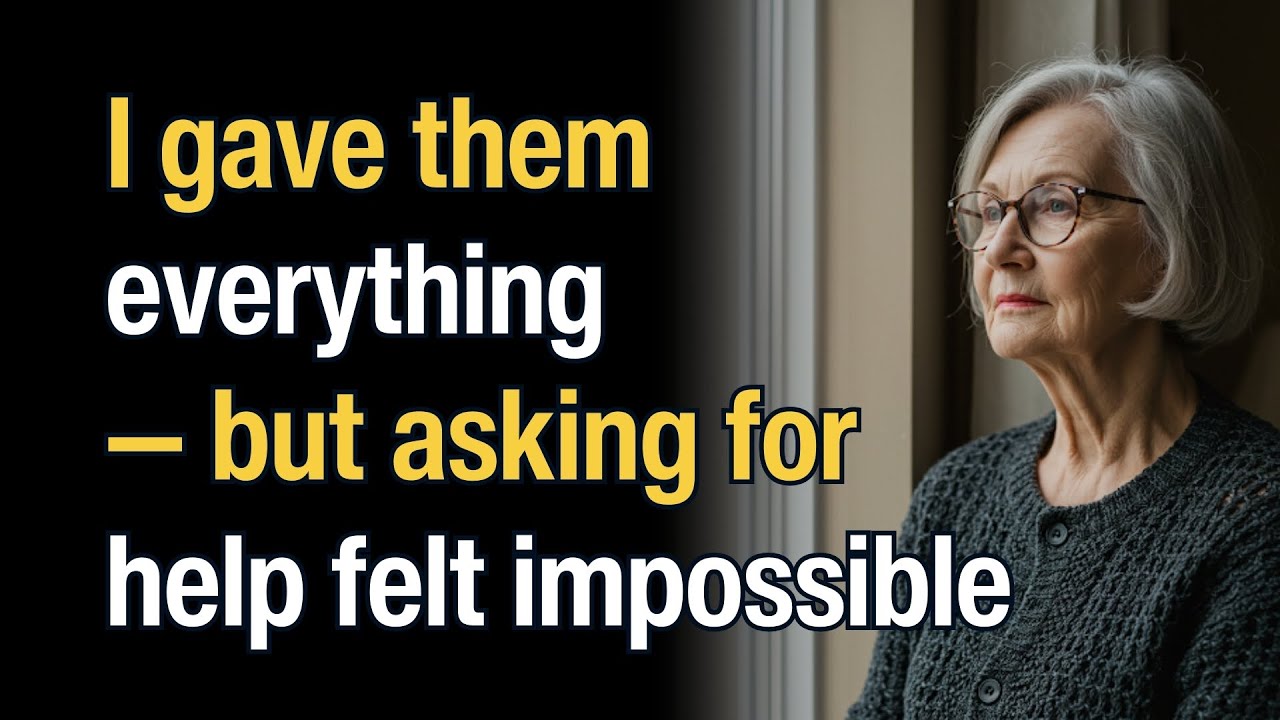
I never made the call. I told myself they were busy. I told myself I didn’t want to be a bother. But the voice underneath was sharper: “They’ll just get irritated.
They’ll make you feel stupid for asking. ” So I stayed quiet, and I did it alone. Maybe you know that feeling. You look at your phone and you want to call your child, but you don’t.
You brace yourself instead of reaching out. Some of us have even said it out loud: “I feel like I’m walking on eggshells with my own child. ”
We need to talk about why that is. And more importantly, we need to talk about how to stop living that way.
It starts with something we rarely examine—our own relationship with our needs. Many of us grew up in homes where the message was clear from childhood: your needs come last. Some of us were told, in one way or another, that our needs didn’t matter at all. We grew up too fast.
We learned that being strong meant never needing anyone. So we got very good at pushing through, at taking care of everyone else while leaving ourselves behind. That doesn’t just disappear when we become parents. It gets baked into who we are.
And if your child consistently puts themselves first, dismisses your feelings, or gets angry when they’re not in control, asking for help becomes even more dangerous. Because somewhere along the way, you may have started to believe a painful lie—that your needs are something to be ashamed of. That word, shame, is different from guilt. Guilt says, “I did something wrong.
” Shame says, “There is something wrong with me. ” And if asking for help ever got you laughed at, dismissed, or punished—when you were a child or even now—your brain learned to connect need with shame. Every time you reach out, that old fear flares up. You freeze.
You shut down. You decide it’s easier to struggle alone than to risk being made to feel small. That’s not weakness. That’s survival.
But here’s the truth: your needs are not shameful. They are human. There is nothing wrong with needing support, needing to be heard, or wanting someone to care for you the way you have cared for others your whole life. Many of us absorbed beliefs we never consciously chose.
One of the most damaging is the idea that someone else’s needs always matter more than our own. It happens slowly. You bend a little to avoid an argument. You keep quiet so they don’t explode.
You agree when you don’t mean it. You go without so they can shine. Eventually, your own voice gets buried. This is not just a personal problem.
It’s a pattern. A system. Every family has an emotional system, an invisible map, and within that map, people take on roles. You might be the peacekeeper.
The giver. The strong one who never needs anything. The one who keeps it all together. In many families, the parent is placed in a role of endless giving—offering praise, attention, and support—while rarely being allowed to ask for anything in return.
And when they do ask, they’re met with guilt, irritation, or silence. So love becomes a transaction. You begin to believe, without even realizing it, that love means being needed, not being helped. That to matter, you have to give.
That needing something is a sign of weakness. But that’s not love. Healthy relationships are built on mutual respect, care, and honesty. If your child struggles with empathy, reciprocity, or shared emotional responsibility, that sense of mutual care may never come.
But that doesn’t mean you can’t change. It doesn’t mean you have to keep living in the same emotional place. You can move. Not necessarily physically, though sometimes space helps.
Emotionally. Mentally. You can begin to reclaim your right to be seen, valued, and helped. That starts with stopping the self-neglect.
No one is asking you to flip a switch overnight. This is not about becoming selfish or demanding. It’s about one gentle truth: you matter, too. And you are allowed to take up space.
You might ask, how do I stop neglecting myself after all these years? That’s the wrong question. The better question is: when? Because the tools are already there.
You can learn new skills. You can build new emotional muscles. You can practice saying no, setting boundaries, reaching out even if your voice shakes. But none of that matters unless you decide you’re done being invisible.
Only you get to make that decision. Not your therapist. Not your child. Not your spouse or friend.
Only you choose when you stop waiting for permission to be treated with kindness. So maybe today is your when. Maybe this is the moment you say, “I deserve to stop suffering in silence. ”
Now let’s talk about what happens when you try.
Have you ever sat in your kitchen, rehearsing a simple request to your child, and then talked yourself out of it? Maybe you told yourself it wasn’t important. That you didn’t want to seem needy. That they’re just too busy with their own lives.
Or maybe you said, “Even if I ask, they’ll just make me feel bad for it. ”
That reaction isn’t just about you. It’s part of the system you’ve been living in. If your child has placed you in a role where asking for help feels emotionally unsafe, you start carrying the shame before anything even happens.
You carry it in advance, as if to protect yourself. But what you’re actually protecting is the emotional status quo. And that status quo is hurting you. Shame, guilt, embarrassment—these are what some therapists call “system feelings.
” They aren’t feelings that rise from your inner truth. They’re feelings you’ve learned to carry, feelings that keep the family system running the way it always has. Shame is a kind of glue. It keeps the roles fixed.
It keeps the peace—but at a terrible cost. Silence. Resentment. Sadness.
Isolation. The good news is system feelings can be named, noticed, and released. One powerful way to do that is to ask yourself: is this feeling mine, or was it handed to me? Say you ask your child to help you move a heavy box.
Something simple. They act annoyed. They say they’re too busy. Then you—the one who asked—start feeling embarrassed.
You feel like you did something wrong. That’s the moment to pause. Ask yourself: did I actually do anything wrong, or am I feeling something that’s been programmed into me? Asking for help is not an offense.
You didn’t scream. You didn’t demand. You didn’t manipulate. You simply asked.
If the person you asked responds with hostility, that’s not a reflection of you. That’s a reflection of their emotional immaturity. We have to start seeing those reactions for what they are: signs that the person may not be safe to ask for help. But that doesn’t mean you’re wrong for having needs.
Here’s what happens when you start to challenge your role. When you begin even gently to ask for help—or simply to acknowledge your own needs—the people who have benefited from your silence the most will often resist. They may try to drag you back into your old role. They may accuse you of being difficult, ungrateful, dramatic, or selfish.
That’s painful, because all you’re doing is trying to live with balance. But this is part of the system. When you shift, the system shakes. So what do you do when the system shakes?
You hold steady. You breathe. You remind yourself: I am not here to perform a role. I am here to be myself.
And your true self includes someone who gets tired, needs rest, deserves respect, and sometimes needs a helping hand without being punished for it. This isn’t about becoming selfish. It’s about becoming whole. There’s a real difference between healthy self-focus and harmful self-absorption.
Healthy self-focus comes from knowing who you are and honoring your limits. Harmful self-absorption relies on using people to hold up a fragile sense of self—demanding, controlling, punishing, placing oneself at the center no matter the cost. You can be kind and still ask for help. You can be generous and still say no.
You can be loving and still protect your peace. And sometimes, protecting your peace means not asking for help from people who consistently hurt you. Let’s be honest. Not every child is safe.
Not every child grows into a kind, respectful adult. When your child consistently behaves in ways that are controlling, manipulative, or emotionally harmful, you may need to grieve the fantasy of the relationship you once hoped for. That’s one of the most heartbreaking steps. But also one of the most liberating.
You are not required to keep asking for love from someone who only knows how to take. You are not required to keep proving your worth to someone who never sees it. You are already worthy. Your worth isn’t determined by how much you give.
It isn’t determined by how well you stay silent. It isn’t determined by how small you become to make others feel big. Your worth is inherent. Complete.
Even if your child never acknowledges it, even if they walk away, even if they say cruel things—you still matter. You still deserve kindness. You still have the right to ask for and receive real help from people who truly care. And maybe, the first person you can start receiving from is yourself.
Real healing doesn’t begin by changing your child. It doesn’t begin by waiting for them to wake up and treat you better. It begins by turning inward with honesty and compassion and saying, “I matter. ”
At first, it will feel awkward.
You might try to speak up, ask for a small favor, and feel that wave of shame hit you like a reflex. That’s okay. That shame is just an echo. It’s not the truth.
It’s not a moral compass. It’s a feeling planted by years of conditioning, and it only has power when you believe it. One of the most freeing things you can do is stop assuming uncomfortable feelings are always true. Just because something feels embarrassing doesn’t mean it’s wrong.
Just because you feel guilty doesn’t mean you’ve done something bad. Sometimes guilt is just the residue of old survival patterns. And shame is often a signal that you’re stepping out of the box someone else built for you. Step out anyway.
Take up space. Pause before automatically saying, “I’m fine. ” Practice asking small things from people you trust—not to test them, but to remind your nervous system that it’s okay to have needs. It’s okay to receive.
You don’t owe your children emotional safety if they refuse to offer you the same. So many parents over sixty have spent years tiptoeing around their adult children, afraid to offend, afraid to set boundaries, afraid that one disagreement will mean no phone calls for months. That’s not parenting. That’s emotional captivity.
Yes, you love your child. Yes, you want connection. But love that costs you your peace, your voice, your health—that is not love. It’s bondage.
And it’s okay to let go of it. It’s okay to stop managing their emotions. It’s okay to let them be upset. It’s okay to stop performing the role of the perfect parent who never complains, never asks, never gets tired.
That role is a cage. And you were never meant to live in a cage. What does freedom look like? It looks like honesty.
Being able to say, “I’m lonely. ” Or, “I’m struggling. ” Or even, “That hurt me. ” Without fear.
Without shame. Without needing to defend why. Freedom looks like choosing relationships where care flows in both directions. Where your needs aren’t mocked or ignored.
Where you’re not punished for speaking your truth. Where you feel seen—not just as a parent, but as a person. And if your adult child can’t offer you that, you are still allowed to seek it elsewhere. Build friendships that feel like family.
Connect with support groups or communities who understand the grief of raising a child who only sees you as useful, not human. Meet others who have walked this same road, who know what it’s like to ache for connection and slowly learn that peace is better than performance. You don’t need to earn your right to rest. You don’t need to prove your worth through sacrifice.
You’ve already given enough. Many of you have spent your entire lives being the strong one. The one who carries. The one who makes things work.
The one who hides your pain so others won’t feel bad. Now, maybe for the first time, you are allowed to lay that down. You are allowed to be tired. To be held.
To be helped. And if your child can’t offer that, it is not a reflection of your value. It is a reflection of their emotional limitations. You are not hard to love.
You were just expected to tolerate too much for too long. That ends now. Maybe the first step is just noticing when shame shows up and saying, “That’s not mine. ” Maybe the next step is practicing one small ask.
Even if it’s just asking yourself what you need today. Maybe it’s writing down your feelings. Maybe it’s telling a friend, “I’ve been putting myself last, and I want to stop. ”
There is no deadline on healing.
There is no shame in starting late. If no one has ever told you this before, hear it now: you are worthy of love even when you’re not giving. You are worthy of rest even when there’s more to do. You are worthy of care even when you’re not perfect.
This is your life. This is your time. You don’t have to spend another day waiting for someone else to see your worth before you claim it. Take a deep breath.
Let that truth settle in your bones. You are not a burden. You are a person—a whole person, with needs, with feelings, with limits, and with deep, powerful value. It’s okay to ask for help.
It’s okay to say no. It’s okay to feel sad. It’s okay to want more. And it’s more than okay to stop managing your child’s comfort at the expense of your own dignity.
You are not responsible for their feelings. You are not the villain in their story. You are not the problem. You’re just a human being, finally ready to choose peace over performance.
And that choice is the beginning of everything.