The metal folding chair hit my left forearm less than three minutes after a three-star general pinned the Purple Heart to my uniform. I remember the sound more clearly than the pain—not a movie crack, but a thick, ugly snap beneath the last fading applause in the Fort Stewart auditorium. Two hundred people stopped breathing at once. My stepmother, Linda, stood over me with both hands still wrapped around the chair.
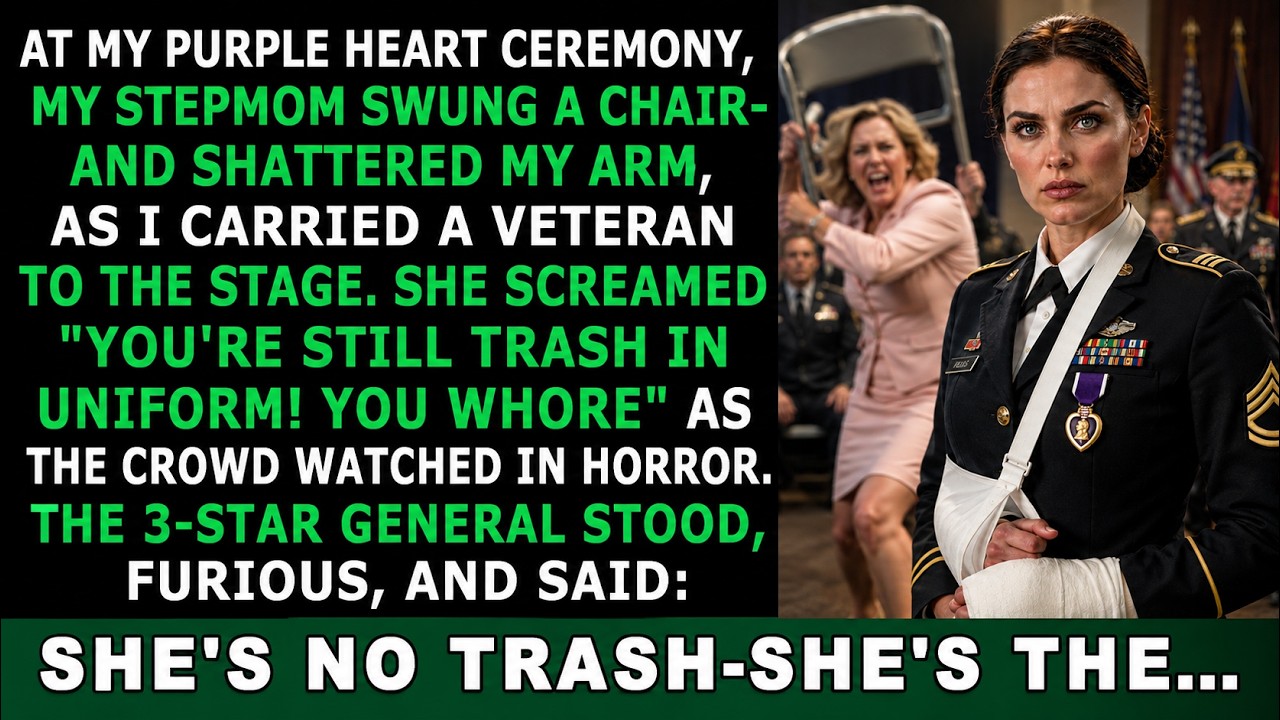
My father, Daniel, stayed in the third row. My half-brother Kyle had a smile on his face that disappeared only when the military police at the back of the room started moving. Linda leaned close enough for me to smell the sweet floral perfume she wore to church. “Who do you think you are?
” she whispered. “You put on that uniform and think you’re better than us. You’re still Porter trash. ”
I didn’t answer her.
I had learned in Afghanistan that pain becomes easier to survive when you stop arguing with it and start observing it. My arm was wrong. The room was tilting. General Robert Hayes was beside me, one hand under my good elbow, his face so controlled that the anger in it was almost worse than shouting.
Then I saw something I didn’t understand. Before he helped me toward the exit, he looked past Linda and gave one small nod to a man in civilian clothes near the rear wall. The man touched the folder under his arm. At the time, I thought it was paperwork from the ceremony.
It wasn’t. And the people who had spent twenty-seven years mistaking my silence for weakness had no idea what was already inside it. My name is Milly Porter. I was twenty-seven years old, a sergeant first class in the United States Army, and until that day I still carried one embarrassing hope I had never admitted out loud.
I wanted my family to be proud of me—not the army. The army had already told me what it thought of my service. The metal on my chest was proof of that. I wanted my father to look at me the way other fathers looked at their daughters.
That was the wound Linda understood better than anyone. When I was fifteen, I ran track. My grandfather had built a wooden shelf across one wall of my bedroom, and every medal I won went there—state finals, relays, regional meets, cheap trophies with plastic gold runners on top. To me, they were evidence that effort could become something visible.
One Tuesday, I came home from practice, and the shelf was empty. Linda was in the living room painting her nails. I asked where everything had gone. She barely looked up.
“Kyle needed the space. ”
I found my trophies in the trash can outside, beneath coffee grounds and a greasy pizza box. One of the runners was bent sideways. I sat on the back steps trying to straighten it with my fingers until my father came home.
He saw what I was doing. He walked past me. That became the pattern. Linda did the damage.
Kyle benefited from it. My father supplied the silence. At seventeen, Kyle got a used car for his birthday. At eighteen, I got a grocery store cake with my name misspelled because Linda said the bakery was busy.
When I enlisted, my father didn’t tell me he was proud. He said, “The army isn’t what it used to be. ”
Basic training at Fort Jackson should have terrified me. Instead, the humidity, the mud, the shouting, and the exhaustion felt almost clean.
For the first time, the rules applied to everyone. If I failed, I failed because I hadn’t met the standard. If I succeeded, no one moved the standard to protect Kyle. A drill sergeant could scream two inches from my face, and somehow it hurt less than my father refusing to look at me across a dinner table.
The army became the first place where I stopped asking permission to exist. But my family found a way into that life, too. My first real paycheck disappeared into my father’s gambling debt. Linda said the refrigerator was failing.
Two days later, Kyle texted me asking why I hadn’t sent enough for the sneakers he wanted. After advanced training, the calls became regular. Roof repair, credit cards, emergency dental work, a car payment. Something was always about to collapse unless I transferred money.
For nearly two years, I worked weekend shifts at a bar off base. I mopped stale beer from the floor at two in the morning, slept for a few hours, then reported for Monday PT with my uniform clean and my eyes burning. I told myself I was helping my family. The truth was uglier.
I was paying for the possibility that one day they might finally treat me like I belonged. The closest I came to understanding that was Thanksgiving. I managed to get seventy-two hours of leave and drove through the night to Charleston. I pictured walking in while dinner was still warm.
I pictured my father smiling. I pictured Linda pretending, at least for one evening, that my arrival mattered. When I opened the door, conversation stopped. Four plates were already dirty.
The serving dishes were nearly empty. Linda looked at me and said, “You should have called. ”
Then she added, “The turkey’s gone. ”
No one moved to make room at the table.
I ate a cold turkey sandwich alone in the kitchen while I listened to forks scrape plates in the dining room. That sound stayed with me longer than it should have. If you have ever spent years trying to earn love from people who benefited from keeping you hungry for it, then you understand why leaving is not always one decision. Sometimes it happens in pieces.
Mine happened in Kandahar. Our platoon had been hit that afternoon. The air still smelled like dust, hot metal, and burned insulation. One of our young soldiers had not come back.
I was sitting against a concrete wall when my phone buzzed. Kyle. For one stupid second, I felt relieved. I thought he had heard something.
I thought he was checking on me. Instead, he was calling from Aspen. He complained about the resort. The sheets weren’t good enough.
The room was smaller than the photos. The ski rental place had overcharged him. I listened while the combat pay I had sent home paid for his vacation. He never asked where I was.
He never asked whether I was safe. Behind him, I could hear music in a hotel lobby. Behind me, someone was crying for a dead soldier. Something inside me became very quiet.
I didn’t cut my family off that night. I wish I could tell you I did. I kept sending money, but after Kandahar, it was no longer love. It was a tax I paid to keep the arguments shorter.
That is why I invited them to the Purple Heart ceremony a year later. Not because I trusted them, but because some part of me was still that fifteen-year-old girl on the back steps trying to straighten a broken trophy before her father came outside and finally noticed. The ceremony began at ten in the morning. My dress uniform felt too stiff across my shoulders.
The auditorium smelled faintly of floor polish and coffee. When General Hayes pinned the medal over my left pocket, I heard applause from people I had served beside. Then I looked at the third row. Linda was whispering to Kyle.
Kyle smirked. My father stared at his shoes. After the presentation, General Hayes stepped down from the stage, and his foot caught slightly on the edge. I reached out by reflex and steadied his elbow.
“Easy, sir. ”
That was all. Linda saw it. To her, every act of competence was an accusation.
She stood, walked to the aisle, grabbed the folding chair, and swung. In less than five seconds, twenty-seven years of private contempt became public evidence. The medics cut the sleeve from my uniform in the base clinic. The room smelled of antiseptic and warm plastic.
My arm was already swelling. Through the open doorway, I saw General Hayes speaking with two MPs and the same civilian I had noticed in the auditorium. A few minutes later, he came inside. He didn’t ask why my family hated me.
He asked, “Sergeant Porter, are you able to answer questions? ”
I nodded. He pulled a chair closer. “Not about the assault.
”
That was the first twist. The civilian introduced himself as an Army counterintelligence investigator. Another agent joined us. They told me they had been examining suspicious contacts connected to people close to deployed service members.
My family’s names had appeared in an investigation months earlier. I felt my stomach tighten. The first question sounded harmless. Had Linda ever arranged calls with people claiming to be journalists or researchers?
Yes. Had they asked about military family life? Yes. Had anyone asked about routines, unit movements, leave schedules, patrol patterns?
I hesitated. One woman had asked whether our platoon tended to use the same areas repeatedly because familiarity helped build trust with local communities. I had given a vague answer. Nothing classified.
Nothing I believed could hurt anyone. The older agent opened his folder. That was the folder I had seen in the auditorium. He placed a bank statement on the table.
My father’s name was at the top. A twenty-thousand-dollar deposit had been highlighted. “Do you know where this came from? ”
I shook my head.
He placed down another page. Thirty thousand, then another: fifty thousand. The dates meant nothing for about three seconds. Then they meant everything.
The thirty-thousand-dollar payment came shortly before an attack that killed Sergeant Peterson and Corporal Jensen. The fifty-thousand-dollar payment came forty-eight hours before the patrol where Sergeant Mark Davis died. Mark had taught young soldiers without making them feel stupid. He remembered birthdays.
He carried extra batteries because someone always forgot theirs. The last time I saw him alive, he had grease on his cheek and was laughing because I had managed to jam my rifle in a way he claimed should have been mechanically impossible. I stared at the date. My broken arm disappeared.
So did Linda’s insult. The room narrowed to the paper in front of me. The agents showed me more. Kyle had posted pictures I sent home on gaming forums.
He bragged about my unit, named soldiers, mentioned when I was coming home, talked about where we had been operating. Daniel had used public computers to send coded messages. Linda had kept contact with people who had presented themselves to me as harmless researchers. Each detail by itself looked small.
Together, they formed a map. And that map ended at graves. My phone vibrated. Linda was calling from temporary military police custody.
The agents looked at General Hayes. He nodded once. I answered on speaker. Her voice came soft and wounded.
“Milly, honey, thank God. These people are treating us like criminals. You need to tell them what happened was a family misunderstanding. I was emotional.
You know how proud I am of you. ”
I looked at Mark’s photograph. For years I had imagined the day I would finally tell Linda everything she had done to me. I thought I would shout.
Instead, my voice came out almost gentle. “You’re not my mother. ”
She stopped talking. I continued.
“And this is not a misunderstanding. ”
Then I ended the call. That was the first boundary I had ever given my family that did not come with an apology. The investigation moved quickly after that.
Major Hansen from JAG helped me build a timeline of every call, every request, every strange question, every transfer. Counterintelligence already had pieces I knew nothing about. My testimony connected them. There were audio recordings, emails, financial records, a statement from one of Kyle’s friends saying Kyle had offered him money for deployment information about another soldier.
The worst evidence was Linda’s voice on a recorded call, discussing what she believed she could get me to reveal. She sounded confident. “She tells me everything,” she said. I listened to that line twice.
Then I asked the agent to stop the recording. Not because I couldn’t handle it. Because I finally understood the thing that had controlled me for years. They had never mistaken my generosity for love.
They had mistaken it for access. General Hayes didn’t promise revenge. He promised procedure. But he also understood humiliation.
The assault had happened in front of my unit, my peers, and families who had come to watch an award ceremony. Rumors were already spreading. Linda was telling people I had provoked her. Daniel was claiming I had used my rank to intimidate them.
Kyle was telling friends the army was protecting me because I was one of their own. Their arrogance gave investigators an opportunity. The awards event had been interrupted before several formal presentations were completed. Command announced that the ceremony would reconvene two days later.
An officer called Linda and told her the command wanted to avoid a public family scandal. She was led to believe I planned to make a statement acknowledging that our conflict had become mutually emotional. Linda heard what she wanted to hear. An apology.
A surrender. She agreed to return. The next morning, I dressed with one arm in a clean white cast. Every movement took twice as long.
I fastened my uniform carefully and looked at myself in the mirror. The Purple Heart was still there. For most of my life, I had thought strength meant absorbing the blow without making trouble. The army had taught me something different.
Discipline is not the same as surrender. At nine hundred hours, the auditorium was full again. Linda entered in a pale pink suit. Daniel walked behind her.
Kyle wore expensive sneakers I recognized because years earlier, I had paid for a pair almost like them. They were seated in the front row. Linda looked up at me and smiled. It was the same smile she had worn when my trophies disappeared.
The smile of someone who believed the outcome had already been decided. General Hayes walked to the podium. He did not raise his voice. “We are here to complete an interrupted ceremony,” he said.
“But first, we are going to correct the record. ”
Linda’s smile weakened. The screen behind him lit up. The first image was not classified material.
It was a simple financial chart built from lawful records. Dates on one side, payments on the other. Twenty thousand, thirty thousand, fifty thousand. My father leaned forward.
His hands went still. General Hayes explained that federal and military investigators had identified an ongoing effort to obtain operational information through the relatives of service members. Then came the first payoff. Audio.
Linda’s recorded voice filled the auditorium. She was not screaming. She was bargaining. That made it worse.
She discussed money. She discussed what she believed she could get from me. She described me as eager to please and easy to manipulate. Nobody in the audience moved.
Linda stood halfway, then sat back down. Her face had lost its color. “That’s edited,” she said. No one answered her.
The next screen showed Kyle’s messages. Pictures. Names. Deployment references.
Travel dates. The careless little details he had scattered online because attention mattered more to him than consequences. Kyle started shaking his head before anyone accused him of anything. “I didn’t know,” he whispered.
That sentence might have mattered to me once. It didn’t matter now. Then General Hayes gave the second payoff. Three official photographs appeared on the screen.
Mark Davis. Sergeant Peterson. Corporal Jensen. The auditorium changed.
Until then, people had been watching a case. Now they were looking at men they knew. Men whose families had received folded flags. The General did not dramatize it.
He simply said investigators had established a connection between compromised information, suspicious payments, and enemy action during the period in which those soldiers were killed. A woman in a black dress stood near the back—Maria Davis, Mark’s widow. She did not scream. She looked at my family for a long time and asked one question.
“Was my husband worth fifty thousand dollars to you? ”
My father lowered his head. Kyle began crying. Linda opened her mouth, but nothing came out.
That silence was the first honest thing I had ever received from her. Military police and federal agents moved in from the side doors. No one resisted for long. Linda kept trying to explain.
Daniel kept saying he hadn’t understood. Kyle repeated that he had only been talking online. The louder they became, the calmer the room felt. I stood on the stage with my arm in a cast and watched them discover what I had learned years earlier.
Words do not control reality. Evidence does. The legal process lasted months. The charges were serious.
The investigations expanded beyond what I had personally known. Attorneys argued over intent, knowledge, money, communications, and the precise role each member of my family had played. I testified. I answered what I was asked.
I did not make a speech. I did not ask the court to heal me. That was not its job. The verdicts and sentences brought consequences, but they did not give me back the years I had spent trying to buy affection.
For a while, that truth hurt more than I expected. After the hearings, I went back to my room and found one of my father’s letters waiting. Four pages. He blamed Linda.
He blamed Kyle. He blamed fear. He blamed confusion. Near the end, he asked me to help him.
There was no real apology. I read the letter once. Then I put it in a drawer. I had spent too much of my life answering demands disguised as family emergencies.
This one could remain unanswered. Months later, I agreed to see Kyle once in a detention visiting room. The glass between us reflected fluorescent light across his face. He looked younger without the swagger.
He cried before I picked up the receiver. “I’m sorry,” he said. “I didn’t understand what they were doing. ”
I believed that he had been stupid.
I also believed stupidity did not erase harm. “I forgive you,” I told him. His shoulders dropped with relief. Then I finished the sentence.
“But forgiveness is not access. You don’t get me back. ”
He stared at me. I set down the receiver and left.
That distinction changed my life. Forgiveness was something I could choose. Reconciliation required safety. They were not the same thing.
General Hayes later asked me to help with a mentorship program for young soldiers struggling with family pressure, financial exploitation, and the loneliness that can come when service changes you faster than the people at home are willing to accept. The first time I spoke to a room of new recruits, I didn’t tell them the dramatic parts. I told them about the cold sandwich on Thanksgiving. I told them about working late shifts to pay bills that were not mine.
I told them about how difficult it can be to recognize exploitation when it arrives wearing the face of someone you love. Afterward, a nineteen-year-old private waited until everyone else had left. She said, “Sergeant, nobody ever told me I was allowed to say no to my family. ”
That sentence meant more to me than applause.
A year after the Purple Heart ceremony, I went to Arlington National Cemetery early in the morning. The grass was wet. The air had that clean autumn cold that settles into your sleeves. I carried three red roses: Mark Davis, Peterson, Jensen.
I placed one at each grave. For a long time, I stood in front of Mark’s headstone without speaking. I thought about the bunker in Kandahar, the phone call from Aspen, the folding chair, the folder under the investigator’s arm, the front row of the auditorium—all the moments when someone had interpreted my silence as permission. Then I raised my hand and saluted.
There was no victory in it. Only respect. Only grief. Only peace.
I used to believe strength meant enduring whatever people did to you without breaking. I was wrong. Sometimes strength is documenting the truth. Sometimes it is lowering your voice while someone else raises theirs.
Sometimes it is letting consequences speak for you. And sometimes the strongest thing you can do is stop trying to convince people to value you. My family thought my silence meant I was weak. The truth was simpler.
Silence was where I learned to listen. Discipline was where I learned to prepare. And the day I finally stopped asking them to love me was the first day I understood that my life had never needed their permission.