I was 23 years into a military career, four deployments deep, with a spine that never quite healed right. But at my sister’s graduation, I was just the family disappointment who never showed up, the one they whispered about missing Thanksgiving. They didn’t see me slip into the back row that morning at Stone Mount University. No uniform, no entourage, just a tailored black coat and a silence I wore like armor.
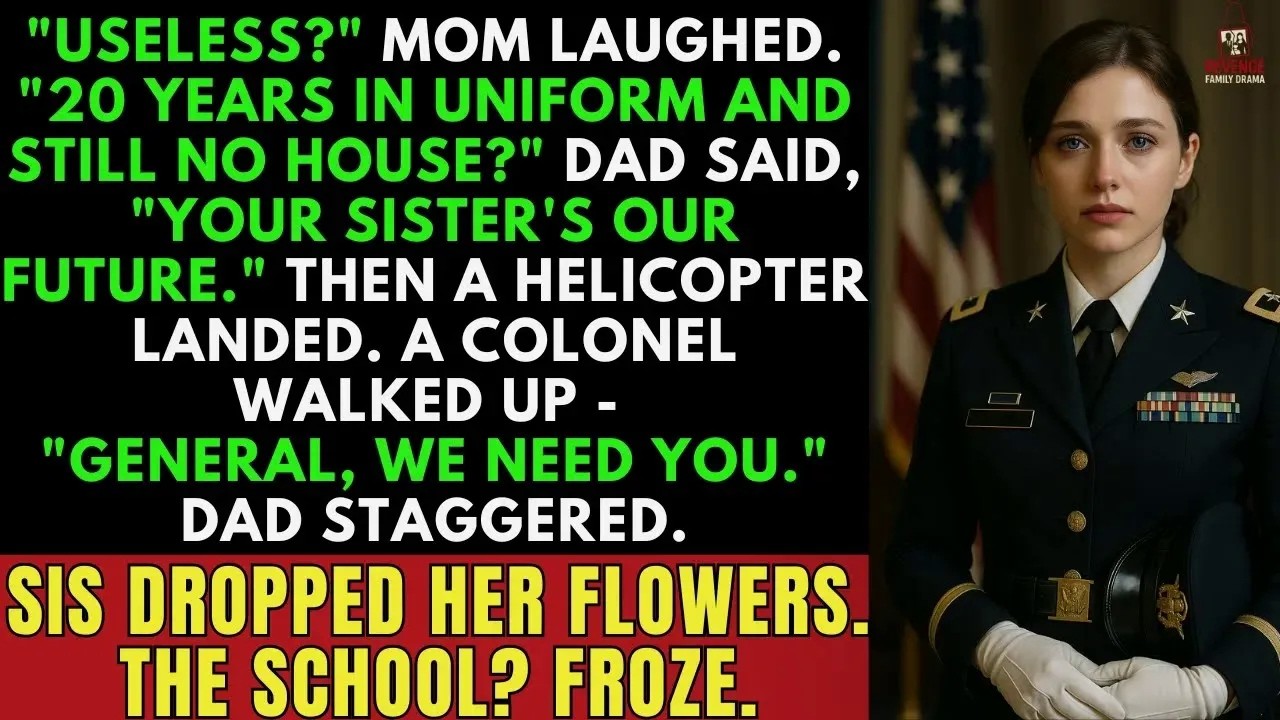
My parents sat in the front row, polished and proud. My sister Juliet stood at the edge of greatness, gold honor cords gleaming against her navy gown. When her name was called, the applause rose like a tide. And then, above it all, came the rotors.
One beat. Then another. A Black Hawk sliced across the sky, descending over the courtyard like judgment. Flags snapped.
Hats flew. My father stood up, then froze. A soldier stepped down, scanned the crowd, and his voice cut through the chaos:
“General Quinn. Washington requests immediate transport.
”
Every head turned. Every secret unraveled. And for the first time in decades, they saw me. Really saw me.
But they had no idea what was coming next. —
I arrived at Fort Caldwell with the adrenaline burned off and a cold focus settled in its place. Colonel Reed Vaughn was waiting outside, a folder in his hand. We’d served together in Kandahar, where silence was currency and trust was earned in fragments.
He didn’t greet me. Just handed me the folder. “You didn’t sign off on any of this. ”
I opened it.
Authorization logs. Procurement trails. Budget approvals. All with my digital credentials.
All pristine. All forged. Page after page carried my name, my clearance code, my security stamp—but not my signature. “Started small,” Reed said.
“Medical shipments. Logistics routing. By last quarter, it ballooned. Unmonitored funds diverted through auxiliary accounts.
”
I scanned the amounts and felt my stomach drop. One line stopped me cold. Recipient: Meridian Access Holdings LLC. Authorization: Q-level, Quinn, T.
M. Secondary beneficiary: Juliet Quinn. My sister’s name. “We caught it last week,” Reed said.
“Compliance flagged the routing path during a separate investigation. When your name popped, I told them to bring it straight to me. ” He stepped closer, lowered his voice. “I know you.
You didn’t touch this. ”
“You sure about the beneficiary link? ” I asked. “Triple verified.
Her name’s attached to an account opened in 2018, during your fourth deployment. ”
I stared out the window. Soldiers moved in clean lines across the training field, their routines precise, unshaken. Inside me, something cracked.
“I want a lawyer. ”
“Already contacted one. Alexis Monroe, civilian, ex-JAG. She doesn’t lose cases like this.
” He paused. “She also doesn’t take them unless she’s sure the client’s innocent. ”
“Then she’ll take mine. ”
Reed studied me for a long second.
“This wasn’t a mistake,” I added. “It’s a system. Someone built it with access to my life. ”
“And whoever did it didn’t think you’d come back looking.
”
I closed the folder, handed it back. My voice was steady. “Then they don’t know me at all. ”
Reed smiled, barely.
“They’re about to. ”
—
Juliet’s graduation dinner was at a glass restaurant on the harbor, the kind of place you only book when you’re sure someone will take your picture. I wasn’t invited, of course. That never stopped me before.
The private upper hall was full of waiters in black vests and gold-rimmed plates. When I entered, conversation dipped a few degrees. My mother saw me first. Her smile flickered, reformed like a politician’s.
“Thalia. We didn’t think you’d be able to join. ”
My father didn’t stand. Just nodded once.
Juliet turned, wine glass in hand. Surprised, but not alarmed. Not yet. “I heard there’d be a toast,” I said, slipping off my coat.
“Didn’t want to miss it. ”
The maître d’ offered to take my coat. I shook my head. I wasn’t staying long.
My mother gestured to a seat at the far end. I didn’t move toward it. Instead, I reached into my bag and pulled out a small black velvet box. I placed it gently in front of Juliet.
“What is it? ” she asked. “A gift. From one Quinn to another.
”
She opened it slowly. Inside sat a sterling bracelet, simple and elegant—except for the engraving on the underside. Eleven digits. Bravo 36, Fireline North.
My deployment code from an operation Juliet once pretended to forget when introducing me to her fellowship board. She stared at it, confused. “What does that mean? ”
“A reminder,” I said, “that some names leave marks, whether you acknowledge them or not.
”
My father’s fork clinked against his plate. “Thalia. This isn’t the time for cryptic metaphors. ”
I turned to him, calm as the tide.
“Actually, it’s the perfect time. ”
Juliet’s eyes flicked between us. “What is going on? ”
I looked directly at her.
“You remember Meridian Access? ”
She didn’t answer. My mother jumped in. “Sweetheart, don’t let her ruin your night.
”
“I’m not,” I said, still watching my sister. “But your name is on something. Something that doesn’t belong to you. ”
Her smile faltered.
“What do you mean? ”
I stepped back from the table. “Ask Dad. ”
His hand trembled slightly as he reached for his glass.
Most people wouldn’t notice. I’d been trained to. I didn’t need to say more. The silence that followed said everything.
—
Alexis Monroe arrived the next morning in a navy trench coat, hair tied back, eyes sharp and unsentimental. She set her briefcase down in the Fort Caldwell conference room like it was her courtroom. “I’ve reviewed the files,” she said, skipping pleasantries. “This isn’t sloppy embezzlement.
It’s constructed fraud, with intent, with layers. ”
I sat across from her, pages of transactions and clearance checks spread between us. “I didn’t sign any of this. ”
“I know.
”
“Whoever did this used high-grade software to replicate your digital signature,” she said. “No pressure inconsistencies, no pen drag. It was rendered, not written. That software was banned from military procurement systems in 2016.
”
I leaned back. “What about chain of custody? ”
She opened her laptop. “This is where it gets worse.
”
On the screen was a transmission dated March 2017, originating from a residential address in Annapolis. The sender: Charles Quinn. He had filed for power of attorney while I was deployed, claiming I was unreachable and justifying financial proxy authority. “He said I trusted him,” I said quietly.
Alexis clicked again. An audio file opened. Static crackled, then my father’s voice, calm and controlled: “She’s in rotation, can’t be reached. I’ll sign on her behalf.
She knows. We’ve done this before. ”
I looked away. “He lied.
I never gave him that right. Not once. ”
Alexis didn’t soften. “If we can prove fraud, digital forgery, financial misappropriation, and impersonation of a federal officer, it moves from internal to federal.
Fast. And Juliet—she may not have known, but her name is listed as secondary beneficiary on two flagged accounts. If she testifies honestly, she’s a witness. If not, she lets the sentence trail.
”
“I want to press charges,” I said. “Publicly. ”
Alexis held my gaze. “If you do this, your father’s name becomes a headline.
So does yours. Are you ready to stand in court and say under oath that your own father forged your identity and exploited your military access for profit? ”
I didn’t hesitate. “For years he signed my name like it belonged to him.
” I slid the folder back toward her. “Now I’m signing it back. ”
Alexis nodded once. “Then let’s build the case.
”
—
The hearing room in the federal courthouse wasn’t designed for drama. Beige walls, frosted glass, the hum of ceiling vents. It smelled of paper and restraint. Across from me sat my father, flanked by two attorneys in tailored gray suits.
Polished. Composed. The kind of man who always seemed one sentence ahead. Juliet sat beside him, hands knotted in her lap, her posture immaculate but her eyes restless.
Alexis stood and laid out the case. Between 2016 and 2021, Charles Quinn had knowingly used his daughter’s military clearance to authorize defense contracts routed through shell corporations. The funds—$17. 4 million—were diverted under falsified credentials tied directly to my name.
She presented the digital metadata proving the signatures were generated with banned software. She played the audio file. My father’s voice filled the room: “She’s deployed. Doesn’t need to be involved.
I’m her legal proxy. She trusts me. ”
His jaw tensed. Barely.
“Is that your voice, Mr. Quinn? ” the commissioner asked. His attorney intervened before he could answer.
“We reserve the right to clarify context. ”
“We’ll get there,” Alexis said coolly. Then she submitted the final page. “This account lists a secondary beneficiary.
Juliet Quinn. ”
Juliet recoiled. “What? ” Her voice cracked.
She turned toward my father, eyes wide. “You put me on that. Without telling me. ”
He didn’t look at her.
He didn’t look at anyone. The commissioner turned to me. “General Quinn, would you like to make a statement? ”
I stood.
“I served abroad while this happened. I returned each time to silence. My family never asked what I saw, only what I could give. They used my absence.
And then they used my name. ”
My voice didn’t tremble. Because for the first time in years, I wasn’t there to protect anyone. I was there to correct the record.
—
The verdict came down one week later. Charles Quinn was formally indicted on four federal charges: identity theft, impersonation of a classified military official, unlawful access of secure systems, and embezzlement of government-linked funds. His assets—scattered across foundations, trusts, and quiet partnerships—were frozen. Every board position he held, from advisory councils to defense-aligned nonprofits, severed ties within 48 hours.
The man who once called me an ungrateful disappointment was now required under oath to explain why he thought my name belonged to him. It never made headlines. By design. Alexis honored my request—no press conferences, no interviews, no morning shows dissecting trauma like entertainment.
I didn’t want my face on the news. I wanted my identity back quietly, fully, without their narrative attached. Three days later, I stood beneath the rotunda of the Hall of Honor at the Pentagon. Dress blues, medals aligned.
The Distinguished Service Medal pinned just above my heart. I didn’t speak about the investigation. Not about the cost, the hearings, the betrayal, or the accounts that bore my name but never my permission. I said only this: “I’m not the legacy of a man who used my silence for personal gain.
I’m the one who endured, the one who returned without applause, without welcome, and stood still when no one was watching. ”
I paused, scanning the faces before me. “And today, I write my name back—letter by letter—onto the record they tried to erase. ”
In the front row, Juliet sat beside Colonel Vaughn.
She didn’t cry. She didn’t speak. But her eyes never left mine. And for the first time, I didn’t feel invisible.
I felt present. Whole. That night, I returned to my office. I placed the medal beside a worn photo of my old unit from Operation Iron Echo—the ones who never got ceremonies, the ones whose names had been left behind in supply reports and encrypted letters.
I lit a single desk lamp. No music. No voice. Just quiet.
I opened a folder labeled simply “Quinn, T. M. ” Inside were two things: a copy of my original deployment oath, and a signature I never gave but had reclaimed. —
A week after the ceremony, Juliet appeared at my office door.
No assistant. No press. Just her, holding a manila envelope like it weighed more than it should. I didn’t offer her a chair.
“I won’t take much of your time,” she said, eyes not quite meeting mine. “But I needed to hand this to you in person. ”
She stepped forward, placed the envelope gently on the desk, then stepped back like she’d crossed into unfamiliar territory. “I’ve withdrawn from the foundation.
Returned every stipend, grant, and disbursement that bore my name, even the ones I didn’t touch directly. It’s all there. Receipts, resignation letters, withdrawal affidavits. ”
I didn’t reach for it.
Not yet. “He told me it was honorary,” she continued. “Said you approved it informally, that you didn’t care about details. ” She exhaled, steadying herself.
“I think I wanted to believe that. Because if I didn’t ask questions, I didn’t have to know how deep it went. ”
Her voice broke—not for sympathy, but under the weight of her own delayed reckoning. “I didn’t come to ask forgiveness.
That would be convenient. I came to say I never wanted to take anything that belonged to you. But I see now that silence takes too. ”
She didn’t cry.
She didn’t make excuses. “I believe you,” I said. Her shoulders dropped, just slightly, like a tension had been living there for years. She turned to go, then hesitated at the door.
“How long have you known? ”
I waited a moment before answering. “Long enough to give you time to come clean. Short enough to still care what you did with that chance.
”
She nodded once and left. After the door clicked shut, I opened the envelope. Inside were notarized documents, reverse transfers, official resignations, and one handwritten note:
*I know this doesn’t erase anything. But maybe it closes the door we never had the courage to open.
—J. *
I folded the note and placed it in the cedar box beside my Distinguished Service Medal and the faded photo of my team that no one in my family ever bothered to ask about. Juliet moved to Denver. My father’s trial unfolded quietly.
His name disappeared from plaques, boards, and alumni pages as if it had never been there. Alexis sent a bottle of eighteen-year bourbon with a note: “Some names are taken. Others are reclaimed. You didn’t just reclaim yours.
You rewrote it. ”
I never gave another speech. But some nights, I walk the lower corridor of Fort Caldwell alone, past restricted zones and sealed doors. My ID still grants access to the archive wing.
I step inside, surrounded by years of operations, sealed boxes, forgotten names. And I remember: they forged my name. They used it. They passed it around like it was theirs to own.
But a name isn’t owned by signatures. It’s owned by presence. And I’m still here. Letter by letter.
Quiet. Unshaken. Mine.