The first time my father called me a fraud in public, I was standing under a chandelier at my younger sister’s wedding, surrounded by two hundred guests and the smell of gardenias and expensive whiskey. “You were not invited, Nora,” he said, loud enough for the nearest tables to hear. “You don’t get to disappear for twelve years, put on a uniform, and come back pretending you have authority over this family. ”
The string quartet stopped.
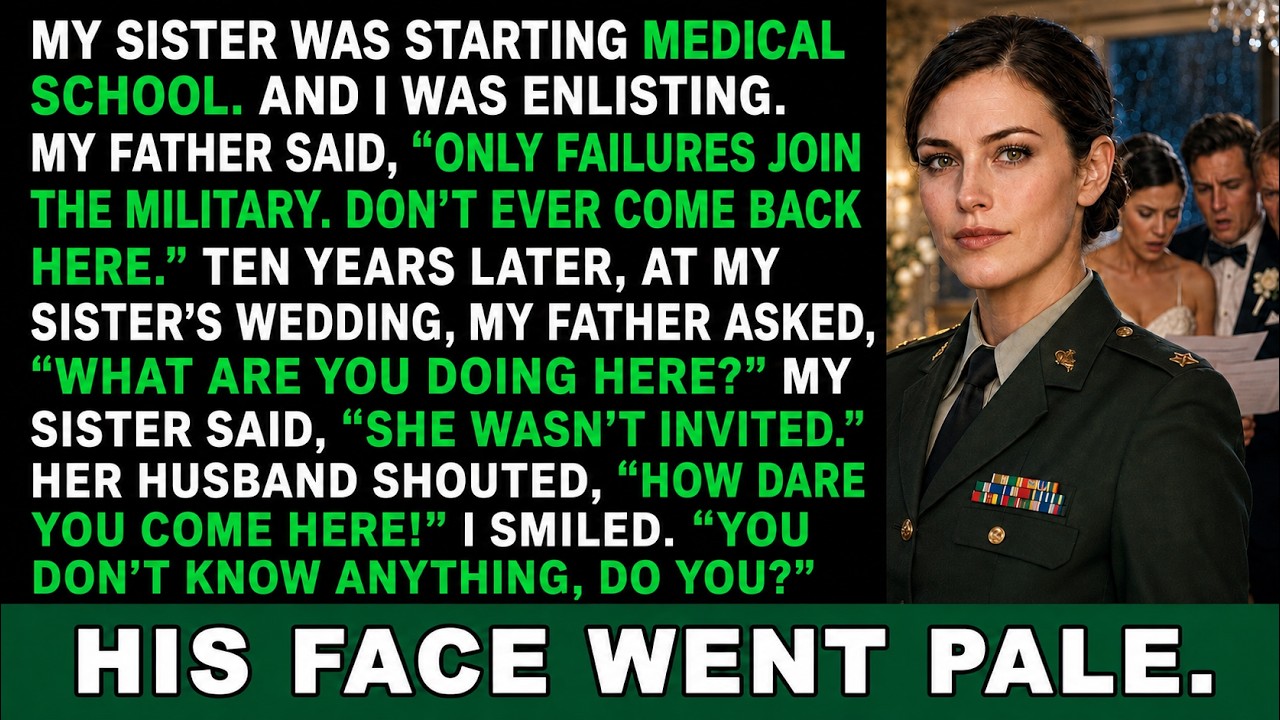
No one had told them to. My sister Sophie stood beside her new husband, one hand wrapped around a champagne glass, two pearl pins still trembling in her hair. Blake Harrow, the man she’d married less than three hours earlier, wasn’t looking at my face. He was looking at the blue document envelope under my arm.
That detail mattered. My father kept going. He said I’d always resented Sophie. He said the army had made me paranoid.
He said I was creating a scene because I couldn’t stand to see her happy. I let him finish. Then I placed the envelope on the linen-covered table and asked Blake one question. “Which signature did you think I wouldn’t recognize—mine or Sophie’s?
”
His glass clicked against the table. No one in that room knew a title officer had called me forty-eight hours earlier. No one knew a $1. 4 million bridge loan had already been frozen.
And no one, including my father, knew why the retired army colonel sitting near the back had risen slowly to her feet when she heard my name. But Blake knew what was inside the envelope. I could see it in the way the confidence left his shoulders before it left his voice. To understand how I ended up there, you have to understand the Keen family and the quiet rules that governed it.
My father, Dr. Martin Keen, was a Richmond cardiologist. He believed there were respectable lives and embarrassing ones. Respectable people became physicians, married respectable people, bought homes with columns, and sent Christmas cards printed on paper thick enough to feel important.
Embarrassing people changed direction. Questioned him. Made choices he hadn’t approved. Sophie learned the rules early.
I learned what happened when you broke them. When I was ten, I won a county essay contest. My father glanced at the certificate and said writing was a hobby. Sophie’s piano required discipline.
At thirteen, I waited an hour outside a school gym in the rain while water filled the seams of my shoes because he’d forgotten me. At seventeen, he left my ROTC scholarship letter beside the toaster until coffee dried across my name. Sophie was never cruel. That made it harder.
She loved me, but she’d been trained to treat our father’s approval like oxygen. At dinner, she watched his face before answering. When he dismissed me, her eyes dropped to her plate. Grandma Ruth was the only person who seemed to notice what that silence was costing both of us.
She owned a narrow brick building on Hanover Avenue. Downstairs was the physical therapy clinic she’d opened after my grandfather’s stroke. Upstairs were two modest apartments. Nothing glamorous, but it had paid for itself for thirty years.
She called it the building that kept women from having to ask permission. On hot Saturdays she gave us lemonade in cloudy glasses and taught us to paint window frames and clean the brass numbers. Property isn’t just money, she’d say. It’s a choice you still own when someone wants to make the choice for you.
I didn’t understand why she repeated that sentence until much later. At twenty-two, I told my father I was declining the path he’d arranged. I’d finished college through ROTC and was commissioning into the army, planning to work in logistics—where quiet decisions decide whether a unit eats, moves, or comes home. He stared at the butter melting on his dinner roll.
“You had every advantage, and this is what you chose. ”
I told him it wasn’t a fallback. He said only people without better options volunteered to be ordered around. Sophie sat across from me, gripping her fork until her knuckles went pale.
I waited for her to speak. She didn’t. “Don’t come back,” my father said, “until you’re ready to stop humiliating me. ”
I carried my duffel bag to a bus station before sunrise.
Sophie watched from her bedroom window. The curtain moved, then went still. The army didn’t heal me. It did something more useful—it taught me that pain didn’t have to make every decision.
During a winter exercise in Germany, the cold was so sharp the metal clasp on my notebook burned my fingers, trucks were delayed, and a young lieutenant started barking three orders at once because panic made him feel active. I learned to lower my voice when everyone else raised theirs. I learned to separate the urgent from the loud. Years later, during a Louisiana flood response, I spent thirty-one hours coordinating food, generators, and medical supplies while water climbed the steps of a rural hospital.
Nobody asked where I went to school. Nobody cared whether my father was proud. They cared whether the oxygen truck reached the loading dock before the backup power failed. It did.
By thirty-four I was Major Nora Keane, an army logistics officer assigned near Fort Gregg Adams. I’d led soldiers, managed contracts worth more than my father could imagine, and learned enough about false invoices and altered records to know fraud usually enters a room dressed as convenience. I didn’t tell my family about the promotion. They hadn’t asked about the earlier ones.
Grandma Ruth died twelve years after I left home. I was supporting an exercise in Poland. By the time I returned, the private funeral was over. Sophie’s number had changed.
A letter I mailed to the clinic came back undeliverable, though the address was correct. Grandma’s attorney, Helen Ward, eventually reached me. The Hanover building had been placed in a trust. Sophie and I were equal beneficiaries.
Neither interest could be sold, transferred, or pledged without both of us appearing before the independent trustee. That protection sounded like Grandma. I signed the acknowledgement in Helen’s office and asked her to send every future document directly to me. Then life resumed.
Training calendars, inspections, my grief folded small and carried where no one could see it. Fourteen months later, on a Tuesday afternoon, I was reviewing a transportation contract when my private phone rang. The caller was Daniel Ruiz, senior counsel for Commonwealth Title. “Major Keane, I need to verify whether you signed a trustee consent in Richmond last Friday.
”
I set down my pen. “I was in Georgia last Friday. ”
The pause was long enough for me to hear paper shift on his desk. The document he described authorized the trust to transfer the Hanover building into Harrow Medical Ventures, an LLC controlled by Blake.
It showed Sophie and me consenting in person. It included scanned copies of our driver’s licenses and signatures witnessed by my father. My name was written in the careful slant I’d used before the army taught me to print in block letters. It had been copied from the acknowledgement I’d signed after Grandma’s death.
Daniel told me the building was being offered as collateral for $1. 4 million. The closing was scheduled for Monday—two days after Sophie’s wedding. “Do not contact the applicants yet,” he said.
“We’ve frozen the file while we review the discrepancy. ”
I asked him to send everything to Helen Ward and a civilian attorney I trusted. Then I sat alone in the fluorescent light of my office and read the documents twice. Blake had listed me as deployed to a restricted location and unable to appear.
My father had signed a statement claiming he’d verified my consent during a secure military call. No such call had ever happened. At 6:18 that evening, a text arrived from an unknown number. It said, “Family paperwork is waiting at your father’s office.
Sign it before Monday and stop making things difficult for Sophie. ”
Attached was a one-page ratification form. If I signed, I would confirm every earlier act as valid—including the forged consent. They weren’t asking for permission.
They were asking me to erase the evidence that they’d never received it. I tried Sophie. Straight to voicemail. I emailed her hospital address and got an automatic reply saying she was away for her wedding.
Then I called my father’s office. His practice manager told me Dr. Keen was unavailable. “Tell him Nora called about Hanover Avenue.
”
Her voice changed. “He said you might call. He said the matter has been handled. ”
That was the moment I decided to attend the wedding.
Not to embarrass Sophie. Not to punish my father. I went because Monday was too close, and because someone had worked hard to keep my sister and me from speaking directly. The reception was at a country club where my father had been a member for twenty years.
I wore a dark green civilian dress and carried the blue envelope. I’d been inside less than a minute when he saw me. His expression wasn’t surprise. It was irritation—like a problem he’d delegated had returned to his desk.
Blake approached before Sophie did. “This is a private event. ”
“Then we can speak privately. ”
“There’s nothing to discuss.
”
“A title company disagrees. ”
For half a second, his eyes moved toward the exit. Then my father stepped between us, and the humiliation began. He told the guests I was estranged, unstable, jealous.
That military life had made me incapable of understanding normal family decisions. The more he spoke, the less I needed to. Sophie arrived while he was telling a hospital board member I’d never held a serious position in my life. That’s when I placed the envelope on the table and asked Blake which forged signature I wouldn’t recognize.
Sophie’s face changed first. “Which signature? ”
Blake reached for the envelope. I moved my hand over it.
“She doesn’t need to see legal accusations on her wedding night,” he said. “It has her name on it. ”
My father lowered his voice. “Nora, enough.
”
Behind him, the retired colonel moved closer. Her name was Elise Morgan. She’d commanded the Sustainment Brigade where I served as a young captain. She’d watched me coordinate the Louisiana hospital response.
“Major Keane,” she said quietly. “Do you need a witness? ”
The title didn’t matter to me. It mattered to my father.
He looked from her to me. “Major? ”
I ignored the question. Sophie took the envelope before Blake could.
She read the first page under the warm lights, still wearing her wedding ring, holding the papers with both hands. “This says I appeared before the trustee last Friday,” she whispered. “I was in surgery all day. ”
Blake’s answer came too quickly.
“It’s preliminary language. The lawyers use templates. ”
“This is my signature. ”
“Because you authorized me to organize the financing.
”
She looked at him. “I authorized you to speak to investors. ”
My father took the document from her and scanned it. His face tightened at one paragraph, then recovered.
“The building is an underused asset,” he said. “Blake’s company could provide long-term security for both of you. ”
“Did Nora agree? ” Sophie asked.
He didn’t answer. “Dad. Did Nora agree? ”
“Your sister refuses everything connected to this family.
”
That sentence revealed more than he intended. Sophie looked at me, and the old hurt moved between us—unopened letters, changed numbers, twelve years of being told what the other sister believed. Blake tried to take her arm. She stepped away.
I told her the closing had been frozen. I told her she didn’t have to decide anything that night. I gave her Helen’s number and said I’d be at a hotel nearby until Monday. My father accused me of staging the whole thing.
I picked up my coat. “Evidence doesn’t need staging. ”
Then I left. Sophie called at 2:06 in the morning.
I was sitting on the edge of a hotel bed, a paper cup of cold coffee between my hands. Rain tapped the air conditioner beneath the window. Neither of us spoke for several seconds. “Did you write to me after Grandma died?
” she asked. “Three times. ”
Her breath broke. “Dad said you signed away your interest and wanted no contact.
”
“I signed an acknowledgement of the trust. Nothing else. ”
She told me Blake had spent the drive home explaining the transfer was a technical step. He said the business would create outpatient clinics for underserved communities.
He said the loan was safe because the building’s rent would cover payments. Then he told her my refusal proved I wanted his company to fail. “Do you? ” she asked.
“I want any company built with your informed consent to succeed. This one was built with our signatures stolen. ”
The rain filled the silence. “Why didn’t you come back sooner?
” she asked. It wasn’t an accusation. It was grief looking for somewhere to sit. “Because Dad told me not to.
And after enough years, I stopped believing anyone inside that house wanted me there. ”
She cried quietly. I didn’t tell her it was all right. It wasn’t.
I didn’t rush to forgive her—forgiveness offered too quickly becomes another way of avoiding truth. I only said, “I never stopped being your sister. ”
At nine the next morning we met at a bakery near the hospital. Flour dusted the glass display.
A mixer thumped behind the kitchen door. Sophie wore jeans and the same pearl earrings from the wedding. She’d removed her ring. Helen joined us with copies of the trust, the title file, and Grandma’s original instructions.
She explained the transfer document was invalid. Both beneficiaries must appear in person before her. Blake had submitted a counterfeit trustee certificate claiming Helen had resigned three months earlier. That was the first twist he hadn’t expected us to find.
He hadn’t just forged our consent. He’d invented the authority that made the consent look usable. Sophie stared at the false certificate. “Who’s the replacement trustee?
”
Helen pointed to the name. Martin Keen. Our father. Sophie’s coffee sat untouched.
“Did Dad sign this? ”
“The signature appears to be his,” Helen said. “Whether he understood the false statement is a question he’ll have to answer. ”
Sophie called him from the table and put the phone on speaker.
He began with irritation. Then she read the sentence claiming Helen had resigned. The line went quiet. Finally, he said Blake had assured him the change was permitted under the trust.
He said he signed because the lender needed a family representative who was available. He said he believed I was overseas and Sophie was occupied with the wedding. “I was at work,” Sophie said. “Nora was in Georgia.
Neither of us was missing. ”
“I was trying to spare you the details. ”
Sophie closed her eyes. “No.
You were trying to spare yourself our answer. ”
Blake’s first message was affectionate. His second blamed stress. His third accused me of using military rank to intimidate the lender.
By noon he’d sent that accusation to my brigade commander, attaching a reception photo of Colonel Morgan as proof. I forwarded the complaint to ethics counsel myself and let my civilian attorney handle the lender. My leave forms showed I was acting privately. My phone records showed the title company contacted me first, and Morgan confirmed she was only a wedding guest.
The review cleared me. Better still, Blake’s complaint became a timestamped admission that he knew the loan had been frozen before I ever spoke publicly about it. If you’ve spent years being called difficult because you asked one honest question, you understand the temptation to overexplain yourself. You want to offer every memory, every motive, every wound, hoping the right arrangement of facts will finally make someone treat you fairly.
I’d done that with my father when I was young. The army taught me to stop. Facts didn’t need me to beg for them. On Sunday evening, Sophie asked me to come to the townhouse she shared with Blake.
The wedding gifts were still stacked in the living room. White ribbon lay across the carpet. The flowers had begun to sour in their vases. Blake was gone.
Sophie led me to his office and showed me a laptop he’d left open. She hadn’t been searching private messages. She’d opened the folder labeled Harrow Medical Financing because it contained her name. Inside was a personal guarantee for the $1.
4 million loan. Her electronic signature appeared on the last page. The audit history showed it had been inserted at 11:42 p. m.
on Thursday while Sophie was working an overnight shift. Blake had obtained the signature image from a hospital credentialing form she’d once emailed him to print. That was the second twist. Sophie hadn’t been his partner in the risk.
She’d been collateral, too. There was more. A spreadsheet listed $186,000 in debts Blake never disclosed. Credit cards.
A judgment from a failed urgent care venture. Money borrowed from two wedding guests who believed they were investing in an existing clinic network. Harrow Medical Ventures had no clinics. It had a rented mailbox, a polished website, and projected revenue copied from another company’s investor deck.
Sophie sat in his desk chair, staring at numbers that had rearranged her marriage in less than a day. “He cried during our vows,” she said. I stood by the window. “People can feel something and still choose to deceive you.
”
“I should have known. ”
“He needed you not to know. ”
She looked at me then, and for the first time since we were girls, she didn’t search my face for judgment. We copied the relevant files in the presence of her attorney.
She changed her passwords, separated her accounts, and stayed that night with a physician she trusted. She didn’t confront Blake alone. The next morning, Blake arrived at my hotel without a jacket. He called the signatures placeholders.
Said one successful funding round would have made the paperwork irrelevant. When apology failed, he blamed Sophie, then my father, then Grandma’s sentimentality. “Sign the ratification,” he said. “The loan closes.
The investors calm down. Sophie never has to know how close this came to falling apart. ”
“She knows. ”
Control left his face.
He asked what she’d found, whether we’d copied the laptop. I answered neither question. “Your father was right about you. You don’t build anything.
You just stand at the edge and wait for other people to fail. ”
I opened the door. “Leave before you say something your lawyer will have to explain. ”
By Tuesday, the dispute had moved into Richmond Circuit Court.
Our attorneys requested a temporary injunction preventing any transfer, lien, or further representation involving the trust property. Blake opposed it. He claimed Sophie approved the plan orally, and I was exploiting a technical defect to destroy his marriage and business. The hearing room smelled like damp coats and old paper.
My father sat behind Blake’s attorney. Sophie sat beside hers. She’d put her wedding ring in a small envelope in her purse. Blake testified first.
He spoke for nearly an hour. He described himself as a health care entrepreneur. He said Sophie wanted financial independence from medicine. He said I’d been absent for twelve years and only appeared when money was involved.
He called the signatures administrative conveniences later intended to be ratified. Then his attorney asked why he believed I would consent. Blake looked directly at me. “Because Major Keane has no real attachment to the property.
She abandoned the family. The uniform is simply how she avoids responsibility for that. ”
My father nodded once. It hurt more than I expected.
Not because I believed them. Because some part of me still remembered wet shoes outside a school gym and a curtain moving in Sophie’s bedroom window. My attorney didn’t ask me to respond. She called Daniel Ruiz from the title company.
He testified that the loan file identified me as unavailable on a classified deployment. He produced the email Blake had sent when the company requested direct verification. “Do not contact Major Keane,” Blake had written. “Operational security prevents her from discussing her location.
Dr. Martin Keen has authority to confirm on her behalf. ”
My leave records showed I wasn’t deployed. My father had my personal number.
Blake had used it to text me the ratification demand. Then Daniel produced the upload logs. The false trustee certificate, both consent pages, and the scanned licenses had all been uploaded from the internet address registered to Blake’s townhouse. Blake stopped taking notes.
Sophie’s attorney called the hospital’s information security manager. He confirmed Sophie’s signature image had been downloaded from the credentialing email account using Blake’s authorized household device—while she was logged into an operating room terminal across town. Blake rubbed his thumb against his index finger until the skin turned red. The judge asked my father to testify about the certificate naming him trustee.
He walked to the witness stand with the posture he used at medical conferences. Under oath, that posture began to fail. He admitted he’d never spoken to Helen. He admitted Blake told him the paperwork needed to be completed before I returned to Virginia.
He admitted he signed a statement claiming he’d verified my consent—though we hadn’t spoken in more than a decade. “Why? ” the judge asked. My father looked toward Sophie.
“I believed the business would secure her future. ”
“And Major Keane’s future? ”
He looked at me for the first time. “I assumed she didn’t care.
”
My attorney placed one final document on the evidence screen. It was an email my father had sent Blake six weeks before the wedding. “Nora will resist if asked directly. Complete what you can before she comes home.
Once Sophie is married, Nora won’t embarrass her by objecting publicly. ”
The room went quiet. That was the third twist. My father hadn’t known every detail of Blake’s fraud.
But he’d known my consent was missing—and he’d counted on my love for Sophie being easier to manipulate than my signature. His hands folded together on the witness stand, then unfolded. He no longer looked like the man who could control a ballroom with his voice. He looked like an aging father reading the exact dimensions of his own failure.
Blake’s attorney tried one last argument. She said the trust language was ambiguous, and the court could still permit a properly ratified transaction if it benefited both sisters. Helen Ward rose when the judge called her. She carried the original trust in a gray archival folder and a smaller sealed envelope.
Grandma Ruth had anticipated pressure. The trust contained a clause none of the counterfeit documents included. Any attempted transfer supported by a beneficiary’s unauthorized signature automatically suspended family management and placed the building under an independent fiduciary for five years. Neither my father, Blake, Sophie, nor I could encumber it during that period.
The loan had never been capable of closing once the forgery occurred. Blake had risked his marriage, his reputation, and possible criminal charges for control he could not legally obtain. But Helen hadn’t brought the sealed envelope for him. She asked permission to read a letter Grandma had directed her to open if anyone attempted to pressure one sister through the other.
The judge allowed it as evidence of the trust’s purpose. Helen’s voice softened. Grandma wrote that Sophie and I had been taught to compete for love when we should have been taught to protect each other. She wrote that I would pretend not to need anyone, and Sophie would pretend agreement was the same as peace.
She left us the building so neither of us would ever have to sign away safety to keep a man, a parent, or even a sister from being angry. The letter ended with one sentence. “If they make you choose between belonging and being free, choose freedom and leave the door open for each other. ”
Sophie covered her mouth.
My father lowered his eyes. Blake stared at the blank legal pad in front of him as if there might still be an argument written there. There was not. The judge entered the injunction, referred the forged filings to the appropriate authorities, and ordered Blake to preserve all business and electronic records.
The lender canceled the application. The title company permanently flagged the counterfeit documents. My father was removed from any role involving the trust. None of it felt like victory.
Outside the courthouse, the rain had stopped, but water still gathered along the curb. No reporters waited. No cameras, no applause, no perfect line that could restore twelve years. Sophie stood beside me beneath the stone archway.
“I’m sorry,” she said. “Not just for Blake. For letting Dad tell me who you were. ”
I watched a bus move through the wet intersection.
“I let him tell me who you were, too. ”
She began to cry. This time, I took her hand. The investigation moved slowly.
Blake’s investors sued. Prosecutors reviewed the forged filings. Sophie filed for an annulment. She learned grief could exist beside relief.
My father paid the trust’s legal expenses, began counseling, and wrote to me twice. I answered neither letter immediately. Six months later, he attended a family support event at Fort Gregg Adams. I hadn’t invited him.
Sophie had. Folding chairs filled a gym that smelled faintly of floor wax and coffee. Children colored at plastic tables while soldiers learned about deployment resources. A young sergeant introduced me to her mother.
“Major Keane kept my family together when my husband was injured,” she said. My father waited until they walked away. “Colonel Morgan told me about the hospital in Louisiana,” he said. “And the soldiers you led in Poland.
”
I looked at him. “You could have asked me. ”
“I know. ” His voice weakened.
“I thought if your life made sense, then the way I treated you would have to make sense, too. ”
For once, he’d said something honest without using it to request forgiveness. “The army didn’t make me worthy,” I told him. “It gave me a place where my worth wasn’t yours to grade.
”
He nodded. We stood in silence while a child’s red balloon bumped against the ceiling. I didn’t hug him. I didn’t tell him the past was gone.
But I let him stay. Sophie and I reopened Grandma’s ground-floor clinic the following spring. We leased it to two physical therapists offering reduced-cost rehabilitation for stroke patients and injured service members. We spent three weekends repainting the upstairs apartments.
On the last Saturday, Sophie found my old essay certificate in a metal cash box Grandma had kept beneath her desk. The coffee stain still crossed the gold seal. On the back, Grandma had written, “Nora notices what other people miss. One day, that will protect her.
”
Sophie sat on the dusty floor and laughed through her tears. I sat beside her until the afternoon sun moved across the boards. For years, I believed strength meant needing less. Less comfort.
Less approval. Less family. I was wrong. Strength wasn’t pretending the wound had never existed.
It was refusing to let the wound choose what I became. It was reading the document before signing it. It was letting evidence speak when humiliation demanded a performance. It was leaving a door open without allowing anyone to drag me through it again.
They’d mistaken my silence for weakness. What they never understood was that silence had become the place where I learned to see clearly. Peace didn’t arrive when the judge ruled in our favor.
It arrived months later in Grandma’s old building, when my sister handed me a paintbrush without asking which one of us our father loved more.