The phone rang at 11:48 p. m. , and the caller ID said “Dad’s house. ” I almost didn’t answer.
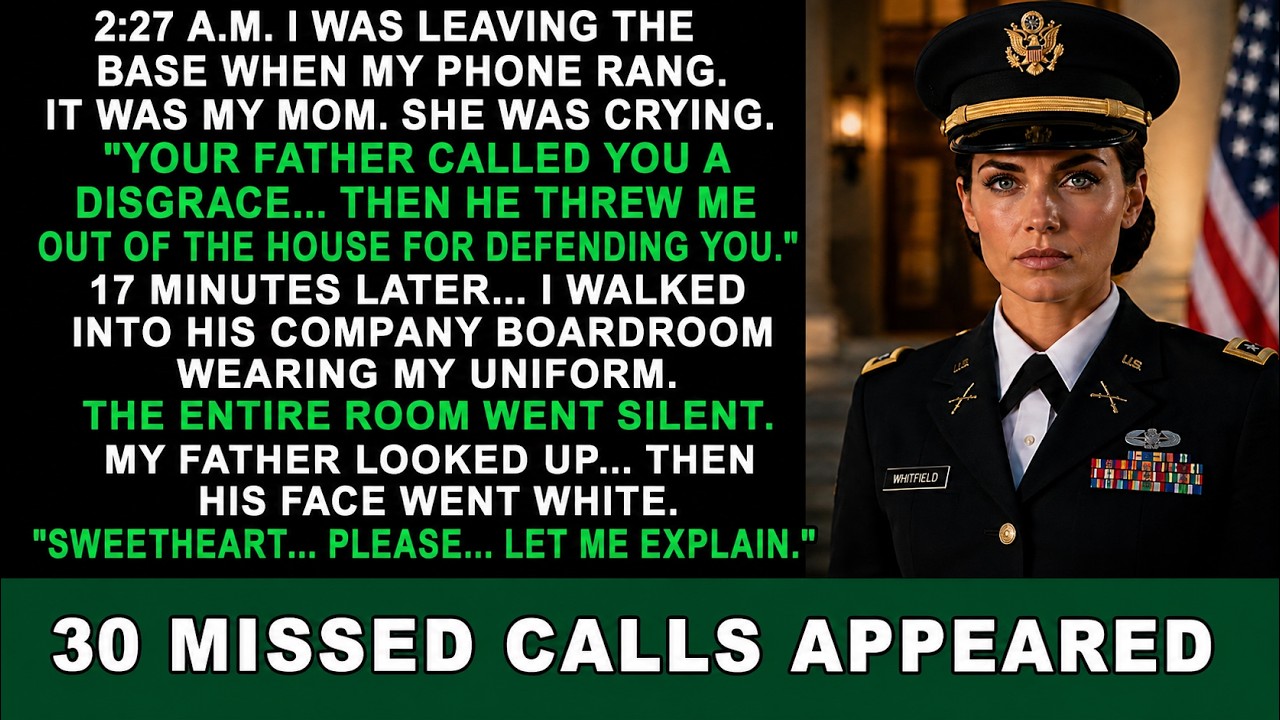
Three days earlier, my father-in-law had stood in front of 200 people at a banquet and called my military uniform a costume. I still hadn’t decided how to forgive that. But it was his house calling, not him. And something about that distinction made my stomach tighten before I even picked up.
“Clare? ” My mother-in-law’s voice was small, smaller than I’d ever heard it. “Can you come? I don’t…
I don’t want to be here right now. ”
I was already reaching for my boots. My name is Clare Whitfield. I’m a major in the United States Army, a logistics officer with sixteen years in, two deployments behind me, and a habit of staying calm that people mistake for coldness.
I’ve moved convoys through country that wanted us dead. None of that prepared me for the particular exhaustion of loving a family that had decided, collectively and without a vote, that I would never really belong to it. The drive to the Whitfield estate took eleven minutes at that hour, headlights carving through fog that had rolled in off the river. The house sat behind a stone wall my husband’s grandfather had built by hand.
Four generations of hospitality money stacked into white columns and a wraparound porch. Warren Whitfield—Bill, everyone called him, except me, because he’d never once invited me to—had built the family’s hotel chain into something that got written up in business magazines twice a year. Twelve properties across three states. A name on brass plaques in four different lobbies.
I found Marion sitting on the porch steps in her robe, a mug of tea gone cold in her hands. She didn’t look up right away. “He didn’t hit me,” she said before I could ask. “He’s never hit me.
I need you to know that first. ”
“Okay. ”
“He told me I embarrassed him at the gala. ” Her voice cracked on the word *embarrassed* like it was too heavy to carry.
“Because I said something about David’s job. Not even about you. About David. ” She finally looked at me.
“And then he told me if I wanted to keep defending this family, I could find somewhere else to sleep tonight. ”
I sat down next to her on the cold stone and didn’t say anything for a while. That was the thing about Bill Whitfield. He never raised a hand, never even raised his voice much.
He didn’t need to. He’d built an entire kingdom on the idea that comfort could be withdrawn like a loan. That love in that house came with an interest rate only he set. “He said something else,” Marion said eventually.
“About you. At the gala, after you’d already gone home. ”
I waited. “He said the company doesn’t need charity cases in dress blues standing next to the family name.
” She swallowed. “He said you’d always be the biggest embarrassment this family ever collected. ”
I’d heard versions of that sentence for six years. Somehow, it still found new ground to land on.
What Marion told me next was the part that actually mattered. Two weeks earlier, she’d walked into Bill’s study without knocking—a habit of thirty-one years of marriage—and found him on the phone, voice low and urgent in a way she’d never heard from him. He’d hung up the second he saw her. Later that night, she’d heard him on the back terrace, still on the phone, saying something that had stuck to her like a burr.
“If Clare starts asking about the Ridge View numbers, we’re finished. ”
I didn’t know what the Ridge View numbers were. I’d never had reason to ask. There was one more thing.
Marion reached into her cardigan pocket and handed me a small Manila envelope. No postage, no return address, just my name in handwriting I recognized instantly. My late father-in-law’s father—the man who’d actually founded the company, dead nine years now. Inside was a key to a self-storage unit in the next county over, and a note in the same careful hand.
*For Clare, when she starts asking questions. Trust the ledger, not the man. *
I sat there on the porch steps with a storage key in my palm and understood, for the first time in six years, that the coldness in that house had never really been about me. It had been about something Bill Whitfield was afraid I’d find.
I want to be honest about something. I didn’t marry into that family looking for a father. I had one of my own, gone too early, and I’d made my peace with that a long time ago. But there’s a particular loneliness in sitting at a table where everyone shares blood except you.
Watching birthdays and graduations get remembered for everyone but the woman who married in. David’s college graduation—Bill had a business trip. My promotion to captain—no card, no call, just a framed photograph of David as a boy delivered with a note about legacy. I understood the message.
It wasn’t cruelty exactly. It was arithmetic. I simply didn’t count. I’d stopped needing him to see me a long time before that porch.
Or so I told myself. Grief has a way of hiding in the places you think you’ve already cleaned out. I joined the army at twenty-two, mostly because I wanted to be somewhere that measured people by what they did instead of what family they’d been born into. Basic training didn’t care whose name was on the mailbox at home.
Neither did the supply depot outside Kandahar, where I spent fourteen months learning that competence—not charm—was what kept convoys alive. I remember standing in a motorpool at 2 a. m. in weather that made your eyelashes freeze together, double-checking manifests by flashlight because a single miscounted pallet could strand a forward unit for a week.
Nobody there needed me to explain myself. The work explained me. I carried that lesson home like a second skeleton. The understanding that the people who talk the most about their own importance are usually the ones who’ve done the least to earn it.
Bill Whitfield talked more than any man I’d ever met. It took me years to understand that the talking was the tell. By the time David and I married, I’d already learned how to sit through a room that underestimated me without flinching. Officers twice my rank had assumed the quiet logistics captain in the corner had nothing worth saying—right up until the plan she’d built was the only one that survived contact.
I brought that same stillness to Whitfield family dinners, not as a performance, but because I’d genuinely stopped needing Bill’s approval to know my own worth. What I hadn’t stopped needing—and what took me the longest to admit—was watching Marion pay for my absence from his good graces in ways I never saw until that night on the porch. The next morning, I didn’t call Bill. Didn’t argue with him.
Didn’t send a text demanding an apology on Marion’s behalf. Instead, I put on my service uniform—not for effect, just because I had a battalion briefing that afternoon and no time to change twice—and drove to Whitfield Hospitality’s headquarters before the briefing, because something in me needed to see his face while I still had the nerve. The lobby hadn’t changed since the first time David brought me there, nervous and twenty-six, hoping his father would approve of me the way he approved of a well-negotiated lease. Marble floor.
A fountain nobody ever really looked at. Bill’s portrait behind the reception desk. Painted, not photographed, because photographs age and portraits apparently don’t. The receptionist recognized my face before my name.
“Mrs. Whitfield—I mean, Major. Is he expecting you? ”
“No.
”
She reached for the phone the way people reach for something to hold on to. Before she dialed, a voice cut across the lobby, warm and startled. “Clare. ”
Dana Reyes had been Bill’s executive assistant for over twenty years.
She used to save me a seat at the company Christmas parties when nobody else thought to. Her hair had gone gray since I’d last seen her, and her smile faded fast when it found mine. “I heard about last night,” she said quietly. “Marion called me this morning crying.
I’m taking care of her. ” Dana glanced toward the executive elevator, lowered her voice further. “He’s not in a good mood. ”
“When is he?
”
A small, tired laugh escaped her. “For what it’s worth, a lot of people in this building stopped being afraid of disappointing him. They just stayed afraid of him. ”
That sentence followed me into the elevator.
The executive floor smelled like fresh coffee and expensive ambition. Through the glass wall of the boardroom, I could see maybe fifteen people gathered for what looked like a regional manager meeting, laughing at something. At the head of the table sat Bill Whitfield. Gray suit.
Silver hair combed with military precision he’d never actually earned. Holding court the way he always had, like the room belonged to him because he’d decided it did. I opened the door without knocking. Conversation died in patches, the way it does when people aren’t sure yet whether to be embarrassed.
Bill looked up, saw the uniform first, then my face, and something flickered behind his eyes before his public smile slid back into place. “Well,” he spread his hands like a man greeting applause that hadn’t come. “Look who decided to grace us. ”
Nobody laughed.
A couple of the younger managers looked at their laptops like the laptops had said something interesting. “I need five minutes,” I said. “We’re in a meeting. ”
“So was Marion.
Last night. Right before you asked her to leave her own house. ”
The temperature of the room changed the way it does before weather. Bill’s jaw tightened, but his voice stayed smooth.
Practiced. The tone of a man who’d spent forty years believing composure was the same thing as being right. “Family matters don’t belong in a board meeting. ”
“Neither does throwing your wife out at midnight.
But here we are. ”
One of the older regional directors cleared his throat and suddenly found his tablet fascinating. I stayed standing, hands loose at my sides, the way I’d learned to stand in rooms where the loudest person was rarely the one actually in control. “I have one question,” I said.
“What are the Ridge View numbers? ”
I watched it land. Not loud. A small tightening around his eyes.
A stillness that lasted maybe half a second too long. Fifteen years of reading logistics reports for discrepancies had taught me to notice half a second. “I don’t know what you’re talking about. ”
“That’s strange.
Because Marion overheard you telling someone on the phone that we’d be finished if I started asking. ”
“Marian misheard a private conversation. ”
“Twice? ”
A woman near the end of the table shifted in her seat.
Somebody’s pen stopped moving. Bill stood, buttoning his jacket like it might restore some authority. The room had quietly stopped extending him. “You have no standing here.
”
“You’re right. I don’t answer to you. ”
I reached into my bag, and for one bright, unguarded second, his eyes went to my hand like he expected a weapon. Instead, I set the storage key on the polished table between us.
Just the key. Nothing else. He looked at it the way a man looks at a snake he thought he’d already killed. “What is that?
” someone asked. “Nothing,” Bill said. Too fast. Too flat.
“Funny,” I said. “You don’t usually go pale over nothing. ”
He didn’t sit back down. He didn’t say another word.
I picked up the key before he could reach for it, told the room I was sorry for the interruption, and left. I wasn’t going to get anything more out of that room that day, and I didn’t need to. I’d gotten what I came for. I’d seen the fear underneath the smoothness.
On my way out, an older maintenance supervisor named Roy, who’d worked the building since before David was born, fell into step beside me at the elevator and slipped a small flash drive into my hand without a word. Glancing once down the hallway before he did it. “Your father-in-law’s father trusted very few people at the end,” Roy said quietly. “I was one of them.
”
“What’s on it? ”
“The truth he wanted you to have. When you finally started asking the right questions. ”
He gave me a small, sad smile and pushed his cart back down the hallway like nothing had happened.
I didn’t open the drive at headquarters. I didn’t open the storage unit that day either. I drove to a diner off the interstate, ordered black coffee I didn’t finish, and plugged the flash drive into my laptop in a booth by the window while a couple of retirees argued about football two tables over. A single folder appeared.
*Whitfield Family Archive. *
Inside were board minutes, financial statements, voice memos, and a journal that began with a sentence that stopped my coffee halfway to my mouth. *If you’re reading this, it means I waited too long to tell someone the truth. And I pray it isn’t my son who made that necessary.
*
It was. Over the following days, with the quiet, patient help of a friend from the Judge Advocate General’s office—a retired colonel named Marcus Hale, who taught me years ago that facts move slower than rumors but outlast them—I learned what the Ridge View numbers meant. For nearly nine years, funds earmarked for the renovation of three aging properties, including federal historic preservation grants, had been routed through a shell vendor that existed only on paper. Millions quietly skimmed, dressed up as maintenance and materials that were never purchased.
Bill’s own father had discovered the beginning of it before he died, and had spent his last two years documenting everything he could get his hands on. Terrified of what his son had become. Unwilling to destroy him publicly without proof strong enough to survive a courtroom. I didn’t want to be the one holding that proof.
But I’d learned a long time ago in the army that the people who look away from a problem because it’s uncomfortable are the same people who end up living in the wreckage of it longest. Marcus made one phone call to a contact in financial crimes. Within a week, federal auditors had quietly begun cross-referencing invoices. I said nothing to David until I had to.
And when I finally told him, sitting across from him at our kitchen table with Roy’s flash drive between us, he put his face in his hands for a long time. And then, when he finally looked up, he didn’t ask me to bury it. He just asked if I’d wait until after his mother had somewhere safe to land. I told him that was already done.
The public part came fast once it started. A regional business paper ran a piece, implying I’d used my military position to intimidate a respected local company. Bill’s fingerprints were all over the framing, right down to the unnamed source close to the family. Church friends who’d known me for years suddenly found reasons not to make eye contact.
Someone at Marion’s own Sunday service told her, loud enough to be heard, that success does strange things to families. Like the corruption was mine to answer for and not his. The final unraveling happened at the company’s annual shareholders meeting, in a conference hall full of investors and department heads who had spent years building honest careers under a dishonest name. Bill stood at the podium describing another record year, smiling through numbers that were about to be revealed as partly fiction.
And near the end, he allowed himself one long look toward the back of the room—toward me—and said something about people who confuse resentment with integrity. He didn’t get to finish the thought. Two federal agents walked in with the company’s own outgoing chief financial officer, who set two boxes of records on the board table and said, in a voice that shook but didn’t stop, that he was done lying for one man’s comfort. Nobody in that room laughed this time.
Nobody defended him. One by one, board members who had spent decades nodding along to his version of events sat in silence and watched fifteen years of paperwork undo him in real time. I didn’t say much. I’d learned that the quietest sentence in a room usually lands the hardest.
When Bill finally turned to me, furious and cornered, and said I’d built this to destroy him, I only told him the truth. “I didn’t build anything. I just stopped protecting you from what you built yourself. ”
He was removed as CEO that afternoon by unanimous board vote.
No handcuffs in that room, just two agents walking a much smaller man out through a lobby he used to own. None of it felt like winning. Six months later, I drove past the old headquarters on my way to visit Marion in the small house she’d chosen for herself. Sunlight on a river she said she’d missed for thirty years without knowing it.
The company survived, barely, under new leadership with no loyalty to the old name. And the historic properties finally got the renovations the grants had promised in the first place. David and I still went to Sunday dinner. Just without the man at the head of the table.
I visited Bill once at a minimum-security facility two hours from home, mostly because David asked me to, and partly because I needed to see for myself that the fear that had run that family for thirty years could actually run out. He looked smaller across that plastic table than he ever had at the head of his own boardroom. He apologized. And I believed that he meant it.
In the limited way a man can mean anything once he’s lost every audience he used to perform for. I told him I forgave him. I also told him forgiveness wasn’t the same as forgetting. And it definitely wasn’t an invitation back into a life he’d spent years making sure I felt unwelcome in.
He nodded like he understood. And for the first time since I’d known him, I believed he actually did. Driving home that evening, I thought about the version of myself who used to sit at that family’s table, hoping someone would eventually decide I belonged there. I don’t think about her much anymore.
Not because I’ve forgotten her, but because she finally got the thing she needed. Not an apology. Not applause. Just the quiet certainty that her worth was never actually up for a vote in that dining room to begin with.
If you’ve ever spent years trying to earn a place at a table that was never going to make room for you, I hope you hear this the way I finally did. You don’t have to burn the house down to stop living in it. Sometimes the strongest thing you can do is simply stop asking permission to be believed.