My father ripped my enlistment papers in half, looked me straight in the eye, and said, “You’re no daughter of mine. ”
That was fifteen years ago. Now I was sitting alone in a quiet room at Fort Liberty, waiting to pin on the silver eagle of a full colonel, when a news report on the television caught my attention. There he was.
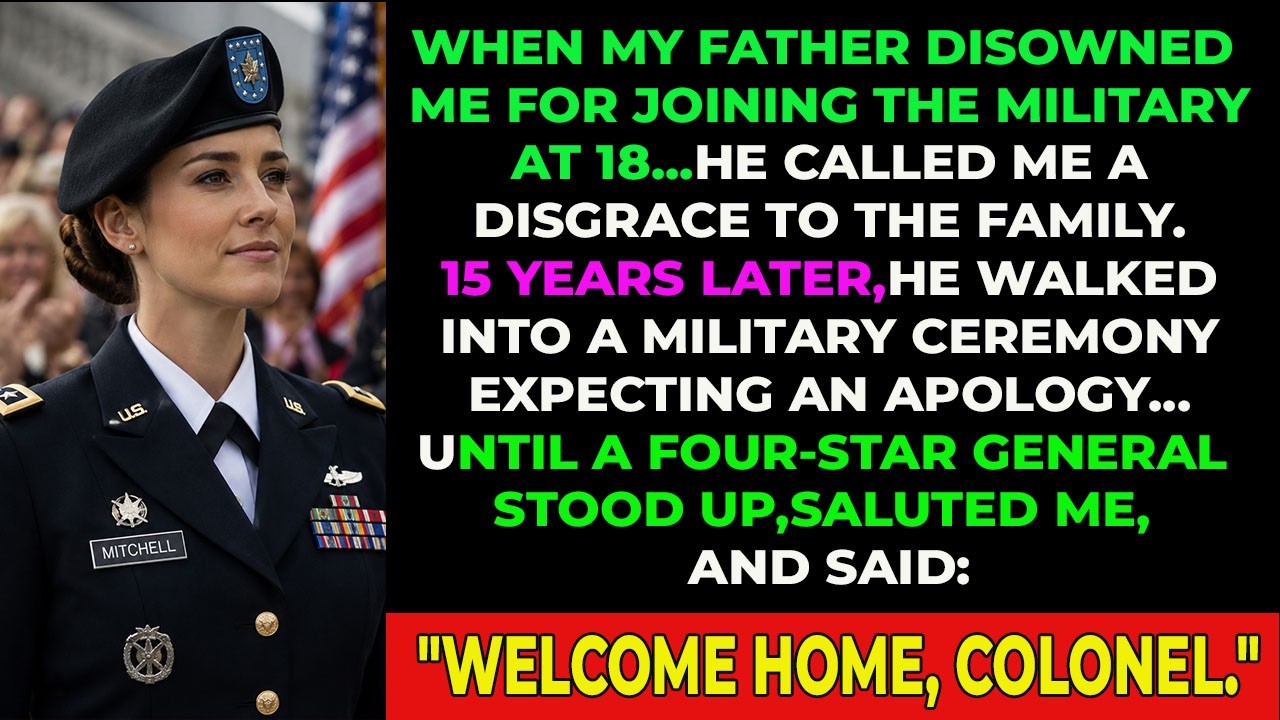
Frank Mitchell. My father. The reporter asked him, “Mr. Mitchell, how does it feel knowing your daughter is being promoted to colonel today?
”
He smiled that confident smile I remembered from childhood. “I’ve been proud of her ever since she decided to join the army. ”
I nearly dropped my coffee. Proud?
That wasn’t the word I remembered. The memory came back in a rush. June 2010. Lancaster, Ohio.
Sunday dinner. Dad sat at the head of the table. Mom brought biscuits from the oven. My older brother Kevin complained about the Cleveland Browns before the season had even started.
I cleared my throat. “I’ve got something to tell everyone. ”
He looked up from his mashed potatoes. “What is it?
”
I slid an envelope across the table. He frowned. “What’s this? ”
“My enlistment papers.
”
Silence. He opened the folder. His eyes moved across the page. Then his jaw tightened.
“You enlisted? ”
“Yes. I leave in August. ”
He leaned back in his chair.
“No. ”
“Dad, I’ve wanted this since high school. ”
“So what, you think you know better than your parents? ”
Mom reached for his arm.
“Frank. ”
He pulled away. He looked directly at me. “The army isn’t for young women.
”
“There are thousands of women serving. ”
“They’re making a mistake, too. ”
I tried again. “I’ve thought about this for years.
”
He stood so suddenly his chair tipped backward. “You think wearing a uniform is going to make you somebody? ”
He grabbed the enlistment packet and ripped it straight down the middle. Then again.
Paper floated to the floor like snow. “You’ll be a disgrace to this family. ”
I bent down and picked up the torn pages. He pointed toward the front door.
“If you leave this house to join the army, don’t ever come back. ”
Mom finally cried, “Frank, please. ”
He ignored her. He looked right at me.
“As far as I’m concerned, I don’t have a daughter anymore. ”
Those words hurt more than anything that happened in the next fifteen years. That night, my grandfather William stepped into my room. He’d served in Korea decades earlier.
He didn’t say much. He just handed me an old challenge coin, worn smooth around the edges. “I carried this overseas. ”
“I can’t take this.
”
“You can. ” He smiled. “Honor usually costs something. ”
Then he gave me fifty dollars.
“Your grandmother would have insisted. ”
He whispered into my ear, “Your father is letting pride do his thinking. ”
The next morning, I loaded my bags into a cab that took me to the Greyhound station. Mom stood on the porch.
She never came down the steps. Dad didn’t come outside at all. Grandpa saluted me from the driveway. I returned the salute even though I hadn’t earned one yet.
The bus ride to Fort Jackson felt longer than any trip I’d ever taken. I kept reaching into my pocket, feeling Grandpa’s coin. One question wouldn’t leave me alone: had I just traded my family for a dream? Or had my father made that choice for both of us?
The army taught me that nobody cared where I came from. At basic training, we all started at the same place. Scared, confused, and wondering if we’d made the biggest mistake of our lives. One afternoon, halfway through a twelve-mile ruck march, I felt a sharp pain in my left foot.
Then my leg gave out. I hit the dirt. “Stress fracture. ”
Instead of graduating with my company, I’d be recycled into another training class.
I lay awake that night staring at the ceiling. Maybe Dad had been right. The next afternoon, I called home. No answer.
I tried again. Straight to voicemail. I didn’t leave a message. One of my drill sergeants saw me outside the barracks.
“You called home? ”
“Yes, they answered. ”
“No. ” He nodded slowly.
“Sometimes the people you expect to carry you don’t. So you learn to carry yourself. ”
That conversation lasted maybe twenty seconds. I’ve remembered it for fifteen years.
I joined a new company after I healed. Starting over wasn’t easy. But something had changed inside me. I stopped worrying about proving my father wrong.
I focused on proving myself right. No family came to my graduation. I spent the afternoon eating barbecue with three recruits whose flights had been cancelled. Funny how strangers can become family faster than relatives sometimes.
Over the next several years, life settled into a rhythm only military families understand. PCS orders, packing boxes, new towns, making friends, saying goodbye, doing it all over again. I attended officer candidate school, earned my commission. Later, the army sent me to graduate school.
My first deployment was to Afghanistan. Movies never show the boring parts. But they don’t show how quickly strangers become people you’d trust with your life. Captain Maria Lopez from Texas.
Chief Warrant Officer Ben Carter from Tennessee. Sergeant First Class Eddie Brooks from Alabama. Different backgrounds. Different politics.
Different religions. None of it mattered. We depended on each other. Back home, life went on without me.
Every Christmas, I mailed a card to my parents. Nothing dramatic. Just “Merry Christmas. Love, Sarah.
”
Every January, the envelope came back. Return to sender. The first time crushed me. By the seventh year, it just made me sad.
Then, one rainy Tuesday morning at Fort Liberty, my executive officer, Major Allison Reed, walked into my office holding her phone. “You’ve been busy. ”
She turned the screen toward me. The headline from the Lancaster Eagle Gazette filled the display: “Local woman to become army colonel.
”
I laughed. “My hometown finally figured out I exist. ”
Then I kept reading. Halfway through the article was a large photograph.
Not of me. Of my father. According to the article, my father had encouraged me to enlist after high school. The reporter quoted him saying, “Sarah always had the heart of a soldier.
I just helped point her in the right direction. ”
I actually laughed. Not because it was funny. Because it was unbelievable.
Allison finally spoke. “Is any of that true? ”
“Not one sentence. ”
“So, what are you going to do?
”
“I have no idea. ”
The story spread. Columbus television stations picked it up. Veterans groups shared it online.
My father was everywhere. He gave interviews. He spoke at the Rotary Club. He even attended a Memorial Day breakfast where people applauded him for raising such an outstanding American.
A week later, I got an email from my mother. The first I’d received from her in over a decade. Subject line: “I’m sorry. ”
Just three sentences: “Sarah, there are things you deserve to know.
Watch your mail. ”
Three days later, an overnight delivery arrived. Inside was another envelope, yellowed with age. My name written in my father’s handwriting.
The letter was dated August 18th, 2010. Two weeks after I’d left home. “Sarah, don’t waste your time writing or calling. You made your choice.
From this day forward I no longer have a daughter. Don’t ever come home. Frank Mitchell. ”
I read it three times.
The words hadn’t become less painful with age. At the bottom of the package was one more folded piece of paper. My mother’s handwriting. “I’ve kept this hidden for 15 years.
Your father is building a reputation on a lie. The truth belongs to you now. ”
Major Reed read the letter. Then she said something I never forgot.
“Sometimes revenge is loud. And sometimes it’s simply refusing to protect someone from the truth. ”
By Friday, I’d made my decision. I wasn’t going to attack my father.
I wasn’t going to embarrass him. If someone asked me the truth, I’d tell it. And if they wanted proof, I’d let my father’s own words speak for themselves. The morning of the ceremony, I rubbed Grandpa’s challenge coin in my pocket and tucked the letter into the inside pocket of my dress blues.
General David Harrington, a four-star general, presided over the promotion. Every soldier in the room straightened instinctively. He walked directly toward me, stopped less than three feet away, and raised a perfect salute. “Welcome home, Colonel Sarah Mitchell.
”
The room exploded with applause. I returned the salute. “Thank you, sir. ”
He turned toward the audience.
“I’ve promoted many officers. But every now and then we recognize someone whose journey represents the very best of this army. ”
His voice softened. “What impresses me most is that she accomplished all of this without something many of us take for granted.
A family waiting to welcome her home. ”
The room became completely still. “Some soldiers inherit strength. Others build it.
Colonel Mitchell built hers. ”
Another standing ovation. Longer this time. When I finally glanced toward the front row, my father wasn’t smiling anymore.
He looked confused. Then uncomfortable. Then frightened. Because he understood something before anyone else did.
The general hadn’t accused him of anything. But every parent in that room had heard the same message: someone had failed this young woman long before the army ever met her. At the reception, a reporter from Columbus raised his hand. “I understand your father is here today.
He gave an interview last week saying he always encouraged your military career. ”
I felt every camera turn toward me. “I think that question is better answered by something my father wrote. ”
I reached into my pocket and removed the old envelope, worn and yellowed.
I handed it to the reporter. He opened it carefully. When his eyes moved across the page, the color drained from his face. He cleared his throat.
Then read aloud. “Sarah, don’t waste your time writing or calling. You made your choice. From this day forward, I no longer have a daughter.
Don’t ever come home. ”
Nobody moved. The reporter looked at my father. “Mr.
Mitchell. Did you write this letter? ”
My father opened his mouth. Nothing came out.
Finally, a single word barely reached us. “Yes. ”
“Then why did you tell the newspaper you supported your daughter’s decision to serve? ”
“I was angry.
”
“Sir, this wasn’t written last week. This was written 15 years ago. ”
A retired sergeant major stepped forward. His jacket was covered with ribbons earned over thirty years of service.
“I buried two sons who wore this uniform. ” His voice shook slightly. “They both came home under a flag. ” He turned toward my father.
“You had the chance to welcome your daughter home. You chose pride instead. ”
The attention my father had enjoyed all morning disappeared in less than two minutes. Not because anyone humiliated him.
Because nobody believed the version of himself he’d been selling anymore. He finally looked at me. “I’m sorry. ”
I walked toward him.
“I appreciate that. ”
“I was wrong. ”
“Yes. ”
“I don’t expect you to forgive me.
”
I answered honestly. “This day isn’t about settling old scores. It’s about honoring the people who stood beside me when I had no family left. My family is standing right there.
”
He lowered his head. For the first time since I’d known him, he had nothing left to say. As he walked toward the exit, no reporters followed. No cameras chased him.
The crowd simply let him go. Three months passed. Then one Friday afternoon, a plain white envelope arrived. No return address.
My father’s handwriting. “Sara, Sarah. I spent 15 years telling myself I did the right thing. The day that letter was read out loud, I realized I’d been lying to everyone, especially myself.
I wasn’t protecting my family. I was protecting my pride. You didn’t embarrass me. I embarrassed myself.
I don’t expect forgiveness. I don’t deserve it. But if you ever decide to talk, I’ll be waiting. Dad.
”
It was the first time he’d signed anything “Dad” since I was 18. Two weeks later, I called the number at the bottom of the letter. “Hello. ”
“It’s Sarah.
”
A long silence. Then a shaky breath. “I wasn’t sure you’d ever call. ”
“I wasn’t either.
”
We agreed to meet at a Bob Evans restaurant just outside Columbus. Neutral ground. He was already there when I arrived. Age had done what pride never could.
His shoulders were lower. His hands trembled slightly as he lifted his coffee cup. He watched every deployment he could find on the news. He never told anyone.
He thought if he admitted he was wrong, he’d have to admit he threw away fifteen years. For the first time in my life, I wasn’t angry. I was sad. Sad for the years we’d never get back.
Sad for my mother, who had spent those years standing silently between us. Sad for the grandchildren he might never know. When breakfast was over, he reached into his wallet. “I know I can’t fix this.
”
“No. ”
“I just needed you to know. ” His voice cracked. “I’ve been proud of you for a long time.
”
I looked at him carefully. “I believe you. I think you just didn’t know how to admit it. ”
Tears rolled down his face.
Mine stayed where they were. I’d already cried those tears years earlier. When we stood to leave, he hesitated. “Can I hug you?
”
I stepped forward. The hug was brief, awkward, human. Not a miracle. Not the ending of a movie.
Just two people acknowledging that some broken things can be repaired, even if the cracks never disappear. I used to think revenge meant watching someone else fall. Now I know better. The greatest revenge was building a life so full of purpose that one person’s rejection could no longer define me.
My father didn’t give me my strength. Losing him did.