The courtroom smelled of burnt coffee and lemon wood polish. Curtis Ward sat beneath the brass seal of Grayhaven County with one hand resting on his silver-headed cane, looking exactly like the decorated retired Navy captain whose photograph hung in our town hall. By noon he had told the judge that my mother died confused, that I forged her will, and that the story of an admiral being my biological father was a fantasy I invented to steal his house. “She drives visiting officers from the airport,” he said, smiling toward the gallery.
“That does not make her important, your honor. It makes her useful. ”
My half-brother Owen lowered his eyes. He had heard that tone before.
So had I. I did not answer. I touched the edge of the dark blue evidence envelope in front of my attorney. It carried a federal certification stamp and had remained sealed since a Navy records custodian delivered it that morning.
Curtis leaned toward his lawyer. “Open it. Let her little performance end. ”
The judge studied me.
“Captain Vail, do you understand that once this packet is admitted, portions of the record may become public? ”
Curtis’s smile weakened at the word captain. “I understand,” I said. The clerk cut the seal.
Somewhere behind me a man rose from the last bench. Curtis turned, saw the four stars on Admiral Daniel Rowan’s uniform, and gripped his cane with both hands. The air changed, but Curtis had no idea what he had just asked the court to open. I grew up in Grayhaven, Virginia, a river town of 6,000 people where church bells carried over the paper mill and everybody knew which families mattered.
Curtis made certain the Wards mattered. At public events, he called me his daughter. At home, I was Evelyn’s girl. My mother married Curtis before I could remember.
She told me my biological father had chosen the Navy over us, and whenever I asked for a name, she would smooth my hair and say, “Some doors hurt less when they stay closed. ”
Curtis always found a way to be nearby when I asked. He and my mother had Owen when I was six. From that day forward, our house divided without anyone naming the line.
On Owen’s 10th birthday, Curtis gave him a walnut stock hunting rifle wrapped in green felt. The den smelled of gun oil and chocolate frosting as neighbors gathered around to admire it. My 10th birthday had passed with a grocery store cake and a used dictionary. When I won the county science fair 2 weeks later, Curtis glanced at my blue ribbon and snorted.
“Paper prizes are for children who can’t lead. ”
My mother waited until he left, pressed the ribbon flat with her thumb, and sewed it inside the lid of my school bag so it would not wrinkle. She did small things like that. She warmed my gloves on the radiator before winter school mornings.
She ironed my white shirts with lavender water. Whenever Curtis dismissed something I had earned, she wrote the date on a yellow index card and kept it in a recipe tin above the stove. At 13, I found her sitting at the kitchen table after midnight. A narrow compass tattoo showed beneath her sleeve, its needle pointing toward a cluster of seven stars.
“Why north? ” I asked. “It isn’t north,” she said. “It is home.
”
She covered it before Curtis entered. Owen received a truck at 16. I received permission to use it if I filled the tank and cleaned the mud from the tires. When I qualified for a statewide leadership program, Curtis refused to sign the form because it required a weekend in Richmond.
“Girls who chase uniforms come home disappointed,” he said. My mother mailed the form from the hospital where she worked nights. I attended on a scholarship. That weekend, a Navy lieutenant spoke about service without once using the words glory or honor.
She talked about responsibility, being the person who stays clear when other people become afraid. I recognized the job before I understood the rank. At 17, I applied for an NROTC scholarship. Curtis laughed at dinner so hard his fork struck the plate.
“You? ” he said. “The Navy will eat you alive. ”
Owen laughed because Curtis did.
My mother did not. Under the table, she placed a small brass compass in my palm. The scholarship letter arrived on a wet April morning. Curtis read it first.
He left it open beside the sink, a brown coffee ring soaking through the word congratulations. “You’ll be back by Christmas,” he said. My mother drove me to the bus station 4 months later. Rain ticked against the windshield.
Before I stepped out, she rolled up her sleeve and showed me the faded tattoo. “A compass does not keep you from getting lost,” she said. “It reminds you that being lost is not the same as being finished. ”
I stopped waiting for Curtis’s approval before the bus cleared the town limits.
The Navy did not eat me alive. It stripped away every habit that had once made me small. During my first deployment, the metal decks of our supply ship held the Arabian heat long after sunset. One night, a helicopter brought in three burned sailors from another vessel.
A refrigeration failure had spoiled part of our plasma reserve, and the nearest replacement was hours away. I rerouted blood products from two scheduled evolutions, cleared a flight window with the air officer, and moved a surgical team before anyone finished arguing about whose authorization belonged on the request. We did not save everyone. We saved two.
Master Chief Luis Ortega found me afterward beside a pallet of empty medical coolers. Jet fuel hung in the air, and my hands smelled of dry ice. “You never try to own the room,” he said. “You just keep it from falling apart.
”
Years later, in the Philippine Sea, a typhoon tore antennas from a support vessel and flooded its lower storage spaces. I stood on a pitching bridge for 11 hours matching fuel, water, pumps, and medicine to ships we could barely see through gray rain. No speech, no metal ceremony. By dawn, every vessel still had what it needed to move.
I missed my mother’s 60th birthday during that deployment. She sent a photograph of one cupcake beside an empty chair and wrote, “The chair is not empty. It is waiting. ”
I kept the photograph through four commands.
By 42, I had learned that panic wastes time, volume hides weak facts, and the most dangerous person in a room is often the one who needs everyone to believe he belongs there. Everything I had trained for, everything I had survived, was preparation for a room I had not entered yet. My mother died on a Sunday morning in February. Cancer had reduced our world to antiseptic, machine hum, and winter light leaking through a hospital blind.
Curtis stood beside her bed when the nurse called me from Norfolk. I arrived 40 minutes later. He told me she had not woken. The nurse, Naomi Bell, waited until Curtis went to sign paperwork.
“She woke once,” Naomi whispered. “She asked whether you had the compass. ”
I showed her the brass piece I had carried since 17. Naomi nodded.
“Then she knew you would find the rest. ”
Curtis held a memorial at the Gray Haven Maritime Museum, where he chaired the foundation board. He spoke for 20 minutes about devotion. He did not mention that my mother had asked for me.
Three days later, he called me into the childhood kitchen. The lavender smell was gone. A new lock had been installed on the back door. “The house passes to me,” he said.
“Your mother changed her documents in November. Owen will manage the property when I’m gone. ”
He slid a photocopied codicil across the table. My mother’s signature leaned too far right.
The notary stamp belonged to a man who had retired 2 years earlier. “I want the original. ”
Curtis smiled. “You want many things.
”
I placed the copy in a clear sleeve. His smile disappeared. “Still collecting paper prizes? ”
“Always.
”
At the first estate conference, there were five people: Curtis, Owen, two lawyers, and me. Curtis claimed I had abandoned the family for a career nobody understood. Owen said the house should stay with the people who were actually here. He would not look at me when he said it.
My attorney asked where the codicil had been signed. “At home,” Curtis said. I slid one hospital record across the table. My mother had been admitted in Richmond on that date, 90 miles away.
Curtis tapped his cane against the floor. “Medical records contain errors. ”
I said nothing. The second escalation came at a foundation luncheon with 30 witnesses.
Curtis invited me, then announced from the podium that grief had made me confused about blood, property, and duty. People shifted in their chairs. Owen stared into his soup. Curtis lifted his glass toward me.
“A uniform cannot repair the hole left by a father who never wanted you. ”
No one laughed. That made him angry. He continued, “Evelyn spent her life cleaning up that man’s absence.
Now Nora wants to reward herself with a house she never came home to maintain. ”
I felt the brass compass against my palm inside my coat pocket. I had already saved a number in my phone, the Navy records liaison assigned to an old procurement archive. I looked at Curtis and nodded once.
“You should have checked the date,” I said. His face tightened. He did not ask which date. The next morning, Curtis filed his petition.
He alleged that I forged my mother’s earlier will, manipulated her during illness, and fabricated my paternity story to damage his reputation. He attached the questionable codicil and requested an injunction barring me from the house. He had turned private cruelty into a public record. That was his mistake.
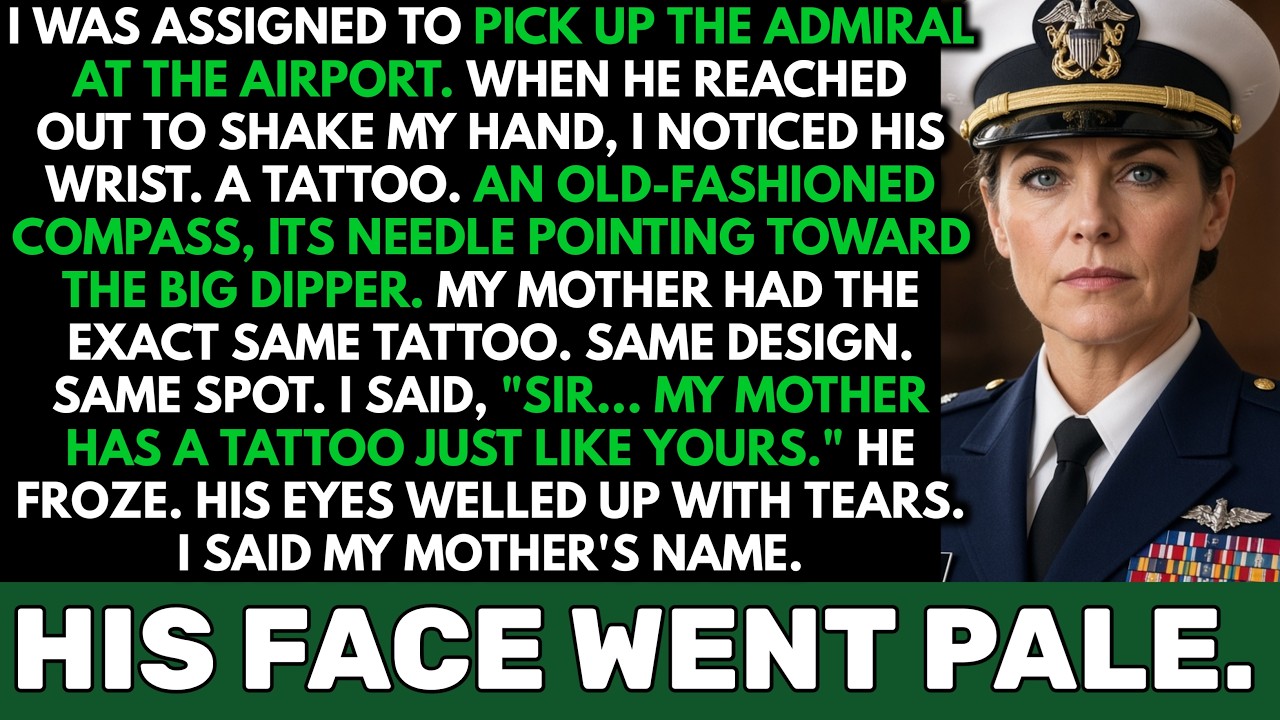
Two days later, I was assigned as senior liaison for a fleet readiness conference in Norfolk. My final arrival was Admiral Daniel Rowan, four stars, silver hair, and the stillness of a man accustomed to rooms organizing themselves around him. He stepped from the terminal and extended his hand. His sleeve pulled back.
On his wrist was an old compass, its needle pointing toward seven stars. For half a second, neither of us moved. His eyes dropped to the small copy of the same design on my wrist, the tattoo I had gotten after my mother’s funeral. “Who gave you that?
” he asked. “Evelyn Vale. ”
The color left his face. “Is Evelyn your mother?
”
“She was. ”
His hand lowered. Airport announcements echoed above us, but his voice barely carried. “What is your full name?
”
“Captain Nora Evelyn Vale. ”
He looked at me as if 42 missing years had arrived at once. In the government vehicle, he removed an old envelope from the inside of his coat. It was addressed to my mother, unopened, with a faded return stamp from 1983.
“I wrote this after I was told she chose Curtis Ward,” he said. “It came back through my command mail. Curtis told me she refused it. ”
“He told her you chose the Navy.
”
Daniel closed his eyes. “I did not know there was a child. ”
I studied his face. I had imagined this man as careless, selfish, maybe cruel.
I had never imagined him grieving a woman whose funeral had already happened. “Do not ask me to call you anything,” I said. “I won’t. ”
That answer was the first reason I stayed.
At 3:00 that morning, I sat alone in my mother’s kitchen. The refrigerator motor clicked on and off. Behind the recipe tin, I found a keyhole that matched the stem of the brass compass. The back panel opened.
Inside lay 31 letters tied with blue thread, a photograph of my mother beside a young Daniel Rowan, and an original birth certificate naming him as my father. On the photograph, both wore fresh compass tattoos. Across the back my mother had written, “We will find our way home. ”
Beneath it was a letter addressed to me.
Before I opened it, I called my attorney. By the time we returned to court, Curtis believed the admiral was theater, the hospital record was clerical noise, and the sealed federal packet contained nothing relevant to my mother’s estate. He made his final attack calmly. That made it worse.
“Your Honor, Nora has always needed to turn ordinary disappointment into persecution,” he said. “She left Grayhaven, missed family events, and came back only when property was available. The gentleman behind her may hold an impressive office, but rank does not establish paternity, authenticity, or ownership. ”
He looked directly at me.
“She is still the frightened girl who believed a uniform could make strangers choose her. ”
A chair creaked in the gallery. Even the court reporter stopped typing. My attorney asked me one question.
“Captain Vale, who is Admiral Rowan? ”
I looked at Curtis. “The man you taught me to blame is sitting behind me. ”
Daniel took the witness chair.
He did not speak about me first. He identified the tattoo, the photograph, the returned envelope, and the dates of his relationship with my mother. A court-authorized laboratory report confirmed paternity. The judge admitted my mother’s original will, stored years earlier with a Richmond attorney, which left the house to me and the foundation a fixed cash gift.
Curtis shifted his cane from one hand to the other. Daniel’s voice remained level. “Captain Vail was not assigned to drive me. She was the senior officer responsible for briefing our readiness group on supply integrity.
I met my daughter because the Navy trusted her with a room full of flag officers before either of us knew who the other was. ”
Curtis stared at the tabletop. That was the first reveal. My attorney lifted the opened federal packet.
The second was quieter. Certified Navy archives showed that Lieutenant Curtis Ward had served as the command mail control officer during the 1983 procurement review Daniel was conducting. The packet contained routing logs for letters addressed to Daniel and my mother. Each had been diverted under Curtis’s initials.
There was also a memorandum Curtis had written to a superior: “Rowan’s contact with Evelyn Vail must be restricted until the vendor review is closed. ”
The vendor was a marine parts company, partly controlled by Curtis’s uncle. Duplicate invoices had been questioned. No criminal case survived the missing records, but Curtis’s career had advanced after Daniel was transferred.
The final page was a sworn statement from the retired yeoman who had processed the mail. Curtis had ordered her to mark Daniel’s letter refused, even though my mother never saw it. Curtis’s thumb began rubbing the brass head of his cane. “That was 43 years ago,” he said.
“It has nothing to do with this will. ”
My attorney placed the disputed codicil beside the old routing slips. A document examiner had matched the pressure pattern, letter formation, and a rare backward hook in the capital E to Curtis’s handwriting. The supposed notary had signed an affidavit stating he never witnessed my mother’s signature.
Hospital security logs placed Curtis in her room with the document while she was sedated. “It establishes a pattern,” my attorney said. “When Mr. Ward feared losing control, he changed the paper.
”
Curtis turned toward Owen. “Tell them your mother wanted you to have the house. ”
Owen’s lips parted, but no words came. For the first time, my half-brother looked less protected than trapped.
The judge invalidated the codicil, confirmed the original will, removed Curtis from any role in the estate, and referred the suspected forgery to the Commonwealth’s attorney. She did not deliver a dramatic speech. She simply closed the file and said, “A respected name is not evidence. Records are.
”
Curtis tried to stand too quickly. His cane slipped and struck the floor. Nobody moved to pick it up. Outside the courthouse, cold rain stippled the stone steps.
Daniel stopped beneath the awning, waiting for me to decide whether he was allowed to stand near me. I felt no triumph, only space, quiet, unfamiliar space where an old question had lived. “Coffee,” I said. “One hour.
”
He nodded. “One hour. ”
Relief did not feel like winning. It felt like finally putting down a weight I had mistaken for part of my body.
Curtis was never led away in handcuffs. The prosecutor accepted a civil resolution after his health declined and the estate was restored. He resigned from the museum board. Invitations stopped.
The men who once gathered around him at the diner began choosing another table. Owen sold his truck to cover legal fees and moved two counties away. He called me once. “Dad said he did it to keep the family together.
”
“He kept the family arranged,” I said. “That is not the same thing. ”
Months later, I saw Curtis alone in the Grayhaven pharmacy counting coins beneath fluorescent light. He looked smaller without a podium.
“I protected your mother,” he said. “You protected the version of yourself that required us to be small. ”
He lowered his eyes. I left without waiting for an answer.
My mother’s letter was the last document I opened. She wrote that she had discovered the original birth certificate shortly before the cancer returned. She had been afraid to contact Daniel after so many years and ashamed that fear had hardened into the story she gave me. She asked the Richmond attorney to preserve her will, hid the letters where only my compass could open the panel, and left one final line beneath my name.
“You were never the child a man abandoned. You were the daughter two frightened people lost and the woman you became found herself anyway. ”
I read that sentence in her kitchen while lavender from an old drawer liner rose in the warm air. That was the inheritance that mattered.
Daniel and I did not pretend blood could manufacture a childhood. We began with coffee. Later came Sunday dinners, awkward photographs, and phone calls that sometimes lasted 3 minutes and sometimes an hour. He never asked for forgiveness on a schedule.
He showed up and let time make its own record. Master Chief Ortega retired that spring. At his ceremony, he saw Daniel standing beside me and understood before I explained. “You kept the room from falling apart,” he said.
“This time, you kept yourself with it. ”
For years, I thought being unwanted was the first fact of my life. Service taught me something different. A fact can survive questions.
A lie needs silence, fear, and people willing to repeat it. The loudest person in your family does not get to define your worth. The person who withheld love does not get to call your independence betrayal. Sometimes the proof that you mattered was hidden before you were old enough to look for it.
Sometimes you become the proof.