“By the third evening, my daughter hardly looked up from her laptop,” I told my therapist, ages ago, but the truth is, I see that same scenario in my office every week now. People drive six hours, or fly across the country, packing gifts and rehearsing the things they’ve been saving up to say. They arrive, and within a few hours, they feel it shift. Your son is on his phone during dinner.
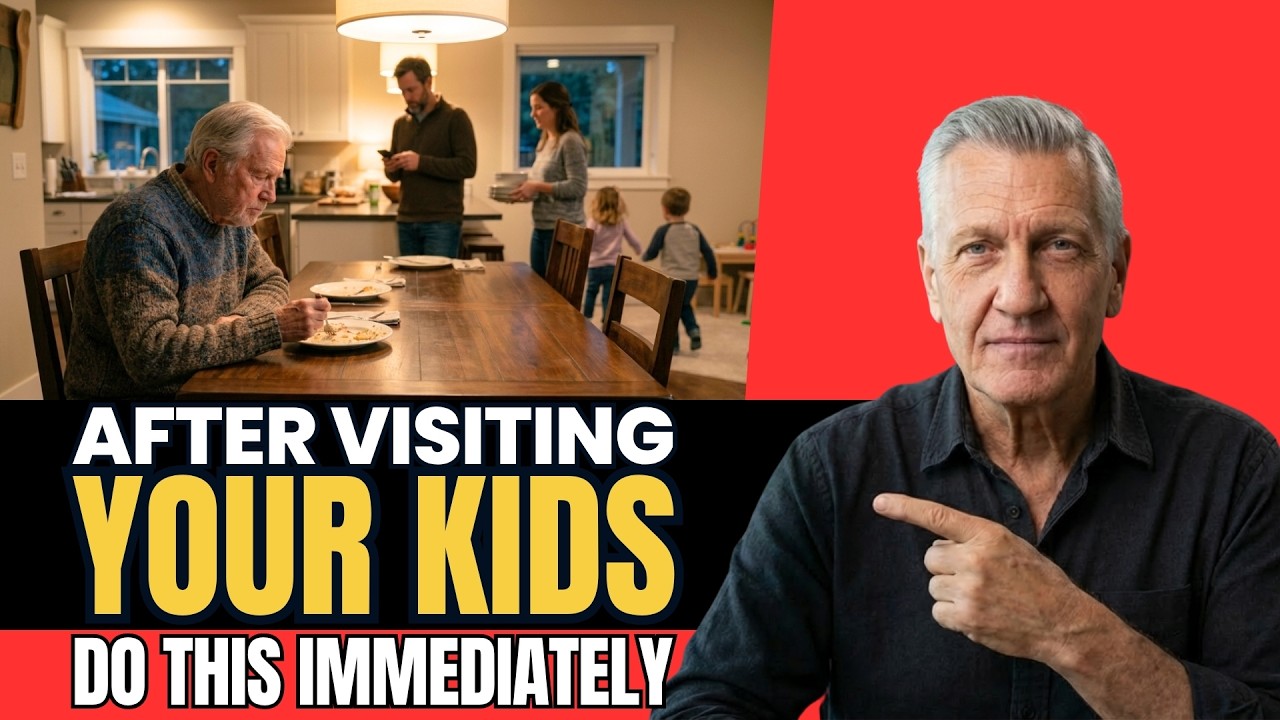
Your daughter-in-law is polite but distant. The grandkids give you a quick hug and vanish. You sit on the guest bed, surrounded by a house full of people, feeling lonelier than you would alone at home on a quiet Tuesday night. You smile through it.
You tell yourself it’s fine. But on the drive back, you think something you’re ashamed to admit: *I wish I hadn’t gone. *
That thought is what brings parents over sixty into my office more than almost anything else. I’ve spent over forty years as a psychologist listening to parents who love their children deeply and are quietly heartbroken because visiting their own kids feels worse than being alone.
If that’s you, I need you to hear this: there is nothing wrong with you. You are not too needy or too sensitive. And your children are most likely not bad people either. But something needs to change.
Here’s why this hurts so much. When you’re alone at home, you might feel lonely, but it’s a quiet kind of lonely. It’s manageable. There’s no one there to disappoint you.
But when you travel with love and hope, and you’re met with distraction or politeness without warmth, your brain processes that as rejection. And rejection activates the same areas of the brain as physical pain. Neuroscience has proven this. Social rejection literally hurts.
So when you come home feeling worse, it’s not because you’re dramatic. Your nervous system experienced something painful. You went looking for connection and came back with proof, or what felt like proof, that you don’t matter as much as you used to. But here’s what else I want you to know.
In most cases, your children aren’t trying to hurt you. They’re drowning in their own lives—jobs, mortgages, toddlers who don’t sleep, teenagers who won’t talk. They love you. They just don’t know how to show it in the way you need.
And you haven’t told them because you believe that if you have to ask, it doesn’t count. We’re going to challenge that belief today. Here are nine things you can do, starting with your very next visit, to protect your heart and rebuild that connection. First, let go of the movie in your head.
Almost every parent who tells me a visit went badly went with a script they’d been directing for weeks. In that movie, the whole family laughs at dinner, the grandkids climb into your lap, your son puts his arm around you and says, *“I’m really glad you’re here, Dad. ”* When real life doesn’t match that movie, you feel devastated. I had a seventy-two-year-old woman in my office, sharp as a tack.
She spent three weeks planning a visit to her daughter in Colorado. She imagined cooking together, going for walks, talking for hours. What actually happened? Her daughter worked from home two of the four days.
The grandkids had soccer. Everyone was too tired in the evenings to do much. She told me, “I felt invisible. ” But I asked her, “Was the script in your head something your daughter agreed to, or something you created alone?
” She went quiet, then said, “She didn’t even know I had one. ” That’s the trap. You’re grading the visit against a test your children never studied for. So before your next visit, replace the script with one single sentence: *I’m here to be near them, not to be needed by them.
* That shift, from expectation to presence, changes everything. Second, say what you need. I know this is hard for your generation. We were raised to believe that love should be obvious, that if someone truly cares, they should just know.
But unspoken expectations are premeditated resentments. Your children are not mind readers. They show love differently. So I’m giving you permission to say what you need, out loud, clearly, without guilt.
It doesn’t sound like, “You never make time for me. ” That’s an accusation. It sounds like this: *“I’d really love thirty minutes after dinner where we just sit together. No phones.
Just us. That would mean the world to me. ”* And you’d be amazed how often your children say, “Of course, Mom. I didn’t know you wanted that.
” Because they truly didn’t. Third, and this sounds backwards, visit for less time, not longer. There’s a principle I’ve shared for years: leave while it’s still good. Think about the best meals you’ve ever had.
You didn’t eat until you were sick. A seven-day visit sounds generous, but by day three, routines clash, you’re in the way in the kitchen, and everyone is quietly counting the days. But a two-day visit, focused and intentional, is easy to enjoy and easy to look forward to. I’ve seen families go from dreading visits to loving them simply by cutting the stay in half.
Try it. Go for a weekend instead of a week. You’ll be surprised how quickly your phone rings with, “When are you coming back? ”
Fourth, bring your own life with you.
When your whole trip revolves around your children, every moment they’re busy becomes a moment you feel abandoned. But if you pack a book you’re excited about, find a local cafe, discover a walking trail, and make a plan for yourself as a genuine part of your trip, something remarkable happens. You stop waiting for your children to fill your cup. You walk in already full.
And that energy is attractive. Your kids actually want to spend time with someone who’s thriving, not someone sitting in the corner waiting to be rescued. Be a guest with a life, not a guest with only a need. Fifth, separate fact from feeling.
After forty years of clinical work, the most dangerous thing in any relationship is not what the other person does—it’s the story you tell yourself about what they did. Your daughter checks her phone during lunch. That’s a fact. But the story you spin?
*She doesn’t care. I’m not important to her. * That’s a feeling dressed up as a fact. In my practice, we call this mind reading, and it’s the most common cognitive distortion I see in parents over sixty.
When you notice a painful thought, pause and ask, “Is this a fact, or is it a feeling? ” She checked her phone. Fact. She doesn’t love me.
Feeling. Learn to separate the two, and your visits will feel completely different—not because your children change, but because you stop writing tragedy into every ordinary moment. Sixth, stop counting who gets more of their time. You visit and notice your son spends Saturday morning with his friends.
Your daughter mentions the mother-in-law watches the kids every Wednesday. You think, *they have time for everyone else but me. * I understand why that hurts. But you are not in competition with anyone.
You hold a place in your child’s heart that no one else can occupy. That place changes shape over time. When your child was five, you were the whole world. At fifteen, you were the anchor.
Now they’re forty, and you’re the roots—still essential, still present, but underground and quiet. That’s not a demotion. A tree doesn’t reject its roots because it’s busy growing branches. Stop counting.
Trust that your place is secure, even when it doesn’t feel like it. Seventh, create a small ritual. Instead of planning a big event every visit, create something small, repeatable, and yours. Maybe it’s Saturday breakfast with your daughter at the same little spot—just the two of you, no kids, no agenda.
Or Sunday evenings when you and your son cook together in the same kitchen with the same terrible jokes. It doesn’t have to be fancy. It just has to be consistent. Rituals remove the pressure of making each visit special.
They tell your nervous system, *you have a place here. * Over time, these small repeated moments become the memories your family treasures most—not the big vacations or expensive gifts, but the sacred, simple times of just being together. Eighth, if the gentle adjustments don’t help, have a real conversation. Not an argument, not a guilt trip, not a tearful explosion at Thanksgiving.
Do it when things are good. Lead with love. I’ve given dozens of patients this exact speech, and it works almost every time: *“I love coming to see you. That hasn’t changed.
But I want to be honest—sometimes I leave feeling more lonely than when I arrived. I don’t think either of us wants that. Can we talk about how to make this better? Not just for me.
For both of us. ”* No blame, no history, no list of everything they’ve done wrong. Say it once. Mean it.
Then give them time. Some children respond immediately. Some get defensive at first but come back with something beautiful. You planted the seed.
Let it grow. And ninth, the most important one, is this: if your happiness depends entirely on your relationship with your children, then every visit will carry a weight it was never meant to carry. When your child is your only source of joy, you’re not visiting them—you’re asking them to save you. That’s a burden no loving child should have to bear.
So build a life that is full without them. Join a walking group. Take a class. Volunteer.
Reconnect with an old friend. When you have your own purpose, your own reasons to get out of bed, something beautiful happens. The visit stops being a lifeline. It becomes a bonus—a cherry on top of an already good life.
And here’s the irony: when you stop needing the visit to complete you, it almost always goes better. You show up lighter and happier. And your children enjoy your company more. They call more.
They invite more. Because being around someone who is living fully is a gift. Go back to that image from the start. The long drive.
The guest bedroom. The quiet. Hold it, and then let it go. That’s not the end of your story.
It’s a chapter you have the power to rewrite, starting with any one of these nine things. Pick the one that hit you hardest. Start there. The goal isn’t to be the center of your children’s lives—those days have passed, and that’s okay.
The goal is to still be in their lives, comfortably and peacefully, and on your terms, too. You gave them everything you had. Now it’s your turn to build a life so strong and so rich that when you visit, you bring something beautiful into the room—not need, not sadness, not a scorecard. Just you.
Whole. Present. At peace. That’s what a strong life after sixty looks like.
Not just surviving, but thriving—with strength, with dignity, and with a heart that’s still wide open.