The rain was relentless that night, a wall of water battering Seattle. My windshield wipers fought a losing battle, barely carving out a sliver of visibility. I gripped the steering wheel until my knuckles were white. These were hands that had once raised championship belts under blinding arena lights.
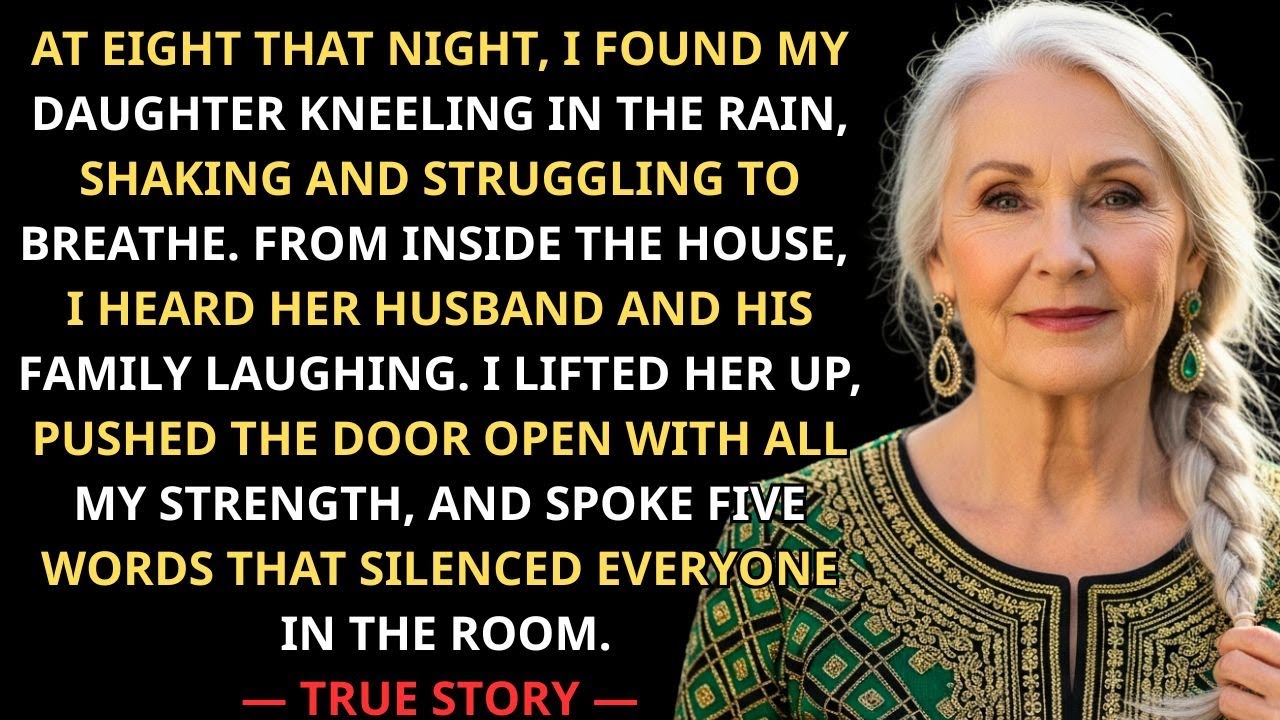
But tonight they trembled. Just after eight in the evening, my headlights hit the iron gates of the Sterling estate. The mansion glowed with warm light, music thumping through the walls. Inside, they were celebrating.
I reached over and placed my hand on the thermal container. Inside was a chicken pot pie, warm and smelling of thyme. Mia, my daughter, had called me two days ago, barely a whisper on the phone. Pregnant, three months along, she couldn’t keep any food down.
The only thing her body craved was the comfort food I used to make her when she was a little girl. I punched the access code into the keypad at the gate. Red light. Denied.
I tried again. Denied. A surge of anxiety tightened my chest. I parked the car, stepped out into the freezing downpour, and ran toward the pedestrian gate hidden in the hedges.
A small miracle—it was unlatched. I sprinted up the gravel driveway, breath forming clouds in the cold air. At the front door, I rang the bell. Nothing.
I pounded on the oak. No answer. Something was wrong. That primal instinct, the same one that used to warn me of an incoming kick before I ever saw it, was screaming at me.
I moved around the side of the house, through the mud, toward the back patio. I peered through the rain-streaked glass. Inside, Victoria Sterling, the matriarch of the shipping empire, held court in a silver gown, a champagne flute in her hand. Her other hand rested like a claw on the shoulder of her son, Caleb.
My son-in-law threw his head back, laughing, his face flushed with alcohol. They looked perfect. But Mia was nowhere. I continued around the patio, past the ornamental rose garden.
The wind howled. And then I saw it. A lump of fabric on the slate stones. Mia was kneeling on the freezing patio, exposed to the full fury of the storm.
She wore a thin, sleeveless silk dress that clung to her shivering frame. Her arms wrapped around her midsection, shielding her small baby bump. She was shaking so violently that her teeth chattered above the wind. “Mia!
” I screamed. I dropped the food container. It shattered on the stones, the warm pie spilling into the mud. I fell to my knees, pulled her into my arms.
Her skin was like ice. Her lips were blue, her eyes vacant. “Mom,” she whispered. “I didn’t mean to disturb them.
”
“What are you doing out here? ” I cried, stripping off my coat and wrapping it around her. “Caleb said I was ruining the mood,” she stammered. “He said my nausea was disgusting the guests.
He told me to get fresh air until I could control myself. But the door… when I turned back, it was locked. ”
Rage exploded in my chest. It was the familiar fury of the fighter, the beast I had spent twenty years learning to cage.
They had locked my pregnant daughter outside in a storm like a disobedient dog. They had left her to freeze while they drank champagne ten feet away. I helped her to her feet, supporting her weight as we hobbled toward the French doors. I grabbed the handle and yanked.
Locked. Through the glass, I saw Caleb glance in our direction. He saw us. He saw his wife soaking wet, blue-lipped, freezing.
And he just turned away. He took a sip of his drink, said something to his mother, and turned his back. That was the moment Elena, the patient mother, ceased to exist. In her place stood Elena the Iron Vance, the undefeated champion who never backed down in her life.
I didn’t knock. I shifted my weight, planted my left foot on the stone, pivoted my hips, and unleashed a sidekick that hit the locking mechanism of the double doors with the force of a battering ram. Wood splintered, metal sheared, and the glass doors flew open. The music didn’t stop, but the conversation died instantly.
I stood in the threshold, water dripping from my nose, holding my half-conscious daughter against my chest. The guests stared. Victoria dropped her champagne glass. It thudded on the Persian rug.
“You animals,” I growled. Caleb looked at me, annoyance flickering in his eyes. “Elena, look at what you’ve done to the door. You’re hysterical.
Mia was just getting some air. ”
“Getting air? ” I screamed. “She is hypothermic.
She is pregnant with your child. She has been out there for hours. ”
Victoria stepped forward, her face a mask of icy disdain. “Take her home, then, if she is so fragile.
She is clearly too weak to handle the responsibilities of being a Sterling wife. Look at her making a scene in front of the investors. ”
I looked at them—the expensive suits, the jewelry, the warm fire crackling in the hearth—then at my daughter fading in my arms. There was no point in talking.
“I am taking her,” I said, my voice trembling with the effort it took not to kill them right there. “And God help you all when I come back. ”
I half-carried, half-dragged Mia back to the car, blasted the heater, stripped her of the wet silk, and wrapped her in a wool blanket. I drove like a madwoman, running red lights, my tires hydroplaning on the slick asphalt.
Mia was mumbling, clutching her stomach, crying out in pain. “Hold on, baby. Hold on,” I pleaded, tears blinding me. When we crashed through the emergency room doors, nurses swarmed us.
They loaded her onto a gurney. Wires attached, monitors beeping. They wheeled her away behind double doors that swung shut, leaving me alone in the harsh fluorescent glare of the waiting room. Hours passed.
They felt like decades. I paced the linoleum floor, my wet clothes drying stiff against my skin. Every time I closed my eyes, I saw Caleb turning his back. I remembered the day Mia was born.
I was twenty-four, at the peak of my career, and when they placed that tiny pink bundle in my arms, the need for violence just evaporated. I retired two years later because I couldn’t bear the thought of her seeing her mother bruised and bleeding. I raised her to be kind, to be gentle, to see the good in people. Had I raised a lamb to be slaughtered by wolves?
A doctor approached, looking grave. “Mrs. Vance? ”
“Yes,” I choked out.
“Is she… is the baby? ”
He shook his head slowly. “I’m so sorry. The hypothermia was severe.
Her body went into shock. The extreme stress triggered massive uterine contractions. We tried everything, but we couldn’t stop the miscarriage. ”
The world tilted on its axis.
A sound escaped my throat, a raw, wounded noise that didn’t sound human. It was the sound of a future being erased. “Mia is alive,” the doctor continued, putting a steadying hand on my shoulder. “She is stable, but she is devastated.
She is asking for you. ”
Walking into that hospital room was the hardest thing I have ever done. Mia lay there, small and pale against the white sheets, an IV line snaking into her bruised arm. When she saw me, her face crumbled.
“I lost him, Mom,” she sobbed. “I lost him. ”
I held her while she cried, rocking her like I did when she was a baby. A cold, hard resolve formed in my gut.
This wasn’t an accident. This was cruelty. And they would pay. The next morning, the silence from the Sterlings was deafening.
No calls. No flowers. No inquiries. Mia lay in bed, staring at the wall.
“I need to call Caleb,” she whispered. “Maybe he doesn’t know. ”
“He knows,” I said gently. “He’s my husband, Mom.
He loves me. It was just a mistake. ”
Her denial was a survival mechanism. I stepped into the hallway and dialed Caleb’s number.
Voicemail. I called the house. A housekeeper told me Mrs. Sterling was unavailable and that I was not to call again.
I drove back to the mansion. The broken doors were already boarded up with plywood. I pounded until my fists ached. Caleb finally opened the door, disheveled, smelling of stale alcohol.
“What do you want, Elena? We are dealing with the contractors for the door you destroyed. ”
“Your son is dead,” I said. “Mia lost the baby last night.
”
Caleb flinched for a second. A shadow crossed his face, a flicker of something that might have been humanity. Then it was replaced by a defensive sneer. “Well, maybe if she hadn’t run off into the rain like a drama queen, this wouldn’t have happened.
She was always too weak to carry a Sterling heir. ”
I wanted to hit him. I knew exactly where to strike. But if I touched him, I’d go to jail.
And Mia needed me. “You are a monster,” I whispered. “Tell Mia to contact my lawyer,” he spat, closing the door. “I think this marriage has run its course.
”
He slammed the door in my face. I went to the police. I went to a lawyer, a sharp-witted woman named Sarah Jenkins who specialized in high-profile divorces. We filed a report for domestic abuse and criminal negligence.
But the Sterings were faster, richer, and they played dirty. Two days later, while I was at the hospital, my house was broken into. The television was there, my jewelry box untouched, a cash jar still on the counter. But my laptop was gone.
The folder with Mia’s medical records and the printed ultrasound photos was gone. And worse, the narrative began to shift. On the local news, a Sterling family spokesperson gave a statement. “We are deeply saddened by the mental health struggles of Caleb’s wife,” the woman said smoothly.
“It is a tragedy when a woman suffers from a phantom pregnancy and uses it to manipulate a family. We hope she gets the psychiatric help she desperately needs. ”
Phantom pregnancy. They were erasing the existence of my grandchild.
They were painting Mia as a hysterical woman who imagined a baby to trap a rich husband. It worked. Neighbors who used to wave at me now looked away. I received hate mail.
Mia saw the comments online before I could take her phone away. She stopped speaking. She just lay in the hospital bed, convinced that maybe she was crazy. I felt like I was in the final round of a championship fight, losing badly.
But you don’t become a champion by quitting. You wait for the opponent to make a mistake. That opening came in the form of a phone call from an unknown number. “Meet me at the Pike Place Market under the big clock.
One hour. Come alone. ”
I went. Standing under the neon clock, amid tourists and the smell of fish, was a woman in a hooded raincoat and dark sunglasses.
It took me a moment to recognize her. Juliana Sterling, Caleb’s younger sister. The quiet one sent away to boarding schools. The one who never smiled in family photos.
“Mrs. Vance,” she said, barely audible over the crowd. “Juliana. Are you here to deliver another message from your mother?
”
She flinched. She reached into her pocket and pulled out a small silver USB drive. “My mother and brother, they think they can buy the truth. They think people are disposable,” she said.
“Why are you helping us? ”
“Because before Mia, it was a girl named Sarah. Before her, it was Emily. Caleb destroys everything he touches.
And my mother sweeps up the pieces and pays people off. ” She looked up, and I saw a deep, old pain in her eyes. “I can’t be silent anymore. I’m done being an accomplice.
”
“What’s on this drive? ”
“Security footage. The raw files from the patio cameras. My mother told the security team to wipe the servers, but I made a copy first.
”
My hand closed tight around the metal. “Thank you. ”
“Don’t thank me yet. Just bury them.
”
She pulled her hood up and vanished into the crowd. I ran to Sarah’s office. We watched the footage together. The high-definition night vision camera captured everything.
Caleb pushing Mia out the door. Him locking it. Mia knocking, begging to be let in. The time stamp ticking away.
Guests inside laughing, ignoring the woman dying on their doorstep. Victoria checking her reflection in the glass, seeing Mia, and closing the curtains. Two hours. She was out there for two hours.
“This is the smoking gun,” Sarah said, her eyes gleaming. “But we don’t just give this to the police. The Sterings have judges in their pocket. We need to try them in a court they can’t bribe.
We need the public. ”
“Exactly. ”
The next day, Caleb Sterling held a press conference on the steps of the King County Courthouse. He wore a black suit.
He squeezed out a tear for the cameras. “My wife is very sick,” he said, his voice trembling with practiced emotion. “There was never a baby. It was a delusion brought on by stress.
We tried to get her help, but her mother interfered. ”
I was standing at the back of the crowd next to Sarah, my phone buzzing in my hand. “Now,” Sarah whispered. We uploaded the video.
We sent it to every news outlet, every blog, every influencer who had covered the story. The reaction was instantaneous. Phones in the crowd started pinging. Reporters looked at their devices, eyebrows shooting up.
The murmur turned into a roar. A reporter shouted, “Mr. Sterling, if there was no baby, why does this video show you locking your pregnant wife outside in a storm for two hours? ”
Caleb froze.
His mask slipped. “What? No, that’s doctored. That’s fake news.
”
Another reporter held up a tablet. “It’s timestamped, sir. We can see you. We can see your mother drinking wine while your wife freezes.
”
The crowd turned. Sympathy evaporated, replaced by visceral disgust. Caleb’s lawyer grabbed his arm, but the questions came like bullets. “Did you know she was hypothermic?
”
“Did you know she miscarried the next day? ”
“Is it true you stole her medical records? ”
Caleb stumbled back, his arrogance shattered. He looked around for his mother, but she wasn’t there.
He was alone. The fallout was nuclear. Within twenty-four hours, the Sterings were the most hated family in Seattle. The police reopened the investigation with the video and subpoenaed hospital records proving the pregnancy was real.
The trial three months later was a spectacle. I sat in the front row holding Mia’s hand. She was still thin, still pale, but her eyes were clear. She wore a simple blue dress, her head held high.
She was no longer the victim. She was the survivor. Juliana took the stand and testified against her own family with quiet dignity. She spoke of the cycle of abuse, the cover-ups, the emotional manipulation.
She looked at her brother and didn’t flinch. The medical examiner detailed the effects of the cold on Mia’s body, confirming beyond a doubt that the stress and hypothermia caused the loss of the fetus. Caleb didn’t testify. The jury deliberated for less than four hours.
Caleb Sterling was found guilty of reckless endangerment, domestic abuse, and gross negligence resulting in bodily harm. He was sentenced to five years in state prison. It wasn’t enough for the life he took, but it was justice. Victoria Sterling never faced a jury.
On the morning she was due to testify, she suffered a massive stroke brought on by the stress of her collapsing empire. She was left paralyzed, trapped in her own body, unable to speak. She spent her remaining days in a high-end care facility, staring out the window at the rain. A year has passed since the trial.
The rain in Seattle hasn’t stopped. It never really does. But it feels different now. It feels cleansing.
Mia didn’t go back to playing the piano. She said the music reminded her too much of the parties at the Sterling House. Instead, she picked up a paintbrush. She started an art therapy program for women who have survived domestic violence.
She leased a small loft in Pioneer Square and calls the studio The Shelter. A place where women can come, be warm, be safe, and turn their pain into something beautiful. I help her run it. I teach a self-defense class in the evenings, showing women their bodies belong to them and no one else.
Juliana moved to New York. She’s studying law. She wants to be a prosecutor. She sends us postcards every month.
She finally found her own voice. One afternoon, I found Mia sitting on the balcony of our small apartment, watching a storm roll in over the Puget Sound. The gray clouds were heavy, but she wasn’t afraid. She was drinking tea, her hand resting absently on her stomach.
The grief is still there. It always will be. You don’t get over the loss of a child. You just learn to grow around the hole it leaves in your heart.
“Mom,” she said. “I used to think I was weak because I couldn’t handle their world. Because I couldn’t handle the cold. Because I let them treat me that way.
”
I sat down beside her and took her hand. “You survived the cold, Mia. You survived the storm. They broke at the first sign of trouble.
You endured. ”
She looked at me, and for the first time in a long time, her smile reached her eyes. “We survived,” she corrected. I wrapped my arm around her.
Yes, we did. We are taught that silence is polite, that enduring suffering is a virtue. We are told to keep the peace, to smile through the pain. But sometimes peace is just a mask for oppression.
Sometimes the most moral thing you can do is disturb the peace. Because if you don’t speak up for the truth, if you don’t scream against the storm, the rain will drown you. Looking at my daughter now, painting a canvas with bright, defiant colors, surrounded by other women finding their power, I know our voices are the only shelter that truly matters. We are no longer victims of the storm.
We are the ones who learn to dance in the rain.