The Greyhound bus ride from Nashville took eleven hours. Eleven hours of grinding diesel, stale cigarette smoke baked into the upholstery, and the rusted factories of the Ohio border blurring past a smudged window. Nobody texted to ask if I made my connection. Nobody called to ask if I was hungry.
When I finally walked up the cracked concrete driveway, the house was dark. I didn’t bother with the front door. I knew the drill. I hauled my canvas duffel around back, climbed the wooden stairs to the garage loft, and dropped my bag on a bare mattress.
Down in the kitchen, a frozen chicken and rice casserole sat on the rack with a neon Post-it note stuck to the foil: *Heat at 350. * That was my welcome home parade. I grabbed a glass of water and let my eyes drift to the fridge. It was a command center of wedding prep.
Dead center, pinned under a cheap magnet, was the seating chart. Gemma’s name sat at the sweetheart table in gold accents. I scanned the cardstock, table by table. Nothing.
Until the bottom corner. Table nine, right by the swinging doors of the venue’s restroom. I was sandwiched between a cousin who drank too much and some guy who used to dorm with my cousin in college. I pressed my thumb against the black ink of my name and smeared it just a fraction.
The only sister, shoved into the darkest corner of the room. Right next to the chart hung the weekend itinerary. At the bottom, someone had slashed a new line in aggressive red ballpoint. *After suit fitting, we’ll come steam the dresses and jackets.
* Underlined twice. It wasn’t a request. It was a mandate from management to the hired help. I folded the schedule into a rigid square and shoved it deep into my cargo pocket.
Command received. No pushback. That was how I survived this house. I played the ghost, the unpaid maid.
Friday hit like a hurricane. The bridal party crashed into the living room, and the house instantly reeked of cheap champagne, hairspray, and vanilla perfume. For two hours, I existed purely as moving furniture. I wore a heavy long-sleeved flannel shirt buttoned tight at the cuffs.
I picked up empty beer bottles and discarded plates. Not one of her bridesmaids made eye contact with me. I was invisible in the very house my blood money kept afloat. I retreated to the kitchen and cranked the faucet to the hot side.
I pushed my left sleeve up just a few inches to keep it dry, and the scalding water poured directly over my forearm. The skin there was a violent patchwork of thick raised grafts, a jagged melted topography that looked like a spider web carved into wax. I didn’t flinch. I couldn’t.
The nerve endings had been burned away to ash years ago in a dry ditch in Afghanistan. From the living room, Gemma let out a loud, piercing laugh. I pushed the faucet lever further. Hotter.
I wanted the rushing sound to drown her out. I closed my eyes. The smell of champagne faded. Suddenly, I wasn’t in a kitchen in Ohio anymore.
I was nine years old, staring down at hundreds of cold metal screws scattered across the concrete floor of aisle four. The injustice in my family did not hatch overnight. It was forged on the cold cracked floors of my father’s hardware store. I was nine.
My assigned position was behind the massive mechanical cash register, standing on an overturned milk crate to see over the keys. I didn’t play. I worked. Gemma was six.
Her position was the lumber cart. She treated the store like her playground, riding the heavy steel cart down the aisle until she bailed at the last second. One Tuesday afternoon, she jumped off too late. The cart slammed into an end cap of loose fasteners.
Hundreds of screws rained down onto the concrete. My father turned the corner. He didn’t yell. He didn’t reprimand her.
He scooped Gemma up, tossed her onto his shoulders, and handed her a piece of wrapped candy. The golden child rewarded for the destruction. Then he turned his head and jutted his chin toward the mess on the floor. I spent the next three hours on my hands and knees, separating the Phillips heads from the flatheads, one by one, while the child who caused the disaster ate candy in the air-conditioned office.
It was in that store where my father handed me the philosophy that defined my life. He slapped his calloused hand against a steel support beam. “People think things collapse when the roof caves in,” he said. “They are wrong.
A structure stands or falls based on what you do before the weight drops. Failure happens in the quiet years in advance. The loud noise at the end is just the notification. ” I didn’t know it then, but he was handing me a blueprint for my own erasure.
I became the prep work, the foundation. I walked Gemma to school every morning for six years. I carried her backpack when her shoulders hurt. I tied her shoelaces with double knots.
When the big corporate chains moved in and bled the store dry, they didn’t look to Gemma to save them. They looked at me. My senior year, my college acceptance letter sat on the kitchen table. A partial scholarship, not enough to cover the gap.
Gemma glanced at it with total indifference. “You’re just going to a state college, right? You’re smart. You can figure it out.
Mom said my out-of-state tuition is going to be crazy. ”
I looked at my father. He didn’t look up. He kept his eyes locked on a stack of red-ink invoices.
His silence was deafening. He needed me to hand over my life raft to the golden child, and he just didn’t have the spine to ask. I crushed the letter in my fist and tossed it into the trash can. The hollow thud against the plastic liner was the sound of my future closing.
By August, I parked in front of a dying strip mall. The Armed Forces Recruiting Center was wedged between a discount laundromat and a pop-up tax office. The recruiter slid a stack of paperwork across the metal desk. I pressed the pen to the paper and signed.
I sold my youth, my knees, and my blood to the United States military. I went home that afternoon and lied. I told them I lost the scholarship. I told them I took a low-level administrative job out west—data entry, filing papers.
My mother clicked her tongue. “Well, that is a shame. But you always were a bit too quiet to stand out in the interviews, Molly. ” I watched my father’s face.
The tight lines of stress around his eyes relaxed. Pure cowardly relief. He didn’t have to feel guilty for asking me to step aside. Two years later, I set up an automated transfer from my military credit union.
Every March and September, the property taxes on that Ohio house were paid in full. The homeowners insurance premiums drafted straight from my hazard pay. The foreclosure notices stopped coming. They simply accepted the financial miracle without ever looking for the source.
They used that breathing room to put Gemma through an expensive private university. She graduated, landed a job as a pharmaceutical sales rep, and became the ultimate American success story. I remained the family ghost. Every holiday, she’d call me on her drive home.
“So, Molly, still doing those odd jobs out west filing papers? You really need to figure your life out. It is getting embarrassing for Mom and Dad. ” She stood squarely on my shoulders and told me I was too short.
I let her have her victory. Then I hung up. Ten seconds later, the ground beneath my combat boots violently shook. July 2014, Afghanistan.
My platoon was pinned down in a dried riverbed. An IED blocked the only extraction route. Eleven men were trapped behind me. I moved forward, cleared the loose sand, found the primary trigger.
Then a secondary device buried under deceptive gravel detonated. The blast threw me backward. Fire latched onto my left arm, melting my uniform into my skin. The primary explosive was still live.
The timer was counting down. I couldn’t drop and roll. I slammed my body forward, pinned my burning arm against the hard earth, and drove my knee down onto the flames. The heat cooked the flesh off my forearm.
I didn’t scream. My right hand stayed steady. I slipped the cutters around the command wire, squeezed, and the detonator went dead. Ninety seconds I worked while my left arm burned alive.
For the next eleven months, my world was a sterile white room in the burn unit in San Antonio. Twice a week, the doctors scraped the dead tissue from my arm to prepare the muscle for skin grafts harvested from my thighs. I bit down on a plastic mouth block so hard I cracked it. I didn’t cry.
Every Sunday afternoon, I walked out to the hospital courtyard in a heavy gray sweatshirt and called home, regulating my breathing so the pain wouldn’t bleed through my voice. My mother picked up. She spent twenty minutes complaining that the contractor painted the church roof the wrong shade of gray. “It is supposed to be slate, Molly, not charcoal.
It is an absolute disaster. ” While she talked about paint colors, the nurses were changing the bloody gauze on my thigh. Nobody knew I was in a hospital bed. They thought I was still filing papers out west.
Summer 2015, I flew home on medical leave, down fifteen pounds. Gemma walked in from a weekend at the lake, golden tan and iced coffee. She looked me up and down with open disgust. “God, Mom, you look like trash.
What are you actually doing? Picking up garbage on the highway? ” I adjusted my left cuff over the scars. “I’m just recovering from a busy season at work.
” She rolled her eyes and walked past me. She had no idea I’d crawled back from the grave so she could complain about the summer heat. Now, six years later, I was standing in that kitchen again, watching steam rise from my ruined arm. I turned off the faucet, changed into a fresh shirt, and slowly fastened the left cuff with clinical precision.
Down range, a fraction of exposed wire cost you your life. Here, a fraction of exposed skin would cost me my carefully constructed peace. I grabbed the handheld steamer, threw it into my truck, and drove straight to the Mercer tailor shop. The air inside was heavy with cedar and the sugary smell of cheap mimosas.
I stood in the far back corner, running the steaming nozzle over linen suits. Gemma held court in the center, buzzing around the groomsmen, laying it on thick for Declan Carter, William’s older brother and the best man. I’d run his background check through a buddy at the VA. Former Army Ranger, two tours in Kandahar.
He stood like a board, watching Gemma with quiet, polite tolerance. My father sat on a leather sofa by the window, sipping black coffee, acting like the proud patriarch footing the bill. He wasn’t paying for any of this. I was.
I kept my head down. Then one of the groomsmen, Jude Parker, leaned against the rack next to me. “What do you do for work anyway? ” he asked loudly.
From the center of the room, Gemma spoke without even turning around. “Do not bother asking her, Jude. She just leeches off Mom and Dad. She cannot hold down a real job to save her life.
It is honestly embarrassing. ”
The shop went dead quiet. Then Jude barked out a laugh. But what broke me was the sound from the leather sofa.
My father lowered his mug, looked at Jude, then at me, and let out a soft, agreeing chuckle. “Sweet as a Sunday, that one. Every family has a late bloomer, right? She stays out of the way at least.
”
The air left my lungs. He knew. The man sitting on that sofa knew exactly whose money paid the mortgage. He knew I gave up my scholarship.
And yet, to save face in front of a bunch of yuppie groomsmen, he threw his own daughter straight under the bus. A dark, sub-zero rage settled in my chest. I didn’t speak. I reached up with my left arm to hang a jacket on the highest hook.
The movement pulled the cuff tight. A sound split the air—the dry, brittle snap of a cheap plastic button breaking. The sleeve slid down my arm. The harsh fluorescent light hit my exposed skin.
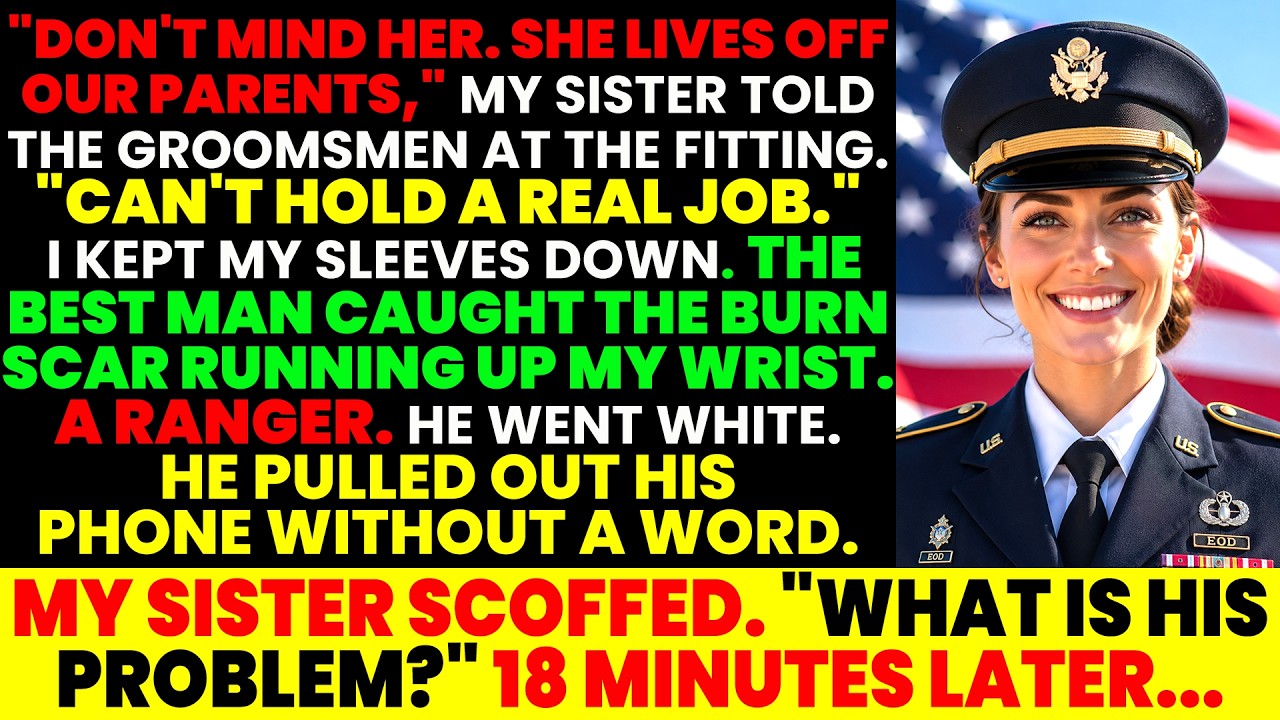
There it was. The thick, melted webbing of burn scars wrapping around my wrist and crawling up my forearm. I froze. Directly across the room, Declan Carter was staring into the floor-to-ceiling mirror, his eyes locked on my left wrist.
The polite tolerance vanished from his face. He closed the distance in three long strides, grabbed my wrist in a tactical hold, and pulled my arm into the light. “Where did you get that? ”
“It is just an old workplace accident,” I lied.
“A chemical fire in a warehouse. ”
He looked up and stared straight through me. The man had spent two tours in Kandahar. He knew exactly what an IED blast radius did to human tissue.
He let go, pulled out his phone, and walked straight out the front door. For eighteen minutes, the shop suffocated in awkward tension. Then a heavy engine revved outside. A dark Ford F-150 slammed into the curb, and two massive guys pushed through the door.
Brody, broad shoulders and a thick beard. Asher, former combat medic. They walked right past Gemma, stopping ten feet from me. “It’s her,” Brody said, staring at my rolled-up sleeve.
Asher stepped closer, scanning my face, then tracking down to the ruined skin. He spoke two words. A classified call sign. A blood password.
“Hazard 21. ”
The glass door opened one more time. Declan stepped back inside. The polite groomsman was gone.
The ranger was back. His eyes were red-rimmed, his chest heaving. “Tell me I am wrong, Master Sergeant,” he ordered, his voice cracking. “Look me in the eye and tell me you are not the one.
”
I squared my shoulders and dropped into rigid military posture. “I cannot do that, Sergeant. ”
Across the room, my father stood up, his coffee mug rattling against its saucer. Gemma froze, orange liquid spilling onto her designer pumps.
Declan turned to face them, the disgust on his face absolute. “July 2014,” he said, every word dropping like a cinder block. “An EOD specialist pinned her own burning arm against a live explosive device in a dry ditch, so eleven of us could walk out alive. I am the one who carried her to the medevac.
I know what her skin smelled like when it burned. ” He stepped closer to Gemma. “You just stood there and called a hero a leech. ”
My father opened his mouth to speak.
No sound came out. Late Saturday afternoon, William walked out the back door of the shop. He stopped five feet away and crossed his arms. “I have eaten eleven dinners at your parents’ house, Molly.
You know how many questions they have asked you about your life? ” He paused. “Zero. I am marrying into this family tomorrow.
After what just happened in there, I need to know the actual structural integrity of the house I am walking into. ”
“Sunday night, after the wedding,” I told him. “Come to the house at 8:00 p. m.
”
Sunday night came. Gemma and William were supposed to be at a hotel downtown. My parents sat exhausted on the front porch. I pulled a wooden chair directly in front of them and sat down.
I didn’t yell. I didn’t cry. I just started laying out the inventory. The crumpled scholarship paper.
The recruiting office next to the laundromat. The dry ditch. The ninety seconds of burning flesh. The eleven months in the burn unit.
The steel tools scraping dead tissue off my arm. My mother’s face crumbled. “You called me in the hospital, Mom. You spent twenty minutes complaining about paint colors while the nurses changed the bloody gauze on my thigh.
”
She bent forward, dropping her face into her hands. I turned to my father. “Look at it, Dad. ” I slid my phone across the glass table, showing the county assessor’s portal.
“You have not paid the property tax on this house in nine years. You have not paid the homeowners insurance either. I set up an auto draft from my hazard pay. The leech you laughed at yesterday is the only reason the bank did not repossess this porch you are sitting on.
”
The realization hit him with the force of a physical blow. The daughter he treated like a failure was his landlord. Suddenly headlights swept across the lawn. Gemma’s sedan pulled aggressively into the driveway.
She marched up the steps, still in her silk reception dress, her hair a mess. “You humiliated me,” she screamed, pointing a manicured finger at my chest. “Declan will not even look at me. William is treating me like I am some kind of monster.
You could have just told me. ”
She wasn’t upset that I had been burned. She was furious because I had ruined her image. I stood up.
“I let you be wrong, Gemma. But you are the one who decided exactly how loud and cruel that wrong was going to be. I am not a prop. And I am not your maid anymore.
You can clean up your own mess. ”
At 2:00 a. m. on the morning of her wedding, I sat by the window in the garage loft and watched the blue glow of her laptop screen project onto the dark grass.
She was digging through the military public affairs archives, searching for the unredacted press release from 2014. The official army commendation for Master Sergeant Molly Allen. I knew the bureaucratic wording. “With her uniform fully engulfed in flames, she remained with the primary explosive device, ensuring the survival of her unit over her own safety.
” The wall she used to measure her arrogant height was actually a blood-soaked fortress protecting her the entire time. At 8:00 a. m. , Gemma knocked on my door.
The perfect glowing bride was gone. She wore a baggy gray sweatshirt, no makeup, her hair in a tangled bun, her eyes red and swollen. She set a cardboard carrier with two Styrofoam cups of gas station coffee on the table. “Why did you not tell us, Molly?
” she asked, her voice cracking. She sounded exactly like the six-year-old girl who crashed the lumber cart. “Why did you just let us treat you like garbage? ”
“Because I did not want the family to have to pay the bill for the truth,” I said evenly.
“If you knew I traded my arm and my future to save this house, the guilt would have crushed you and Dad. So I took the hit. I played the failure. It was the only way to keep the structure standing.
”
She dropped her head onto her arms and sobbed, loud, ugly, heaving cries that shook her whole body. She was waiting for me to fix it. To walk around the table, put a hand on her shoulder, and tell her it was okay. I sat in my chair and did not move an inch.
People need to feel the absolute heavy weight of their own pain. I was done being the cushion for this family. She cried for ten solid minutes. Eventually, she realized the rescue team was not coming.
She sat up, wiped her nose on her sleeve, and stood. Without a word, she picked up her cup and walked over to the utility sink. She grabbed a sponge and scrubbed at it, but her hands were clumsy. She rinsed it, rushed it, and set it upside down on the drying mat.
It was a disaster—a thick film of soapy residue, cloudy water pooling at the rim. Every instinct I had screamed at me to get up and rewash it. I stayed in my chair. She walked out the door and headed down the stairs to face her wedding day.
At the reception, under the white canvas tent, the seating chart had changed. My name was no longer at table nine. It was at table two, front and center, right next to the immediate family. I stood nearby holding a glass of club soda.
William’s parents stopped at our table to greet mine. My mother found a backbone she hadn’t used in two decades. She looked William’s father dead in the eye. “I want you to meet my oldest daughter.
This is Master Sergeant Molly Allen, Army Explosive Ordnance Disposal. A late payment on a long overdue debt, but she paid it in full. ”
I sat down. Resting dead center on my plate was a thick piece of cardstock.
Black ink. *Hazard 21. * I flipped it open. Eleven names in Declan’s sharp military block lettering.
Sergeant Miller. Corporal Hayes. Private First Class Jackson. Eleven men who woke up this morning and lived their lives because I put my knee in the dirt and suffocated a fire in 2014.
I slid the card into my breast pocket. It weighed a ton. Later, Gemma raised the microphone at the head table. She didn’t mention the blast.
She didn’t mention my name. She looked out, her eyes locking onto my table for a split second. “To the people who always show up early and do the heavy lifting in the dark,” she said, raising her glass, “thank you. ” Short, clean, accurate.
I walked across the tent to table four. Brody and Asher sat there nursing domestic beers. Declan stood behind them, his tie loosened. Nobody stood up.
Nobody gave a speech. Brody looked up at me and lifted his bottle exactly one inch off the tablecloth. “Two words to one person. ” Asher and Declan raised their glasses to the same height.
I raised my bourbon. We drank. A silent, ironclad ritual. I reached down and snapped the button off my left cuff.
I folded the flannel back, pushing it past my elbow. The thick, violent burn scars were completely exposed to the open air of my hometown. A cool breeze brushed against the rough grafted skin. I didn’t hide it.
Brody took a sip of his beer, not even glancing at my arm. “So, you think Cleveland has a shot at the pennant this year? ” Normalcy. No pity, no staring, just baseball stats.
That absolute boring normalcy was the greatest victory of my entire life. The next morning, I threw my duffel into the bed of my truck. The tailgate clanged shut. I climbed into the cab and cranked the ignition.
I rolled the window all the way down and rested my scarred arm on the metal frame. The morning sun beat down on my skin. I didn’t need to hide anymore. I put the truck in drive and pulled out onto the long stretch of asphalt heading west.
Delayed respect is still respect. You take it when it comes. But you never, ever confuse their delayed recognition with your actual value. Your worth does not change based on who finally decides to acknowledge your sacrifice.
Your value was always there. It was there on the quiet days when nobody was watching. It was there in the empty rooms, the hospital beds, and the cold kitchens where you carried the heavy weight all by yourself to keep the family from falling apart.