“Don’t ever call me dad again as long as you’re wearing that uniform. ”
Those were the last words my father threw at me before I walked out of his house. Fifteen minutes later, our housekeeper called, barely able to catch her breath. “Major, don’t come home.
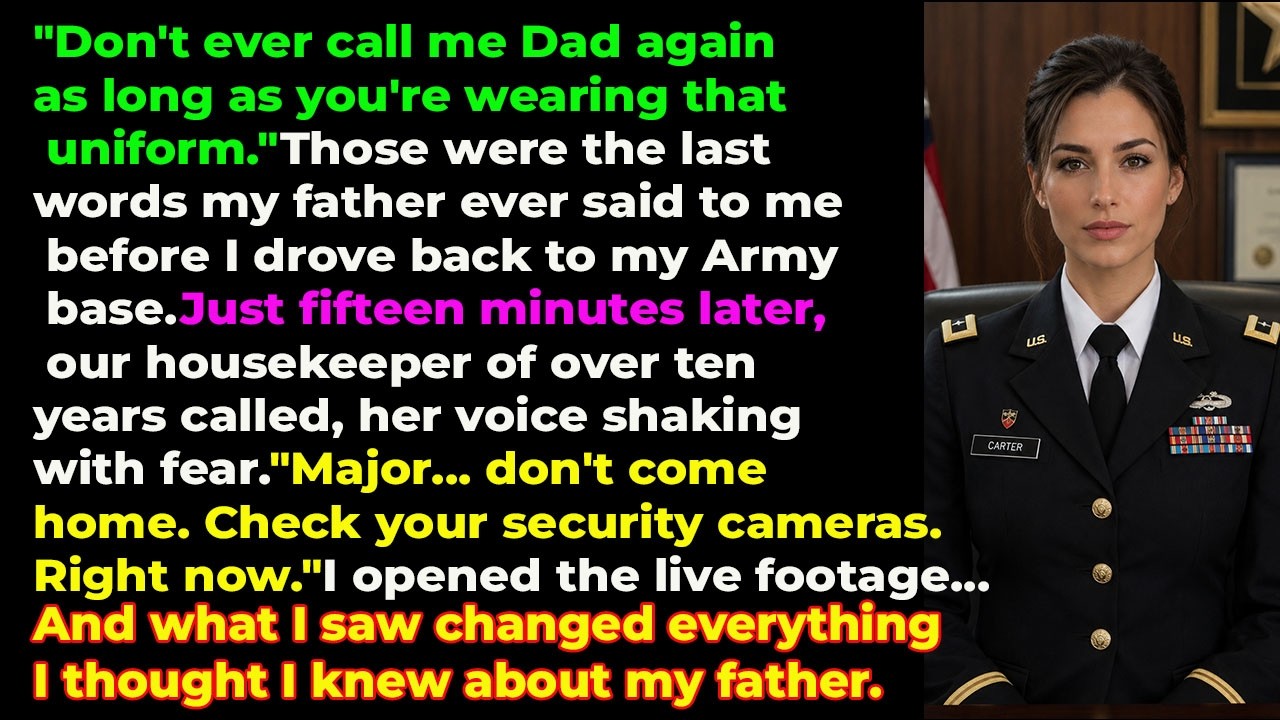
” A pause. “Check your security cameras right now. ”
I tightened my grip on the steering wheel as my SUV rolled north on Interstate 65. Rain streaked across the windshield, and the wipers beat a steady rhythm that made Maria’s trembling voice sound even more frightening.
“What happened? ” I asked. “I can’t explain over the phone. ”
“Is my father hurt?
”
“No. ”
“Then tell me. ”
Another silence. “I think he’s destroying something.
”
My name is Emily Carter. I’m thirty-four years old, a major in the United States Army stationed at Fort Campbell. I’d spent most of my adult life moving wherever the army needed me—Germany, Texas, South Korea, North Carolina. Last month I’d returned from a humanitarian logistics mission supporting flood relief overseas.
It wasn’t glamorous work, but it mattered. At least it mattered to me. To my father, it never had. Growing up in Franklin, Tennessee, everyone knew Richard Carter.
He owned Carter Construction, sponsored Little League teams, donated money to churches, and shook hands with politicians every election season. People called him generous, hard-working, a pillar of the community. At home he was something else. Not violent, not cruel in the obvious ways.
He simply believed there was one right way to live, and everyone else was wrong—especially me. He wanted a daughter who would stay close to home, marry young, help manage the family business, and eventually take care of him and my mother. Instead, I enlisted in the army two weeks after college graduation. He never forgave me.
My mother had tried to keep peace between us until cancer took her twelve years earlier. After her funeral, every conversation with my father became shorter. Every visit became harder. Still, he was my father.
So when my younger brother Daniel called a month earlier to say Dad was turning seventy and wanted the whole family together, I decided to come. Maybe age had softened him. Maybe time had healed something. I was wrong.
The birthday dinner was held at my father’s house just outside Franklin. More than eighty people came. Church friends, neighbors, former employees, business partners. Even the county commissioner stopped by.
Maria greeted me at the door with the warm smile I’d known since she started working for us over a decade ago. “You look tired,” she whispered. “I’ve had worse weeks. ”
She gently straightened my jacket.
“Your mother would have loved seeing you in uniform. ”
I smiled. It was exactly the kind of thing Mom would have said herself. Dinner started peacefully enough.
People asked about army life. Some thanked me for my service. One elderly veteran wanted to know if Fort Campbell still looked the way he remembered from the early seventies. We laughed together.
For almost an hour, everything felt normal. Then someone raised a glass. “Richard,” his business partner said, “you must be proud. One child running your company and another serving the country.
”
The table grew quiet. Dad slowly set down his fork. “Proud? ” He looked directly at me.
“I had bigger dreams for Emily. ”
A few uncomfortable chuckles floated around the room. I forced a smile. “It’s okay, Dad.
”
“No,” he replied. “It isn’t. ”
Daniel shifted in his chair. Maria stopped pouring iced tea.
My father leaned back. “You know what the army gave me? ”
I didn’t answer. “It took my daughter away.
”
The room became painfully silent. “I didn’t go anywhere,” I said softly. “You chose strangers over family. ”
“I chose to serve.
”
“You chose a uniform. ”
“I chose a purpose. ”
His jaw tightened. “And what purpose is that?
Missing birthdays, missing holidays, letting your own family become strangers. ”
“I’ve missed plenty because I was helping people who needed us. And your family didn’t. ”
His words landed harder than I wanted to admit.
I glanced around the table. No one spoke. No one wanted to. “I came here because I wanted tonight to be peaceful,” I said.
“So did I. ”
“Then let’s stop. ”
Instead, he stood. “You’ve embarrassed this family for fifteen years.
”
I felt every eye in the backyard turn toward me. “You wear that uniform like it’s more important than your own blood. It isn’t. ”
“It always has been.
”
I pushed back my chair. “I think I should leave. ”
Then came the sentence I’d remember for the rest of my life. His voice echoed across the backyard.
“Don’t ever call me dad again as long as you’re wearing that uniform. ”
No one moved. Not Daniel. Not the guests.
Not even me. For a second, I couldn’t breathe. Then Maria quietly handed me my car keys. She squeezed my hand.
“I’m so sorry. ”
I nodded once, walked to my SUV, and drove away. I made it less than twenty miles before my phone rang. Maria.
At first I thought Dad had changed his mind. Maybe he wanted to apologize. Maybe she’d convinced him. Instead, she whispered, “Major, don’t come home.
”
I pulled onto the shoulder. Rain drummed against the roof. “What happened? ”
“I heard voices.
”
“What voices? ”
“Your father’s office. He told everyone to leave after you drove away. ” She lowered her voice even more.
“But I forgot my purse upstairs. I was still inside. ”
“What did you see? ”
“I didn’t.
I heard. ” She swallowed. “He opened the room under his office. ”
I frowned.
“There isn’t a room under his office. ”
“There is. ”
Before I could answer, my phone buzzed. A notification from my home security system.
Dad had forgotten that years ago I’d helped install remote access for emergencies. My hands suddenly felt cold. I opened the app. The camera came alive.
My father’s office looked exactly as I’d left it earlier that evening. Bookshelves, leather chair, family photos. Then the rug moved. A hidden trapdoor slowly lifted from the floor.
My father climbed down first. Two men in expensive suits followed, carrying heavy black duffel bags. Minutes later they returned with dusty cardboard boxes. Each box had thick black marker across the front.
One word: Emily. Without hesitation, my father carried the first box outside. He dumped everything into the fire pit. Flames rose into the rainy night.
Photographs, scrapbooks, old report cards. My childhood disappeared one page at a time. Then one of the men held up another box. “What about the letters?
”
My father’s answer chilled me to the bone. “She can never read those. ”
I stared at the screen until the flames swallowed the last photograph. For a moment I couldn’t move, couldn’t blink, couldn’t even convince myself what I was watching was real.
The man feeding my childhood into a fire was the same man who never missed church on Sunday, who volunteered at food drives every Thanksgiving, who reminded everyone to do the right thing. Maria’s voice finally pulled me back. “Emily? ”
“I’m here.
”
“What do you want me to do? ”
I looked at the camera feed again. The rain had picked up, hissing against the fire pit, but it wasn’t enough to put out the flames. Richard stood with his hands in his pockets while the two men carried out another box.
“We need proof,” I said. “I know. ”
“Can you get outside? ”
“I’ll try.
”
“And Maria? ”
“Yes? ”
“Don’t let him see you. ”
“I won’t.
”
The call ended. I sat on the shoulder of Interstate 65 with my hazard lights flashing while eighteen-wheelers roared past, shaking my SUV. Every instinct I had as an Army officer told me to drive straight back to Franklin. Every instinct as a daughter wanted to believe there had to be an explanation.
Maybe those weren’t my things. Maybe there was some misunderstanding. Then another notification appeared. The backyard camera froze for a second before reconnecting.
One of the men was holding a bundle of yellow envelopes tied together with faded blue ribbon. Even through the grainy night vision, I recognized the handwriting. My mother’s. I hadn’t seen it in over twelve years.
My father took the bundle without hesitation, then tossed it into the fire. Something inside me broke. I turned the SUV around and headed south. Halfway back to Franklin, I called my old college friend Sarah Mitchell.
We’d met at ROTC twenty years earlier. She’d left the Army after eight years and joined the Franklin Police Department. She answered on the second ring. “Emily, I thought you were headed back to post.
”
“I was. ”
“You okay? ”
“No. ”
I told her everything.
Not dramatically, just the facts. When I finished, she was quiet for several seconds. Finally, she said, “You understand I can’t send officers into someone’s home because they burned old papers. ”
“I know.
”
“Do you have footage saved? ”
“I’m downloading it now. ”
“Good. But if those papers are evidence, they might be.
”
“Might? ”
“Emily, I need more than suspicion. If we do this wrong, your father becomes the victim. ”
That sentence landed harder than I expected.
Richard Carter as the victim. In Franklin, plenty of people would believe it. “I’ll keep watching the cameras,” I said. “Call me if anything changes.
”
By the time I pulled into a gas station outside Spring Hill, my hands were shaking. Not from fear. From anger. I walked inside and bought the strongest coffee they had.
Back in my SUV, I sat without starting the engine. I opened the security app again. The office camera was offline. Then the backyard camera.
Then the driveway. One by one, every camera went black. Richard had figured it out. Maria called again.
“I got one. ”
“What? ”
“One letter. I pulled it from the fire.
”
“Are you safe? ”
“I think so. He almost caught me. ”
“Leave.
”
“I already did. ”
“Where are you? ”
“The diner on Columbia Avenue. ”
The Waffle House parking lot was nearly empty when I arrived.
Maria sat in a corner booth with a cup of coffee she hadn’t touched. When she saw me, she reached into her purse and carefully pulled out a scorched envelope. The edges were black. Half the paper was gone, but my name was still there.
Emily. Written in my mother’s handwriting. I couldn’t speak. Maria slid it across the table.
“I think this belongs to you. ”
My fingers trembled as I unfolded what remained. Only part of the letter had survived. *Emily, if you’re reading this, your father didn’t tell you.
* The next lines had burned away. Farther down: *never stopped being proud. * Another missing section. Then one final sentence near the bottom: *Love always, Mom.
*
I read it three times. Four. Five. My father had told me Mom stopped writing months before she died.
That chemotherapy had made it impossible. That she’d asked him to throw away unfinished letters because she didn’t want me remembering her that way. I’d believed him. For twelve years.
Maria watched me quietly. “I lied to you. ”
I looked up. “What?
”
“The day your mother died. I heard them arguing. ”
“You never told me that. ”
“I promised your mother I wouldn’t.
”
“My mother asked you to keep secrets from me? ”
“No. ” She took a deep breath. “She asked me to protect you.
”
The words hung between us. “Emily, your mother wasn’t afraid of dying,” Maria’s eyes filled with tears. “She was afraid of what your father would do after she was gone. ”
I felt the room tilt.
Maria reached into her purse again. This time she removed a small brass key attached to a faded leather tag. “I’ve carried this for twelve years. ”
“What does it open?
”
“I don’t know. ”
“Then why keep it? ”
“Your mother gave it to me. The night before she went into hospice.
” She closed my fingers around the key. “She said if anything ever happened, and if Richard ever started destroying things, I was supposed to give this to you. ”
I turned the leather tag over. Stamped into the worn surface were six words: Cumberland Self Storage, Unit 214.
“Does my father know about this? ”
Maria slowly shook her head. “No. ”
I barely slept that night.
Not because of the storage unit. Not because of the letter. Because every memory I’d carried for the last twelve years suddenly felt unstable. At seven the next morning, I drove to Cumberland Self Storage.
A quiet facility tucked behind a shopping center on the north side of Franklin. I placed the brass key on the counter. “I need to know who rents unit 214. ”
The woman behind the counter typed for a few seconds.
“I’m sorry, I can’t release customer information. ”
“I understand. ” I reached into my wallet and handed her my driver’s license. “My mother gave me this key before she passed away.
”
The woman’s expression softened. “I still can’t tell you anything without proof. ”
As I turned to leave, she stopped me. She disappeared into the back office.
A minute later, she returned with an older gentleman wearing a maintenance uniform. His name tag read Roy. He studied my face for several seconds. “You Emily?
”
I blinked. “Yes. ”
“I remember your mama. ”
My heart skipped.
“You knew her? ”
He nodded. “Sweetest woman ever rented a unit here. ”
“When?
”
“Oh. ” He thought for a moment. “Twenty-five years, maybe. ”
“Long before she became sick.
”
“Long before anyone knew she was dying. ” Roy looked at the key. “She told me one day a young woman in Army uniform would walk through that door. ”
I felt chills run down my arms.
“What exactly did she say? ”
He smiled sadly. “She said, ‘If my daughter comes, let her in. If my husband comes, call the police.
’”
Unit 214 sat near the back fence. Roy unlocked the outer gate. “I’ll leave you folks alone. ”
Maria squeezed my shoulder.
“You ready? ”
“No. ”
I slid the brass key into the lock. It turned smoothly.
The metal door rattled upward. The unit wasn’t full of money or jewelry or property deeds. It looked ordinary. Plastic storage bins, old furniture, Christmas decorations, several cardboard boxes, a rocking chair, my mother’s sewing machine.
Then I saw it. A pink bicycle. Small, with white handlebars. My bike.
A tiny army sticker I’d put on the frame when I was thirteen was still there. We spent nearly two hours opening containers. Elementary school artwork, soccer trophies, my first softball glove, Mom’s recipe cards, Christmas ornaments we’d made together. Every item my father claimed had been lost in a basement flood had actually been hidden.
Then Maria lifted the lid on a large plastic tote. Inside sat dozens of neatly wrapped birthday presents. Each had a gift tag. Emily, age 23.
Age 24. Age 25. Every birthday after my mother’s death. I carefully opened one package.
Inside was a leather journal. The first page read, “Emily, your father may never give this to you. If you’re reading it someday, then at least one of my plans worked. ”
There were six journals, one for each year she knew she probably wouldn’t live to see.
She had written them before she died. Letters, advice, stories, family recipes, career encouragement. Everything. One passage made me stop breathing.
*If you still dream about serving in the army, please don’t let anyone make you believe I’d ever stand in your way. *
For twelve years, I had believed my mother opposed my decision to enlist. My father said she’d cried when I signed my ROTC papers. He said the army had broken her heart.
It wasn’t true. Not even close. Maria quietly unfolded another document. It was a bank receipt dated three weeks before my mother’s death.
Then another, and another, all from the same branch. Large withdrawals. Large transfers. The amounts grew bigger every month.
None of them looked familiar. I took photos with my phone. “I need a lawyer. ”
By noon I was sitting across from Rebecca Lawson, an estate attorney in downtown Nashville.
She listened without interrupting while I explained everything. The cameras, the fire, the letters, the storage unit. When I finished, she folded her hands. “Major Carter—Emily.
If even half of this is genuine…”
“What? ”
“This isn’t just about inheritance. This could involve fraud. ” She pointed to the bank records.
“Potential concealment of estate assets. ”
That evening she called me back into her office. She slid a certified copy of my mother’s medical file across the desk. “Look at the date.
”
According to the hospital records, my mother had met with an oncology social worker just sixteen days before she died. The notes included one sentence: *Patient is making long-term plans following separation from spouse. *
I looked up. “Separation?
”
Rebecca nodded slowly. “Your mother wasn’t planning to stay married. ”
My father always said they were closer than ever. That night I called Daniel.
He answered on the third ring. “I found mom’s letters. ”
Silence. “Daniel?
”
“I don’t want to hear it. ”
“You need to. Our father lied. He burned them.
I saw him. ”
“You’re doing this because you want money. ”
I felt the words hit harder than I expected. “You really believe that?
”
“I believe Dad. ”
The line went dead. Rebecca arranged a meeting with Harold Benson, a retired CPA who had worked for Carter Construction for nearly twenty years. He looked to be in his late seventies, thin, gray flannel shirt, veteran’s cap.
He recognized me immediately. “You’ve got your mother’s eyes. ”
“I’ve heard that before. ”
“I’ve been expecting this day,” Harold said.
“I always figured you’d come asking questions eventually. ”
Harold had joined Carter Construction when my parents were still in their forties. Back then the company was small, honest, successful enough to support several dozen families. “So what changed?
”
He sighed. “Your mother died. ”
“You mean grief? ”
“No.
I mean control. ” He stirred his coffee without drinking it. “Every decision had to go through him. No exceptions.
He stopped trusting employees. He stopped trusting family. And eventually he stopped trusting the law. ”
Harold reached into an old leather briefcase.
“I’ve carried these for eleven years. ” He placed three photocopies on the table. Each contained accounting entries, bank transfers, property numbers, corporate account codes. Rebecca’s eyes narrowed.
She pointed to one column. “These aren’t construction expenses. ”
“No, they’re hidden distributions,” Harold said. “Money that should have remained part of your mother’s estate.
”
“How much? ”
Harold didn’t answer immediately. Finally, he said, “Over the years, several million dollars. ”
The words settled over the table like heavy fog.
“I reported it,” Harold said. “To the company’s attorney. He told Richard. And I was fired two weeks later.
For poor performance. I’d never received a negative review in nineteen years. ”
“This helps? ” I asked.
“No,” Harold shook his head. “It isn’t enough. Richard always had backup plans. ”
That sentence stayed with me all afternoon.
Backup plans. It sounded exactly like my father. Every fishing trip, every family vacation, every business deal. He always prepared for what might go wrong.
If he had hidden financial records, he had probably hidden witnesses, too. The answer came sooner than I expected. Around five that evening, my phone buzzed. Daniel.
His voice was colder than I’d ever heard it. “Leave Dad alone. ”
“I’m trying to find out the truth. ”
“I know exactly what you’re trying to do.
You’ve embarrassed him enough. ”
“I haven’t embarrassed anyone. ”
“He says you’ve been telling people he’s a criminal. ”
“I’ve told exactly three people.
”
“That’s three too many. ”
“Daniel. Have you actually asked him about Mom’s letters? ”
Silence.
“Daniel? ”
“He says you’re imagining things. ”
“You believe that? ”
“I believe my father.
”
The call ended. Again. Later that night, Maria knocked on my hotel room door carrying a grocery bag with two sandwiches. Rebecca was with me.
For a while, nobody talked about evidence. We talked about Mom—her laugh, her chocolate pecan pie, the way she always sang off-key while gardening. For the first time all week, I smiled without forcing it. Then Maria became quiet.
“There is something else. I didn’t think it mattered before. ”
“What didn’t? ”
“The week before your mother died, she met someone.
A man. They talked for almost an hour. At First National Bank. When they came outside, your mother hugged him.
And she handed him a large envelope. The kind lawyers use. ”
“Did Richard know? ”
“I don’t think so.
”
The next morning, Rebecca made several phone calls. Around noon, she finally smiled. “I found him. The man from the bank.
He wasn’t a banker. He was your mother’s private attorney. He retired to Chattanooga. ”
We drove to Chattanooga that afternoon.
The retired attorney, Walter Gaines, lived in a quiet brick home overlooking the Tennessee River. He answered the door himself. Ninety if he was a day. Still sharp, still formal.
He listened without interrupting while I explained who I was. When I finished, he closed his eyes for several seconds. “I wondered if this day would ever come. ”
He disappeared into another room.
When he returned, he carried a small sealed envelope. Across the front in my mother’s handwriting were seven words: *For Emily, only if Richard fails her. *
Walter placed it in my hands. “I promised your mother I would never open it.
I haven’t. I won’t. ”
I didn’t open the envelope in Walter Gaines’s living room. For a long moment I simply held it.
My mother’s handwriting looked exactly the way I remembered it—neat, steady, impossible to mistake. Walter watched me quietly. “Your mother hoped you’d never need that. ”
“What does that mean?
”
“It means she hoped your father would choose honesty. ” His expression softened. “She loved him once. I think she stopped trusting him.
”
Those words hurt more than I expected. Not because they were shocking, but because they sounded true. An hour later, the three of us sat around Rebecca’s conference table. Rebecca turned on a video camera.
“For the record, this envelope has remained sealed since it was entrusted to Mr. Walter Gaines. ”
Walter nodded. “I swear under penalty of perjury.
”
Rebecca looked at me. “You can open it. ”
My hands trembled. Inside were three items: a handwritten letter, a notarized affidavit, a small flash drive.
Rebecca stared at the affidavit first. “Oh. ”
“What? ”
“This changes everything.
”
The affidavit was signed by my mother two days before she entered hospice. She stated in her own words that she intended to file for divorce. She believed Richard had concealed company assets. She feared he would alter financial records after her death.
And if anything happened to prevent her wishes from being carried out, she wanted every document turned over to law enforcement. I couldn’t speak. Not because I doubted the paper, but because I recognized her signature. I’d seen it hundreds of times growing up.
It was real. Then Rebecca plugged the flash drive into her laptop. A single video file appeared. The date stamp read April 14th, twelve years earlier.
Rebecca clicked play. My mother appeared on the screen. She looked thinner than I remembered. Her hair had already begun falling out from chemotherapy, but her eyes—they were still bright, still full of life.
She smiled. “Hi sweetheart. ”
My throat closed instantly. “If you’re watching this,” she laughed softly, “then I’m probably not around anymore.
”
No one in the room moved. “I don’t know how old you’ll be when you see this. I hope you’ve built a life that makes you proud. ” She paused.
“And if you’re still thinking about serving in the army, put on that uniform. I’ve always been proud of you. Always. ”
Tears blurred my vision.
She looked away for a moment. Then her expression changed. More serious. “If your father tells you I wanted anything different, he isn’t telling you the truth.
”
The room became completely silent. My mother continued. “Richard wasn’t always the man you’ve known, but somewhere along the way he became afraid. Afraid of losing control.
And frightened people make terrible choices. ”
She didn’t accuse him of murder. She didn’t call him evil. She simply described the man she’d lived with.
It somehow hurt even more. The recording ended with one sentence. “I hope one day you can forgive us both. ”
The screen went black.
Rebecca finally broke the silence. “This is enough. ”
“For what? ”
“To begin legal proceedings.
And criminal. ” She nodded slowly. “If investigators confirm the financial evidence. ”
Three days later, Franklin gathered for its annual community leadership gala at the Williamson County Performing Arts Center.
Every ticket had sold out weeks earlier. Richard Carter was receiving the lifetime community service award. Local television stations were covering the ceremony. Church leaders filled the front rows.
Business owners lined the aisles. It was exactly the audience my father had spent thirty years impressing. Rebecca had contacted the district attorney that morning. The investigators already possessed copies of every document, every video, every affidavit.
They asked us not to interrupt the ceremony. Instead, they would act when Richard finished speaking. I sat quietly near the back of the auditorium, still wearing my army service uniform. Daniel sat beside our father in the front row.
He never turned around. Richard stepped onto the stage to a standing ovation. The applause lasted nearly a full minute. He smiled, waved, adjusted the microphone.
“I’ve spent my entire life believing that character is measured by the way we treat family. ”
I closed my eyes. For years, I would have believed every word. Now each sentence sounded rehearsed, carefully polished, beautiful, empty.
Halfway through his speech, two investigators quietly entered through the side doors. Most people didn’t notice. Richard did. His smile faltered for the first time.
The lead investigator waited patiently until the applause faded. Then he walked onto the stage. He handed Richard a folder. “We need to speak with you regarding an active criminal investigation.
”
The room fell silent. Richard looked confused. “There must be some mistake. ”
The investigator remained calm.
“There may be, which is why we’d appreciate your cooperation. ”
Television cameras immediately swung toward the stage. Richard looked directly at me. For the first time in my life, I saw fear in his eyes.
Real fear. Not anger. Not frustration. Fear.
Then Daniel stood. He looked from our father to me. Slowly he walked across the aisle and stopped beside my seat. His voice barely rose above a whisper.
“You were telling the truth. ”
I nodded. “I wish I hadn’t been. ”
He lowered his head.
“I found mom’s journals. This morning. I went back to the storage unit. ” Tears filled his eyes.
“I thought dad was protecting us. He was protecting himself. ”
Without another word, Daniel sat beside me. Not beside Richard.
Beside me. Across the auditorium, my father noticed. His shoulders slumped. Not because investigators surrounded him, not because television cameras kept recording, but because for the first time in thirty years, neither of his children believed him anymore.
That was the moment I realized something. The investigation might take months. The lawsuits might take years. But the lie that had controlled our family for over a decade had ended.
The investigation stretched over the next nine months. Richard was never arrested in front of television cameras. There were no handcuffs outside his house. Real life rarely works that way.
Instead, prosecutors quietly built their case. Civil court moved first. After months of hearings, the probate judge ruled that significant portions of my mother’s estate had been concealed through fraudulent transfers. Several properties were returned to the estate.
Corporate ownership had to be restructured. Trust accounts were reopened. The financial consequences were enormous. The emotional ones were impossible to calculate.
Daniel and I barely spoke during those months. Not because we were angry, but because we were embarrassed. Embarrassed that we’d both believed the same lies for so long. One Saturday afternoon, he asked if we could meet at Pinkerton Park, where we’d spent countless summers as kids.
He handed me two cups of coffee. “I owe you an apology. ”
“You don’t owe me anything. ”
“I do.
” He stared across the water. “I called you greedy. I called you a liar. I was wrong.
”
Neither of us said anything for a while. Finally, he laughed. “You know what’s funny? I used to think you joined the army because you wanted to get away from us.
”
“I did want to leave. ”
He nodded. “I just never understood why. ”
“I don’t think either of us did.
”
For the first time in years, we talked like brother and sister again. Not perfectly, but honestly. Maria officially retired that spring. Using part of the inheritance restored to my mother’s estate, Daniel and I bought her a small one-story home in Columbia, Tennessee.
Nothing extravagant. Just a quiet place with a front porch and enough room for the flower garden she’d always wanted. When she saw the keys, she covered her face and cried. So did I.
The rest of the inheritance surprised a lot of people. Several reporters asked whether I planned to take over Carter Construction. I didn’t. That had never been my dream.
Instead, Daniel became president of the company. He spent the next year rebuilding its reputation the right way. Transparent accounting, independent audits, fair contracts. He often said he wasn’t trying to save the family business.
He was trying to deserve it. As for me, I established the Margaret Carter Military Family Scholarship, named after my mother. Every year it helps the children of active duty service members and veterans attend college in Tennessee. At the dedication ceremony, I wore my army uniform.
This time, I wore it with absolutely no shame. Almost a year after the gala, Rebecca called. “Something came for you. A letter.
From your father. ”
I drove to her office that afternoon. The envelope was plain. No return address, just my name.
Inside was one handwritten page. His handwriting looked older somehow, less certain. It read:
*Emily, I spent most of my life believing that if I controlled every decision I could protect this family. Somewhere along the way, protecting became possessing.
I convinced myself I was preserving your mother’s legacy when I was really rewriting it. The hardest part isn’t losing my business. It isn’t losing my reputation. It’s realizing I taught both of my children to fear disappointing me instead of trusting me.
I don’t expect forgiveness. I only hope that one day when you remember me, you remember that I wasn’t always the man I became. *
*Dad*
Not Richard. Not father.
Dad. Two weeks later, I visited him. He was living alone in a modest apartment outside Murfreesboro while waiting for the remaining court proceedings to conclude. He looked smaller.
Age had finally caught up with him. When I walked in wearing civilian clothes, he smiled faintly. “I wondered if you’d come. ”
“I wasn’t sure I would.
”
We talked for nearly an hour. Not about court. Not about money. Not even about guilt.
We talked about Mom. Her laugh. Her cooking. The road trips we’d taken when Daniel and I were little.
For one brief hour, she was with us again. When it was time to leave, he stood awkwardly. I knew he wanted a hug. I couldn’t give him one.
Not yet. Maybe not ever. Instead, I reached out and shook his hand. He nodded.
“I understand. ”
As I walked toward my car, I realized something I hadn’t understood a year earlier. Revenge hadn’t healed me. The truth had.
The truth gave me back my mother. It gave me back my brother. It gave me back the parts of myself I’d spent years doubting. My father lost almost everything because of his own choices.
I didn’t celebrate that. There wasn’t anything to celebrate. There was only relief that the lies had finally ended. If there’s one thing this experience taught me, it’s that the people who love us should never have to hide the truth from us.
And sometimes the strongest thing we can do isn’t seeking revenge. It’s choosing honesty, even when it breaks our hearts.