I climbed into the wrong car on a foggy January morning, and I didn’t know it until the driver said my son’s name. I was on my way to LAX to see Ethan off on his first overseas business trip to Tokyo. I’d woken early, made my usual coffee, and wrapped my old leather tool roll in brown paper and twine to give him before he went through security. It was meant to be a quiet kind of goodbye, a father handing his son something that had been somewhere.
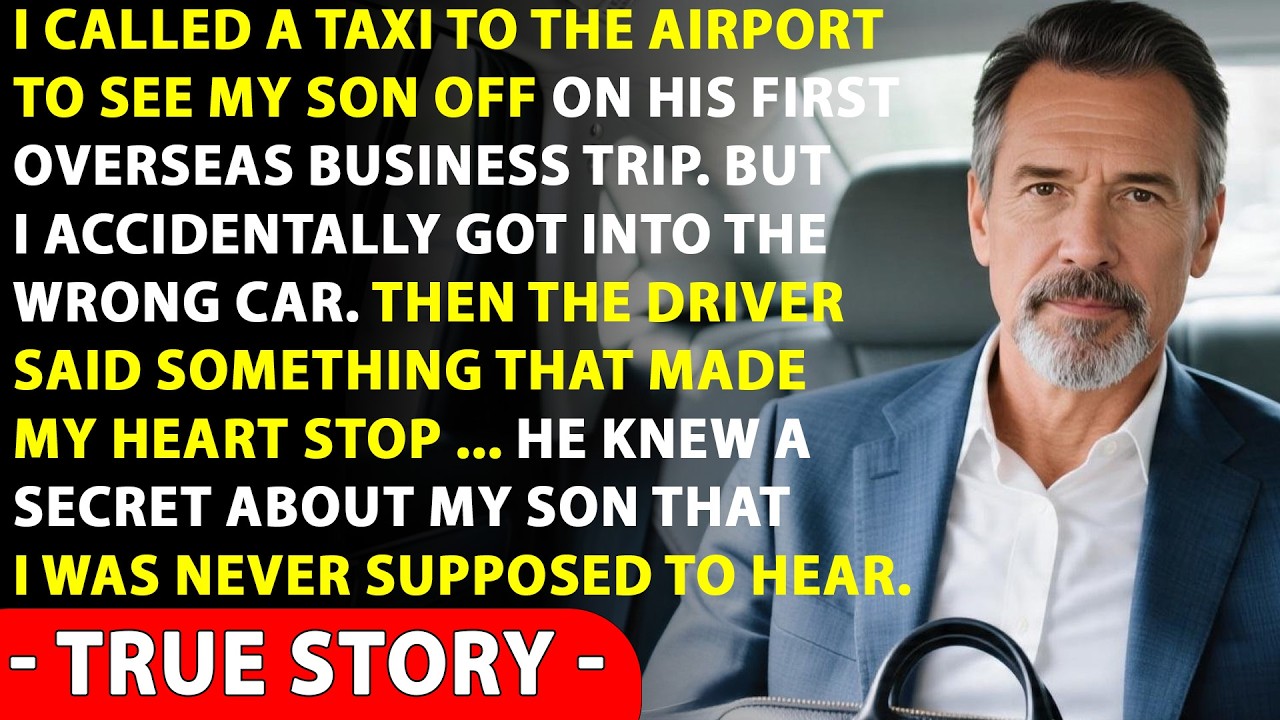
The car smelled like coffee and pine. The driver was a broad-shouldered man with a close-cut beard. We’d gone half a block when he glanced in the rearview mirror and said, “Ethan heading to LAX early today, huh? ”
My hand tightened around the package on my lap.
He thought I was my own son. I should have corrected him right then. I didn’t. Something made me hold still and listen.
He kept talking, easy and conversational, about a run a few weeks back. He said I’d asked him to drive past the old bank district on the east side, asked which intersections had traffic cameras, asked what time patrol units usually came through. He said I’d made a phone call in the back seat and told someone, “After this trip, everything gets settled. ”
I reached up slowly and pulled off my hat.
The driver’s eyes went wide. The friendliness drained out of his face. “Sir,” he said carefully, “you’re not Ethan. ”
“No,” I said.
“I’m Walter Bennett. I’m his father. ”
His name was Caleb Morrison. He’d driven for Wells Fargo security for eight years.
He kept a spiral notebook. When something felt off on a ride, he wrote it down. And over the past six weeks, my son had ridden with him six times, asking the kind of questions that only mean one thing. He was casing a bank.
Caleb pulled over and told me everything, page after page from his notebook. The dates. The routes. The questions about property auctions and foreclosures.
The phone call where Ethan had said he’d handled everything and told someone not to get jumpy. And the last time, when Ethan had parked half a block away and watched the bank’s front entrance for forty minutes, counting something, his lips moving. I made it to the airport anyway. I found a pillar near the wall and watched my son from forty feet away.
He looked exactly like what he told me he was: a young professional heading somewhere important. But his hands were wrong. He kept pressing his thumb against his index finger, checking his phone with a tight, urgent motion, making a call with his back turned to the crowd. He scanned the terminal left, center, right, the way you do when you want to make sure no one is watching you.
He walked through security without looking back. I stood at that pillar and never handed him the package. I went home and checked the joint bank account I shared with Ethan, the one I’d added him to six years ago because he asked and I saw no reason not to. The balance was $11,240.
It had carried between thirty and forty thousand dollars for a decade. I clicked through the transaction history. Three withdrawals that I’d been told were a car repair, an investment opportunity, and a short-term personal loan. Fifteen thousand dollars gone.
My roof money. Then I called the bank. They confirmed the withdrawals were authorized. They also confirmed there was a secondary Visa card on my account, opened fourteen months ago in my name.
I’d never applied for it, never held it. Its most recent charge was three days earlier, at the Venetian Hotel and Casino in Las Vegas. I called Frank Duca, a retired private investigator, the closest thing I had to a brother. I asked him to find out what he could, and didn’t tell him why yet.
He called back the next morning. “Ethan hasn’t worked for his company for eight months,” he said. “They let him go last May. Misconduct.
They said it was deliberate. ”
Eight months of mornings. Eight months of him getting up, putting on a clean shirt, driving away, and coming home with stories about meetings and projects and a promotion that was always just around the corner. I had cooked him eggs.
I had believed every answer. Frank mentioned a name: Meridian Credit. A private lending outfit. Hard money, high interest, the kind of place you go when the banks have already said no.
And another name: Ryan Cole. A real estate outfit out of Nevada called Pacific Rim Holdings. Shell company. Fraud allegations that never went anywhere.
I met with a lawyer Diana Reyes, who specialized in elder law and asset protection. She pulled up the Los Angeles County property records. There was a lien on my shop, a deed of trust filed in October securing a loan of $180,000 from Meridian Credit. The loan had been authorized by a power of attorney document, signed with my full authority.
On October 4th, I had been at Cedar-Sinai for a heart checkup. They gave me medication for the procedure. On the drive home, Ethan said we needed to stop and sign some insurance paperwork. I couldn’t read it properly.
The medication made everything blur. I signed what he put in front of me. The POA was signed that same afternoon, three and a half hours after I’d been given hydrocodone. There was a notary stamp.
The signature on it was clean and controlled, without a single trace of the tremor I’ve had in my right hand since 2019. Someone had practiced writing my name. Someone had waited for a day when I couldn’t read what I was signing. Diana told me the POA was void.
The lien was void. She filed an emergency motion to freeze the auction, and it was granted. But there was more. Pacific Rim Holdings was positioned to buy my shop at auction for cents on the dollar the moment the loan defaulted.
Ethan was their inside man. He’d taken his thirty percent cut of the sale price. He’d mortgaged my shop for $180,000 and wired the money straight to Ryan Cole’s operating account within forty-eight hours. He wasn’t trying to pay his debts.
He was buying into the plan. I found a letter from Margaret in the bottom drawer of the filing cabinet, one she’d written before she died and never given me. She knew. She’d seen something in him even then.
She wrote that Ethan always knew exactly how to reach me, that his love for me had no floor, no ceiling, that someone might one day use that against me. She wrote, “Don’t let the love make you blind, Walter. Trust yourself the same way with people, even the ones you made. ”
Frank’s contact at the FBI confirmed Ryan Cole had been on a watch list since 2019.
Caleb had given them his notebook and the dash cam recordings. Cole was arrested. He gave them Ethan in exchange for consideration on his charges. They waited to arrest my son until he walked back through my door.
I heard his key in the lock at 7:22 on January 20th. He came in smiling, arms open, talking about Tokyo like he’d been there. Meetings that went better than expected. The precision of the engineering.
“I kept thinking about you, Dad. ”
I let him talk for four minutes. I counted. Then I opened the drawer and set the folder on the table.
I placed the photos out one by one. The hotel corridor. The one-way flight to Las Vegas. The hotel folio.
The bank statements with the yellow highlights. The power of attorney next to the discharge summary. He tried the excuses first. Rerouted flight.
A connection issue. He didn’t want to worry me. Then he tried the tears. “I’m in trouble, Dad.
I never wanted it to go this far. ”
I asked him to tell me the money wasn’t true. He just looked at me, and the calculation in his expression fell away, replaced by something raw and honest and very tired. “I didn’t think it would actually get to that point,” he said.
Then the doorbell rang. “That’ll be them,” I said, and I walked to the front door. Behind me, I heard my son pull in a sharp breath, the breath of a man who has just understood, all at once and completely, exactly what that sentence means. At the civil hearing on February 25th, Diana got the POA declared void and the lien vacated.
All claims against my shop were dismissed with prejudice. The judge looked at me over her glasses and asked whether I had knowingly given my son power of attorney. “No, ma’am,” I said. “I did not.
” My shop was mine again. I went back to work. I taught a twenty-year-old named Marcus how to read a torque spec, and he turned out to have the best instincts I’d seen in thirty years. By four in the afternoon, the Chevy pickup we’d been working on was running.
I sent the young men home and stood alone in the shop, listening to the metal settle, and I felt like a man who had work to do tomorrow. A few weeks later, Frank called us together for a barbecue. Caleb came. We sat in the cold backyard with string lights and talked about the Dodgers and a lemon tree that never produced a single lemon.
Nobody mentioned the courthouse or the warrant or the kitchen that night. We left all of that at the gate. Some things are carried better if you occasionally set them down. When I got home, there was an envelope on the front step.
The return address was printed in small block letters. Metropolitan Detention Center. Inside were three pages, both sides, written in his mother’s handwriting style. He didn’t ask me to visit.
He didn’t ask me to write back. He didn’t make any requests at all. He wrote about what he knew he had done, all of it, not a version of it that made him look better. And he wrote that the thing he had to live with was that I had trusted him completely, without question, and he had used it.
The last line was: “I love you. I know that might not mean much right now, but it’s true, and the truth is something I owe you. ”
I folded the pages back into the envelope and slid them carefully, the way he had folded them. Then I got up and walked into the living room and set the envelope down on the shelf, next to Margaret’s photograph.
The one where she’s laughing at Big Sur, the wind in her hair. The woman I was still in quiet conversation with. The son I had made with her, who had broken something important. I stood there for a moment and said, out loud, to her photograph, “I don’t know yet.
”
The next morning, I woke at five, before the alarm. I made coffee and stood at the window while it brewed, watching the sky turn from black to that deep blue that comes just before dawn. The lemon tree in the corner of my yard had started putting out blossoms, pale and small and stubborn. I thought about the shop, about Marcus, about the sign that needed repainting come spring.
I thought about my son waking up in a different kind of room, carrying the same weight in a place where the carrying is harder. I did not pick up the phone. I did not write a letter. I didn’t know yet if I would, or when, or what I would say if I did.
But I held the coffee cup in both hands and looked out at the morning and I did not close any doors that I wasn’t certain needed closing. Then I put on my jacket, picked up my keys, and went to work.