My phone rang at 2:27 a. m. as I stepped out of battalion headquarters at Fort Campbell. The screen read “Mom.
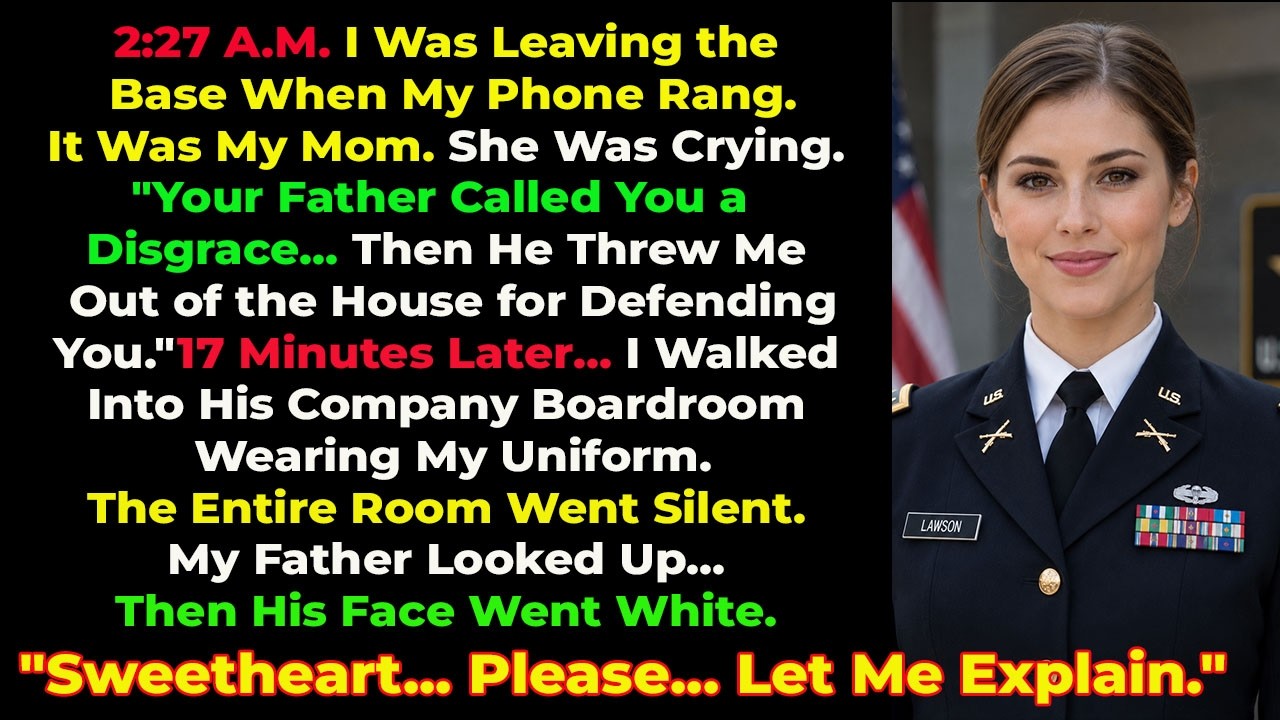
” She never called that late unless something was terribly wrong. The moment I answered, I heard her crying. Not loud sobs—quiet ones. The kind someone makes after they’ve already given up trying to stay strong.
“Rebecca,” she whispered. “Mom, what’s happened? ”
There was a long pause. “Your father, he called you a disgrace again.
”
“What did he do? ”
“He said having a daughter in the army embarrassed him. Then he told me if I wanted to defend you, I could leave his house. ” Another pause.
“I left. ”
For a few seconds, I couldn’t hear anything except the distant hum of generators on the base. Fort Campbell never really sleeps. Somewhere behind me, soldiers were loading equipment for an early training exercise.
A helicopter crossed the dark Kentucky sky. “Where are you? ”
“In a motel near downtown Nashville. ”
“I’ll be there.
”
She started to protest. “It’s late. ”
“I said I’m coming. ”
I hung up before she could argue.
My name is Rebecca Lawson. I’m 46 years old. I’ve served in the United States Army for nearly 24 years. I’ve deployed twice overseas.
I’ve commanded soldiers through floods, tornado relief, and emergencies that never made national news. People assume those experiences make you fearless. They don’t. Nothing prepares you for hearing your own mother sound defeated.
I climbed into my black Ford F-150 and pulled onto Interstate 24. The highway was nearly empty. Truck stops glowed in the darkness. Gas stations stood open for travelers who looked as tired as I felt.
I kept replaying her words. Your father called you a disgrace. It wasn’t the first time, not even close. My father, Charles Lawson, had spent most of his life building Lawson Development Group, one of the largest commercial construction companies in Middle Tennessee.
People admired him. Church leaders praised him. Business magazines featured him. He donated money to youth sports, libraries, and political campaigns.
Around town, he was known as a self-made man. At home, he was different. Growing up, I believed every daughter wanted one thing—for her father to say he was proud of her. I never heard those words, not once.
When I earned an appointment to West Point, he told everyone I was wasting my potential. When I graduated, he didn’t come. He claimed he had a meeting. Mom attended alone.
I still remember scanning the crowd after the ceremony. Every other cadet seemed to have family cheering. Mine consisted of one woman waving with both hands while trying not to cry. When I received my commission, Dad mailed a card.
Inside were four words: “You could do better. ”
That card sat in a box in my closet for years, not because I treasured it, because it reminded me to stop expecting something he was never willing to give. The closer I got to Nashville, the harder it became to concentrate on driving. Every memory surfaced at once.
Birthdays he skipped, promotions he ignored, phone calls he never returned. He told neighbors I worked for the government, never that I served my country. Mom always defended me, always. And somehow, she paid the price every single time.
The motel sat just off Murfreesboro Pike—nothing fancy, two stories, a flickering vacancy sign. I spotted Mom’s silver Honda in the parking lot. She opened the door before I even knocked. The moment I saw her, my stomach tightened.
She looked exhausted. Her hair wasn’t brushed. Her sweater was wrinkled. Her eyes were swollen from crying.
But what caught my attention most was the suitcase sitting beside the bed. She hadn’t packed for a night. She’d packed to leave. I wrapped my arms around her.
Neither of us spoke for nearly a minute. Finally, she managed a weak smile. “I knew you’d come. ”
“I’ll always come.
”
She nodded, then made coffee using the tiny motel machine. It tasted terrible. Neither of us cared. “What happened?
” I asked. She stared into her paper cup. “Your father hosted another board dinner. ” I wasn’t surprised.
Those dinners were legendary. Investors, lawyers, executives, politicians—everyone trying to impress everyone else. “He started talking about families. ” She swallowed.
“Someone asked whether you were coming to the company anniversary next month. ”
I already knew the answer. “I wasn’t invited. ”
She shook her head.
“He laughed. ” My chest tightened. “He said he didn’t need military charity decorating his company. ”
I looked away.
She continued. “I told him you devoted your life to serving people. ”
“What did he say? ”
Her eyes filled again.
“He stood up in front of everyone. ” She took a shaky breath. “And he said—” She struggled to repeat it. “A woman wearing army medals doesn’t impress me.
She’ll always be the biggest disappointment this family ever produced. ”
Silence settled between us. I didn’t know which hurt more—the insult or imagining my mother standing there while everyone watched. Around 4:30 in the morning, she quietly spoke again.
“Rebecca? ”
“Yeah? ”
“I haven’t told you everything. ” I looked up.
“He isn’t acting this way because he hates your career. ”
“What do you mean? ”
She hesitated. Then she leaned closer.
“I think he’s scared. ”
“Scared of what? ”
She lowered her voice. “Three weeks ago, I accidentally walked into his home office.
” He had never cared if Mom entered his office. “He slammed the laptop shut. He looked terrified. I heard him arguing with someone on the phone later.
”
“What did he say? ”
“If Rebecca ever starts asking questions, everything falls apart. ”
Every muscle in my body froze. Asking questions about what?
“I don’t know. ” She reached into her purse. “I almost forgot. ” She handed me a folded envelope.
“I found this in our mailbox yesterday. There was no return address, only my name written in careful handwriting. ”
Inside was a single key—a storage unit key—along with a handwritten note: “Your grandfather wanted Rebecca to have this when the time was right. Trust no one.
”
I read it twice, then a third time. My grandfather had been dead for almost 12 years. I looked at Mom. “Did Dad know about this?
”
She slowly shook her head. “No. ”
Outside, dawn was beginning to lighten the Nashville skyline. I slipped the key into my pocket.
For the first time in years, I wasn’t thinking about winning my father’s approval. I was wondering what he had spent so many years trying to hide. Tomorrow morning, I wasn’t going to call him. I wasn’t going to argue with him.
I was going to walk straight into the Lawson Development boardroom wearing my army uniform. And this time, I wasn’t there as his daughter. By 8:12 a. m.
, I was standing in front of Lawson Development Group’s headquarters on West End Avenue in Nashville. The 20-story glass building reflected the morning sun like it had nothing to hide. I sat in my truck for a moment with both hands on the steering wheel. My dress uniform felt heavier than usual, not because of the medals, because I wasn’t walking into that building as a daughter hoping to fix a broken relationship.
I was walking in because my mother had nowhere else to go. There comes a point when loyalty stops being a virtue and starts becoming permission. I had finally reached that point. I stepped out of the truck and crossed the parking lot.
People noticed immediately. A security guard opened the front door before I reached it. “Morning, Colonel. ”
I nodded.
Morning. He recognized the name on my uniform before he recognized my face. Lawson. That’s right.
His expression changed. “Mr. Lawson is upstairs. ”
“I know.
”
He hesitated, then quietly added, “Good luck. ” That surprised me. I’d expected cold looks. Instead, I was beginning to notice something else—people looked nervous.
The lobby hadn’t changed much since I was a teenager. Marble floors, a fountain in the middle. Photos of commercial buildings my father claimed had transformed Tennessee. His portrait hung behind the reception desk—smiling, confident, generous.
The version of Charles Lawson the public adored. The receptionist froze when she saw me. “Can—can I help you? ”
“I’m here to see my father.
”
“Do you have an appointment? ”
“No. ”
She reached for the phone. Before she touched it, a familiar voice echoed across the lobby.
“Rebecca. ”
I turned. Linda Morales. She’d been my father’s executive assistant for over 25 years.
She used to sneak me cookies whenever Mom brought me to the office after school. Her hair had turned silver since I’d last seen her. She looked genuinely happy to see me. Then her smile faded.
“I heard about your mother. ”
“News travels fast. ”
“I’m taking care of her. ”
Linda glanced toward the elevators.
“He isn’t in a good mood. ”
“When is he ever? ”
A tiny smile escaped her. “For what it’s worth,” she lowered her voice, “a lot of people around here stopped believing him years ago.
”
That sentence stayed with me. Maybe Dad ruled through fear more than respect. The boardroom occupied the entire top floor. As the elevator climbed, I caught my reflection in the mirrored doors.
Army service uniform, Colonel’s eagle, rows of ribbons—24 years of service. For years, I’d wished my father would see those things and finally feel proud. Today, I honestly didn’t care anymore. The doors opened.
Laughter spilled into the hallway. Someone was telling a golf story. Coffee cups clinked. Expensive shoes crossed polished hardwood floors.
I walked toward the conference room. The assistant outside looked startled. “Ma’am? ”
I simply smiled.
“I know where it is. ”
Without knocking, I opened the door. Conversation stopped immediately. Nearly 20 executives turned toward me.
Some recognized me instantly. Others only saw the uniform. At the far end of the table sat Charles Lawson, my father. Perfect gray suit, red tie, gold watch.
Exactly the same expression I’d remembered my whole life—annoyance. He looked up from his papers, then laughed. Not because something was funny, because he wanted everyone else to laugh, too. “Well,” he said loudly, “look who decided to visit.
”
Nobody joined in. His smile weakened for just a second. “You finally here to ask for a job? ”
“I already have one.
”
“I meant a real one. ”
A few uncomfortable chuckles echoed around the room. No one seemed eager to encourage him. He stood.
“You know, ladies and gentlemen,” he spread his hands dramatically, “my daughter chose government work instead of learning how business actually operates. ”
Still, no one laughed. One board member looked down at his notebook. Another stared out the window.
Something felt different. Even they seemed tired of listening to him. I remained standing. “I came because Mom spent last night in a motel.
”
His smile disappeared. “This isn’t the place. ”
“You made it the place when you humiliated her in front of your board. ”
Several people exchanged uneasy glances.
Dad straightened his jacket. “Family disagreements don’t belong in corporate meetings. ”
“Neither does throwing your wife out of the house. ”
Silence.
You could hear the air conditioner running. Finally, one older director cleared his throat. “Charles. ”
Dad raised one hand without looking at him.
“I’ll handle this. ” He turned back toward me. “Your mother overreacted. ”
“Did she?
”
“I simply explained that I was disappointed. ”
“You called me a disgrace. ”
“I told the truth. ”
His voice stayed calm.
Mine did, too. Years in the army teach you something valuable—the calmest person usually controls the room. I had no intention of raising my voice. “I have one question.
”
He folded his arms. “Go ahead. ”
“Why are federal auditors visiting next week? ”
His face changed.
Only for a second. But I saw it. So did everyone else. “What are you talking about?
”
“I asked a simple question. ”
“There aren’t any auditors. ”
I watched his eyes. He was lying.
Not confidently—desperately. One board member slowly removed his glasses. Another reached for a bottle of water with shaking hands. Interesting.
They knew something. I continued. “The Army Corps of Engineers recently paused several infrastructure contracts connected to Lawson Development. ” That part was public information.
Nothing confidential. His jaw tightened. “So, I wondered why. ”
He forced a smile.
“Construction projects get reviewed all the time. ”
“They do. ” I nodded. “And reviews usually don’t make CEOs panic.
”
“I’m not panicking. ”
“No. ” I looked around the room. “It certainly doesn’t look like you are.
”
A few people couldn’t hide their reactions. One executive actually coughed to cover a laugh. Dad noticed. His ears turned red.
“You have no authority here. ”
“You’re right. I don’t. ”
“I don’t answer to army officers.
”
“I never said you did. ”
“Then why are you here? ”
I reached into my purse. For one brief moment, his eyes widened.
Instead of documents, I placed the storage key on the conference table. Nothing else. Just the key. It slid across the polished wood, stopping halfway between us.
His face lost every bit of color. He stared at it. Didn’t move. Didn’t blink.
I had no idea what it unlocked. But apparently, he did. “What is that? ” one director asked.
Dad answered too quickly. “Nothing. ”
I looked directly at him. “Really?
”
He finally picked up the key. His fingers trembled. The Charles Lawson I knew never trembled. Ever.
“You should leave. ”
“No. ” I said, “Leave. ”
“I’ll leave.
” I paused. “After I tell everyone one thing. ”
Nobody spoke. “If my grandfather left something behind,” I looked around the room, “I intend to find it.
”
Dad slammed both hands onto the table. “Rebecca. ”
The sudden outburst startled everyone. Then he realized what he’d done.
He slowly sat back down, trying to recover, trying to look composed. It didn’t work. The room had changed. The executives weren’t watching me anymore.
They were watching him. For the first time in his career, Charles Lawson looked afraid. I picked up my purse. “I’m done.
”
As I reached the door, someone quietly called my name. “Colonel. ”
I turned. It was the elderly maintenance supervisor pushing a janitor’s cart.
I’d seen him years ago when I was still in high school. His name tag read “Earl. ”
He glanced down the hallway before speaking. “Your grandfather trusted very few people.
”
“So I’ve heard. ”
He slipped a small envelope into my hand so quickly no one inside noticed. “You’ll need this before you open that storage unit. ”
“What is it?
”
He smiled sadly. “The truth. ”
Then he pushed his cart down the hallway as though nothing had happened. I looked down at the envelope.
Inside was an old flash drive labeled in black marker: “For Rebecca only. ”
Suddenly, my grandfather’s mysterious key didn’t seem nearly as important. Whatever was on that drive, my father had spent years hoping I’d never see it. I didn’t open the flash drive in my truck.
For all I knew, it could have contained nothing more than old family photos or tax records. But judging by the look on my father’s face when he saw that storage key, I doubted it. Somewhere between Nashville and Clarksville, I pulled into a Waffle House just off Interstate 24. It was almost 10:00 in the morning.
The breakfast crowd had thinned out, leaving only a few retirees reading newspapers and a pair of truck drivers arguing over college football. It felt like the safest place in the world. Ordinary. Exactly what I needed.
I ordered scrambled eggs, black coffee, and a biscuit I never touched. Then I pulled my government-issued laptop from my bag. The flash drive slid into the USB port with a quiet click. For three long seconds, nothing happened.
Then a single folder appeared: “Lawson Family Archive. ”
My pulse quickened. I opened it. Inside were dozens of neatly organized folders—board minutes, financial records, personal letters, voice recordings, property deeds, private journals.
The earliest file dated back to 1998. My grandfather had been documenting something for nearly 15 years before he died. I clicked on the journal first. The opening page read: “If you’re reading this, Rebecca, it means I waited too long to tell you the truth.
I pray I’m wrong, but if Charles is still running this company, you’re going to need proof instead of stories. ”
I leaned back in my booth. Grandpa Henry had always spoken plainly. He hated gossip.
If he wrote something down, he expected to prove it. I kept reading. According to his journal, Lawson Development had once been a very different company. When Grandpa started it in the early 1970s, it built schools, churches, and affordable homes throughout Tennessee.
He believed a business should improve the community that supported it. My father believed something else—growth, prestige, profit. The journal described years of arguments between them. Grandpa wanted slow, steady expansion.
Dad wanted luxury developments, political connections, and bigger loans. Then came a sentence that made me stop reading: “I believe my own son has begun hiding money from the company. ”
I read it twice, then a third time. It couldn’t be true, could it?
A waitress refilled my coffee. “You okay, honey? ”
I looked up, realizing I’d been staring at the screen for several minutes. “Yeah.
”
“You sure? ”
I forced a smile. “Just family stuff. ”
She nodded knowingly.
“Sometimes that’s the hardest kind. ”
She walked away before I could answer. I opened another folder. This one contained scanned contracts.
Most looked ordinary—invoices, construction bids, payroll reports. Then I noticed something strange: the same subcontractor appeared again and again. Volunteer State Materials LLC. I’d never heard of them.
Every payment was unusually large, sometimes millions of dollars. Curious, I searched Tennessee’s public business database. No active company. No office.
No employees. Nothing. A shell company, or at least it looked like one. My stomach tightened.
The next folder contained audio files. I plugged in my earbuds. The first recording began with my grandfather’s familiar voice. “If you’re hearing this, I’m probably gone.
”
I swallowed hard. He’d been gone for 12 years. Hearing his voice again caught me completely off guard. “I’ve spent too long hoping Charles would remember the values this company was built on.
” A long sigh. “He won’t. ” Paper shuffled. “I’ve copied every document I could safely obtain.
” Another pause. “I couldn’t stop him. ” His voice cracked. “But maybe someday you can.
”
The recording ended. I sat there staring through the diner window. Traffic rolled by as though the world hadn’t changed. Mine just had.
Instead of going directly to the storage unit, I made another decision. I called someone I trusted—Colonel David Mercer, retired. Former Army JAG officer. One of the most honest lawyers I’d ever known.
He answered on the second ring. “Rebecca. ”
“Colonel, do you have time? ”
“For you, always.
”
“I think I’ve stumbled into something bigger than a family argument. ”
Thirty minutes later, I was sitting in his small law office in downtown Clarksville. No marble floors. No expensive artwork.
Just bookshelves, framed military photos, and a coffee maker that looked older than both of us. He spent nearly an hour reviewing the files. He barely spoke. Finally, he removed his reading glasses.
“Where did these come from? ”
“My grandfather. ”
“Did anyone else know? ”
“I don’t think so.
”
He looked at me carefully. “Rebecca… If these documents are authentic,” he paused, “this isn’t simply financial misconduct. ”
“Then what is it?
”
“It could be organized fraud. ”
The room suddenly felt smaller. “I don’t want to destroy him,” I admitted. Colonel Mercer nodded.
“I know. ”
“He’s still my father. ”
“And that’s exactly why you shouldn’t investigate this yourself. ”
“What do you mean?
”
“Emotion clouds judgment. ” He folded his hands. “You need someone completely independent. ” He reached for his phone.
“I know a financial crimes investigator with the FBI. ”
I looked at him. “You’d call the FBI? ”
“I’d ask someone to quietly verify whether these records are genuine.
”
“What if they’re not? ”
“Then no harm done. ”
“And if they are? ”
He looked directly into my eyes.
“Then innocent people deserve to know. ”
That afternoon, I picked up my mother from the motel. She insisted on paying for her own room. I insisted harder.
We stopped for lunch at a small diner in Clarksville. For the first time in years, she actually laughed. Not because anything was funny, because she finally felt safe. Halfway through lunch, I asked the question that had been bothering me all morning.
“Mom? ”
She looked up. “Did Grandpa know? ”
She quietly nodded.
“He suspected. ”
“You knew. ”
“I knew he worried. ”
“Why didn’t anyone tell me?
”
She stared out the window. “Because your grandfather hoped your father would change. ”
“And you? ”
“I hoped, too.
” She smiled sadly. “I waited 40 years. ”
I reached across the table and took her hand. She squeezed mine.
“I should have left years ago. ”
“No. ” She looked confused. “You left when you were finally ready.
”
Tears filled her eyes again. This time, they weren’t tears of fear. That evening, my phone rang. Unknown number.
I answered. “Rebecca Lawson. ”
“This is Special Agent Michael Torres with the FBI. ”
My heart skipped.
“Colonel Mercer shared several documents with us. ”
“I understand. ”
There was a brief silence. “We’ve already compared two of the contracts.
”
“And? ”
“They appear genuine. ”
I closed my eyes. “We’d like permission to examine everything.
”
“Of course. ”
He hesitated before speaking again. “Colonel? ”
“Yes.
”
“If the rest of these files match what we’ve already verified,” another pause, “your father hasn’t been hiding one crime. ”
My grip tightened around the phone. “What are you saying? ”
“We may be looking at 20 years of fraud.
”
Outside my mother’s new apartment, children were riding bicycles through the parking lot. Someone was mowing the grass. A dog barked across the street. Life looked perfectly normal.
But I suddenly realized something. The phone call at 2:27 that morning had never really been about my mother getting thrown out. It had been about the beginning of the end. And somewhere hidden inside an old storage unit my grandfather had protected for over a decade, there was almost certainly much more waiting to be uncovered.
Three days later, life looked almost normal. That was the strange thing about uncovering something enormous. The rest of the world kept buying coffee, driving to work, arguing about football, and standing in line at the grocery store as if nothing had changed. Meanwhile, I couldn’t remember the last time I’d slept more than four hours.
I still reported to Fort Campbell every morning. At 0600, I was in formation with officers who had no idea my family was falling apart. By 0730, I was reviewing logistics reports for an upcoming engineering exercise. Soldiers expected consistency from their commander.
They deserved it. Whatever happened outside the gate stayed outside the gate. At least I tried to keep it that way. Sometimes I succeeded.
Sometimes I caught myself staring at a map without seeing it. One afternoon, my executive officer, Major Lisa Grant, closed the office door behind her. “You’ve been somewhere else all week. ”
I looked up from my paperwork.
“I’m fine. ”
She smiled. “I’ve served with you for six years. ” She folded her arms.
“I know what fine looks like. ”
I laughed quietly. “So what does this look like? ”
“Like someone carrying a backpack full of bricks.
”
That was probably the most accurate description anyone had given. Later that afternoon, my phone buzzed. Special Agent Michael Torres. “Rebecca, we’ve confirmed almost everything.
”
I stepped into an empty hallway. “How bad? ”
“Worse than we expected. ” He sounded tired.
“Your grandfather wasn’t exaggerating. ”
“What did you find? ”
“The shell company received payments from at least 14 public construction projects. ”
I leaned against the wall.
“In millions? ”
“Tens of millions. ” He paused. “And that’s only what we’ve confirmed.
”
I closed my eyes. “What happens now? ”
“We keep building the case. ”
“And my father?
”
“He doesn’t know we’re involved. Yet. ”
“Not yet? ”
That evening, I drove my mother to look at apartments.
She refused to stay in a motel another night. “I don’t need anything fancy,” she said. “I just want somewhere peaceful. ”
We found a small apartment complex outside Clarksville.
Brick buildings. Neatly trimmed hedges. A tiny pond where two children were feeding ducks. The property manager, Mrs.
Jenkins, was probably in her 70s. She looked at Mom kindly. “You living alone? ”
“For now.
”
Mrs. Jenkins nodded as though she’d heard that answer before. “We look after each other here. ”
My mother smiled for the first time all day.
“I’d like that. ”
Watching her sign a one-year lease was strangely emotional. She wasn’t just renting an apartment. She was choosing herself for the first time in decades.
The peace didn’t last long. Two mornings later, my phone exploded with text messages. Lisa was the first. “Have you seen today’s paper?
”
I hadn’t. I stopped at the post exchange and bought a copy of the Tennessean. The headline stretched across half the front page: “Local CEO Targeted by Disgruntled Daughter. ”
Below it was a photograph of me walking into Lawson Development wearing my Army uniform.
The article claimed I’d tried to intimidate my father’s board. It suggested I’d used my military status to pressure a private company. Every sentence twisted the truth just enough to sound believable. I knew immediately who had leaked the story.
Dad. For years, he had cultivated friendships with reporters, politicians, and business leaders. This was exactly how he fought—not with fists, with reputation. By lunchtime, three different reporters had left voicemail messages asking for interviews.
I ignored every one of them. Colonel Mercer had warned me: “Never argue through the media. Facts move slower than rumors, but they last longer. ”
The hardest part wasn’t the newspaper.
It was church. That Sunday, Mom insisted on attending the same church we’d gone to for over 30 years. As we walked inside, conversations became noticeably quieter. Some people smiled politely.
Others looked away. One older gentleman shook my hand. “Praying for your father. ” Not for my mother.
Not for me. For my father. Another woman whispered loudly enough for us to hear: “I always knew success changes people. ” I’m not sure which one she meant.
Mom joked quietly as we found our seats. I laughed. It wasn’t a big laugh, just enough to remind us we still could. Sometimes humor is less about finding something funny and more about refusing to let bitterness win.
Monday afternoon brought another surprise. Earl, the maintenance supervisor, called me. “I found something else. ”
“Where?
”
“Old storage room. ”
“I’ll be there. ”
When I arrived at Lawson Development after business hours, Earl unlocked a small records room in the basement. Dust covered everything.
Metal filing cabinets lined the walls. “I was cleaning this out,” he said. “Look behind that cabinet. ”
Together, we slid it several inches.
Hidden behind it sat a cardboard box. Inside were dozens of old cassette tapes, each carefully labeled. Executive Meetings, 1999, 2001, 2003. I looked at Earl.
“Why would anyone record board meetings? ”
He smiled. “Your grandfather believed memories fade. ” I picked up one tape.
“He preferred evidence. ”
Colonel Mercer had the tapes digitized. Two evenings later, we listened together. Most recordings were routine—budget discussions, construction schedules, insurance renewals.
Then we reached one dated September 14th, 2004. Dad’s voice filled the speakers. “If the inspectors ask questions, delay them. ”
Another executive answered.
“That’s risky. ”
Dad laughed. “No. Getting caught is risky.
”
The room went silent. Even 22 years later, hearing those words made my stomach turn. Mercer slowly paused the recording. “That,” he said quietly, “isn’t just unethical.
”
“I know. ”
“It’s evidence. ”
The FBI’s investigation accelerated. Subpoenas were prepared quietly.
Financial analysts worked through thousands of transactions. Still, they weren’t ready to act. “We only get one chance,” Agent Torres reminded me. “If we move too early, he’ll destroy whatever we haven’t found.
”
Waiting became torture. Every day, my father walked into his office believing he was untouchable. Every day, I wanted to confront him. Every day, I reminded myself that patience wasn’t weakness.
It was discipline. The army had taught me that. Then something happened none of us expected. Late Friday afternoon, my phone rang.
It was Linda, Dad’s longtime assistant. Her voice was shaking. “Rebecca? ”
“What happened?
”
“The chief financial officer resigned. ”
I straightened in my chair. “Resigned? ”
“He walked into your father’s office.
And he said he couldn’t lie anymore. ”
“What did your father do? ”
“He threw a crystal paperweight across the room. ”
I sighed.
“No one was hurt? ”
“No. ” She lowered her voice. “The CFO is meeting with federal investigators tonight.
”
I looked out my office window toward the parade field. For the first time since all of this began, I felt the balance shifting. Not because my father was finally losing, because people who had been afraid for years were beginning to tell the truth. Just before sunset, Agent Torres called.
“We have enough for an arrest? ”
“Not yet. For search warrants. ” He paused.
“And Rebecca? ”
“Yes? ”
“The annual shareholders meeting is Monday morning. ”
“I know.
”
“I think your father plans to announce a major expansion. ”
I almost laughed at the irony. “He still thinks he’s winning. ”
Torres answered quietly.
“He won’t think that for much longer. ”
I looked across the Kentucky hills as the sun disappeared beyond the trees. Some battles end with shouting. Others end with silence.
I had a feeling Monday’s silence would be one my father never forgot. Monday morning arrived gray and humid—the kind of Tennessee morning that made your uniform stick to your shoulders before 9:00. I parked across the street from Lawson Development just after 8:15 a. m.
For a long moment, I stayed inside my truck. I wasn’t afraid of my father anymore. I was afraid of what the truth would do to everyone connected to him. Thousands of employees had built honest careers there.
Families depended on those paychecks. Not everyone inside that building deserved to suffer because one man had mistaken power for character. My phone buzzed. It was my mother.
“Are you all right? ”
“I will be. ”
“I’ve been praying all morning. ”
“I know.
”
She hesitated. “I need you to hear one thing before you go inside. ”
“I’m listening. ”
“No matter what happens today—” her voice became steadier, “don’t become the kind of person your father became.
”
I smiled. “I won’t. ”
After we hung up, I took one slow breath and stepped out of the truck. The lobby looked much busier than it had the week before.
Shareholders, reporters, attorneys, and employees filled every corner. Coffee cups, laptops, stacks of annual reports. The company was preparing to celebrate another successful year. Most of them had no idea it was about to become the most important meeting in the company’s history.
Linda spotted me first. She walked over quickly. “I’m glad you’re here. ”
“How are you holding up?
”
She laughed nervously. “I’ve worked for your father 27 years. ” She looked toward the elevators. “I’ve never seen him this angry.
”
“Angry usually means he’s losing control. ”
She nodded. “I think he knows that now. ”
The shareholders meeting was held in the largest conference hall on the executive floor.
Nearly 200 people filled the room—directors, investors, department managers. Several local reporters sat quietly near the back. At exactly 9:00 a. m.
, Charles Lawson walked onto the stage. If someone had never met him before, they would have believed he was the picture of confidence. Perfect suit. Perfect smile.
Perfect posture. “My friends,” he began, “thank you for another outstanding year. ”
Applause echoed through the room. He clicked to the first presentation slide.
Revenue had increased. New contracts. Future developments. Everything looked impressive.
He spoke for nearly 15 minutes without interruption. Then he smiled. “I’d also like to address certain rumors that have circulated recently. ”
Several people shifted in their seats.
“I’ve spent 40 years building this company. ” He placed one hand over his heart. “I won’t allow personal family disagreements to distract from our mission. ”
His eyes found mine near the back of the room.
“There are people who confuse bitterness with integrity. ” He didn’t say my name. He didn’t have to. Everyone knew exactly who he meant.
Before he could continue, the conference room doors opened. Three people entered: Special Agent Michael Torres, the Assistant United States Attorney, and the company’s former Chief Financial Officer. Every conversation stopped. The CFO looked exhausted.
He carried two banker boxes filled with documents. My father stared at him. “What is this? ”
The CFO didn’t answer.
Instead, he walked directly to the board table. “I need to make a statement. ”
The chairman looked confused. “You have the floor.
”
The room became so quiet that someone dropping a pen sounded loud. The CFO cleared his throat. “For 11 years,” his voice shook, “I helped conceal fraudulent financial transfers. ”
No one moved.
“I told myself I was protecting the company. ” He looked directly at the shareholders. “I was actually protecting one man. ” He turned toward my father.
“I’m done doing that. ”
My father’s face hardened. “This is ridiculous. ”
“No.
” The CFO slowly opened the first box. “This is accounting. ”
He removed folders one by one. Wire transfers.
Invoices. Corporate records. Signed approvals. The projector screen changed.
One spreadsheet appeared after another. Millions of dollars. Payments routed through companies that existed only on paper. Directors began whispering.
Someone stood up. Another shareholder demanded copies. A woman in the front row quietly covered her mouth with both hands. Then Agent Torres stood.
“Mr. Lawson. ” He spoke calmly. “We have federal search warrants for company records and executive offices.
”
My father laughed—actually laughed. “This is political. ”
Torres didn’t react. “No, sir.
It’s business. ”
Then Colonel Mercer entered, carrying something I recognized immediately—the digital recorder. “We have one additional item. ” He connected it to the room’s sound system.
My father’s eyes widened. “No. ”
The recording began. His own voice filled the room.
“If the inspectors ask questions—” a pause, “delay them. ”
Another executive responded, “That’s risky. ”
Dad laughed. “Getting caught is risky.
”
Silence. No editing. No dramatic music. Just his own words.
The room seemed to shrink around him. One board member slowly removed his company pin and placed it on the table. Another quietly closed his notebook. No one defended him.
Dad looked around desperately. “You’re all making a mistake. ”
Nobody answered. He pointed at me.
“She planned this. ”
I finally stood. “No. ” Every eye turned toward me.
“You planned it. ”
He shook his head. “You’re my daughter. ”
“I am.
”
“You owe me loyalty. ”
I looked at him for several seconds before answering. “I owed you honesty. ” The room remained silent.
“I gave you that for years,” I continued. “You asked for obedience instead. ”
He took one step toward me. “I built everything you have.
”
I couldn’t help smiling sadly. “No, Dad. ” I gently touched the eagle on my uniform collar. “I built this.
”
The chairman slowly stood. His voice sounded older than it had an hour earlier. “Charles—” another long pause, “the board has reached a unanimous decision. ” He unfolded a prepared document.
“You are removed as chief executive officer, effective immediately. ”
My father looked from face to face, searching for one ally, one friend, one person willing to save him. There wasn’t one. Power built on fear almost always stands alone in the end.
Federal agents approached quietly. No handcuffs, no unnecessary drama—just professionalism. Agent Torres spoke softly. “Mr.
Lawson, we need you to come with us. ”
For the first time in my life, my father looked small. He glanced toward me—not angry, not proud, simply tired. “I never thought—” He stopped speaking, then finished almost in a whisper, “you’d become stronger than me.
”
I walked toward him, close enough that only he could hear my answer. “I never wanted to be stronger. I only wanted you to be my father. ”
His eyes filled for just a moment.
Then the agents escorted him from the room. No one applauded. No one celebrated. Justice isn’t entertainment.
It carries too much weight for that. As the doors closed behind him, I looked around the room. People weren’t staring at me anymore. They were looking at the empty chair where Charles Lawson had sat for nearly 30 years.
Sometimes the loudest moment in a person’s life arrives in complete silence. That morning, silence finally told the truth. Six months later, I drove the same stretch of Interstate 24 again. The difference was that this time I wasn’t racing toward another crisis.
I had the windows down. Country music played softly through the speakers. For the first time in a long while, I noticed things I’d ignored for months—the green fields outside Clarksville, roadside fruit stands, motorcycles heading south, families stopping for barbecue on a Saturday afternoon. Life had quietly started moving forward.
Mine had too. Lawson Development Group still existed. Honestly, there had been days when I wasn’t sure it would. After my father’s arrest, several projects were temporarily suspended while federal investigators sorted through contracts and financial records.
Hundreds of employees feared they would lose their jobs. That possibility weighed on me more than I expected. Most of those people had done nothing wrong. They were estimators, electricians, project managers, accountants, receptionists, equipment operators, and office assistants.
They had simply gone to work every morning. The newly appointed board acted quickly. They hired an independent CEO with no previous ties to my father. Outside auditors reviewed every active project.
The company publicly apologized to clients and shareholders. It wasn’t enough to erase the damage, but it was a beginning. Several veterans housing developments that had been delayed by fraudulent accounting were finally completed. Watching families receive the keys to their new homes brought me more satisfaction than seeing my father sentenced ever had.
That surprised me. Justice mattered. Helping innocent people mattered even more. My mother had settled into her apartment in Clarksville.
It wasn’t large—a small kitchen, a comfortable living room, a tiny balcony overlooking a courtyard where children rode bicycles every evening. She loved it. She joined the church choir, started volunteering twice a week at the county food pantry, even adopted an older rescue dog named Maggie. The dog followed her everywhere.
“You know,” Mom laughed one afternoon, “I’ve spent so many years taking care of everyone else. ” She scratched Maggie behind the ears. “I almost forgot what peace feels like. ”
I smiled.
“You deserve every minute of it. ”
She looked at me carefully. “So do you. ”
Back at Fort Campbell, life had returned to its familiar rhythm.
Morning briefings, training exercises, equipment inspections, promotion boards, young officers asking questions I used to ask myself. One afternoon, a newly commissioned lieutenant knocked on my office door. “Ma’am, do you have a minute? ”
“Of course.
”
He looked nervous. “I’m not sure I’m cut out for this. ”
I remembered feeling exactly the same way years earlier. “What makes you think that?
”
“My father says I should have gone into business. ”
I couldn’t help smiling. “Parents aren’t always right. ”
He laughed.
“No, ma’am. ”
“What matters isn’t whether everyone understands your choices. ” I leaned back in my chair. “It’s whether you can look at yourself in the mirror every morning.
”
He nodded slowly. “I think I can. ”
“Then you’re already ahead of a lot of people. ”
As he left, I realized I hadn’t been thinking about my own father while giving that advice.
I’d simply been telling the truth. A month later, I received permission to visit the federal correctional facility where my father was serving his sentence. People asked why I wanted to go. Some thought I wanted closure.
Others assumed I wanted revenge. Neither answer was correct. I wanted honesty. Maybe for the first time in our lives, the visitation room was quiet.
Plastic chairs, vending machines humming in the corner, families speaking softly across metal tables. When my father walked in, I barely recognized him. The expensive suits were gone. So was the confidence that had once filled every room he entered.
He looked older, smaller, more like the man he might have been if he’d never spent decades pretending to be larger than everyone else. He sat across from me. For almost a minute, neither of us spoke. Finally, he broke the silence.
“Your mother doing all right? ”
“She’s happy. ”
He nodded. “I’m glad.
”
That surprised me. It sounded genuine. “I’m sorry,” he said quietly. I looked at him.
“I know those words don’t fix anything. ”
“No, they don’t. ”
He lowered his eyes. “I spent my whole life believing success meant winning.
” His hands rested quietly on the table. “I competed with everyone. ” Another pause. “My partners, my competitors, my friends.
” Then he looked at me. “Even my own daughter. ”
I didn’t interrupt. “I couldn’t stand the idea that you found purpose somewhere I couldn’t control.
” The room fell silent again. “I kept waiting for you to fail. ” His voice cracked. “You never did.
”
For years, I had imagined this conversation. I thought hearing those words would heal something inside me. Instead, I simply felt sad. Not angry, not victorious, just sad.
Because the little girl who desperately wanted her father’s approval had grown up a long time ago. “I forgive you,” I said. His eyes filled with tears. “But forgiveness doesn’t erase responsibility.
”
“I know. ”
“And it doesn’t erase the past. ”
“I know. ”
“But I won’t carry it anymore.
”
He nodded slowly. “I wouldn’t ask you to. ”
When the guard announced visiting hours were over, my father stood. “So this is goodbye.
”
I smiled gently. “No. ” I paused. “It’s simply where our lives go in different directions.
”
For the first time I could remember, he smiled back without trying to win anything. Driving home that afternoon, I thought about everything that had happened since that phone call at 2:27 a. m. For a long time, I believed revenge meant making someone suffer as much as they made you suffer.
I was wrong. Real justice isn’t about creating more pain. It’s about refusing to let lies continue hurting innocent people. If I had stayed silent, my father might have kept his company.
But countless families would have continued paying the price. Telling the truth cost all of us something. It also gave us a chance to rebuild. Today, my mother laughs more than she cries.
The company employs honest people under honest leadership. And every morning when I button my uniform, I no longer wonder whether my father is proud of me. I’ve learned that self-respect lasts longer than approval that never comes. Your worth isn’t determined by another person’s inability to see it.
Sometimes the bravest decision isn’t getting even—it’s choosing integrity when it would be easier to stay silent.