The moment the four-star admiral slammed her challenge coin onto the white tablecloth and asked, “Wait, are you a major? ” every smile at that engagement dinner vanished. My mother-in-law looked as though the floor had dropped from under her chair. My father-in-law’s smug grin froze halfway across his face.
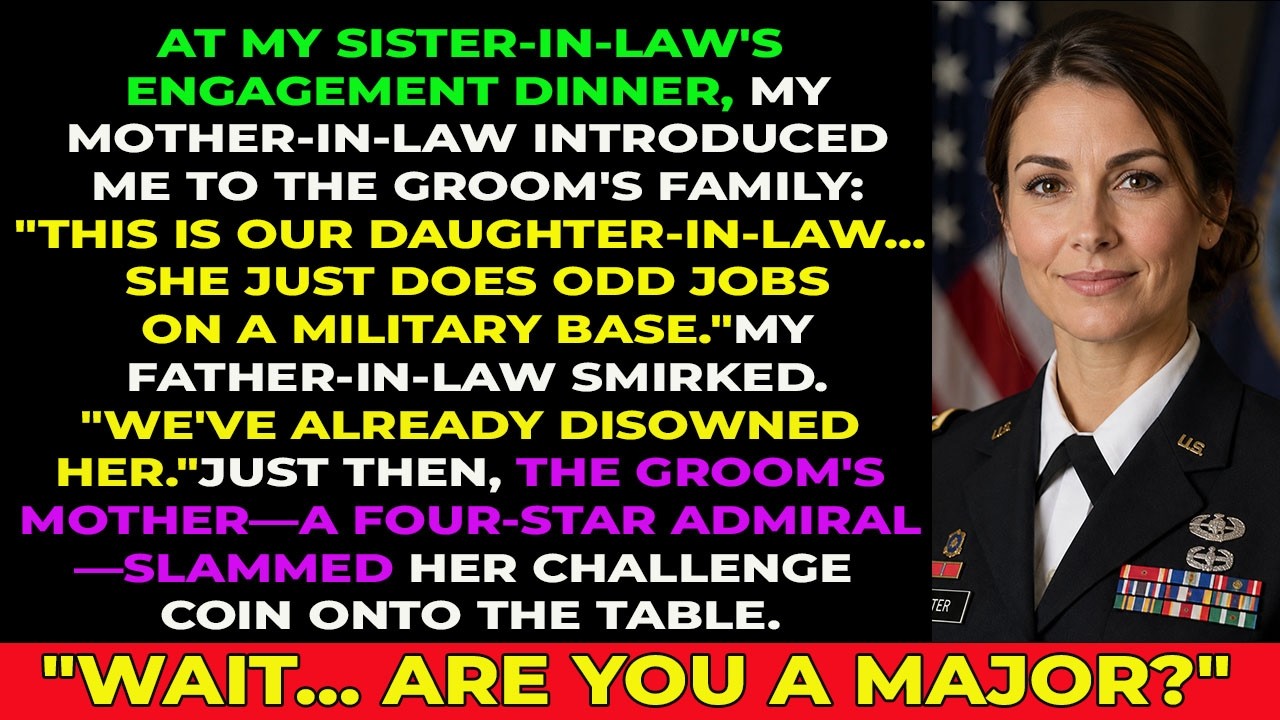
Seconds earlier, they had proudly told the table that they had already disowned me because I was just a woman doing odd jobs on a military base. They thought they had embarrassed me in front of an important family. Instead, they had exposed themselves. I wish I could say I enjoyed it.
The truth is, I only felt tired. By your late forties, after more than two decades in the army, revenge isn’t as satisfying as people imagine. You stop dreaming about humiliating the people who hurt you. You just hope that one day they’ll finally see the truth.
That evening, I wasn’t looking for justice. Justice walked into the room wearing four stars. The restaurant overlooked the Elizabeth River in Norfolk, Virginia. Polished wood floors, quiet piano music, walls covered with photographs of Navy ships from every generation.
My sister-in-law Ashley had chosen it because her fiancé Michael’s family had deep military roots. She wanted everything to feel elegant without being flashy. The irony wasn’t lost on me. For nearly nine years, Daniel’s parents had treated my military career like an embarrassing family secret.
Daniel and I arrived about fifteen minutes before dinner. He squeezed my hand as we stepped inside. “You okay? ” he asked quietly.
I forced a smile. “I’ve survived deployment briefings. I can survive dinner. ”
He laughed softly, but there wasn’t much confidence behind it.
Daniel loved me. I never questioned that. What hurt was how often he convinced himself that keeping peace with his parents was easier than standing up to them. Sometimes silence wounds just as deeply as cruel words.
Ashley greeted us warmly, hugging me tightly. Unlike her parents, she had always treated me kindly. She never joined the jokes or the whispers. More than once, I’d caught her changing the subject whenever her mother started criticizing my career.
“I’m happy for you,” I said honestly. “I know,” she smiled. “Tonight’s going to be good. ”
I hoped she was right.
Guests slowly filled the private dining room. Retired Navy officers, teachers, engineers, nurses, several veterans wearing small American flag lapel pins. Everyone looked relaxed. Everyone except me.
I’ve spent enough years reading rooms to recognize tension before anyone speaks. My mother-in-law, Linda, moved from table to table greeting guests like she was hosting a political fundraiser. Her husband Richard followed close behind, laughing louder than necessary at every joke. Status mattered to both of them.
It always had. They loved introducing people by their occupations. Doctors, lawyers, business owners, executives. In their minds, your profession determined your value.
I learned that lesson during my first Thanksgiving with the family. When someone asked what I did, I answered proudly. I’m an army officer. Linda had smiled politely before saying, “Oh, Emily just helps around the military base.
”
Years of education, training, and leadership reduced to helping around. At first I corrected her. Eventually, I stopped. Some battles simply aren’t worth fighting.
Dinner began with appetizers and quiet conversation. Ashley and Michael looked genuinely happy together. Michael struck me as thoughtful. He listened more than he talked.
That alone impressed me. About halfway through the first course, Linda stood. “I’d like everyone to get acquainted,” she smiled brightly. “We’re becoming one family.
”
She began introducing relatives around the room. My brother owns three dental practices. My cousin just retired from Johns Hopkins Hospital. Our nephew works for a federal contractor.
Every introduction sounded like another resume. Eventually, she reached Daniel and me. She rested a hand lightly on my shoulder. “This is our son Daniel.
” She smiled proudly. “And this—our daughter-in-law. ” Another pause. “She just does odd jobs on a military base.
”
The words landed exactly the way she’d intended. Light enough to sound harmless. Cruel enough to erase a lifetime. A few people offered polite smiles.
Someone nodded. No one knew what to say. Before I could respond, Richard chuckled. “We’ve already disowned her anyway.
”
Several guests laughed awkwardly, assuming it must be family humor. It wasn’t. Daniel shifted beside me. “Dad.
”
Richard waved him off. “We’re kidding. ”
Except we all knew he wasn’t. Years earlier, they’d actually told neighbors I wasn’t really part of the family anymore because I had chosen the army over family.
I sat perfectly still. Military bearing becomes second nature after enough years. Never react immediately. Observe first, respond later.
Across the table, Michael’s mother hadn’t smiled once. She looked to be in her early sixties, silver hair neatly pinned back, posture perfectly straight. She’d introduced herself earlier simply as Catherine Reynolds. Nothing about her suggested she expected special attention.
No mention of rank, no mention of accomplishments. Just quiet confidence. She studied me for several seconds. Not my face—my posture, my hands, the faint tan line around my left collarbone where insignia regularly rested beneath dress uniforms.
Tiny details civilians rarely notice. She glanced toward my husband, then back at me. Finally, she asked gently, “Emily, have we met before? ”
“I don’t believe so.
”
“You’ve worked around Norfolk a few times. ”
Her eyes narrowed thoughtfully. Something had clicked. She slowly reached into her handbag.
The conversation around the room continued. No one paid attention. She removed a heavy brass challenge coin. I recognized it instantly.
United States Navy. Four-star command. Not something handed out casually. She placed it in her palm for a brief second.
Then—bang. The coin struck the table hard enough that every fork stopped moving. The piano music from the next room suddenly seemed much louder. Twenty pairs of eyes turned toward her.
She looked directly at me. Not at Linda. Not at Richard. Only me.
Her voice remained calm, steady, professional. “Wait. ” Another long pause. “Are you a major?
”
The room went completely silent, so still that I could hear ice shifting inside someone’s water glass. My mother-in-law stared at me with wide eyes, as if I had somehow staged the moment to embarrass her. My father-in-law looked from me to the woman across the table, trying to decide whether this was some kind of joke. Even Daniel seemed frozen, though he knew the answer better than anyone.
I looked at Catherine Reynolds and gave the smallest nod. “Yes, ma’am. ”
She studied me for another second before offering a respectful smile. “I thought I recognized your bearing.
”
No one at the table said another word. The waiter arrived with the next course, noticed the tension immediately, quietly set the plates down, and disappeared without saying a thing. I wish I could tell you I felt triumphant. Instead, I felt something closer to sadness.
Because that single question had revealed a truth I had spent years trying to keep from becoming a spectacle. As I sat there, memories flooded back to another day almost twenty-five years earlier. I was twenty-three years old when I raised my right hand and took the oath to support and defend the Constitution of the United States. I hadn’t grown up in a military family.
My father taught history at a public high school outside Richmond. My mother worked as a librarian for nearly thirty years. We weren’t wealthy, but we never doubted the value of hard work or public service. After graduating from the College of William and Mary, I surprised nearly everyone by applying for officer candidate school.
Some friends thought I was throwing away opportunities in the private sector. Others assumed I would leave after my first obligation. Instead, I found something that felt larger than myself. The army gave me responsibility long before I believed I deserved it.
It taught me that leadership wasn’t about being the loudest person in the room. It was about taking care of people when they were tired, frightened, or discouraged. Over the years, I served at Fort Campbell in Kentucky, Fort Belvoir in Virginia, and later at the Pentagon during a joint planning assignment. I deployed twice to the Middle East and spent months helping coordinate humanitarian logistics after natural disasters overseas.
The work wasn’t glamorous. Most days involved meetings, planning documents, impossible deadlines, and making difficult decisions that affected hundreds of soldiers and their families. But every promotion reminded me that trust had to be earned one day at a time. By the time I pinned on the gold oak leaves of a major, I cared less about rank than I did about the soldiers depending on me.
That same year, I met Daniel. It happened during a volunteer event supporting military families at Fort Belvoir. He wasn’t in the service. He worked as a civil engineer for a transportation firm in Northern Virginia.
While other volunteers hurried through the event, Daniel stayed behind helping an elderly Vietnam veteran load donated furniture into his pickup truck. That caught my attention. Not because it was dramatic, but because no one had asked him to do it. Kindness without an audience tells you a great deal about a person.
We started talking over coffee the following week, then dinner, then weekend hikes along the Potomac. Within two years, we were married. At first, his parents seemed polite enough. Linda complimented my manners.
Richard admired my discipline. But that changed the first time my career interfered with their plans. Three months after our wedding, I received orders for an overseas deployment. We had to cancel a family beach vacation.
Linda barely spoke to me afterward. “You couldn’t ask someone else to go? ”
“No. It’s a commitment.
”
She shook her head. “You always make the army sound more important than family. ”
I wanted to explain that the army wasn’t replacing my family. It was part of the promise I had made before I ever met them.
But she had already decided what she believed. Richard wasn’t much different. He had built a successful commercial real estate business and measured nearly everyone by income and status. Whenever people asked about me, he found ways to avoid mentioning the army.
Sometimes he said I worked on government projects. Other times he said I helped with administrative work at a military installation. Eventually, that description became even smaller. Emily does odd jobs on base.
Every time I heard those words, I swallowed my pride. Not because I was ashamed of my service. Because correcting him always turned into an argument. “You military people are so sensitive,” Richard would laugh.
“I was only simplifying. ”
Simplifying. That became his favorite word. He simplified years of sacrifice into a sentence that made me sound like a temporary employee.
Daniel usually tried to smooth things over afterward. “You know how dad is. Mom doesn’t mean anything by it. They’ll come around.
”
I wanted to believe him. I truly did. Years passed. Promotions came.
Assignments changed. Our home filled with photographs from duty stations across the country. Yet every holiday dinner felt exactly the same. Linda introduced doctors with admiration, lawyers with excitement, business executives with pride.
Then she’d reach me. Emily works around the military. No rank. No responsibility.
No acknowledgement that I had spent birthdays, anniversaries, and Christmas mornings thousands of miles from home because soldiers were counting on me. The strange thing was that I never needed applause. Recognition had never been the point of serving. What hurt wasn’t that they ignored my career.
It was that they erased it. There is a difference. Then Ashley met Michael. She called me one Sunday afternoon.
“I want you to know something before Mom starts planning everything. ”
“What is it? ”
“Michael’s family has a military background. ”
“That’s nice.
”
“His mother retired from the Navy. ”
“Good for her. ”
Ashley hesitated. “Emily, she’s a four-star admiral.
”
I nearly dropped the phone. “You’re serious? ”
“Completely. ”
“What does your mother think?
”
“She thinks Mrs. Reynolds is just another retired government employee. ”
I couldn’t help smiling. Linda had spent years dismissing military service while unknowingly trying to impress one of the highest-ranking officers ever to wear a Navy uniform.
Life has a remarkable sense of irony. Still, I made a decision. I wouldn’t say a word. Not because I wanted anyone embarrassed.
Because I refused to use my rank as a weapon. If Daniel’s parents ever respected me, I wanted it to be because they finally saw me as family. Not because they discovered the title stitched onto my uniform. Looking back now, perhaps I stayed silent too long.
Sometimes humility inspires understanding. Other times, it gives prejudice a comfortable place to live. As those thoughts passed through my mind, I looked across the table at Admiral Catherine Reynolds. She hadn’t taken her eyes off me.
Then she leaned forward slightly and asked a second question that made my heart skip. “Tell me, Major Carter, were you assigned to the Joint Logistics Task Force in Washington six years ago? ”
To everyone else, it sounded like military jargon. To me, it felt like someone had quietly opened a door to a chapter of my life I had never expected to revisit at my sister-in-law’s engagement dinner.
“Yes, ma’am. ”
The admiral’s face softened. “I knew it. ” She leaned back in her chair and let out a quiet laugh.
“I told myself it couldn’t possibly be the same officer. ”
Every eye in the room shifted between us. Linda looked confused. Richard looked irritated.
Daniel looked both relieved and nervous. Ashley seemed completely lost. Michael, however, was studying me with growing curiosity. The admiral folded her hands on the table.
“Were you part of the hurricane response planning team? ”
“Yes, ma’am. ”
“The Norfolk exercise? ”
“Yes.
”
“The joint briefing with Army, Navy, Coast Guard, FEMA, and State Emergency Management? ”
“Yes, ma’am. ”
She smiled broadly. “I remember now.
”
I couldn’t help smiling back. “It was a long week. ”
“It certainly was. ”
A few guests exchanged puzzled glances.
Finally, Michael spoke. “Mom, what are you talking about? ”
She looked toward her son. “The officer who coordinated civilian supply routes after the hurricane simulation.
”
Michael frowned as he searched his memory. “I was in graduate school then. ”
“You visited headquarters one afternoon. ”
His eyebrows rose.
“Wait. ” He looked directly at me. “Were you the major giving the presentation with all the county emergency maps? ”
“I was.
”
He snapped his fingers. “I remember. You answered every question without looking at your notes. ”
“We’d practiced for weeks.
”
“No,” he said. “You knew the material. ” His words were simple, but they carried genuine respect. “I appreciated that.
”
The admiral nodded. “That presentation influenced planning procedures for several coastal installations. ”
A retired Navy captain sitting farther down the table leaned forward. “You coordinated that exercise?
”
“One member of a very large team,” I answered. He smiled knowingly. “People who actually lead usually say things like that. ”
Richard cleared his throat.
“There must be some misunderstanding. ”
No one answered. He looked directly at the admiral. “I mean, Emily works around a military base.
”
The admiral’s expression remained perfectly calm. “No,” she said gently, but very clearly. “Major Carter serves the United States Army. ”
Richard forced an uneasy laugh.
“Well, maybe in an office somewhere. ”
“I assure you,” the admiral replied, “the army doesn’t promote people to major by accident. ”
Several guests smiled. Not because they wanted Richard embarrassed.
Because the truth had become impossible to ignore. Linda suddenly leaned toward Daniel. “You knew. ”
Daniel looked at his mother in disbelief.
“Of course I knew. ”
“Why didn’t you ever tell us? ”
He stared at her for several long seconds. “I did.
I told you when she was promoted. I invited you to the ceremony. You said it wasn’t important. ”
Linda blinked.
“I don’t remember that. ”
“I do. You told me promotions happen all the time. ”
No one reached for their food anymore.
The elegant dinner had quietly transformed into something much more personal. Ashley looked at me. “Emily. ” Her voice cracked.
“Were you really deployed overseas? ”
I nodded twice. She looked stunned. “Why didn’t anyone ever tell me?
”
I smiled sadly. “I assumed they had. ”
She slowly turned toward her parents. Neither of them met her eyes.
The admiral picked up her water glass before speaking again. “Major Carter, if I remember correctly, you also briefed senior commanders during the humanitarian logistics conference. ”
“Yes, ma’am. ”
“You solved a transportation problem that had delayed emergency medical shipments.
”
“It wasn’t just me. ”
She smiled knowingly. “There you go again. ”
I laughed quietly.
“Old habits. ”
The admiral looked around the room. “In the military, we remember officers who make everyone else successful. ” She paused.
“Emily was one of those officers. ”
Hearing those words from someone of her experience meant more to me than I could explain. Not because she praised me. Because she understood what leadership actually required.
The retired Navy captain nodded. “That’s about the highest compliment someone can receive. ”
Across the table, Richard shifted uncomfortably. He looked at me for the first time all evening.
“Why didn’t you ever say something? ”
I answered honestly. “You never wanted to hear it. ”
His mouth opened slightly, then closed again.
Linda finally spoke. “You let us believe—”
“No. ” I kept my voice even. “I answered every question anyone asked.
When I corrected you the first Thanksgiving, you changed the subject. The Christmas after that, nothing. Daniel’s birthday dinner, still nothing. The barbecue after my promotion, you said I was being sensitive.
”
Recognition slowly appeared in her eyes. Each memory returned one piece at a time. Every correction had been dismissed. Every explanation interrupted.
Every accomplishment minimized. The realization settled heavily across her face. Michael quietly broke the silence. “I’ve noticed something.
”
Everyone looked at him. “My parents never introduce people by what they own. ” He smiled toward his mother. “They introduce people by how they serve.
”
The admiral nodded. “Rank matters inside the military because it defines responsibility. ” She glanced toward me. “But character matters everywhere.
”
Richard rubbed his forehead. “I honestly thought—”
He stopped. No one rushed to help him finish. Finally, he admitted almost under his breath, “I thought if she were successful, she’d have said something.
”
The admiral answered before I could. “Some of the finest officers I’ve ever known were the least interested in talking about themselves. ”
She reached into her purse again. This time she removed a small leather card holder.
Inside was an old photograph. She slid it across the table toward me. “I wondered if you’d remember this. ”
I picked it up.
It showed nearly thirty officers standing together after the joint planning conference. There I was, standing in the second row, several years younger, holding a folder under one arm. “I haven’t seen this in years. ”
The admiral pointed toward another officer.
“General Morrison took that picture. ”
I laughed. “He insisted nobody leave before the group photo. ”
“He always did.
”
For the first time that evening, the tension eased slightly. Shared memories have a way of reminding people that life is much larger than one awkward dinner. Still, the hardest conversation hadn’t happened yet. The admiral turned toward Linda and Richard.
Her tone remained courteous—never harsh, never theatrical. “I hope you’ll forgive me for speaking plainly. ”
Neither of them answered. “You’ve spent this evening introducing careers.
” She paused. “But somewhere along the way—” her eyes drifted toward me “—you forgot to introduce your family. ”
No one spoke. Outside the restaurant windows, the lights of ships reflected across the dark water of the Elizabeth River.
Inside, every person at that table seemed to understand that nothing about this family would ever be quite the same again. Then the admiral looked back at me and quietly asked, “Major, would you mind walking with me after dinner? There are a few things I’ve wanted to ask you for years. ”
I nodded.
“It would be my honor, ma’am. ”
Dinner eventually resumed, though no one seemed interested in the food anymore. Conversations became quieter. People chose their words more carefully.
Even Richard, who usually dominated every gathering with stories about business deals and golf outings, barely spoke. When dessert was served, Admiral Catherine Reynolds glanced toward me. “Would you care to take a walk? ”
“Of course, ma’am.
”
She smiled. “Please—Catherine is fine tonight. ”
“Then only if you’ll call me Emily. ”
“I’d be happy to.
”
We stepped outside onto the restaurant’s riverside patio. The July evening was warm, with a gentle breeze rolling off the Elizabeth River. Across the water, the lights from Naval Station Norfolk shimmered in the distance. Every few minutes, the faint sound of a ship’s horn echoed through the harbor.
For a while, neither of us spoke. Years in uniform teach you that silence doesn’t always need filling. Finally, Catherine rested her hands on the railing. “I owe you an apology.
”
I looked at her in surprise. “For what? ”
“I should have recognized you sooner. ”
I laughed softly.
“I wasn’t exactly wearing a name tag. ”
“No,” she smiled. “But I pride myself on remembering good officers. ”
I looked out across the dark water.
“I never expected to be recognized tonight. ”
“I can tell. ”
Another quiet moment passed. Then she asked the question I had been expecting.
“Why did you let them believe those things about you? ”
I didn’t answer immediately. There wasn’t a simple explanation. “It’s complicated.
”
“I have time. ”
I took a slow breath. “When Daniel and I got married, I believed people would eventually judge me by the way I treated them. ” I smiled sadly.
“I thought if I was patient enough, they’d stop caring about my career and simply see me as their daughter-in-law. ”
“And they never did? ”
“The more responsibility I earned in the army, the smaller they made my job sound. Every promotion became another opportunity for them to pretend nothing had happened.
When I became a captain, they said I handled paperwork. When I became a major, they told people I worked around the base. When I deployed, they said I was traveling for government business. ”
I laughed once—not because anything was funny, but because sometimes laughter keeps disappointment from becoming bitterness.
“My own neighbors knew more about my career than my husband’s parents. ”
Catherine sighed. “That must have been exhausting. ”
“It was.
But the hardest part wasn’t what they said. ”
She waited. “It was watching Daniel convince himself it would get better. Just give them time.
They’re old-fashioned. They don’t understand military life. They’ll come around. ” I paused.
“Hope is a beautiful thing until it becomes an excuse for accepting what should never be accepted. ”
Catherine turned toward me. “Did he ever defend you? ”
The question deserved an honest answer.
“Sometimes. Usually afterward. ”
She nodded slowly. “I’ve seen that before.
”
“So have I. My husband used to say people avoided conflict because they feared losing relationships. ” I smiled faintly. “And he eventually realized they often lose the relationship anyway.
”
Those words settled heavily inside me. Because they were true. Over the years, Daniel hadn’t protected peace. He had protected discomfort.
There is a difference. We continued walking along the brick pathway beside the river. Families strolled past with young children. A retired couple sat quietly on a bench watching boats move through the harbor.
Catherine looked toward the water. “You know, when I was a lieutenant, an admiral once told me something I’ve never forgotten. ”
“What was that? ”
“Never confuse humility with invisibility.
”
I repeated the words quietly. “Humility with invisibility. ”
“You’ve practiced humility. But somewhere along the way—” she looked directly at me “—your silence allowed other people to write your story.
”
I felt that sentence more than I expected. Because she wasn’t criticizing me. She was helping me understand something I’d never fully admitted to myself. I had believed staying quiet made me stronger.
Perhaps it had. But it had also given Linda and Richard permission to define me. Not just for strangers—for family. “For years, I always worried speaking up would sound arrogant.
”
“It depends why you’re speaking. If you’re speaking to make yourself look important, that’s pride. If you’re speaking to protect the truth, that’s integrity. ”
I stood there for several seconds without saying anything.
Twenty-four years in uniform. Countless leadership courses. Hundreds of difficult conversations. Yet somehow I’d never framed it quite that way.
The truth wasn’t something to hide. It was something to protect. Catherine changed the subject slightly. “Do you still mentor young officers?
”
“Whenever I can. ”
“They’re fortunate. ”
“I hope so. ”
She laughed.
“I’ve read some of your evaluations. ”
That surprised me. “You have? ”
“A few years ago, your brigade commander recommended you for a joint leadership panel.
You declined. Your unit needed me. ”
She smiled knowingly. “I suspected that would be your answer.
”
I laughed. “I’ve never been very good at promoting myself. ”
“I noticed. ”
We reached the end of the pier, where the breeze was stronger.
She reached into her purse again and removed the same challenge coin she’d placed on the dinner table. Heavier than most service coins, engraved with the seal of the United States Navy and four stars around the edge. “Do you know why I carry this tonight? ” she asked.
I shook my head. “I carry it everywhere. It reminds me that rank is temporary. The person wearing it matters more than the stars stamped on it.
”
Behind us, the restaurant door opened. Daniel stepped outside. He spotted us near the river but didn’t interrupt. Instead, he stood several yards away, waiting respectfully.
Catherine noticed him. “He looks like a man carrying a great deal of regret. ”
I followed her gaze. “He probably is.
”
“Do you still love him? ”
The question caught me off guard. After a long pause, I answered truthfully. “Yes.
But love and trust aren’t always the same thing. ”
She nodded. “They aren’t. ”
Daniel slowly walked toward us.
Before he reached us, Catherine quietly touched my arm. “Emily. ”
“Yes? ”
“I believe tonight wasn’t the end of your story.
” She looked toward the restaurant, where Linda and Richard remained inside. “I think it was the beginning of theirs. ”
I didn’t yet understand exactly what she meant. I would soon.
Because less than three weeks later, an invitation arrived from Admiral Catherine Reynolds. An invitation that would bring both families together again under circumstances none of us could have imagined. Three weeks after the engagement dinner, a cream-colored envelope arrived in our mailbox. The return address simply read, “Office of Admiral Catherine Reynolds, Retired.
”
Daniel handed it to me as I stood at the kitchen counter making coffee. “I think this is for both of us. ”
Inside was a handwritten note. Emily and Daniel,
I hope you’ll join us for the Hampton Roads Joint Service Community Leadership Recognition Ceremony next Saturday.
It would mean a great deal to our family to have you there. I’ve also invited Linda and Richard. Some lessons are best learned together. Warmly,
Catherine
I read it twice before handing it to Daniel.
He sighed. “I don’t know if my parents will come. ”
“I think they will. ”
“Why?
”
“They care too much about appearances to decline an invitation from a retired four-star admiral. ”
He gave a reluctant smile. “You may be right. ”
Saturday arrived warm and bright.
The ceremony was held at a large community auditorium overlooking the waterfront in Norfolk. It wasn’t a military promotion or retirement ceremony. It honored service members, veterans, first responders, educators, and volunteers who had strengthened military communities throughout southeastern Virginia. I appreciated that.
It wasn’t about medals. It was about people. Daniel and I arrived early. Veterans wearing Korean War, Vietnam, Gulf War, Iraq, and Afghanistan caps filled the lobby.
Families greeted one another warmly. Volunteers handed out programs while a high school JROTC color guard rehearsed near the entrance. Many of the older veterans reminded me of soldiers I’d served alongside over the years. Some walked with canes.
Others leaned on grandchildren. Almost every face carried stories that no history book could fully capture. About ten minutes before the program began, Linda and Richard entered. They looked uncomfortable—not embarrassed, unsure.
They spotted us across the lobby. For a brief moment, none of us moved. Finally, Linda approached. “Hello.
”
Her voice was unusually quiet. “Hello, Linda. ”
She glanced down. “I wasn’t sure if you’d be here.
”
Richard nodded politely toward me. “Evening. ”
“Good evening. ”
That was all.
No arguments, no sarcasm, no jokes. Oddly enough, the absence of disrespect felt almost unfamiliar. We found our seats together. Catherine greeted guests near the stage, stopping often to shake hands with retired sailors, marines, soldiers, and local civic leaders.
She treated everyone exactly the same. A retired corporal received the same warm greeting as a former congressman. I noticed Linda watching carefully. Perhaps for the first time, she was seeing leadership instead of status.
The ceremony began with the national anthem. Then came remarks from local officials. Community volunteers were recognized. Scholarships were awarded.
Several Gold Star families received standing ovations that left few dry eyes in the room. About halfway through the evening, the master of ceremonies stepped to the podium. “Our next recognition honors someone whose work has quietly improved the lives of military families for many years. ”
I smiled politely.
There were dozens of deserving people in the audience. I never imagined my name would be next. “Major Emily Carter, United States Army. ”
For a split second, I honestly thought there must be another Emily Carter.
Then Catherine looked directly at me from the front row and smiled. Daniel squeezed my hand. “Go. ”
“I didn’t know.
”
“I don’t think you were supposed to. ”
I slowly stood. The applause began gently, then grew louder. As I walked toward the stage, something unexpected happened.
People started recognizing me. A retired colonel stood first, then a Navy commander, a Coast Guard captain, an Air Force chief master sergeant. Soon nearly every uniformed veteran in the auditorium was on their feet. Not because of my rank.
Because many of them knew my work. Some had served beside me. Others knew soldiers I had mentored. I felt my throat tighten.
Catherine stepped to the podium. “This recognition is presented for years of leadership, mentorship, and unwavering commitment to military families, wounded service members, and community partnerships across multiple installations. ” She paused. “There are officers who seek recognition.
” Then she looked at me. “And there are officers who quietly spend their careers making sure others receive it. ”
The audience applauded again. She handed me the framed certificate.
Then, instead of immediately stepping aside, she leaned toward the microphone. “I would like to share something personal. ”
The room became still. “Three weeks ago, I met Major Carter under unfortunate circumstances.
” A few people smiled knowingly. “I watched someone diminish her service. ” She glanced briefly toward the audience—not accusingly, simply honestly. “What impressed me wasn’t her rank.
It was her restraint. I have served with extraordinary leaders over four decades. I’ve learned that the strongest among them rarely announce their own accomplishments. They simply continue serving.
”
The applause that followed felt almost overwhelming. As I stepped away from the podium, several former commanders approached. Colonel James Holloway, now retired, embraced me warmly. “I’ve been telling people for years you were one of the finest logistics officers I ever worked with.
”
“It’s good to see you, sir. ”
A civilian emergency management director shook my hand. “We still use procedures your team developed. ”
Another officer smiled.
“My daughter still talks about your leadership workshop. ”
One conversation became another, then another. Daniel stood quietly nearby watching. His eyes glistened.
Across the auditorium, I saw Linda and Richard. Neither of them spoke. People kept approaching them. “You must be so proud.
”
“What an impressive daughter-in-law. ”
“She’s remarkable. ”
Every compliment landed gently. No one intended to embarrass them.
But the contrast was impossible to escape. For years, they had measured people by titles, neighborhoods, and salaries. Tonight, they were surrounded by people measuring someone by integrity. Those are very different currencies.
After the ceremony ended, guests gathered in the reception hall. Coffee was served alongside homemade cookies donated by military spouse organizations. Nothing extravagant. Just warm conversation.
Richard slowly walked toward me. His shoulders looked lower than I had ever seen them. He hesitated before speaking. “I didn’t know.
”
I answered carefully. “Yes, you did. ”
He looked confused. “You just never believed it mattered.
”
His eyes dropped to the floor. For once, he didn’t argue. For once, there was no clever reply. Only silence.
And sometimes silence is the first honest thing a person has to offer. As the evening drew to a close, Catherine joined us once more. She looked at Linda and Richard with kindness rather than judgment. Then she said something none of us would ever forget.
“Respect borrowed from appearances disappears the moment appearances change. ” She smiled gently. “But respect earned through character stays long after the uniform comes off. ”
Those words followed us all the way home.
None of us realized then that the hardest conversations and the deepest healing were still waiting. The drive home from Norfolk to our house in Northern Virginia took a little over three hours. Neither Daniel nor I turned on the radio. The only sounds were the tires humming along Interstate 64 and later Interstate 95.
About halfway home, Daniel finally spoke. “I’m sorry. ”
I kept my eyes on the road ahead. “I know.
”
“No. ” His voice was heavier than before. “You don’t. ” He rubbed his hands together, the way he always did when he was anxious.
“I’ve apologized for little things over the years. Tonight isn’t about little things. ”
I waited. “I kept telling myself I was protecting everyone.
” He gave a short, bitter laugh. “I wasn’t. ”
“You were protecting yourself. ”
He nodded without looking at me.
“I hated conflict so much that I convinced myself silence was kindness. It wasn’t. ”
“No. ”
His voice cracked.
“It was cowardice. ”
That word hung between us. I had never called him a coward. I never needed to.
Sometimes people arrive at painful truths on their own. “I should have corrected them every single time. ”
“Yes. ”
“I should have walked out of family dinners.
”
“Probably. ”
“I should have defended you before you ever had to defend yourself. ”
I reached over and gently rested my hand on his. “I never wanted you to fight with your parents.
”
“I know. ”
“I just wanted to know you’d stand beside me. ”
He nodded. “I understand that now.
”
For the first time in years, I believed he truly did. The following Wednesday evening, our doorbell rang just after six. I opened the door expecting a package delivery. Instead, Richard stood on the porch alone.
He wasn’t wearing one of his expensive golf shirts or tailored jackets—just a plain blue button-down shirt and a pair of khakis. He looked older than he had a month earlier. Not physically. Emotionally.
“May I come in? ”
I stepped aside. “Of course. ”
Daniel looked up from the living room and froze.
“Dad. ”
Richard gave a small nod. “We need to talk. ”
The three of us sat around the kitchen table.
No coffee, no snacks, no distractions. Richard folded and unfolded his reading glasses several times before speaking. “I’ve been thinking. ” No one interrupted.
“I owe both of you an apology. ”
Daniel started to respond, but Richard raised a hand. “Please. I need to say this without anyone rescuing me.
”
That sentence surprised me. It suggested he had spent more time reflecting than defending himself. He took a slow breath. “My father served in Korea.
”
I had never heard him mention that before. “He came home different. ” Richard stared at the tabletop. “He never talked about what happened.
He yelled. He drank. He shut everyone out. I was twelve before I realized the war had ended years earlier.
” His voice softened. “I blamed the military. Not the war, not trauma. The military.
It wasn’t rational. It was easier. ”
He looked at me. “So whenever I saw someone in uniform—” he paused “—I saw the thing that took my father away.
”
The room was completely still. It didn’t excuse anything. But it explained something. “I never hated you personally,” he swallowed hard.
“I hated what your career reminded me of. ”
I answered carefully. “I wish you’d told me. ”
“I was ashamed.
” He smiled sadly. “And pride has a funny way of disguising shame. ”
Daniel quietly wiped his eyes. Richard turned toward his son.
“I also owe you an apology. ”
Daniel frowned. “For what? ”
“For teaching you that keeping people happy mattered more than doing what’s right.
”
Daniel looked stunned. “I learned that from you. ”
“I know. ” Richard nodded.
“And I’m deeply sorry. ”
The next afternoon, Linda called. She asked if she could stop by. She arrived carrying a small pie from a bakery we all liked.
The pie stayed untouched for nearly an hour. She sat on our couch, twisting a paper napkin between her fingers. Finally, she looked at me. “I’ve spent my whole life comparing families.
” She laughed quietly at herself. “I compared neighborhoods, schools, churches, jobs, cars. I thought if people admired our family—” she looked down “—then we’d somehow become more valuable. ”
Her eyes filled with tears.
“I introduced everyone by what they did. ” She smiled through the tears. “I hardly ever introduced them by who they were. ”
No one rushed her.
“I kept waiting for you to impress me. ” She looked directly at me. “The terrible part is, you already had. ”
I felt something inside me soften.
Not disappear. Not heal completely. Just soften. She reached into her purse and removed several old family photographs.
“I brought these. ”
I noticed something immediately. In nearly every picture from holidays over the years, I was missing. Family reunions, Christmas, barbecues, birthdays.
There was an empty space where I should have been. “I never realized how often we left you out. ” She touched one photograph gently. “I can’t change those.
But I’d like to help make new ones. ”
The sincerity in her voice was unmistakable. Forgiveness, I’ve learned, doesn’t usually arrive with dramatic speeches. It comes through quiet choices repeated over time.
I looked at both of them. Richard and Linda. People who had caused years of hurt. People who were finally choosing honesty over pride.
“I forgive you. ”
Linda began crying openly. Richard closed his eyes. I continued.
“But forgiveness doesn’t erase the past. It simply means I won’t let the past decide our future. ”
Richard looked relieved. “We don’t deserve that.
”
“Maybe not. ” I smiled gently. “Neither do any of us, if we’re being honest. ”
Over the following weeks, small things began changing.
Richard stopped introducing people by professions. Instead, he’d say things like, “This is my friend Bill. He volunteers at the food pantry. ” Or “This is our neighbor Susan.
She checks on older folks during snowstorms. ”
Linda began asking real questions about my work. Not classified details, of course. About soldiers, families, leadership.
She listened. Really listened. For the first time since I’d known her. One Sunday afternoon, Ashley called.
“The wedding’s next month. ”
“I know. ”
She hesitated. “Mom wants to ask you something herself.
”
“What? ”
“She wants you to sit in the front row. ”
I smiled. “That’s where family belongs.
”
There was a long silence. Then Ashley whispered, “I think we’re finally becoming one. ”
As I ended the call, I looked out our kitchen window. The road ahead wasn’t perfect.
Trust never returns overnight. But something had changed. The walls that pride had built over nearly a decade were finally beginning to come down. And with the wedding only weeks away, our family was about to discover that the greatest victories rarely come from proving someone wrong.
They come from giving people the chance to become better than they once were. The wedding took place on a clear October afternoon at a historic chapel near the Chesapeake Bay, followed by a reception at a community waterfront hall in Virginia Beach. The air carried just enough of an autumn chill to remind everyone that summer had finally surrendered. Maple leaves drifted across the sidewalk as guests arrived dressed in suits, dresses, military uniforms, and Sunday best.
It was beautiful without trying too hard. Ashley had planned the kind of wedding that focused on people instead of perfection. No extravagant decorations, no unnecessary extravagance. Just family, friends, good food, and the hope of beginning a marriage on solid ground.
Daniel and I arrived early to help greet guests. As I walked toward the entrance, I noticed something that stopped me in my tracks. Linda was standing by the welcome table. She wasn’t directing people toward their seats.
She wasn’t organizing flowers. She was greeting every guest with a warm smile. When she saw me, she walked over immediately. “You look wonderful.
”
“So do you. ”
She hesitated for only a second before gently taking my hand. “I’ve been waiting for you. ”
“For me?
”
She nodded. “There’s someone I’d like you to meet. ”
She led me toward a couple who had just entered the reception hall. “This is our daughter-in-law, Emily.
”
That was all. No explanation, no occupation, no attempt to impress anyone. Just four simple words. Our daughter-in-law, Emily.
I smiled. Those words meant more than any title ever could. The couple greeted me warmly, and the conversation moved naturally to Ashley, the weather, and the drive from Richmond. No one asked what I did for a living.
No one seemed to care. For the first time since joining Daniel’s family, I simply belonged. During the ceremony, I watched Ashley and Michael exchange vows beneath the stained-glass windows of the little chapel. The pastor spoke about patience, forgiveness, and the daily decision to choose love over pride.
I couldn’t help smiling. Those words had become deeply personal. Marriage, I’d learned, isn’t strengthened by never making mistakes. It’s strengthened by having the courage to admit them.
After the ceremony, guests gathered at the reception hall overlooking the bay. Children chased one another across the lawn. Older couples danced to songs they had loved for decades. Veterans swapped stories that somehow became funnier with every telling.
It felt less like a formal wedding and more like the kind of community gathering that reminds you why small moments often become life’s biggest memories. During dinner, Michael stood to thank everyone for coming. He looked toward his mother. “I’ve always admired my mom’s military career.
” Then he smiled at Ashley. “But this year, she reminded me that leadership isn’t about rank. ” He glanced toward our table. “It’s about treating people with dignity.
”
His words were brief, but they carried the weight of everything our two families had experienced. Later that evening, Catherine found me standing alone near the water. The moon reflected across the Chesapeake Bay in long silver ribbons. “I’ve been looking for you,” she said.
“I figured you’d eventually find me. ”
She laughed. “You always did prefer quiet corners. ”
We stood together watching waves roll gently against the dock.
“You know,” she said, “I’ve attended more military ceremonies than I could ever count. I’ve seen extraordinary acts of courage. ” She looked at me. “But I’ve also learned that some of the hardest battles are fought around kitchen tables.
”
I nodded. “I think you’re right. ”
She reached into her purse. I smiled.
“You really do carry that purse everywhere. ”
“I certainly do. ” She laughed as she pulled out the familiar challenge coin—the same one she had placed on the engagement dinner table weeks earlier. She held it in her palm.
“I’ve been thinking about this. ”
Without another word, she offered it to me. “I’d like you to have it. ”
I looked at the coin for several seconds.
It was beautiful. Heavy. Worn smooth around the edges from years of being carried. “I can’t accept this.
”
“Why not? ”
“It belongs to you. ”
She smiled gently. “It belongs with someone who understands what it represents.
”
She closed my fingers around it. “No. ”
She looked surprised. “I already have something more valuable.
”
“And what’s that? ”
I glanced back toward the reception hall. Inside, Linda and Richard were laughing with Daniel while helping one of Michael’s elderly uncles find his seat. No one seemed worried about appearances anymore.
No one was trying to impress anyone. Just people caring for one another. “I have my family. ”
Catherine followed my gaze.
A warm smile crossed her face. “I suppose you do. ”
She slipped the coin back into her purse. “Then perhaps I’ll keep carrying it a little longer.
”
“I think you should. ”
As the evening drew to a close, Richard walked onto the patio carrying two cups of coffee. He handed one to me. “I remembered how you take it.
”
I looked at him. “Cream, no sugar. ”
He smiled. “I’ve been paying attention.
”
It was such a small thing. But healing is often built from small things. Not grand speeches, not dramatic gestures. Simple acts, repeated until trust quietly returns.
Before we left, Linda asked if everyone would gather for one last photograph. The photographer arranged grandparents, parents, siblings, cousins, and children. Then Linda looked directly at me. “Emily?
”
“Yes? ”
“Stand next to Daniel. ”
I did. She stepped beside us and slipped her arm through mine.
The camera flashed. This time, there was no empty space. Driving home that night, Daniel reached across the center console and held my hand. “You know what I’ve been thinking?
”
“What? ”
“What if Admiral Reynolds hadn’t recognized you? ”
I smiled before he finished. “Eventually, something else would have revealed the truth.
”
He nodded. “I think you’re right. ”
The truth has a way of being patient. When I look back on everything that happened, people often assume the story is about revenge.
It isn’t. Revenge may have opened the door, but grace walked through it. The greatest victory wasn’t watching my in-laws realize who I was. It was watching them become better than who they had been.
Titles fade. Uniforms are folded away. Careers end. Even medals eventually gather dust in display cases.
But kindness, integrity, humility, and the courage to admit when we’re wrong—those become the inheritance we leave our children and grandchildren.