The hallway was full of guests, but all I could feel was the small pressure of a hand against my own. I looked down. Cody, my three-year-old grandson, stared up at me with serious brown eyes. “Grandpa,” he whispered, “Mommy cries a lot.
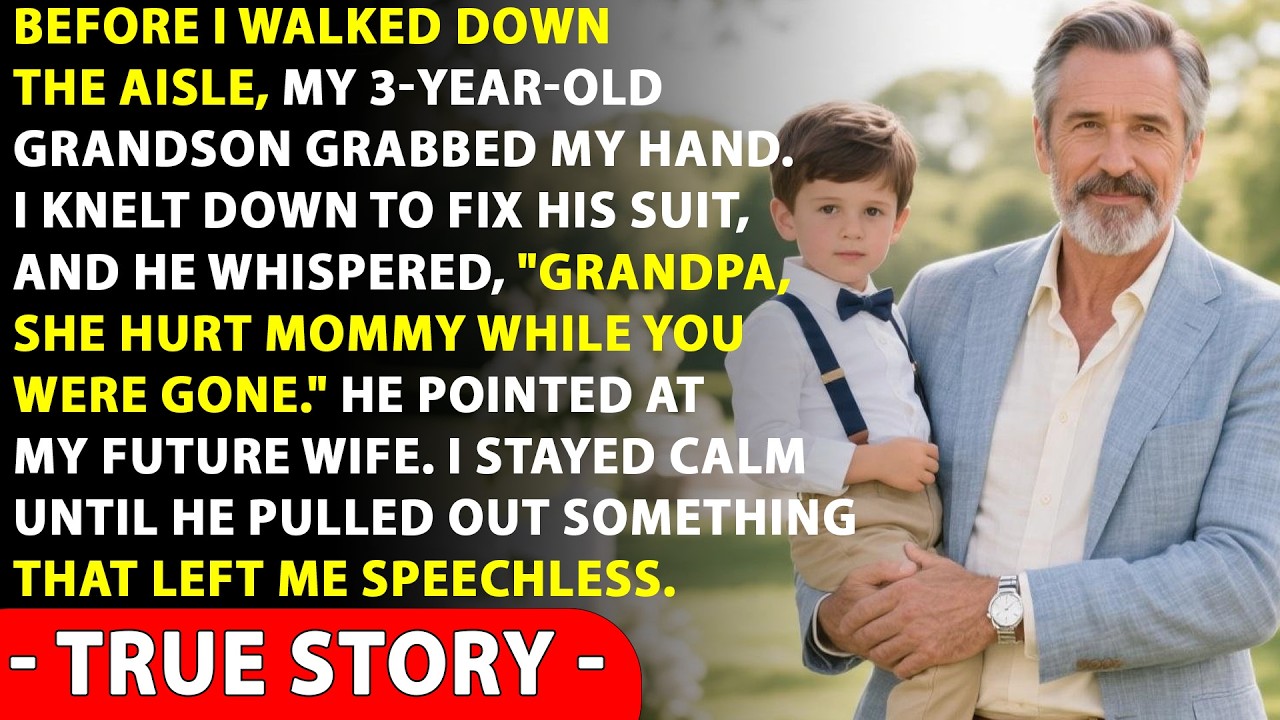
She has hurt mommy many times. ”
My chest tightened. “What do you mean, buddy? ”
He pressed his hand to his heart.
“It hurts in here, Grandpa. Mommy says that is where sad lives. ” He reached into his little jacket pocket and pulled out a tablet, holding it up to me. “I made a video.
By accident. But I think the people in it are talking about you. ”
I took the tablet. My hands were steady; my heart was not.
Down the hall, I could hear the string quartet playing the piece I had chosen because Margaret loved it. I didn’t know it then, but that moment in the hallway was the end of everything I thought I was building, and the beginning of the truth I should have seen years before. My name is George Harland. I built my first business with $23 and a handshake.
I built Harland Estate brick by brick over 40 years. I built a family. I raised a daughter. I buried a wife.
And on the morning of November 15th, I stood in front of my bedroom mirror in a charcoal suit, silver at my temples, ready to marry again. I told myself I deserved this. That’s what my brother Bobby said the night before. “George, you have given this family everything you had.
It’s time somebody gave something back to you. ”
I believed him. I want to tell you about my daughter, Emily. She was 31 when she met Trevor Holloway.
She had Margaret’s green eyes and my stubbornness. She had built her career from an entry-level analyst into a director’s role by the time she was 28, and her boss once told me she was the kind of person a company builds its next decade around. Trevor walked into her life at a conference in Memphis. He was charming, well-dressed, and had a story about a startup that changed details every time he told it.
Margaret was sick by then, but she watched him across the dinner table with those eyes of hers. Later she said, “George, that young man has never built anything with his own hands. ”
“He’s an entrepreneur,” I said. Margaret never pushed.
She just planted the seed and let me water it myself. I didn’t water it fast enough. Emily and Trevor married in June of 2021, three months before Margaret passed. Cody arrived in August.
For a while, things seemed fine. The trouble started quietly, the way real trouble always does. Not with a confrontation, but with small absences. Emily stopped joining her weekly work calls.
Then she stopped going into the office on Thursdays. Then one Monday morning, she called to say she was taking a leave of absence indefinitely. “Trevor thinks I should focus on Cody,” she said. Her voice sounded careful, like someone choosing each word from a list of approved options.
I asked her three more questions. Each answer came back in that same rehearsed tone. I told myself she sounded tired. I told myself new motherhood was hard.
I told myself all the reasonable things a father tells himself when he doesn’t want to believe something is wrong with his child. By then, I was already distracted. Five months after Margaret died, I met Diane Mercer at a charity dinner. Bobby introduced us.
She lost her husband two years ago, a good man from Atlanta. I didn’t want to enjoy talking to her. But I did. She asked about my work with real curiosity.
She had opinions about architecture and my city. She mentioned her late husband only once, briefly. I appreciated that more than I could say, because I still couldn’t talk about Margaret without my voice doing things I couldn’t control. We had coffee the following week, then dinner two weeks after that.
By April, she had been to Harland Estate twice for Sunday gatherings. Everyone seemed to like her. She was warm with the staff. And I told myself I was simply enjoying the company of someone who understood loss.
What I didn’t see was what happened every time I turned away. Sarah Briggs, our housekeeper of 20 years, saw it. She had been the memory of this house, the one who noticed changes the way a doctor notices changes in a patient. She noticed Diane in August.
“I have worked in this house for 20 years,” Sarah told me later, “and I have never seen anyone switch expressions the way that woman could. The second your back was to her, the smile was gone. Not faded. Gone, like a light somebody flipped off.
”
Diane asked questions, small, innocent-sounding questions. About the estate. About the business. About who had keys and which decisions required my signature.
I had read it as interest in what I had built. She was interested in what could be taken from it. Over 18 months, withdrawals from the joint account she convinced me to open reached just under $240,000. I never saw it because I wasn’t looking.
And while I was drinking her expensive French press coffee, she was quietly removing thirty-eight years of my marriage from the walls. The photograph of Margaret and me at the top of the stairs was replaced with an abstract print. I didn’t notice. She made it all so reasonable.
I never saw the bruises on my daughter’s wrist. I never saw the way she sat on the front porch with Cody asleep on her shoulder, an expression on her face I had only seen once before, on Margaret near the end. I never saw the letters she wrote me that never arrived. I never saw the videos Trevor filmed of her crying on the bathroom floor at 2 AM, or the way he used them to isolate her from everyone who could have helped her.
I was too busy believing I was healing. It was my friend Dr. Peter Walsh who finally told me. Emily had come in for her annual physical.
Trevor waited outside. When Peter examined her wrist, there was bruising. She said she caught it on a cabinet door. Emily told him not to push.
She called him two weeks later and gave him permission to tell me everything. Peter called me on a Sunday night in September. “George, she is stronger than Trevor gave her credit for,” he said. “You already know what to do.
You have known since Cody came to you this morning. You are not wrong. You have never been more right about anything. ”
So I put a plan in motion.
I told Bobby. We gathered what we needed. Sarah had kept a notebook for 15 months, every date, every conversation, every expression she saw on Diane’s face when I left a room. Marcus, my head of security, had logged the midnight visits of Trevor’s lawyer to my document room.
He had documents ready to transfer control of my company. He was waiting for the wedding to get me to sign them. On the morning of the wedding, I stood at the altar while 400 guests settled into their seats. Diane stood at the side entrance in her ivory dress.
Trevor sat in the front row, comfortable as a man who believed the hard part was done. I gave Marcus the signal. The screen behind the altar came to life. The video lasted 43 seconds.
Trevor’s voice came through the speakers, casual, as if discussing a business transaction, describing how he intended to ensure I signed documents I had not read at a reception I would not leave until the ink was dry. Diane’s voice followed, measured and certain, explaining how simple it would be to manage Emily now that she was so thoroughly isolated. The chapel went silent. I let the silence hold.
Then I said, “Sarah. ”
She walked to the front with the unhurried composure of a woman who had been waiting 15 months for this moment. She opened her notebook and began to read. Dates.
Times. Withdrawals. Conversations. The names of the seventeen objects removed from my home.
She read for four minutes and twenty seconds, and her voice never wavered. Then I said, “Peter. ” He described what he had observed in his examination room, what a trained physician sees when a patient is frightened and has been for a long time. Then I opened the side door.
Emily walked in, wearing a gray sweater and dark jeans. She looked like herself. She looked at me. I reached out my hand.
She took it. Her grip was hard and certain. Trevor stood from his chair. He moved toward the side door and stopped because Raymond Sutherland and two other men he had borrowed money from were standing in the aisle, beside them two attorneys holding paperwork Trevor was legally required to address.
Diane set down her bouquet of white roses. The face she had maintained for two years was gone. What was underneath it was nothing I recognized. Just absence.
They left Harland Estate at 11:47 that morning through the side entrance. Emily and I sat in the garden that afternoon. She told me she was sorry she hadn’t found a way to tell me sooner. I told her she protected her son, that’s what I saw when I looked at what she did.
“Your mother would have seen the same thing. ”
She laughed. “She would have figured it out in about a week and a half. ”
Later that evening, I went to the storage room and found the box where Diane had put Margaret’s things.
I carried the photograph of Margaret and me up the stairs and hung it back on the nail that had held it for 38 years. I promoted Sarah to head of household operations and gave her the cottage on the east side of the property. That night, I sat in my study and wrote three words in my notebook. Not a plan.
Just three words for myself: “I was loved. ”
Not by Diane. I understand that now. But before her, and underneath everything she tried to build over and around and against it, there had been 40 years of a woman who loved me completely, a daughter who protected her child rather than saving herself, and a three-year-old boy who drew his great-grandmother into a picture of a family holding hands because he understood, without being told, that she belonged there.
I closed the notebook. I turned off the lamp. Upstairs, my grandson was sleeping. Down the hall, my daughter was sleeping.
At the top of the stairs, Margaret was back where she belonged. And for the first time in longer than I could remember, I slept.