The porcelain shattered against the imported Italian marble floor, but it wasn’t a plate. It was my heart, or at least the physical manifestation of a legacy that had survived the Great Depression, two World Wars, and the rise of my family’s shipping empire. My daughter-in-law, Serena, stood over the fragments of the 1924 Patek Philippe pocket watch, utter disdain painted across her face. Beside her, her mother, Linda, let out a cackle that sounded like glass grinding in a garbage disposal.
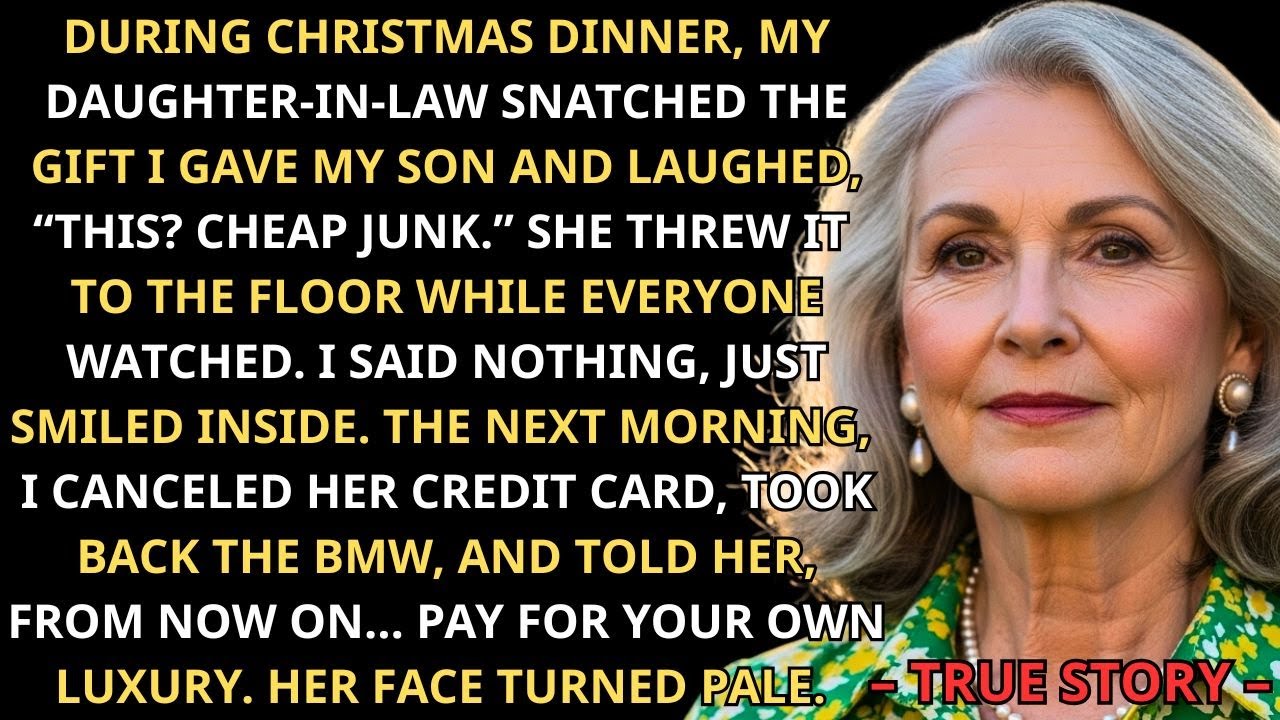
It was Christmas Eve. The air in my Seattle mansion should have smelled of pine and roasted duck. Instead, it reeked of betrayal. I sat at the head of the mahogany table, twenty-two guests frozen in suspended animation, their silverware hovering halfway to their mouths.
I looked at my son, Julian. He was staring at the tablecloth, his jaw tight, refusing to meet my eyes. He said nothing. He did nothing.
In the silence that stretched on, the mother in me finally died so that the businesswoman could be reborn. I did not scream. I did not cry. I simply reached into my clutch, pulled out my phone, and initiated the sequence of events that would burn their parasitic world to the ground.
But to understand why the destruction of a watch was the final straw, you have to understand the woman who held the match. I didn’t inherit a dynasty. I built one from rust, salt water, and the refusal to be ignored. I grew up in the gray industrial docklands of Bremerton, Washington.
My father, Arthur, was a foreman at the shipyards—a man of calloused hands and few words who smelled permanently of diesel and rain. He taught me that respect wasn’t demanded loudly. It was commanded quietly through competence. When he died from asbestos exposure, he left me nothing but a small life insurance policy and that pocket watch.
It had belonged to his father, a man who laid railroad tracks across the Pacific Northwest. The watch wasn’t just a timepiece. It was a compass. Engraved on the back were the words: “Integrity is the currency of the soul.
”
I took that currency and invested it. I started Vance Logistics with one rusted trawler and a loan with an interest rate bordering on criminal. I was twenty-two, a woman in an industry dominated by men who thought the only place for a female on a dock was bringing them coffee. I learned to shout over crane engines and negotiate contracts standing ankle-deep in mud.
I married a gentle man named Robert, an architect with a softness that balanced my hardness. We built a life, a fortune, and a son, Julian. Robert died in a car accident when Julian was fifteen. The loss turned my heart into a stone fortress, so I poured all my unspent love, grief, and resources into Julian.
He was sensitive and artistic like his father, but with a passivity that worried me. I shielded him. I sent him to the best schools, paid for Ivy League tuition, handed him a seat on the board before he’d earned his first paycheck. I thought I was protecting him.
In reality, I was crippling him. Then came Serena. They met at a gallery opening four years ago. Julian was twenty-four, Serena twenty-six.
She was breathtaking—hair that fell in obsidian waves, piercing blue eyes, and a smile that lit up a room while simultaneously assessing the net worth of everyone in it. She called herself a lifestyle curator and brand ambassador. I later learned that meant she was unemployed with an Instagram account. From the moment she shook my hand, her grip limp, her eyes scanning over my shoulder for someone more important, I knew.
A mother’s intuition bypasses logic and strikes directly at the gut. I saw a predator. Julian saw a muse. The courtship was a whirlwind of performative romance.
Serena documented every date and gift for her followers. Julian wasn’t a partner; he was a prop. She moved into our penthouse three months later. That’s when the subtle erosion of my life began.
Small comments first. “Eleanor, darling, this furniture is a bit dated, isn’t it? ” Then isolation. “Oh, Julian, let’s stay in tonight.
Your mother looks tired. ”
She built a wall between my son and me, brick by brick, mortared with fake concern. When they announced their engagement, I offered to pay for the wedding. I expected fifty or sixty thousand dollars.
Serena presented me with a binder the size of an encyclopedia: a vineyard in Napa, a custom gown from Paris, and gift bags that cost more than my father’s annual salary. The total came to nearly a million dollars. I sat Julian down. “Son, this is excessive.
This money could be a down payment on a house, an investment. ”
“Mom, please. It’s Serena’s dream. Her followers expect a certain level of excellence.
”
“Her followers are not paying the bill. I am. ”
“You can afford it,” he snapped. “Why are you being so controlling?
Do you want to embarrass me? ”
That was the lever Serena had installed in his mind—that my prudence was malice. I paid. I smiled.
I watched my son pledge his life to a woman who spent the ceremony checking her reflection in her phone. After the honeymoon, also paid for by me, they claimed the housing market was too volatile to buy. “Just a few months” at the mansion turned into three years. My sanctuary became a content creation studio.
Ring lights appeared in the living room. My antique rugs were rolled up because they clashed with the aesthetic. Packages arrived daily. Then came Linda.
Serena’s mother arrived from Florida with four suitcases and a sob story about a flooded condo, supposedly for a week or two. She treated my staff like her servants, complained about the thread count of the sheets, and critiqued my chef’s coq au vin. I retreated. I spent more time at the office, burying myself in logistics reports to avoid the toxicity in my own home.
The turning point came in early November. I was reviewing quarterly expense reports with Marcus, my accountant since the days of the single trawler. He slid a dossier across his desk. “The spending has accelerated.
In the last fiscal year, the outflow is nearly 2. 3 million dollars. ”
“Impossible. The house upkeep is barely a fraction of that.
”
“It’s not the house. It’s the lifestyle. A Porsche leased under the company name, driven solely by Serena. A rental apartment in downtown Seattle occupied by a friend of Linda’s.
First-class flights for “brand research. ” And jewelry—over four hundred thousand dollars. ”
There were charges for consulting fees paid to a shell company registered to Linda. Withdrawals at casinos in Vegas.
“Cut them off,” I said flatly. “If we do that abruptly, Julian might challenge it legally if his name is on the trust. We need a strategy. ”
“I don’t need a legal strategy,” I whispered.
“I need to know who my son really is. ”
That evening, I returned home early. As I passed the library, the door was slightly ajar. I heard voices.
“She’s looking frail, don’t you think? ” Serena, sharp and devoid of the sugary coating she used in my presence. “She’s an ox,” Linda scoffed. “That woman will live to be a hundred just to spite us.
”
“She can’t live forever. If she becomes incapacitated—senile or mentally unfit—Julian gets power of attorney. And since Julian does whatever I tell him, we get the keys to the kingdom. ”
The clink of a wine glass punctuated the sentence.
“I just need to push her a bit. Make her snap. A few more months of pressure, maybe a public outburst, and we can make a case for dementia. Then we put her in one of those nice facilities in Switzerland and finally renovate this mausoleum.
”
I stood in the hallway, shadows concealing me. A cold, deadly clarity washed over me. They weren’t just mooching off me. They were plotting to bury me alive for the gold.
I walked away silently. I opened my safe, took out the Patek Philippe, and held it to my chest. I thought of my father in the shipyard rain. If they wanted a show, I would give them a finale they’d never forget.
I spent the next month planning. I hired a private investigator to document every move they made. I had forensic accountants trace every stolen cent. I updated my will.
I prepared the transfer of assets. And I organized the Christmas dinner. The best caterers in Seattle. White roses and silver ribbons.
Our closest friends, business associates, and a few of Serena’s influencer friends she was desperate to impress. The dinner began well enough. The wine flowed. Serena was in her element, posing for photos, broadcasting her perfect life to three hundred thousand followers, wearing a dress that cost eight thousand of my dollars.
Julian sat beside her, a ghost of the bright young man he used to be. When it came time for gifts, Serena made a production. She handed me a box of anti-aging creams. “Because at your age, Eleanor, maintenance is everything.
”
I smiled back. “Thank you, dear. ”
Then I reached under the table and produced a small, hand-carved wooden box. The room went quiet.
“Julian,” I said, my voice steady. “This year, I wanted to give you something that can’t be bought. Something that cannot be put on a credit card. ”
He opened the box.
His eyes widened at his grandfather’s watch resting on silk. I told the table its history, my eyes locked on him. “Your grandfather worked in the shipyards for forty years. He didn’t have a Porsche or a penthouse.
He had honor. He used to tell me that a man’s character is defined by what he does when no one is watching. I’m giving this to you now, Julian, because I believe you’re at a crossroads. ”
Tears formed in his eyes.
“Mom, I know how much this means to you. Thank you. ”
Before he could close the box, Serena snatched it. “Let me see.
” She turned it over, her nails clicking against the metal. “It’s old. Look, the casing is scratched, and it’s not even gold—it’s brass. ”
“It’s gold-plated.
The value is not in the metal. ”
“Well, it looks like junk,” she laughed, holding it up for her friends. “Seriously, Eleanor? You run a billion-dollar logistics company and you give your only son pawn shop trash?
That is so tacky. ”
“Serena, stop,” Julian muttered. “No, honestly, it’s insulting. It smells like old metal and grease.
”
And then, with a look of pure malice, she opened her fingers. The watch fell. Time seemed to slow. I watched the heirloom spinning, Julian’s hand twitching but failing to move.
I heard the sickening crunch of the crystal shattering against the marble. The back casing popped open. Gears spilled out like guts. Silence.
Absolute, suffocating silence. Linda started laughing. “Oh, oops. Butterfingers.
Well, at least now you can buy him a Rolex, Eleanor. Something real. ”
I looked at the broken watch. Then I looked at Julian.
I waited. “Julian,” I said softly. “Are you going to pick it up? ”
He looked at Serena, who was smirking.
He looked at me. He looked at the floor. His face flushed red, but he didn’t move. That was the moment.
I realized my son wasn’t a victim. He was an accomplice. I stood up. I didn’t yell.
I smoothed my silk dress, walked over to the mess, knelt, and gathered the pieces of my father’s legacy into a handkerchief. I placed them in my pocket. I pulled out my phone. “Eleanor, sit down.
You’re making a scene,” Serena hissed. I ignored her. “Mr. Henderson,” I said, my voice amplifying in the silent room.
“Yes, I know it’s Christmas Eve. Initiate protocol zero immediately. The Porsche Cayenne, license plate Vance one—it’s in the driveway. Repossess it now.
”
Serena’s smile faltered. “What? ”
I dialed security. I had the biometric access codes changed, removing all authorized users except myself.
“Yes, including Julian. ”
“Mom, what are you doing? ” Julian stood, panic reaching his eyes. I dialed Credit Services.
I reported four cards as stolen by unauthorized users, canceled the platinum and the black accounts, and froze the joint checking assets. “Yes, total freeze. ”
“You can’t do that,” Linda shrieked. “We have reservations for Aspen!
”
I finally looked at them. “You have nothing. You are guests who have overstayed your welcome by three years. ”
I walked to the side table and tossed a Manila envelope onto the turkey platter.
“That is a forensic accounting of every dollar you’ve siphoned from this family. Two point three million. Fraud, embezzlement, and elder abuse. My lawyer, sitting right there, has already drafted the civil suit and the eviction notice.
”
The room turned to Mr. Sterling, who raised his wine glass in a silent toast. “Eviction? Mom, we live here,” Julian stammered.
“Not anymore. You have exactly one hour to pack your personal belongings. Not the things I bought. Just the things you paid for.
Which is practically nothing. ”
“You’re bluffing,” Serena sneered. “You wouldn’t kick your own son out on Christmas. ”
“My son died the moment he watched his wife destroy his grandfather’s memory and said nothing.
The man standing in front of me is a stranger, and strangers don’t sleep in my house. ”
A heavy engine rumbled outside. Orange flashing lights washed over the dining room walls. “My car!
” Serena screamed. “My car,” I corrected. The next hour was chaos. Serena screamed and threw vases.
Linda stuffed silverware into her purse until security escorted her out. Julian stood shell-shocked, watching his life dismantle. When they finally stood on the porch in the pouring rain, Serena shivering in her thin dress, she tried to order an Uber. Her card was declined.
She tried another. Declined. “Where are we supposed to go? ”
“I hear the Motel 6 on the highway has vacancies.
It’s very affordable. ”
I closed the heavy oak door in their faces. I locked it. For the first time in three years, I sat in my living room and listened to the sound of peace.
The fallout was swift. The next day, Serena’s social media empire collapsed. A guest at dinner had recorded the whole confrontation and posted it: “Gold Digger Gets Owned by CEO Mom. ” Four million views by Boxing Day.
Brands dropped her. Friends blocked her. Linda took a bus back to Florida two days later, leaving her daughter behind with nothing. Julian tried to call me for two weeks.
I didn’t answer. He showed up at the office. Security turned him away. He needed to hit rock bottom.
I kept tabs on him. I’m a mother, not a monster. They moved into a studio in a rough part of town. Serena got a job as a hostess at a chain restaurant.
Julian worked construction, hauling drywall and mixing cement. One rainy Tuesday in April, my secretary buzzed me. “Mrs. Vance, there’s a young man here to see you.
He says he just wants to leave something. ”
“Send him up. ”
Julian walked in. He looked different.
Thinner, tanned, weathered. His hands were covered in cuts and calluses. He wore work boots and a flannel shirt. He looked like Arthur.
He didn’t sit down. “I’m not here to ask for money,” he said, his voice raspy. “And I’m not here to ask for my job back. ”
“Why are you here?
”
He reached into his pocket, pulled out a small velvet pouch, and placed it gently on my desk. “I took it to a specialist. It took me four months to save up for the restoration. I worked double shifts.
I ate ramen every night, but I paid for it. Me. Not you, not the trust. ”
I opened the pouch.
The Patek Philippe was there. New crystal. Polished casing. It ticked rhythmically, a heartbeat restored.
“Serena left me,” he said. “About a month ago. Said she couldn’t live like a peasant. Found some tech guy in San Francisco.
I didn’t fight for her. ”
He looked me in the eye. “I fought for this watch instead. Because when she dropped it, something broke in me too.
I realized I had become a man with no history, no spine. You were right, Mom. About everything. ”
I looked at the watch, then at my son’s battered hands.
“Sit down, Julian. ”
“I can’t stay long. My shift starts at two. I just wanted to return it.
It belongs to you. ”
“It belongs to the family. And you are family. ”
I walked around the desk.
I took his rough, workingman’s hand in mine. “You fixed the watch. But you fixed something more important. You found your dignity.
”
He broke down then, weeping, holding on to me, shaking with the release of months of shame. I held him tight, smelling rain and sawdust—a smell that reminded me so much of my father that my heart ached. It’s been eight months since that Christmas. Julian didn’t move back.
He refused. He lives in a one-bedroom apartment he pays for himself, studying for his captain’s license. He wants to work on the boats, not in the boardroom. He wants to earn his place.
We have dinner every Sunday. I cook. He brings dessert. We talk about tides and shipping routes.
Last night, as I sat by the fire listening to the watch tick on the mantelpiece, I realized the best gift I ever gave my son wasn’t a trust fund or an education. It was the moment I took everything away. Because sometimes you have to let the artificial lights go out so you can finally see the stars.