The night my mother-in-law seated me beside a trash can, the laughter was loud enough to make my ears burn. Then a four-star admiral crossed the room, looked straight at me, and asked, “Commander Carter, why are you sitting by the garbage? ”
The silence that followed was so sudden I could hear the air conditioning humming. My husband Daniel stood near the front of the reception hall, his new insignia bright.
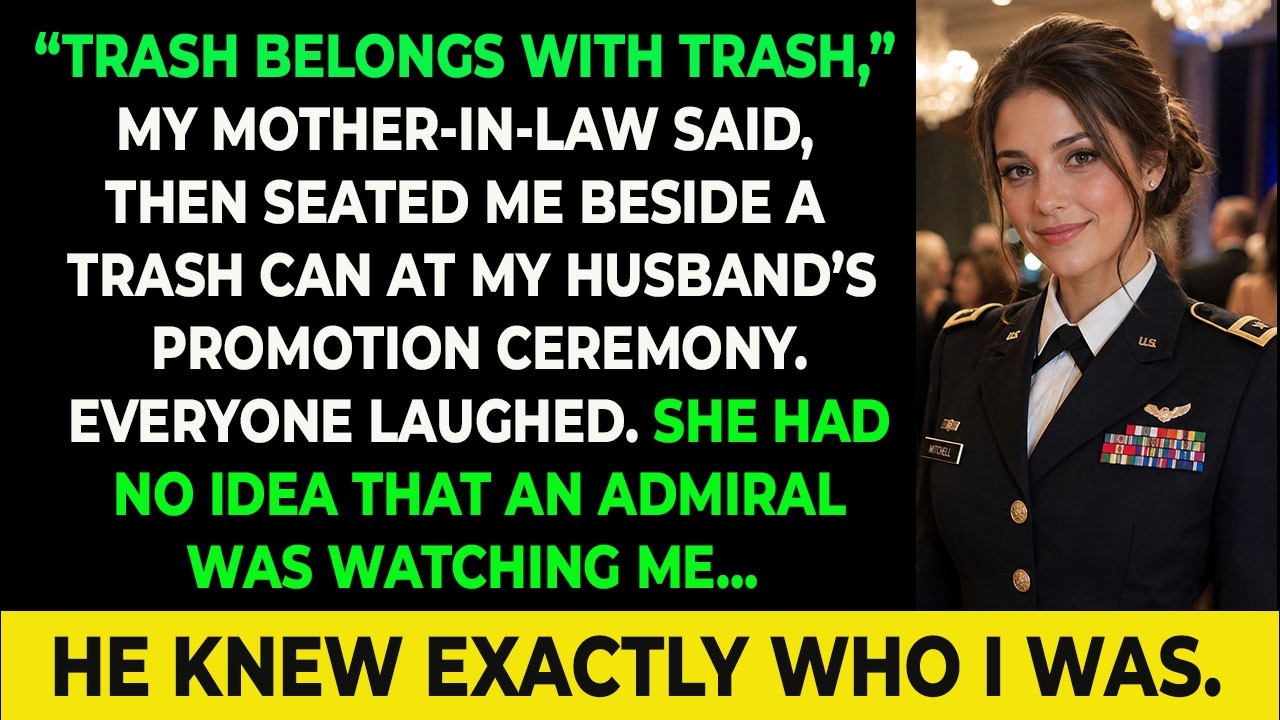
His mother Eleanor was beside me, smiling like she’d won something. She hadn’t. But that moment came later. To understand how I ended up beside a trash can at my own husband’s promotion party, you have to understand how humiliation works.
It rarely begins with one cruel sentence. It begins with small comments at dinner. It begins when people stop asking for your opinion. It begins when your husband lets his mother insult you because correcting her would make his evening uncomfortable.
After 25 years of marriage, I’d learned to pretend those things didn’t hurt. My name is Margaret Carter. Most people call me Maggie. I was 56 years old and lived in Norfolk, Virginia, where military families come and go so often you learn not to get attached.
Daniel and I had been married for 25 years. For most of that time, I thought we were a good team. I packed his bags for every deployment. I answered his calls from overseas.
I learned to sleep alone when storms rattled the windows and he was halfway around the world. When his mother needed help after knee surgery, I drove across town three times a week. I bought her groceries, filled her prescriptions, did her laundry. I never asked for praise.
I thought that was what marriage meant. But Eleanor never considered me family the way I wanted. She called me “the civilian” when she thought I couldn’t hear. She introduced me at a dinner once as “Daniel’s wife,” as though I hadn’t brought a name with me.
I spent years trying to earn her approval. I cooked her favorite meals. I remembered her birthday. I sat beside her at hospital appointments.
It was never enough. Daniel stayed out of it. That was his way. He wasn’t cruel like his mother.
He just didn’t want conflict. I learned that silence can hurt more than cruelty. The promotion ceremony was supposed to be a proud day. It was held at a naval facility in Norfolk, followed by a formal reception.
I wore a navy blue dress I’d owned for years. Nothing flashy. When we arrived, Daniel kissed my cheek. “You look nice,” he said.
I thanked him. Then he went to talk to some officers. I watched him disappear into the crowd and felt proud for a moment. That feeling didn’t last.
Eleanor came toward me carrying her purse. “Come with me,” she said. I followed her to the back of the reception hall. There were round tables, most already occupied.
Then I saw the chair. It was pushed against a wall beside a large black trash can. I laughed because I thought she was joking. “You want me to sit there?
”
“Yes. ”
I waited. She leaned closer. “Trash belongs with trash.
”
I stared at her. A couple nearby heard it. One man covered his mouth. A woman laughed.
Then another person joined in. My face went hot, but I refused to give her what she wanted. I sat down, not because I accepted her insult, but because I wouldn’t give her the satisfaction of seeing me run. The trash can was less than two feet from my shoulder.
I could smell coffee grounds and paper from inside it. Across the room, Daniel saw me. Our eyes met. I waited for him to come over, to say something, anything.
Instead, he looked away. That was the moment something inside me changed. Not dramatically. No explosion, no shouting.
Just quiet realization. I had spent 25 years protecting Daniel’s comfort, and he had spent years allowing other people to destroy mine. I folded my hands in my lap and watched the ceremony. Daniel was called forward.
Everyone applauded. I applauded too, because I wasn’t going to become the kind of person Eleanor believed I was. Then something strange happened. A senior admiral near the front turned around.
He looked directly at me. I had never met him, at least not in the life Daniel knew. He looked away, then looked back. His expression changed.
He leaned toward another officer and said something I couldn’t hear. A few minutes later, he found me again. This time, he looked certain, not confused. When Daniel received his new rank, the room applauded.
Eleanor stood proudly. The admiral stood too, but he wasn’t looking at Daniel. He was looking at me. He walked across the room.
Conversations faded one by one. People turned in their chairs. I stood. The admiral stopped in front of me.
For one long second, neither of us spoke. Then he smiled. “Commander Carter,” he said quietly. “I never thought I’d see you sitting beside a trash can.
”
My heart stopped, because there was only one reason he could have called me commander. And Daniel had never known about it. Daniel turned around. The color drained from his face.
He knew my name, but he had never heard anyone use my old military rank. Eleanor looked confused. “Commander? ” she repeated.
The admiral extended his hand. “Admiral Thomas Reynolds. ”
I shook it. “It’s good to see you, sir.
”
Daniel stared at me like I had become a stranger. “You were a commander? ”
I didn’t answer right away. There were too many memories rushing back.
All of them had started long before I ever met Daniel. Years earlier, before marriage, before Norfolk, before I became the woman who remembered her mother-in-law’s prescriptions, I had been someone else. Someone I deliberately left behind. I joined the Navy when I was 22.
I wasn’t from a military family. My father worked at a Ford plant in Michigan. My mother was a school secretary. I joined because I wanted a life bigger than the small town where I grew up.
I worked hard. I learned quickly. Eventually I found myself in assignments that required discretion. I couldn’t tell my parents much.
I couldn’t tell friends. Some nights I couldn’t even explain why I was working late. But I was proud. I earned promotions.
I received commendations. I learned to keep my mouth shut when silence protected other people. Somewhere along the way, I met Thomas Reynolds. He wasn’t a four-star admiral then.
He was a senior officer, demanding but fair. He remembered people who did their jobs well. More importantly, he remembered people who did the right thing when nobody was watching. That was why his presence frightened me more than it impressed me.
If he recognized me publicly, my carefully buried past was no longer buried. Daniel finally approached us. “Admiral, it’s an honor. ”
Reynolds shook his hand.
“Congratulations, Captain Carter. ”
Daniel thanked him. Then the admiral looked at me again. “How have you been?
”
“I’ve been well. ”
He nodded. “You disappeared. ”
I smiled faintly.
“I thought that was the point. ”
He laughed, the first time that evening anyone had laughed without trying to hurt me. Daniel looked between us. “What exactly did you two do together?
”
Reynolds glanced at him. “That is a long story. ”
Eleanor stepped forward. “I had no idea Maggie served.
” The way she said “served” made it sound ridiculous. I could have told her everything right there. I could have listed every award, every difficult assignment, every night I spent wondering whether I would make it home. But I didn’t.
I just said it was a long time ago. Daniel’s eyes narrowed. “How long? ”
“Before we met.
”
“You never told me you were a commander. ”
“You never asked. ”
That silenced him. The reception continued, but something had changed.
People who had ignored me earlier came to introduce themselves. Some asked about my service. Others just wanted to be near the admiral. Eleanor disappeared to the other side of the room.
For the first time that evening, she looked uncomfortable. I didn’t enjoy seeing it. That surprised me. I had expected satisfaction.
Instead, I felt tired. I had still been humiliated. Daniel had still watched. And the woman who had spent years calling me insignificant had only stopped because someone with more authority recognized me.
I didn’t want respect because of a uniform I’d worn decades ago. I wanted respect because I was a human being. After the reception, Daniel and I drove home in silence. Finally, he spoke.
“Why didn’t you tell me? ”
“I didn’t think it mattered. ”
“How could that not matter? ”
“Because I loved you.
”
He didn’t answer. I continued, “When we got married, you were building your career. I didn’t want our marriage to become a competition. ”
“Were you hiding something from me?
”
“I was protecting a part of myself that belonged to me. ”
He frowned. “I don’t understand. ”
“I know.
”
At home, I went into the spare room where I kept old photographs and documents. I opened the bottom drawer of a wooden filing cabinet. Inside was a small blue box I hadn’t opened in years. Daniel stood in the doorway.
“What is that? ”
I lifted the lid. Inside were my old navy ribbons, photographs, commendations, and a folded letter. Daniel stepped closer.
“That’s you. ”
“Yes. ”
He picked up a photograph. I was 28, standing beside three other officers.
I looked younger, stronger, certain. “Why did you leave? ” he asked. I touched the folded letter.
“Because I thought I had done enough. ”
That wasn’t the whole truth. There had been an investigation, a contractor, missing records, money moving through accounts that should never have been connected. I had walked away afterward, not because I was afraid, but because I wanted an ordinary life.
A husband, a home, maybe grandchildren someday. I thought ordinary meant safe. I had been wrong. Daniel picked up the letter.
“Who wrote that? ”
“Admiral Reynolds. ”
He unfolded it, his eyes moving across the page. Then he looked up.
“What does this mean? ”
I took the letter from his hand. “It means there are things about my life you never knew. ”
He stared at me.
“Now I want to know everything. ”
I closed the box. “Then you’re going to have to decide whether you want the truth because you love me, or because you finally understand that you underestimated the woman standing beside you. ”
That night, Daniel went to bed without another word.
I stayed at the kitchen table until nearly two in the morning. Outside, Norfolk was quiet. But inside my mind, the past had begun knocking on the door, and this time I knew I couldn’t keep it locked forever. The next morning, Daniel was already awake when I came into the kitchen.
He sat at the table with a cup of coffee, staring at the blue box. “You didn’t sleep,” I said. “Neither did you. ”
He pushed the box toward me.
“I want to understand. ”
“What do you want to understand? ”
He looked down. “Who you were.
What you did. ”
I sat across from him. “You said you were a commander. What did you actually do?
”
I took a slow breath. “My work involved maritime intelligence and security. ”
He frowned. “That sounds vague.
”
“It was supposed to be. ” I explained only what I was permitted to explain. Even after all these years, some details belonged to the government and to the people who had trusted me. I had worked on investigations involving naval contractors and irregularities in procurement records.
At the time, nobody called it corruption. There were softer words—accounting discrepancies, administrative irregularities, contractual concerns. But I knew what I was seeing. Money was moving through companies with no legitimate reason to be connected.
Equipment was bought at inflated prices. Records disappeared. People who asked questions were suddenly transferred. One of those people was a young logistics officer named Michael Harris.
He discovered something in shipping records and brought it to me because he trusted me. That decision changed both our lives. “What happened to him? ” Daniel asked.
“He was reassigned. His career never recovered. ”
The investigation eventually reached senior leadership. Admiral Reynolds became involved.
He reviewed the evidence himself. Then I was asked to testify. “Were you afraid? ” Daniel asked.
“Yes. ” It was the first time I had admitted that aloud. “I was afraid the investigation would fail. I was afraid people would lose their careers.
I was afraid my own reputation would be destroyed. And most of all, I was afraid telling the truth wouldn’t matter. ”
But I testified anyway. The investigation uncovered enough evidence to stop a major contract.
Several people were disciplined. Others resigned. One contractor lost a lucrative agreement. The Navy quietly changed internal procedures.
There was no dramatic press conference, no movie scene. That wasn’t how real life worked. Sometimes the biggest victories happened in conference rooms with fluorescent lights and stale coffee. A year later, I left active service.
Then I met Daniel. “Why didn’t you ever tell me? ” he asked. “I told you enough.
”
“No, you never told me you were involved in something like this. ”
I shook my head. “I didn’t want our marriage to be about it. ”
He rubbed his forehead.
“I thought you left because you couldn’t handle military life. ”
I stared at him. “You thought that? ”
“My mother said…”
I held up my hand.
“Don’t. ”
He stopped. I had spent years hearing Eleanor’s opinions repeated through him. That morning, I finally understood how deeply her voice had become his own.
“She told you I couldn’t handle it,” I said. Daniel didn’t answer. “She told you I wasn’t ambitious. ”
Still nothing.
“She told you I was lucky to have you. ”
He looked down. I didn’t need an answer. I had it.
Later that afternoon, I opened the old filing cabinet again. There was one document I had never shown him. A memorandum from the investigation. My name appeared near the bottom.
So did Reynolds’s. I had kept it because it reminded me not of what I accomplished, but what it cost. I had lost friends, lost sleep, and carried the burden of wondering whether I had done enough. Then my phone rang.
It was Admiral Reynolds. “I owe you an apology,” he said. “For not reaching out sooner. There were people from that investigation who never forgot what you did.
I knew you wanted a private life, so I respected that. ”
“I appreciate it. ”
“But I didn’t expect to find you sitting beside a trash can. ”
I laughed softly.
“Neither did I. ”
His voice became serious. “Maggie, there is something you need to know. ”
My stomach tightened.
“What? ”
“The investigation from all those years ago may not be as finished as we thought. Some records have resurfaced. ”
“Why are you telling me?
”
“Because your name is in them. ”
I closed my eyes. For 25 years, I had believed that chapter of my life was finished. Now I understood why he had looked at me that way at the reception.
He hadn’t simply recognized an old colleague. He had recognized someone whose past was becoming relevant again. “Is there a problem? ” I asked.
“There could be. Someone may have been protecting the wrong people. ”
“Who? ”
“I can’t discuss that over the phone.
”
“Then what should I do? ”
“Keep every document you still have. And don’t let anyone pressure you into destroying anything. ”
That evening, Daniel came home carrying flowers.
“I owe you more than an apology,” he said. “Then start with the truth. ”
His face tightened. He reached into his jacket and pulled out his phone.
He placed it on the table and turned the screen toward me. Text messages. From a woman named Karen, who worked in Daniel’s command. They started ordinary—questions about work, jokes, complaints about meetings.
Then they changed. Late-night messages. Messages about missing each other. Messages about hotel rooms during temporary assignments.
I kept scrolling. My hands were steady. That surprised me. I had expected rage, tears.
Instead, I felt something colder. Disappointment. “How long? ” I asked.
“About eight months. ”
“Your mother knew. ” His silence answered me. “Did she know before the promotion ceremony?
”
“Yes. ”
“And she still put me beside the trash can. ”
He looked down. “I’m sorry.
”
“Don’t say that yet. Tell me why. ”
Daniel was quiet. Finally, he said, “Because I was ashamed of myself.
I spent years feeling like I wasn’t good enough. You had your own career. You were confident. You had done things I could barely understand.
I convinced myself that I needed to be the successful one. ”
“So you made me smaller. ”
“Yes. ”
The honesty was painful, but it was the first honest thing he had said all day.
“My mother made it easy,” he continued. “She kept telling me you weren’t ambitious anymore, that you had settled into being a housewife because you couldn’t compete with me. ”
I laughed once, not happily. “Your mother thought I couldn’t compete with you.
”
Daniel looked ashamed. “She didn’t know who you were. ”
“Neither did you. ”
He had no answer.
The next morning, I met with an attorney in downtown Norfolk. I didn’t tell Daniel where I was going. She explained Virginia’s laws, our property, our accounts, the practical consequences of separation. “Whatever you decide,” she said, “make sure you’re making the decision from a position of knowledge, not fear.
”
I wrote that sentence down. Knowledge, not fear. That afternoon, Reynolds called again and asked me to meet him privately. We met at a quiet restaurant near the naval base.
He arrived in civilian clothes. “What records resurfaced? ” I asked. He slid a folder across the table.
“Your original report was one of the documents requested. Your report identified a chain of payments that never received a complete follow-up. ”
“I thought that case was closed. ”
“It was.
But one of the companies involved later became part of a much larger defense contractor. The money never simply disappeared. It moved. ”
“Do they think I kept evidence?
”
“No. They want to know what you remember. ”
I looked out the restaurant window. For 25 years, I had avoided this world.
I had raised a family, paid bills, cleaned kitchens, attended birthdays. Now the past had found me again. But this time, I wasn’t 28. I wasn’t alone, and I wasn’t afraid.
When I returned home, Eleanor was sitting on my front porch. “Maggie, we need to talk. ”
She followed me inside. “Daniel told me what happened.
”
“I was wrong,” she said. “I’m sorry. ”
“You should be. You were cruel.
”
“Yes. You weren’t confused. ”
“No. I knew exactly what I was doing.
”
“Why? ”
Her eyes filled with tears. “Because I was afraid. Afraid that you were going to become the most important person in Daniel’s life.
”
She told me something I had never heard. Daniel’s father had spent his entire career believing he had failed as a military man. Eleanor had spent decades trying to make sure her son never felt that way. When Daniel married me, she believed my accomplishments would make him feel inadequate.
“I convinced myself that if I made you smaller, he’d feel bigger. I was wrong. ”
I sat across from her. “Yes,” I said quietly.
She wiped her eyes. “I don’t expect you to forgive me. ”
“I don’t. ”
She nodded.
“But I hope someday you will. ”
I didn’t answer. Forgiveness wasn’t something I could give that afternoon. It had to be earned.
Later that evening, I opened the folder Reynolds had given me. The first page was an old memorandum. The second was a financial chart. The third made my breath catch.
There was a signature I recognized. Someone I had trusted 25 years ago. Someone who had sworn the investigation was finished. Someone who had told me to go home and forget everything.
The signature belonged to a man named Richard Hale. A senior civilian official involved in the contractor investigation. One of the people who told me the case was over. I remembered his handshake, his calm voice.
“Go home, Commander Carter. You’ve done your part. ”
I had believed him. Now I wondered how much of that had been a lie.
At six the next morning, I called Reynolds. “I know who signed the document. Richard Hale. ”
There was a long silence.
“Yes. ”
“Why didn’t you tell me? ”
“Because suspicion isn’t evidence. ”
“What’s happening now?
”
“There will be an internal review. You may be asked questions. Will you need an attorney? ”
“Yes.
”
That afternoon, I met with the same attorney. She listened carefully. Then she said, “You don’t have to become part of the investigation beyond what you’re legally required to do. But if you choose to cooperate, document everything.
And Maggie, don’t make decisions about your marriage based on what happens with the investigation. ”
She was right. The military investigation belonged to my past. My marriage belonged to my present.
I couldn’t let one distract me from the other. When I got home, Daniel was sitting at the kitchen table with an envelope in front of him. “What is that? ”
“Separation papers.
”
I stared at him. “You’re leaving? ”
“No. ” He pushed the envelope toward me.
“I thought you might want to. ”
I didn’t touch it. “You’re giving me the choice. ”
“Yes.
I’ve spent too long making choices for you. ”
He looked older than he had a week earlier. “I’ve spoken with my attorney. I’ve also reported the relationship with Karen to my command.
”
“You did? ”
“Yes. Because I lied to you. I don’t want to lie to anyone else.
”
“What happened? ”
“They’re reviewing everything. I may lose the promotion. ”
I nodded.
There was a time when that news would have frightened me. We had planned our retirement around his career. But now I understood something. A promotion could be earned again.
Trust couldn’t. “Are you still seeing Karen? ”
“No. I ended it because I finally admitted to myself that I had become someone I didn’t respect.
”
That answer mattered. But it wasn’t enough. “I need time,” I said. “I know.
” He stood. “I’ll sleep in the guest room. ”
I watched him disappear down the hallway. For the first time in 25 years, I realized I didn’t have to follow.
A week later, the internal review began. I answered every question I could. I provided copies of the documents I had kept. I told the truth about what I remembered and admitted when I didn’t.
I never exaggerated. I never guessed. If I was going to reclaim my dignity, I wasn’t going to lose it along the way. Daniel’s situation became more complicated.
His command reviewed his conduct. The affair itself wasn’t criminal, but his failure to disclose the relationship and certain professional decisions raised questions. His promotion was placed under review. When someone asked him what happened, he told them the truth.
“I betrayed my wife. I made choices that damaged my judgment. Whatever consequences come from that, I accept. ”
I heard about it from a mutual friend.
I didn’t feel triumphant. I felt sad, because this was the man I had loved. Somewhere along the way, he had become so desperate to prove himself that he had forgotten what being a good man actually required. Eleanor came to see me again.
This time she brought a small cardboard box. “I found these in Daniel’s old room. ”
Inside were photographs from the early years of our marriage. One showed Daniel and me standing outside our first apartment, both laughing.
We were young, had almost no money, mismatched furniture, worn carpet. But we were happy. Eleanor sat beside me. “He loved you then.
I know he still does. ”
I looked at her. “Love isn’t enough. ”
She nodded.
“I was jealous of you. You were strong. You didn’t need anyone to tell you who you were. ”
“And you thought that made me dangerous.
”
“Yes. I spent years trying to make you feel small because I was afraid my son would admire you more than he admired me. ”
I didn’t comfort her. Not because I wanted her to suffer, but because sometimes people need to sit with the consequences of what they’ve done.
“I won’t hate you,” I finally said. “But I won’t pretend this didn’t happen. ”
Several weeks passed. Then Reynolds called.
The review had found significant evidence against Hale. “What happens now? ”
“There will be further investigation. ”
After 25 years, the truth was finally moving.
Then Daniel came into the kitchen with a folder in his hand. “They made their decision. My promotion is being revoked. ”
I felt a strange ache in my chest.
“I’m sorry. ”
He nodded. “So am I. But that’s not the worst part.
I finally understand that I spent years chasing a rank because I thought it would make me worthy of the people I loved. You were the thing that mattered. ”
I didn’t answer. He looked at me.
For the first time since the ceremony, I reached across the table and took his hand. Not because everything was forgiven. Not because the marriage was repaired. But because I could finally see the man underneath the uniform.
And maybe, if he was willing to do the hard work, he could learn to see the woman underneath mine. The first morning Daniel woke up without his promotion, he made coffee for both of us. He placed my mug on the table and sat across from me. The silence felt different now.
It wasn’t something he used to avoid difficult conversations. It was something we shared while trying to understand what came next. “I’ve made an appointment with a therapist,” he said. “For yourself?
”
“Yes. ”
“Good. ”
“And I found someone for us, too. ”
I nodded.
“I’ll consider it. ”
For the next several months, we worked through the wreckage slowly. There were no dramatic declarations, no overnight transformation. Real change is much less exciting than that.
Daniel learned to listen without defending himself. He learned that saying “I didn’t mean it that way” didn’t erase what someone experienced. He learned to answer difficult questions directly. And I learned something too.
I learned that forgiving someone did not require me to stop remembering. It did not require me to pretend the past hadn’t happened. And it certainly didn’t require me to give up my boundaries. The investigation into the old contractor case continued.
Richard Hale eventually became the focus of a broader federal inquiry. I was interviewed several times. Each interview brought back memories I had buried for decades. But this time I wasn’t the frightened young commander wondering whether anyone would believe her.
I was a 56-year-old woman who had already survived being underestimated by the people closest to her. The evidence eventually showed that money from the original contract had been redirected through several companies over the years. There were subpoenas, interviews, financial records, lawyers, months of paperwork. No one was dragged away in handcuffs while reporters shouted questions.
That was what justice often looked like in real life. Slow, careful, uncomfortable, but real. One afternoon, Reynolds asked me to meet him at a quiet office near the naval station. “You were right to leave when you did,” he said.
“I wasn’t sure of that for a long time. ”
“You should be. You spent years believing that walking away meant you had lost. You didn’t lose.
You chose a different life. ”
That sentence stayed with me. I hadn’t abandoned my life. I had simply become someone else.
A wife, a mother, a neighbor, a friend, a woman who knew which grocery store had the best peaches and which mechanic wouldn’t overcharge an elderly customer. Those things mattered too. My life had never been small. I had only allowed other people to convince me it was.
Daniel started volunteering with a local veterans organization. At first I thought it was just another attempt to repair his image. Then I saw him one afternoon helping an older veteran carry boxes from his car. Nobody was watching.
He was simply helping. That was when I realized something had changed. He wasn’t trying to become impressive. He was trying to become decent.
That was a much harder task. One evening, he came home with a stack of paperwork. “Financial documents,” he said. “I’ve been going through everything.
Our accounts, retirement plans, insurance, the house. ”
“Why? ”
“Because I hid things from you. I want you to know exactly where we stand.
”
Every account was listed. Every debt, every investment, every monthly expense. He had also sold a vehicle he had purchased without telling me and used the money to pay down debt. “You didn’t have to do this,” I said.
“Yes, I did. You spent 25 years trusting me with our life. I don’t get to ask for trust back without earning it. ”
That was the first time I believed him.
Not completely, but enough to begin. Eleanor changed too. She stopped calling every Sunday. Instead, she called once every few weeks and asked whether I wanted to talk.
If I said no, she accepted it. She never complained to Daniel. She never demanded forgiveness. She simply waited.
One Saturday, I found her outside my door holding a pie. “I made too much,” she said. I smiled. “You always make too much.
”
I let her in. We ate at the kitchen table. Eventually she said, “I have one more thing to tell you. I was wrong about you.
You weren’t making Daniel feel small. I was making him feel small by teaching him to compare himself to you. ”
That was perhaps the most honest thing she had ever said. “I don’t expect us to become close,” she said.
“We might. ”
She looked surprised. “But it will take time. ”
“I understand.
”
It did. Not every wound closes because someone says sorry. Some wounds become scars. You learn to live with them.
You just don’t press on them every day. About a year after the promotion ceremony, Daniel and I were sitting on our back porch. The evening was warm. A baseball game played softly on the television inside.
“Do you ever regret staying? ” he asked. I thought about the question. “I didn’t stay for you.
”
He nodded. “I know. ”
“I stayed because I wanted to see whether the person I married was still in there. ”
“And?
”
I smiled. “Sometimes. ”
“That’s fair. ”
“I don’t know what our marriage will look like five years from now.
”
He took my hand. “I do. I want it to look honest. ”
“That would be a good start.
”
A few months later, Reynolds invited me to a small veterans recognition ceremony. No cameras, no reporters. Just service members, families, and a few retired officers. When my name was called, I walked to the front.
Reynolds shook my hand. “Still the same Commander Carter,” he said quietly. I smiled. “Just older, wiser.
”
Daniel stood in the back, watching. He wasn’t trying to be noticed. He was simply proud. For the first time, I didn’t need him to defend me.
I didn’t need Eleanor to approve of me. I didn’t need an admiral to recognize me. My worth had never depended on any of them. The woman sitting beside that trash can had already known who she was.
She had simply forgotten for a little while. A year after the night my mother-in-law put me beside that trash can, I drove back to the same naval facility in Norfolk. The road looked exactly the same. But I wasn’t the same woman who had arrived there wearing a navy blue dress, wondering why her own husband wouldn’t stand up for her.
That woman had spent years trying to keep the peace. I now understood the difference between peace and silence. Daniel sat beside me in the passenger seat. We had been rebuilding our marriage slowly, not perfectly.
There were still difficult conversations. But he no longer avoided them. If I said something hurt, he didn’t tell me I was too sensitive. He listened.
If I needed space, he gave it. If I asked a difficult question, he answered it. Trust didn’t return because he asked for it. It returned because he kept earning it.
We were attending a small ceremony honoring veterans who had contributed to their communities after leaving active duty. Reynolds had invited me months earlier. I almost said no. Then I remembered what he had told me: “You don’t have to hide from the life you once lived.
”
So I went. When we entered the reception room, I saw Eleanor near the entrance. She looked nervous. She wore a simple gray sweater and black slacks.
When she saw me, she smiled. “Good morning, Maggie. ” No insult, no sarcasm. Just my name.
I returned the greeting. She looked at Daniel. “Your father would have been proud of you. ”
Then she turned to me.
“And he would have been proud of you, too. ”
I didn’t know what to say. “I’ve wanted to say that for a long time,” she said. I nodded.
“Thank you. ”
It wasn’t a dramatic reconciliation. No audience, no applause. Just two women in a hallway acknowledging that years of hurt had happened between them.
Sometimes that is what forgiveness looks like. Not forgetting. Not pretending. Just choosing not to carry the anger everywhere you go.
Later, I was called to the front. Reynolds introduced me without exaggeration. He simply said I had served with integrity and had once made a difficult decision when doing the right thing was not the easy thing. I looked at the people before me.
Veterans with gray hair. Spouses who had waited through deployments. Adult children sitting beside elderly parents. I thought about that trash can, about Eleanor’s words.
“I’ve learned something about dignity,” I began. The room became quiet. “Dignity isn’t something another person gives you. And it isn’t something they can take away.
Sometimes people try to make us feel small because they are afraid of our strength. Sometimes they insult us because they don’t understand us. Sometimes the people who should protect us are the ones who disappoint us most. ”
I paused.
“But you don’t have to become cruel just because someone was cruel to you. You don’t have to destroy someone to prove that they were wrong about you. And you don’t have to forgive before you’re ready. ”
I saw an older woman wipe her eyes.
“Forgiveness isn’t permission,” I continued. “It’s not forgetting, and it doesn’t mean allowing someone to hurt you again. For me, forgiveness meant putting down something heavy that I had been carrying for too long. ”
When I finished, the applause was gentle.
Not loud, not theatrical. Sincere. After the ceremony, we walked outside. The wind coming off the water was cool.
Daniel slipped his hands into his pockets. “I’m proud of you,” he said. I smiled. “I know.
”
He laughed. “That sounded very confident. ”
“I am. ”
He looked at me.
“You should be. ”
We stood quietly. Then he asked, “Do you ever think about what would have happened if the admiral hadn’t recognized you that night? ”
“I would still have left that chair.
”
He nodded. “Even without him. ”
“Especially without him. ”
“I understand now.
That night wasn’t about the admiral. It was about me realizing I didn’t need anyone’s permission to respect myself. ”
“And I should have stood up for you. I’ll always regret that.
”
“I know. ”
He looked at me. “Do you think you’ll ever completely forgive me? ”
I considered my answer.
“I already have. ”
His eyes filled with tears. “But forgiveness doesn’t mean I forget. ”
“I understand.
”
“And it doesn’t mean we’re going back to the way we were. ”
“I don’t want to go back. I think we can build something better. ”
“Maybe we could.
Maybe we couldn’t. At our age, I had stopped pretending I could control the future. I had learned to judge people by what they did consistently, not what they promised during emotional moments. Daniel had spent the past year showing me who he wanted to become.
So I gave him the chance to keep showing me. As for Eleanor, she eventually became part of my life again. Not the center of it, not the person whose approval I sought. But family.
She apologized publicly to the people who witnessed that awful night. She never again referred to me as “the civilian. ”
Once, months later, she teased me about the trash can. “I’m still ashamed of that,” she admitted.
“You should be. ”
She laughed. “I deserved that. ”
I smiled.
“Probably. ”
Then she hugged me. It was awkward. It wasn’t perfect.
But it was real. And real was enough. Sometimes I think about that chair. A simple folding chair beside a black trash can.
For years, I thought that was the place where my humiliation began. Now I realize it was the place where my life changed. Eleanor thought she was putting me in my place. Daniel thought he was protecting his career by staying silent.
Everyone in that room thought they knew who I was. They were wrong. But the most important thing I learned wasn’t that I had once been a commander. It wasn’t that an admiral remembered me.
It wasn’t that an old investigation eventually exposed people who had hidden behind power and money. The most important lesson was much simpler: never let someone else’s cruelty become the definition of your worth. If you’ve ever been made to feel too old, too ordinary, too poor, too quiet, or somehow not good enough, remember something. You don’t have to prove your value to people committed to misunderstanding you.
Stand up when you can. Walk away when you must. Protect your finances. Protect your dignity.
And never confuse forgiveness with surrender. I still remember sitting beside that trash can. But I don’t remember the laughter anymore. I remember the moment I stood.
I remember looking at my reflection in a nearby window and thinking, “I know who I am. ”
That was enough.