The retired Colonel didn’t ask my name before he took my wrist. His fingers closed around the silver bracelet, not hard enough to hurt, but with the urgency of a man stopping someone from stepping into traffic. The ballroom lights caught the tiny marks engraved inside the metal. For one second, Colonel David Ingram looked angry.
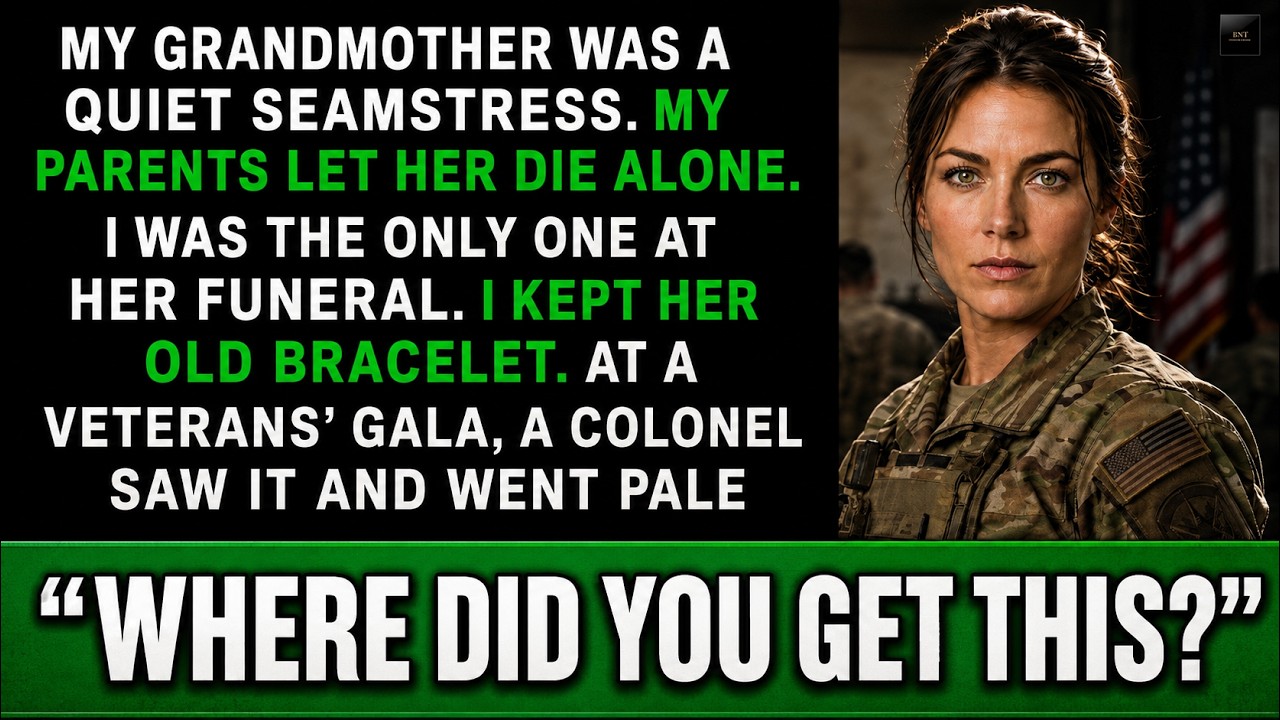
Then he looked afraid. “Who authorized you to wear this? ” he asked. The veterans charity gala continued around us.
Glasses touched. A string quartet played beneath the chandelier. My father stood three feet away with a drink in his hand and the familiar expression he wore whenever he thought I’d embarrassed him. “Oh, don’t mind her,” he said.
“Mara is an emergency room nurse. She collects dramatic things. ”
I could smell whiskey on his breath. The Colonel didn’t look at him.
His eyes stayed on the bracelet. “Where did you get it? ”
“It belonged to my grandmother,” I said. “Eleanor Marsh.
She died six weeks ago. ”
His grip loosened. Behind him, a retired general stopped mid-sentence. A woman wearing a navy service pin turned toward us.
Even the Colonel’s breathing changed. “Eleanor Marsh from Whitfield, Tennessee? ”
“Yes. ”
My father gave a small laugh.
“Colonel, I assure you my mother-in-law was a seamstress. She lived in the same little house for forty years and barely left the county. ”
That was when Colonel Ingram finally looked at him. “You should stop speaking about things you do not understand.
”
My father’s smile disappeared. The Colonel released my wrist carefully, as though the bracelet could break open and expose something dangerous. “Lieutenant Colonel Ellis,” he said quietly. “We need a private room.
”
My mother’s face changed when she heard my rank. My brother Grant stared at me as if the Colonel had confused me with someone else. I’d served fourteen years in the Army Reserve, completed two overseas medical rotations, and commanded a trauma stabilization team. My family knew I’d joined after nursing school.
They had simply never asked what I did there. To them, I was still just Mara, the quiet daughter who came when called and left before arguments became ugly. But the Colonel wasn’t shaken by my rank. He was shaken by my grandmother’s name.
He led me into a side office near the ballroom kitchen. The walls were thin enough that I could hear plates being stacked in the next room. He closed the door, removed his glasses, and asked me the strangest question anyone had ever asked about Eleanor Marsh. “Did your grandmother ever teach you how to sew a French seam?
”
I stared at him. “Yes, when I was eleven. ”
“Did she ever tell you why the stitches had to be seven millimeters apart? ”
“She said neat work was safer work.
”
The Colonel sat down slowly. “That was not a sewing lesson. ” He looked at the bracelet again. “It was a recognition test.
”
That was the first crack in the life my family had built around my grandmother. By the time the night ended, everything we believed about her would be gone. But to understand why the truth hurt so badly, you have to understand how ordinary we’d decided she was. Eleanor Marsh lived at the end of a gravel road outside Whitfield in a faded white house with green shutters and a porch railing my brother promised to repair for three years.
There were tomatoes behind the kitchen, lavender along the fence, and an old Singer sewing machine beside the front window. The machine made a soft mechanical rhythm that filled the house when I was a child. My mother called it a lonely sound. I called it home.
Grandma Eleanor never competed for attention. At family dinners, she listened while my father talked about work and Grant talked about himself. She waited until everyone had eaten before putting food on her own plate. When someone interrupted her, she didn’t fight for the sentence.
She simply stopped speaking. My family mistook that for emptiness. My father once said, while she was in the room, “Eleanor could have done something with her life if she had possessed any ambition. ” She was folding a napkin at the time.
Her fingers paused for half a second, then continued. I was seventeen. I looked at her, waiting for anger. She only said, “Ambition is not always loud, Robert.
” He laughed because he thought she was defending a life he considered small. I remember the exact sound of the ice shifting in his glass. Grant was the person my parents displayed. His report cards went on the refrigerator.
His soccer trophies stayed in the living room until the dust gathered beneath them. When he was accepted into a private university, my father opened champagne. When I received a full nursing scholarship, my mother said, “That’s practical. ”
No one came to my military commissioning except Grandma Eleanor.
It rained that morning. She sat in the second row wearing a navy blue coat and shoes that had been repaired at least twice. After the ceremony, she touched the new gold bars on my uniform and said, “Authority is safest in the hands of someone who does not need to display it. ”
I thought it was one of her quiet sayings.
Years later, in a field hospital where generators coughed through a sandstorm and a young soldier’s blood soaked through three layers of gauze, I understood what she meant. The loudest person in a crisis was rarely the strongest. Strength was the medic who held pressure without shaking, the pilot who waited for the landing zone to clear, the nurse who lowered her voice while everyone else raised theirs. That was how Grandma Eleanor lived.
She lowered her voice. The world leaned away and failed to hear her. Military service sharpened what she’d taught me. I learned to sleep in ninety-minute pieces, read a room before entering, and recognize fear hiding inside anger.
At home, my father called deployments training trips. Grant told people I played soldier on weekends and worked at the hospital when I wanted a real job. I said nothing. Not because it didn’t hurt, but because some people use your reaction as proof they still control you.
Grandma understood. She never asked for dramatic stories. She asked whether I was sleeping, whether my hands still trembled after difficult cases, whether I had someone trustworthy beside me when the helicopters came in. Once, after I returned from an overseas rotation, I woke at three in the morning on her couch with my heart racing.
The house was dark except for the kitchen light. She was already awake, pouring hot water into two cups. “You heard something? ” I asked.
“No,” she said, “but you did. ”
She placed tea in front of me and sat without questions until my breathing slowed. That kind of silence isn’t empty. It’s shelter.
When she became ill, my family treated it like another inconvenience that would resolve itself if ignored. The first call came from her neighbor, Mrs. Bell. Grandma had collapsed beside the sewing machine.
The ambulance took her to Whitfield County General, forty minutes away. My mother sent a message in the family group chat: “Mom is in hospital. Probably dehydration. We’ll see how she is tomorrow.
” Grant sent a thumbs up. My father didn’t respond. I was finishing a twelve-hour shift in Nashville when Mrs. Bell called me directly.
“No one is here with her,” she said. There are sentences that divide your life into before and after. That was one of them. I drove four hours through rain.
Water hissed beneath the tires. My uniform was still in the trunk from reserve duty and the smell of hospital disinfectant clung to my hair. I called my parents twice. My mother said she had an early appointment.
My father said the doctors were professionals and didn’t need an audience. When I reached Grandma’s room, she looked smaller than I’d ever seen her. The fluorescent lights made her skin almost translucent. A cup of coffee sat untouched beside the bed, cold enough that a thin film had formed on the surface.
She smiled when she saw me. “You came. ”
“Of course I came. ”
She moved her fingers beneath the blanket and I took her hand.
“Your parents won’t. ”
“They will. ”
“No. ” Her voice was gentle.
“Do not spend my last days defending people who are not here. ”
I looked toward the window because rain was easier to watch than her face. She died three nights later. There was no confession, no final explanation.
At 2:17 in the morning, the monitor changed. The nurse stepped forward and the woman who had attended every important day of my life left the world with only me beside her. Five people came to the funeral. Mrs.
Bell, the pastor, Doris from the library, an elderly woman in dark glasses whom I didn’t recognize, and me. My parents sent flowers with a printed card. Grant texted, “Sorry, work crisis. ”
The elderly woman stood far behind the others.
When the casket began to lower, she raised two fingers briefly to the edge of her eyebrow. Not a formal salute. Something smaller, older. Then she walked away before I could reach her.
That was the first open door. I didn’t know it yet. After the funeral, my mother called to ask how soon the house could be listed. My father had already spoken to a realtor.
Grant wanted the antique furniture appraised. I spent three days sorting through Grandma’s things while they sent messages about market value. Most of the house was exactly what it appeared to be. Thread, fabric, recipe cards, paperback mysteries with cracked spines.
But behind the sewing machine, I found a narrow wooden box. Inside lay the silver bracelet. The outer surface was plain. The inside held a row of tiny engraved symbols—three short lines, a circle, two angled marks, then a sequence of numbers too small to notice unless you were searching.
Beneath it was a folded note, not a confession, just one sentence. For the one who looks instead of taking. I put the bracelet on. Two weeks later, my parents held what they called a family estate dinner.
It wasn’t about grief. It was about division. My father placed a legal pad on the dining table and listed the house, the car, the furniture, and Grandma’s savings. Grant complained that I’d spent too much time in Whitfield and might have removed valuable items.
“What exactly are you accusing me of? ” I asked. “I’m saying you had access,” he replied. “You always liked being the responsible one.
”
My mother kept her eyes on her plate. My father tapped the legal pad. “We need transparency. Eleanor was impressionable at the end.
”
“She was alert until the final night. ”
“You’re a nurse, Mara. You know how sick people can be manipulated. ”
The fork in my hand stopped moving.
Across the room, the refrigerator motor hummed. No one spoke for several seconds. Then Grant noticed the bracelet. “Is that hers?
”
“Yes. ”
“You took jewelry from the house without declaring it. ”
“It was left with a note. ”
My father held out his hand.
“Give it to me. ”
“No. ”
It was one of the few times I’d ever refused him without explanation. His face darkened.
“You do not get to decide what belongs to you. ”
“Neither do you. ”
He pushed back from the table. “This military attitude may work with people under your command, but not here.
”
I looked at him. “You have never known anyone under my command. ”
He laughed because he thought I was trying to sound important. That was his mistake.
The Veterans Gala happened four weeks later. A surgeon from my hospital had bought a table for staff who worked with injured service members. I almost declined, but Grandma had believed that showing up mattered, especially when no one expected you. I wore a black dress, no uniform, no metals.
The bracelet rested against my left wrist. My parents were there because my father’s company had sponsored a table. Grant came with them. When Colonel Ingram recognized the bracelet and addressed me by rank, I watched three people realize they had missed fourteen years of my life.
But that was not the most damaging truth in the room. Colonel Ingram sat across from me in the side office. The sound of dishes moved behind the wall. “Your grandmother was part of a civilian intelligence network active during the final decades of the Cold War,” he said.
“The official name is still restricted. Among the people who served inside it, the network was called Lantern. ”
I said nothing. “The bracelet identified a primary relay custodian.
The markings are not decoration. They correspond to verification phrases and emergency transfer procedures. ”
“My grandmother made wedding dresses. ”
“She made communication channels.
”
He explained that women in small towns—people no one considered politically important—carried information through ordinary work. Measurements, fabric orders, pattern changes, repair notes. A hem length could confirm a meeting. Seven-millimeter stitches could authenticate a message.
Certain thread colors marked compromised routes. The sewing machine beside Grandma’s window had been part of a system that moved intelligence without radios, uniforms, or official vehicles. “How long? ” I asked.
“Thirty-one years. ”
The room seemed to narrow. “What did she prevent? ”
“I cannot give you full operational details.
I can tell you she protected field identities, exposed two penetrated channels, and maintained continuity during an event that could have cost dozens of lives. ”
“Dozens? ”
Colonel Ingram looked down. “My life was one of them.
”
That explained the fear in his face. He hadn’t seen a piece of jewelry. He had seen the hand that once reached through darkness and pulled him out. He told me the woman at the funeral was named Ruth Calder, another former Lantern custodian.
Ruth had attended because she knew Eleanor’s death couldn’t be officially acknowledged. She had tried to contact my family once before, but my father had returned the letter unopened. I thought I’d misheard him. “When?
”
“Eleven years ago. ”
The Colonel opened a thin folder and showed me a photocopy of an envelope. My father’s handwriting crossed the front in thick black ink. Unknown sender.
Return to post office. The address was Ruth’s. A new question opened before the old one closed. Why had my father refused a letter connected to Grandma?
What else had been placed in front of us and discarded because we had already decided it couldn’t matter? Colonel Ingram asked whether I’d found anything else in the box. I showed him a photograph of the note. For the one who looks instead of taking.
His expression changed. “There should be a second compartment. ”
The next morning, I returned to Whitfield. The house was under contract but not yet sold.
My father had given the realtor permission to begin clearing it. Two men were carrying Grandma’s sewing table toward a truck when I arrived. “Put that down,” I said. One of them glanced at the realtor.
She recognized something in my voice and nodded. Inside the wooden box, beneath a felt panel I had mistaken for the base, I found a brass key and a strip of cloth with seven blue stitches. The key opened a narrow cabinet hidden behind a false back in the sewing table. Inside were no jewels, no cash, no dramatic weapon.
There were letters, dozens of them, bound with ribbon. Some were written in code. Some were ordinary thank-you notes from people who never explained what they were thanking her for. There was a commendation with nearly every line redacted, a photograph of Grandma standing beside three women in plain coats, a sealed envelope addressed to me, and a newer document from a probate attorney in Nashville.
The house had never belonged to my parents. Three years earlier, Grandma had transferred it into a charitable trust for veterans’ families and rural emergency medicine. She had named me trustee—not because I was the nearest relative, but because, in her words, I had learned the difference between responsibility and possession. My father’s realtor had no legal authority to sell it.
Worse, the signature authorizing the sale wasn’t Grandma’s. It was my father’s attempt to imitate it. I sat on the floor beside the sewing machine, the papers spread around me, while dust moved through a stripe of sunlight. I didn’t feel victorious.
I felt tired. If you’ve ever spent years hoping someone would become kind simply because you remained loyal, you understand that kind of exhaustion. It isn’t the pain of one cruel sentence. It’s the weight of a thousand small dismissals—the missed call, the empty chair, the promise to visit, the way people speak over someone until even the silence begins to feel like consent.
For most of my life, I thought keeping peace meant absorbing damage quietly. The army taught me something else. Silence is useful only when it gives you time to see clearly. After that, it becomes a choice.
I called the probate attorney. Then I called Colonel Ingram. Then, for the first time, I called my father without giving him a warning disguised as a question. “The house sale is suspended,” I said.
He was quiet for half a second. “What did you do? ”
“I read the documents. ”
“You had no right to interfere.
”
“I am the trustee. ”
His breathing grew louder. “That is impossible. ”
“The deed is recorded.
The trust is valid. ”
“The sale authorization carries a forged signature. ”
His voice dropped. “Be careful what you accuse me of.
”
“I have not accused you. I have preserved the paper. ”
That frightened him more. People like my father understood arguments.
They knew how to interrupt, intimidate, and redirect. Evidence gave him nothing to fight except himself. He filed a petition three days later claiming Grandma lacked capacity when she created the trust. Grant submitted an affidavit saying I had isolated her from the family.
My mother signed a statement that I used my medical knowledge to influence a vulnerable woman. They turned my presence at Grandma’s deathbed into proof against me. The hearing was scheduled for a Monday morning in Davidson County Probate Court. My father arrived in a dark suit with two attorneys.
Grant sat behind him checking his phone. My mother looked as though she hadn’t slept. I came in uniform because I had a reserve command review that afternoon and no reason to hide the life they had ignored. The courtroom smelled like burnt coffee and wet wool.
Rain tapped against the tall windows. My father’s attorney looked at my uniform, then at my ribbons, and whispered something to him. My father shook his head. He still believed rank was decoration.
The first hour belonged to them. They described Grandma as lonely and confused and me as ambitious, secretive, and hungry for control. Then my father said, “Eleanor was a simple woman. She could not possibly understand a trust this complex.
”
My attorney asked when he had last spent an uninterrupted hour with her. “I don’t recall. ”
“Within five years? ”
My father called the question irrelevant.
The judge waited. He couldn’t answer. Grant talked too much on the stand. He said Grandma depended on him because she had asked him to repair the porch, and that I had used the Army to act superior.
My attorney asked whether he’d repaired the railing, visited her in the hospital, or attended her funeral. “No,” he answered each time. “Then how did your sister isolate her from you? ”
The lie had nowhere left to stand.
My father’s attorney recovered quickly. He argued that the trust was based on fantasy, that references to military service in Grandma’s papers suggested delusion, and that the mysterious bracelet demonstrated my willingness to build an exaggerated story around an old woman’s confusion. That was his final confident attack. My attorney stood.
“Your Honor, we request permission to introduce a sealed federal verification and call Colonel David Ingram, retired. ”
The side door opened. Colonel Ingram entered with Ruth Calder and a woman from the Department of Defense Historical Review Office. No one wore a dramatic expression.
No one needed one. The government attorney confirmed that Eleanor Marsh had served for more than three decades in a restricted civilian support capacity tied to national security operations. The details remained protected, but her competency records, annual evaluations, and legal clearances established that she had been mentally sound when she created the trust. My father stared at the table.
Colonel Ingram testified next. He didn’t tell war stories. He described procedures, dates, verification marks, the bracelet, the seven blue stitches, the fact that Grandma had passed cognitive and security reviews more demanding than any estate examination. Then my father’s attorney asked whether Eleanor had been important.
The Colonel looked at him for a long moment. “Important is not the correct word. ”
“What is? ”
“Essential.
” He turned slightly toward the judge. “There are people alive because Eleanor Marsh understood that being overlooked could be used as protection. She kept her cover for thirty-one years. She endured being underestimated because the work required it, but no person in this courtroom should confuse invisibility with insignificance.
”
My father’s hands began to tremble. The first reveal destroyed his claim that Grandma had been confused. The second destroyed the story he had told about me. The government attorney submitted a letter Grandma had written during the creation of the trust.
It was not classified. The judge allowed it to be read aloud. “My granddaughter Mara has never asked what she could take from me. She has asked whether I was warm, whether I had eaten, and whether the porch light was working.
She came to my hospital room without being summoned twice. She understands service because she has lived it. I appoint her not because she is military, but because power has not made her cruel. ”
The letter continued.
“To my daughter, son-in-law, and grandson, I do not leave you the house because you already treated it as yours while I was still alive. Property does not repair neglect. Money does not transform absence into love. I hope losing an inheritance costs you less than losing the years you chose not to know me.
”
My mother covered her mouth. Grant looked at the floor. My father remained still until the judge asked about the forged sale authorization. He tried to explain.
He said the realtor needed speed. He said everyone understood what Grandma would have wanted. He said families handled signatures informally all the time. Each sentence made the previous one worse.
The judge referred the document for investigation, denied the challenge to the trust, and ordered my family to pay its legal costs from their own funds. The ruling was clean, precise, almost quiet. But the legal result wasn’t the part that broke them. It was the knowledge that Grandma had seen them clearly.
Outside the courtroom, rain darkened the stone steps. Reporters were not waiting. There were no cameras. Real consequences often happen without music.
My mother approached me first. “Why didn’t she tell us? ”
I looked at her wet hair, the mascara beginning to run beneath one eye. “She tried to show you who she was every day.
”
“That is not the same as telling us. ”
“No,” I said. “It required us to pay attention. ”
Grant stood behind her with his hands in his coat pockets.
“I should have fixed the railing. ”
“Yes. ”
He looked as if he expected me to soften it. I did not.
My father came last. His face had lost the confident color it carried into court. “You made us look like criminals. ”
“I presented the documents.
”
“You could have handled this privately. ”
“You filed a public petition. ”
He opened his mouth, then stopped. For the first time in my life, my father had reached the end of an argument and found no smaller person to place beneath him.
I lowered my voice. “You mistook her silence for permission. You mistook mine for weakness. They were never the same thing.
”
Then I left. There was no celebration. I drove to Whitfield in the rain. I changed out of my uniform at the house and sat on the porch beneath the broken railing.
The air smelled like wet wood and lavender. Inside, the sewing machine waited beside the window. Colonel Ingram arrived near sunset. He carried a small archival box.
Inside was the final item the government could release—a commendation signed decades earlier recognizing an unnamed civilian custodian whose actions preserved a compromised network and enabled the recovery of nine field personnel. Nine, not dozens in the abstract. Nine people with families, birthdays, unfinished conversations, and lives that continued because Grandma knew when to change the color of a thread. Colonel Ingram placed the commendation on the table.
“She refused a formal ceremony. ”
“That sounds like her. ”
“She said applause would make the work feel smaller. ”
I smiled for the first time that day.
Before leaving, he looked toward the sewing machine. “She asked about you once. ”
I turned. “When?
”
“Years ago. She knew you had joined the army. She wanted to know whether a person could serve and still remain kind. ”
“What did you tell her?
”
“That service reveals what is already there. ” He nodded toward me. “She seemed relieved. ”
After he left, I opened the sealed envelope addressed to me.
Grandma’s handwriting was steady. “Mara, if you are reading this, then someone finally recognized the bracelet, or you became curious enough to search beneath what was visible. Both would make me proud. There are things I could not tell you.
Silence protected people, but silence also became a habit, and habits can injure the people standing closest to us. I sometimes wondered whether I used duty to excuse my distance. I hope you will not make that mistake. You learned to endure more than you should have.
Do not confuse endurance with love. Do not keep returning to closed doors simply because they belong to family. The bracelet is not proof that I was extraordinary. It is proof that ordinary appearances can be useful.
Wear it only if it reminds you to look twice at quiet people. And remember this—the strongest person in a room is often the one who has nothing left to prove. Love, Grandma. ”
I read the letter at the kitchen table while evening settled over the garden.
The refrigerator clicked on. Rainwater moved through the gutter. Somewhere down the road, a dog barked twice. Nothing about the moment looked historic.
That was what made it hers. My father accepted a plea over the forged signature, paid restitution, and completed community service. Grant withdrew from the estate fight. My mother began helping at the Whitfield library.
Change came in smaller forms than apology. Grant repaired the porch railing after the house no longer belonged to him and no one would praise him. My mother read Grandma’s unclassified letters one packet at a time. “I was her daughter,” she said once.
“I should have known. ”
Being related to someone is not the same as seeing them. My father never asked forgiveness, but months later he visited Grandma’s grave alone. I did not follow him.
Regret belongs to the person carrying it. The trust converted Grandma’s house into a small residence for families of veterans receiving treatment in Nashville and scholarships for rural emergency nurses. We kept the sewing room exactly as it was. The Singer machine remains beside the window.
The bracelet symbols were reproduced on a small plaque without explanation. Most visitors assume they are decorative. That would have made Grandma smile. I still work in the emergency department.
I still serve in the reserve. I still drink coffee that goes cold before I remember it’s there. But I notice different things now. The old man who folds his discharge papers into perfect quarters because his hands need a task.
The custodian who remembers which patients are alone. The young private who says he’s fine while staring at the door every time a cart rattles past. The mother who brings extra sandwiches because she knows someone else will forget to eat. Quiet service is everywhere.
So is quiet pain. For years I believed strength meant staying composed while people misunderstood me. Sometimes it does. Discipline can keep you alive.
Silence can protect what matters. But there is another kind of strength—the strength to stop making yourself smaller so other people can remain comfortable. The strength to present the document. To close the door.
To let someone face the consequences of the story they chose to tell about you. My grandmother spent thirty-one years using invisibility as a weapon against people who threatened lives. My family used invisibility against her. That is the difference attention makes.
One kind of silence protects, the other erases. I wear her bracelet every day now. Not because it connects me to secrets or military history. Not because a retired colonel recognized it or a courtroom finally heard her name spoken with respect.
I wear it because it reminds me that no life is small simply because it is quiet. And whenever I feel the metal against my wrist, I remember the last lesson Eleanor Marsh left me. You do not need to prove your strength to people committed to misunderstanding it.
You only need to stop handing them the power to define you.