The email arrived at 3:15 on a cloudy Wednesday. Subject line: urgent. Meeting with Charles, the CEO, and HR. No context, no warning.
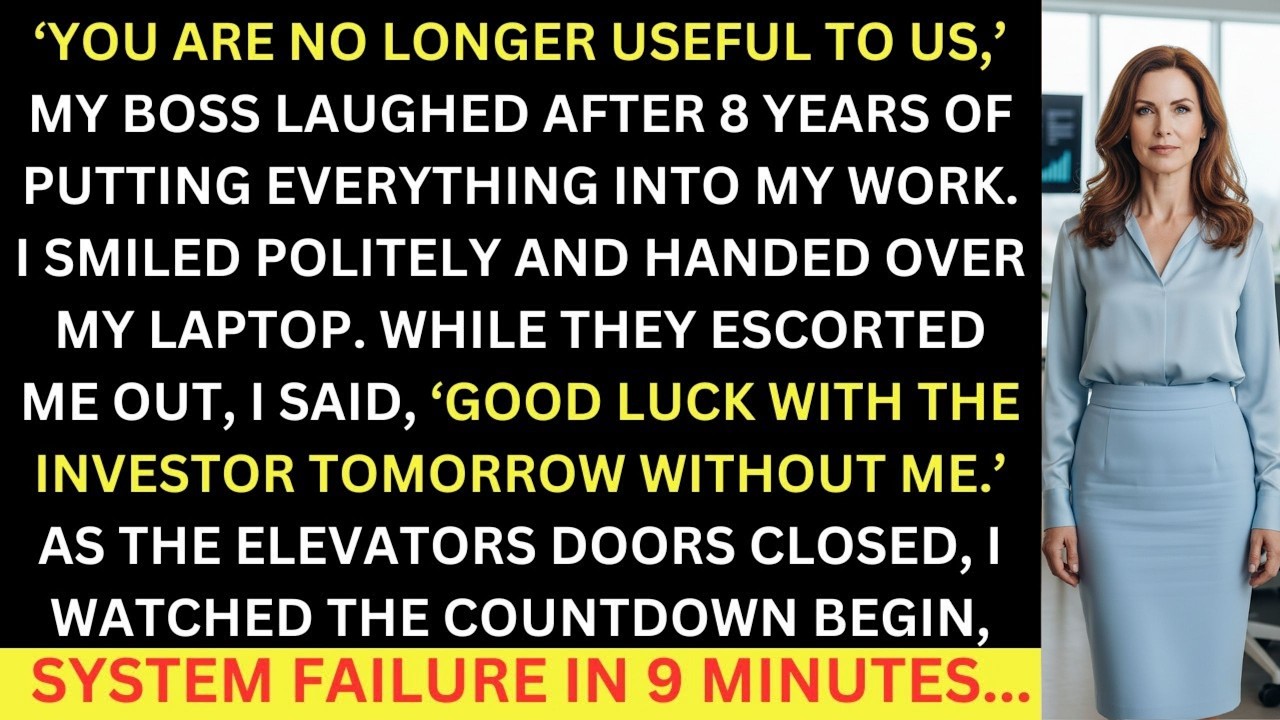
I walked down the glass hallway with my laptop, past the development lab humming with the servers I had built, past the framed milestone photos that never once included me even though I had been there for all of them. Charles sat at the head of the conference table, fingers steepled, wearing the kind of smug expression a man has when he thinks he’s won something. Margaret from HR wouldn’t look at me. “Tessa,” Charles said, reading off a script, “we appreciate everything you’ve contributed, but we’re taking the company in a new direction.
Effective immediately, your role is being dissolved. ”
No warning. No gratitude. Just corporate jargon layered over eight years of early mornings, late nights, missed holidays, and skipped birthdays.
I kept my face still. Silence unsettles people more than rage. “Of course,” I said evenly. “Would you like my laptop now?
”
Margaret blinked, surprised by my calm. “Yes,” Charles said with a satisfied nod. “That would be ideal. ”
I placed it gently on the table.
Two security guards waited outside the door. As they flanked me, I turned to Charles one last time. “Good luck with the investor meeting tomorrow,” I said with a small smile. “Without me.
”
He raised an eyebrow. “We’ll manage. ”
I smiled wider. “Let’s hope so.
”
As the elevator doors closed, the countdown began. What no one knew was that Nexus Core, the AI-driven platform I had designed from scratch, had a built-in integrity fail-safe. It was triggered only if my credentials were removed from the system. A final line of defense.
Not to destroy anything, but to protect it. Six months earlier, I had noticed strange server pings late at night. Files being copied. Logs being altered.
I traced them back to an account tied to Charles’s executive assistant. I kept quiet and built an invisible security shell around the core system. It wasn’t sabotage. It was insurance.
At minute one, the system registered a critical authentication error. By minute three, internal processes began to loop. At minute six, the dashboard flooded with anomalies. By minute nine, the platform crashed completely.
Investors were scheduled to view the demo the next morning. There was no clear way to bring it back online. I sat on my couch at home, sipping chamomile tea, watching a reality dating show I barely paid attention to. At exactly 5:12 p.
m. , my phone rang. It was Eli, the lead systems engineer. One of the few people there I actually respected.
“Tessa, it’s me. You didn’t hear this from me, but the system’s down. Completely. Charles is freaking out.
They think it’s sabotage. ”
“And what do you think, Eli? ”
“I think you built something too smart to be handled like that. And I think Charles is finally learning what happens when you burn the person who holds everything together.
”
Ten minutes later, my phone rang again. Rachel, Charles’s assistant. “Charles would like to speak with you. It’s urgent.
A car will be sent to pick you up within the hour. ”
“Tell him I’m busy,” I said. “Maybe tomorrow. ”
“Tessa, please.
”
That please told me everything. They weren’t just inconvenienced. They were terrified. Nexus Core wasn’t just a product.
It was the foundation of their entire investor pitch, their valuation, their future. At 7:00 p. m. , Charles called himself.
“Tessa,” he said, trying to sound calm, “we’ve had an unexpected hiccup. I think there’s been some kind of authentication bug. ”
“A bug? ” I repeated, feigning concern.
“Yes. We’d like your help in resolving it. ”
“Is this a freelance gig, or am I back on payroll? ”
Silence.
Then a sigh. “We can discuss that when you’re here. ”
I made him wait another hour before I agreed to come. When I arrived, the place was in chaos.
Engineers running back and forth, alarms flashing, desperation buzzing in the air. Charles met me in the boardroom, tie loosened, hair disheveled. “Can you fix it? ” he asked.
I pulled a USB drive from my coat pocket and set it on the polished mahogany table. “I can. But we need to talk first. ”
He narrowed his eyes.
“You think you’re in a position to negotiate? ”
“I know I am. ”
In that moment, the power had shifted. I wasn’t just the woman they discarded.
I was the key to the thing they had gambled their entire future on. “This contains the fix? ” he asked, voice tight. I let the silence stretch.
Long enough for him to squirm. “It contains the protocol update,” I said at last. “The system is functioning exactly as designed. But it no longer recognizes you or anyone at Ashridge as a trusted authority.
”
Charles scoffed. “That’s absurd. We own it. We paid for its development.
”
“You paid for a product. You didn’t pay for understanding. And you sure as hell didn’t pay for loyalty. ”
His face reddened, but he couldn’t argue.
He knew he’d lost the upper hand. I stood and walked to the window overlooking the city skyline. From up here, Ashridge looked powerful. Imposing.
But I knew how fragile the foundation really was. “I gave you eight years,” I said quietly. “And you tossed me out like I was nothing. No warning.
No meeting. Not even a thank you. You didn’t just fire me. You removed the person who built your entire infrastructure without the decency of a conversation.
And now, the very system you wanted to showcase to your investors doesn’t trust you. ”
He flinched just slightly. “Tell me what you want,” he muttered. “I want full recognition as Nexus Core’s lead architect.
My name on every document, every patent, every press release. You make me a ghost, I make your system vanish. Fair trade. ”
He swallowed hard.
“What else? ”
“Twenty-five percent equity in the platform. Retroactively vested. And a seat on the board.
”
His eyes widened. “You’re out of your mind. The board will never—”
“They will if they want their investors to show up tomorrow. Without that update, you don’t have a demo.
You have a very expensive failure. ”
He leaned back, exhaling slowly through his nose like a bull trying not to charge. “You planned this,” he said. “You set us up?
”
“No. I protected what I built. ”
Another long pause. Then, finally, a slow nod.
“I’ll need it in writing,” I added. “You’ll have it by morning,” he muttered. “No. Tonight.
Before I hand over anything. ”
He stared at me. “You don’t trust me? ”
I smiled.
“You fired me. ”
It took three hours. They drafted the paperwork, emailed it to my attorney, made the necessary edits, and returned it with digital signatures. When Charles tried to reduce my equity from 25 to 20 percent in the third draft, I simply stood, took the USB, and walked toward the door.
“If the paperwork doesn’t match exactly what we discussed, the system will stay down. And so will your company. ”
Rachel handed me the corrected version five minutes later. With the contract legally binding, I returned to the table and pushed the USB toward him.
The system would restore its trust protocols and full function. But it would also initiate an oversight loop that reported all administrative changes back to me. “From now on, if you try to sideline me again, Nexus Core will know. And it will act accordingly.
”
Charles looked at the drive as if it had grown fangs. But he didn’t argue. He simply nodded and whispered, “Understood. ”
As I reached the elevator, he called out, “Tessa.
You could have burned us to the ground. Why didn’t you? ”
I glanced over my shoulder. “Because I didn’t build Nexus Core to destroy things.
I built it to protect them. Including myself. ”
The next morning, I walked into Ashridge Solutions through the front door. Not with a visitor badge, not flanked by security, but as a returning architect with a signed agreement and a digital trail of my reinstatement filed with HR before dawn.
During the investor demo, Charles introduced me as the system’s original architect, co-lead developer, and strategic adviser. For once, the room full of investors saw the brain behind the brilliance, not just the brand. But I wasn’t done watching my back. One afternoon, while reviewing audit logs, I noticed something strange.
Nexus Core had flagged multiple access attempts from restricted admin accounts, all traced to the Finance department. Partial downloads of source code documentation. Encrypted, fragmented, but unmistakably mine. I confronted Charles.
“Why is someone in your finance team trying to duplicate core files? ”
He barely glanced at the report. “I don’t know, but I’ll look into it. ”
“No,” I said, voice low.
“I will. ”
That night, Nexus Core sent me a critical threat notification. Someone was trying to clone the platform. Not destroy it, not alter it, but copy it.
Quietly, subtly, to spin it off under a different name. One without me attached to it. Charles had signed the agreement to bring me back. But someone else still wanted me gone.
I set a digital tripwire. A line of bait code nested within a documentation packet. On Friday at 2:41 a. m.
, someone took the bait. The access credentials belonged to Rachel. Charles’s executive assistant. The same Rachel who had called me the night I was fired.
The one who had stood silently outside his office during my negotiation. The one who smiled at me every morning since like nothing had ever happened. I requested the full access logs tied to her account. Over 40 unauthorized code pulls in six weeks.
Multiple download attempts. Two outbound data transfers sent to an unlisted domain. The domain belonged to Ashridge Ventures, a shell subsidiary I had never heard of. But one that Charles had quietly created three months prior.
Charles was listed as the primary executive officer. Rachel was listed as co-founder. They weren’t just trying to push me out again. They were trying to spin off Nexus Core behind my back.
Package it under a new name. Strip my name from the patents. Sell the clone to investors while keeping the original running long enough to cover their tracks. I activated phase two of the protection protocol.
A kill switch hidden in the secondary authentication layer. Every time unauthorized code was accessed, the system flooded the intruder’s session with false data. Fabricated algorithms, scrambled version histories, decoy prototypes that looked real but led nowhere. To a thief, it appeared as if the crown jewels had been stolen.
In reality, they were holding glass. The next morning, Charles summoned me to his office. His face was pale, jaw tight. He held up a tablet showing a chaos of corrupted code.
“This is from the internal development backup,” he said. “It’s scrambled. ”
“Looks like someone accessed it without proper clearance,” I said evenly. “Nexus Core has countermeasures against unauthorized duplication.
”
“Tessa, if you’ve sabotaged—”
“I haven’t sabotaged anything. Nexus Core is working exactly as designed. It protects itself, even from you. ”
“And if I told you this has already gone too far?
That investors were promised a new version, an expansion built under a new entity? ”
“Then I’d say you’re about to have a very uncomfortable board meeting. ”
He stared at me, hatred creeping into his expression. “You don’t get to win this.
”
I smiled. “I already did. You just haven’t read the source code. ”
Three days later, the board met in emergency session.
It wasn’t called by Charles. It was called by me. I had sent a formal report to every director, complete with evidence: access logs, security alerts, file transfer records, documentation of the shell company. A full timestamped trail tracing the attempted theft of Nexus Core’s source code and the deliberate effort to cut me out.
I didn’t have to embellish a single word. The truth was damning enough. Charles walked in 20 minutes late, looking like he hadn’t slept. Rachel didn’t come at all.
When the board chairwoman folded her hands and looked directly at Charles, she asked, “Do you deny any of this? ”
Charles cleared his throat. “Rachel acted alone. ”
“Charles is listed as the majority shareholder of Ashridge Ventures.
Rachel is a secondary officer,” I said. “The transfers came from her account, but the project, that was his. ”
He said nothing. The vote was unanimous.
Charles was removed as CEO within the hour. Rachel’s employment was terminated retroactively. The shell company was dissolved. The board named me interim CTO and granted me controlling interest over the future of Nexus Core.
What satisfied me most wasn’t the title or the power. It was that for the first time in eight years, I didn’t have to prove my worth. It was documented, sealed, recognized. Nexus Core’s investor launch went ahead on schedule.
We signed five major contracts in two weeks. At the product reveal, I stood at the front of the stage, no longer a shadow behind the screen, but the face of the future. One afternoon, a young developer named Mariah knocked on my office door. She was new, wide-eyed, brilliant, fresh out of grad school.
“Can I ask you something? ” she said nervously. “How did you know when to fight? When to push back?
When to walk away? ”
I thought about it for a long moment. “I didn’t. Not always.
But I learned the difference between defending my ego and defending my work. And when someone tried to take what I’d built, not because they understood it, but because they thought they could, that’s when I knew. ”
She nodded slowly, filing the words away. “Protect what you build,” I added, “whether it’s code, an idea, or your peace of mind.
Not because someone will try to steal it, but because when they do, you’ll be ready. “