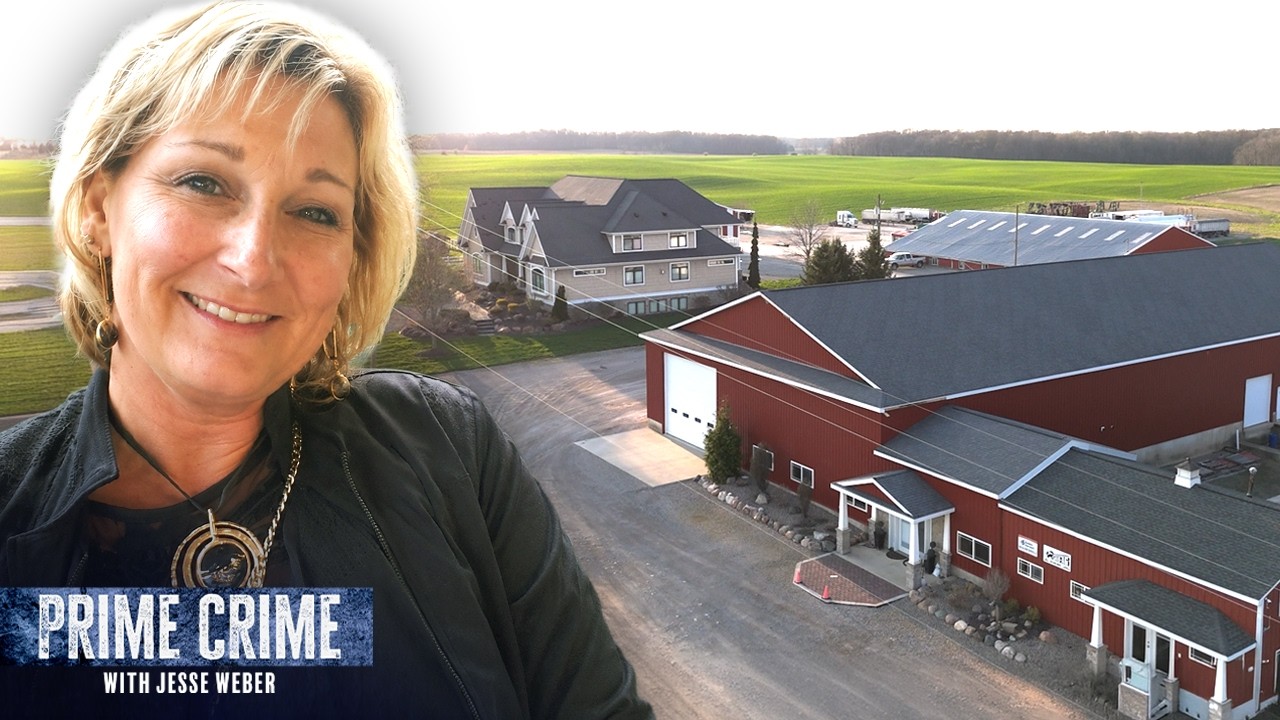
The sun had barely risen over the sprawling farmland of Tipton, Michigan, when the first call came in. It was a Sunday, April 25th, 2021, and the Warner family farm was already stirring with the rhythms of planting season. But by midday, a terrifying void had opened up.
Deianne Warner, a 52-year-old mother of five, a successful businesswoman who co-owned a massive trucking and crop farming operation with her husband, Dale, had vanished. Her vehicles, a Cadillac Escalade and a Hummer, were still parked at the farm. Her phone was off.
 Her purse, containing her makeup and essential medications, was gone. But the most chilling detail was the silence. Deianne, known to everyone as D, was never silent.
She was a force of nature, a woman who commanded every room she entered, a mother who was in constant, loving contact with her children. That silence was the first alarm bell, a sound that would echo through three and a half years of agonizing mystery, a nationwide search, and a trial that would finally expose the dark secrets buried beneath the fertile soil of Lenawee County.
The initial report was filed by her adult children, who grew increasingly frantic when their mother failed to respond to texts and calls. Her daughter Raquel had texted, “Where are you?” and received nothing.
This was profoundly out of character. D’s phone was an extension of her being, always on, always accessible. Her children, Zack, TJ, Amber, and Raquel, converged on the property.
They found the house quiet, the atmosphere thick with an unnatural stillness. They immediately contacted the Lenawee County Sheriff’s Office. Dispatcher Hubry took the call, a routine request for a phone ping for a missing person.
But this was far from routine. The dispatcher’s log notes a husband, Dale, who was initially calm, almost dismissive. “I don’t know if she’s missing or if she just left,” he told authorities.
He recounted a Saturday night of tension, a fight over a disgruntled employee, D’s talk of suicide and leaving. He said she had taken migraine medication, passed out on the couch, and when he left for work at 6:00 a. m.
on Sunday, she was snoring. When he returned, she was gone. He seemed unconcerned, even suggesting she had simply run off with someone.
“You want to get everybody all fired up and then she shows up a day or two later,” he said to a deputy. That blasé attitude, in the face of a wife’s disappearance, was the first red flag for law enforcement.
The Warner farm was not just a home; it was an empire. D and Dale ran two highly successful businesses from the property: a trucking company that D owned outright, and a massive crop farming operation that spanned thousands of acres. They employed truckers, mechanics, office staff, and farmhands.
The operation was a showpiece of rural Michigan, with well-maintained equipment, new buildings, and a constant hum of activity. D was the engine of the business, a hard-driving saleswoman who had met Dale while both worked for a supply company. Their marriage was a second one for both, and it had begun as an 𝒶𝒻𝒻𝒶𝒾𝓇.
This history would become a central, poisonous thread in the investigation. D’s brother, Greg Hardy, was among the first to voice suspicion. “Given that Dale’s own marriage to D began with an 𝒶𝒻𝒻𝒶𝒾𝓇, he’s got to wonder the same way he got her, is that now the way he lost her?”
 he would later say. The family’s trust in Dale evaporated almost immediately.
The search for D Warner was a frantic, sprawling effort. Law enforcement, aided by family and neighbors, scoured the 3,000 acres of the Warner property and adjacent lands. They used tracking dogs, drones, and cadaver dogs.
They found nothing. No scent. No DNA.
No sign of a struggle. The only clue was the missing makeup bag and a ring D had left on Dale’s desk. Dale himself was cooperative, but his behavior was increasingly erratic.
He led investigators around the property, but he seemed more concerned with getting back to work than finding his wife. He told deputies he had to get to work, asking them to leave. When they returned with a search warrant, he was anxious about the tracking dogs, warning them not to take them into the chemical barn because the chemicals would burn their paws.
He was calm, almost too calm, in the face of a missing wife. “You’re way too calm for me, man. I’d be scared,” one deputy told him.
Dale’s response was chillingly pragmatic: “I want my wife back. I can make more money. I can’t make another wife.”
As the days turned into weeks, the investigation zeroed in on Dale. His story began to crack under scrutiny. He had told police that D was not having an 𝒶𝒻𝒻𝒶𝒾𝓇, but investigators discovered he had been secretly tracking her.
He had installed hidden cameras in their home and a GPS tracking device on her Hummer. Text messages between the couple revealed a toxic cycle of control and 𝓪𝓫𝓾𝓼𝓮. D had written to friends about a December 2020 incident where Dale had thrown her into a dresser and refused to let her leave.
She had told her sister-in-law, Amy, that she was going home on that fateful Saturday to tell Dale she wanted a divorce. This was the last straw. The prosecution would later argue that Dale, who had told police he “sure as hell didn’t want to go through another divorce,” snapped when faced with the reality of losing D and their empire.
The surveillance video from the farm on Sunday, April 25th, became a crucial piece of evidence. It showed Dale going about his chores, but there were two anomalies. First, he was seen on a front-end loader heading toward the house at a time that didn’t align with his stated timeline.
 Second, he was seen inside a barn, near welding equipment, seemingly searching for something. In the corner of the frame, headlights panned through the barn, and Dale ducked behind a truck as if to avoid being seen. The defense would argue this was innocent, that he was simply working.
But the prosecution saw a man trying to hide something. The video, combined with the fact that D’s body was never found in the initial search, led investigators to a chilling theory: she had been sealed inside something metal.
For three and a half years, the case went cold. D’s family, led by her brother Greg, never gave up. They offered a $50,000 reward, petitioned the court to have her declared dead, and even put up a billboard near the farm that read, “Help Dale find D,” a pointed taunt at the man they believed was her killer.
Greg became a relentless thorn in Dale’s side, accusing him of falsifying a power of attorney and illegally selling D’s company. The Michigan State Police took over the investigation, and in November 2023, they finally had enough evidence to arrest Dale Warner. He was charged with open murder and tampering with evidence.
He pleaded not guilty.
The trial began on February 12th, 2026, in Lenawee County. The prosecution laid out a devastating case. They called D’s daughter, Amber, who testified that her mother had come to her house on Saturday morning, hysterical, saying she was done with the marriage.
“We’re selling everything. I’m done,” D had said. The prosecution argued that this was the motive: Dale, facing divorce and the loss of half of his business empire, killed his wife.
They presented evidence of the secret cameras, the tracking device, and the history of domestic violence. They showed the jury the surveillance video from the barn, where Dale was seen gathering welding supplies. The most damning piece of evidence came from a search warrant executed months after the arrest.
Investigators, following the theory that D was sealed in metal, tracked down a series of anhydrous ammonia tanks on the property. One tank had been cut open and rewelded shut, then painted with new stickers. They took it to a border checkpoint in Detroit, where an X-ray machine revealed the outline of a human body.
Inside, they found D’s remains. She had been strangled, had suffered blunt force trauma to the head and face, and was wrapped in a tarp, duct-taped, and sealed in the tank. She was still in her pajamas.
The defense argued that the evidence was circumstantial, that there was no direct proof Dale had committed the murder. They pointed to the timeline, suggesting it was impossible for Dale to have killed D, disposed of her body, and welded the tank shut in the hours he was at the farm. They even called Greg Hardy to the stand, suggesting he had a motive to frame Dale due to his obsessive involvement in the case.
 Greg admitted he had texted someone that he had “potential liability” if the prosecutor failed to get a conviction, but he maintained his innocence. The defense’s strategy was to create doubt, to suggest that D had run off with another man or that someone else was responsible. But the jury was not swayed.
After a week-long trial, the jury deliberated for just nine hours. They returned a verdict of guilty on both counts: second-degree murder and tampering with evidence. Dale Warner, now 58, showed no emotion as the verdict was read, but his head dropped.
The family of Deianne Warner, seated in the courtroom, let out a collective sigh of relief. It was not joy, but a grim sense of closure. “It was more relief than joy,” Greg Hardy said later.
“We didn’t let anybody down. We didn’t fail.”
At the sentencing hearing, D’s children delivered powerful victim impact statements. Her daughter Raquel spoke of the void left by her mother’s death. “Our mother was the foundation of our family and a source of strength for so many others.
She was our protector, our supporter, and our motivator and our best friend. Her death created a pain and burden that none of us will ever fully recover from,” she said. The judge sentenced Dale Warner to up to 70 years in prison for the murder charge and 10 years for tampering with evidence, to be served consecutively.
He will be eligible for parole after 33 years, but for the family, the sentence was a measure of justice.
The case of Deianne Warner is a stark reminder of the hidden violence that can fester behind the closed doors of a seemingly successful life. She was a mother, a grandmother, a businesswoman, and a force of nature. She was also a victim of a husband who could not bear to lose control.
Her body was found, but her spirit remains a beacon for her family. Greg Hardy, reflecting on the ordeal, said, “It should be about how somehow we can tell this story and keep some other woman like my sister from going through this and being killed. If that can be a positive, then we’ve been successful in this story.”
The farm in Tipton is quiet now, but the memory of D Warner, and the fight for justice, will not fade. The case is closed, but the scars remain, a testament to a life taken too soon and a truth that was buried, but ultimately, unearthed.