The crystal flutes clinked like shattering ice as the woman I had called daughter for a decade smiled and signed away the rest of my life over a glass of vintage champagne. I stood on the upstairs landing, my fingers trembling against the mahogany railing of the house I had essentially bought with the sweat of my own brow. Downstairs, Beatrice Thorne laughed that sharp, metallic sound and spoke the words that turned my blood to slush. She told her friends, with a nonchalance more terrifying than any scream, that my room was needed for a new executive home office.
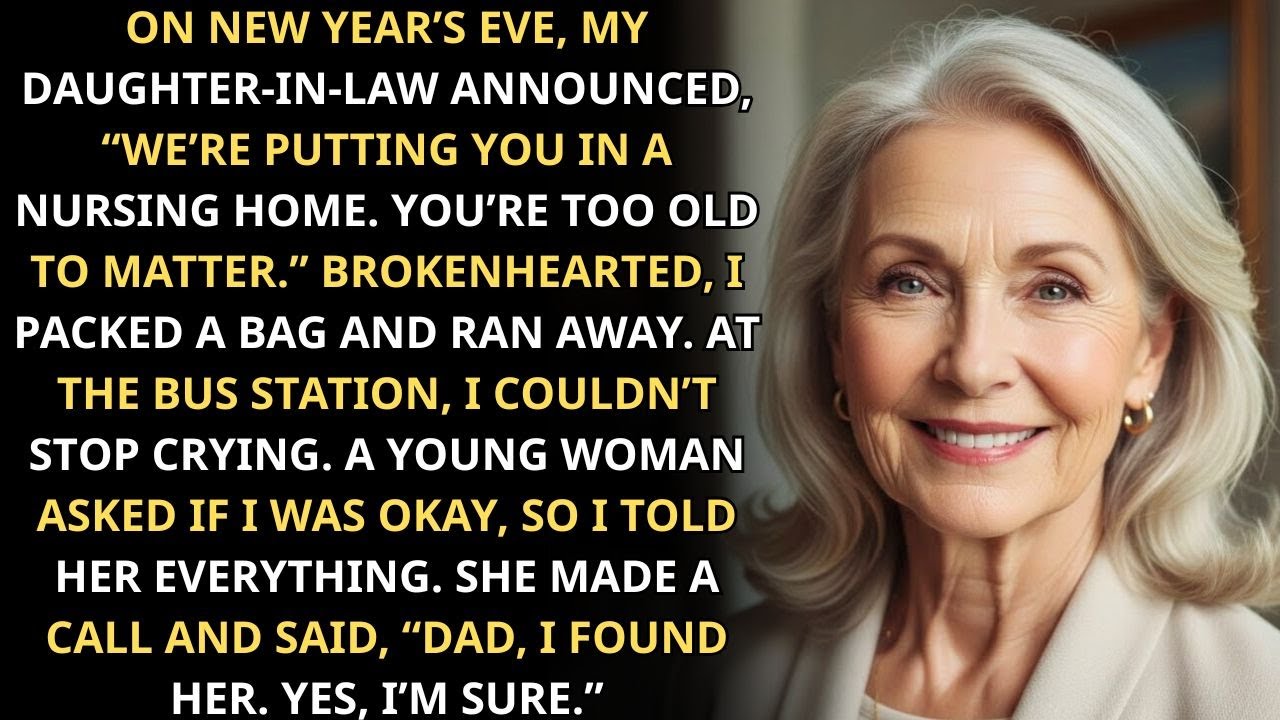
And that at eighty-two, I was little more than a piece of antique furniture that no longer fit their minimalist modern aesthetic. She didn’t whisper. She didn’t care if I was listening from the rafters. She simply stated that the paperwork for the Shady Pines assisted living center was already processed, and that my presence at their New Year’s Eve gala would be an unnecessary complication to their image.
My son Julian stood beside her, swirling his amber drink. He didn’t defend me. He didn’t remind her of the years of care I had given. He simply nodded and muttered that it was for the best, that I would be happier among people of my own vintage.
As if I were a bottle of wine being relegated to a dusty cellar because the label had begun to peel. I retreated to my room, a space that had shrunk with every passing year until it felt less like a sanctuary and more like a holding cell. My name is Evelyn Thorne. For forty-two years I was the pulse of the Oak Creek Public Library, the guardian of a thousand stories.
Yet here I was, being edited out of my own family’s narrative. I remembered the day Julian was born, when the world seemed to expand with the force of his first breath. I remembered the grueling years I spent working three jobs after his father passed, just to ensure he never felt the cold bite of poverty. I had been a teacher, a librarian, a mentor, and a mother.
But in this house of marble, glass, and lies, I was merely an inconvenience to be managed. As the laughter from the party grew louder below, I realized I had become a ghost before I was even dead. But as I tucked a faded photograph of my parents into the side pocket of my old floral suitcase, a spark of something fierce flickered in my chest. It was the memory of a heavy brass key hidden in a velvet-lined box at the bottom of my jewelry chest.
A key to a place they had forgotten existed. The move to the sprawling estate in Emerald Heights had been framed as an act of love. But looking back through the lens of this final betrayal, I saw it for what it truly was: a calculated, slow-motion theft of my independence. Julian had convinced me to sell my sun-drenched cottage, arguing that the stairs were a hazard to my brittle bones.
He promised me a suite, a place of honor, a role as matriarch. But the moment the check from the sale of my home cleared and was funneled into the down payment for his cold monument to ego, the walls began to close in. Beatrice replaced my sturdy oak furniture with sharp-edged pieces that offered no comfort. She donated my extensive library to a thrift store, claiming old paper harbored dust that was bad for the boys.
She relegated my meals to the kitchen island while they dined in the formal room. I had allowed myself to be diminished inch by inch, believing that the price of proximity to my grandchildren was the slow erasure of my own identity. That night, I didn’t leave a long, weeping letter filled with accusations. I wrote three simple sentences on cream-colored stationery.
I told them I was not furniture to be moved when the decor changed. I told them I was taking back what remained of my life. And I told them not to look for me, because they would never find the woman they had tried so hard to break. I stepped out of the back service entrance, the cold December air hitting my face like a splash of mountain water.
The bus station was a three-mile walk through the silent suburbs, a distance my doctor would have said was impossible for my aging hips. But rage is a powerful lubricant for old joints. I walked past the manicured lawns and silent expensive cars, carrying nothing but a suitcase and the sudden, terrifying, exhilarating realization that for the first time in sixty years, I owed no one anything. The station was a cathedral of neon and desperation.
I sat on a hard blue plastic bench and watched the digital clock count down to the 11:15 bus to Willow Creek. A place I hadn’t visited in decades. A forgotten patch of land my parents had left me in their will, a cabin on the edge of a lake so still it looked like a mirror for the winter stars. Julian and Beatrice didn’t know I still held the deed.
As I sat there, the adrenaline began to fade, replaced by a hollow ache. I thought of my grandsons who had stopped visiting because their mother told them I needed rest. I thought of the birthdays where my thoughtful gifts were tucked away because they didn’t fit the aesthetic of a modern childhood. A sob escaped me, then another.
The dam had broken. I wept for the woman who had spent her life building bridges for others, only to find herself stranded on a crumbling, lonely island. “Are you okay, ma’am? ”
The voice was soft, melodic, and held a note of genuine concern I hadn’t heard in years.
I looked up through a blur of tears to see a young woman in a dark blue medical coat, her hair pulled back in a practical bun. I told her I was fine, just waiting for my bus. She didn’t offer a polite nod and walk away. She sat down next to me on the cold bench.
“My name is Elena,” she said quietly. “I just finished a double shift at the city hospital. I’ve seen that look on many faces. It’s the look of someone who has been carrying the weight of the world and just realized the world isn’t carrying them back.
”
I don’t know why I did it. But the story spilled out of me in a torrent. I told her about Julian’s childhood, about the marble floors I had scrubbed on my hands and knees, about the champagne toast that had been my social execution. I told her I was going to Willow Creek with nothing but three thousand dollars hidden in a hollowed-out copy of Great Expectations and a heart that felt like it had been through a meat grinder.
Elena listened with a stillness that was profound. She didn’t offer empty platitudes. She simply held my hand. When I finally went silent, she stood and made a quick phone call in a hushed but urgent tone.
My heart hammered. Was she calling the police? Was she calling Julian to report a wandering elderly woman? I started to stand, my instinct to flee returning with a vengeance.
But she was back before I could pick up my suitcase. “Please don’t be afraid,” she said softly, her eyes shining with a strange, sudden light. “I just called my father. He’s been looking for a specific woman for a very long time.
I think you might be the person who saved his life forty years ago when the rest of the world chose not to see him. ”
Her father, she explained, was a man who had grown up in poverty, a boy written off by every authority figure until one teacher saw the brilliance beneath the hunger and the holes in his shoes. Before I could process her words, a black SUV pulled up to the curb. A man stepped out into the cold night.
He was tall, with silver hair and a face that bore the lines of a man who had worked hard for every ounce of his success. But his eyes were unmistakable. They were the eyes of a seven-year-old boy named Marcus Sterling. The boy who used to sit in the back of my classroom and draw intricate diagrams of machines he wanted to build.
The boy who arrived every winter morning without a coat, his shoes held together by layers of gray duct tape. He walked toward me with pure, unadulterated reverence. He dropped to one knee right there on the dirty, gum-stained linoleum of the bus station floor and took both of my hands in his. “I have spent twenty years trying to find you to thank you,” he said, his voice breaking.
“You bought me that blue Parker pen in the winter of 1984. You told me my mind was a kingdom that no one could ever take away from me. You gave me the books that taught me how to be an engineer when I thought I was destined for the scrap heap. And you never told anyone it was you.
”
The world tilted on its axis. The boy I had quietly helped, skipping my own lunches so he could have a sandwich without the shame of charity, was now a man of immense stature, looking at me with more genuine love and respect than my own son had managed in a decade. He saw my suitcase. He saw my tear-stained face.
He didn’t need to ask what had happened. “Elena told me everything on the phone,” he said, his jaw tightening with a controlled, righteous fury. “You are not going to a bus station. You are never going to be alone or discarded ever again.
You are coming with us. ”
I tried to protest, the old habit of not wanting to be a burden rearing its head. But Marcus wouldn’t hear of it. He told me about the Sterling Foundation, a massive charity providing resources and scholarships for underprivileged students, named in my honor.
He told me his home had a guest cottage that was empty and waiting, a place filled with light and books. As we drove away from the neon glow of the station, Marcus spoke with a quiet legal intensity. He was one of the state’s most prominent attorneys, specializing in elder law and civil rights. A career path he had chosen because of the injustices he witnessed as a child.
He asked about the house I sold, the bank accounts Julian managed, the way I had been treated. As the details emerged, his professional demeanor sharpened into something formidable. “Mrs. Thorne, what they did to you isn’t just a family dispute.
It’s a form of predatory abuse. They coerced you into selling your primary assets, isolated you from your support systems, and were attempting to institutionalize you without any medical or legal consent. This is not how your story ends. This is where we start the rewrite.
”
For the first time in years, the crushing weight in my chest began to lift. I wasn’t just a grandmother being discarded like an old coat. I was a client, a friend, and a human being with rights that were about to be enforced with the full weight of the law. The Sterling estate was nothing like the Thorne house.
Where Julian’s home was a cold, echoing monument to his ego, Marcus’s home was a living, breathing space filled with warmth. His wife Clare greeted me at the door at two in the morning, not with a look of annoyance, but with a hug that smelled of lavender and genuine welcome. They didn’t put me in a back room. They sat me at a large hand-carved wooden table, served me hot tea and homemade soup, and listened as I spoke about my life, my books, and my dreams.
The next morning, the battle for my life truly began. Marcus sat in his sun-filled study and placed a call to Julian. I sat in a comfortable armchair nearby, my heart racing like a hummingbird’s. The conversation was brief, clinical, and absolutely devastating.
Marcus informed Julian that he was now representing me in all legal and financial matters. A full forensic audit of the sale of my home was being initiated. Any attempt to contact me or proceed with the involuntary placement would be met with a restraining order and a lawsuit for elder financial abuse. I could hear Julian’s frantic voice over the speaker.
“You can’t just take my mother. This is a family matter! ”
Marcus smiled a cold, sharp expression. “I’m the boy she saved when you were too busy being a child of privilege to notice her sacrifice, Julian.
And I’m the man who is going to make sure she gets back every cent, every book, and every ounce of dignity you stole from her. ”
The long silence on the other end of the line was the most satisfying sound I had heard in twenty years. Over the next few months, the transition of my life was like a slow, beautiful sunrise. Marcus’s team of investigators discovered a trail of betrayal even deeper than I had imagined.
They found that Beatrice had been systematically siphoning my social security checks into a private account. She had even forged my signature on a power of attorney document while I was recovering from the flu a year prior. They got my money back. Nearly four hundred thousand dollars once interest and the full value of my stolen assets were calculated.
But more important than the recovery of funds was the restoration of my spirit. With the money, I was able to fully restore the cabin at Willow Creek. We turned it into a sanctuary, a small, sturdy house filled with light, with a wide porch overlooking the shimmering water and a library open to every child in the surrounding village. I became the woman I was always meant to be.
An elder of the community. A master storyteller. A woman who knew her worth to the very penny. The most difficult day came six months after the legal settlement was finalized, when Julian arrived at my door.
He looked ten years older, his expensive Italian suit wrinkled and ill-fitting. Beatrice had left him the moment the money stopped flowing and the scandal began to touch their elite social circles. He sat on my porch looking out at the lake for a long time without saying a word. “Mom, I honestly didn’t know how bad it was,” he finally whispered.
I looked at him, and for the first time in my life, I didn’t feel the maternal urge to rush over and comfort him. I felt a profound, quiet sadness for the man who had traded his mother’s soul for a marble floor and a sense of belonging among people who didn’t love him. “You did know, Julian. You knew every time you watched me eat a cold sandwich alone in my room while you hosted parties.
You knew every time you let her speak to me as if I were a ghost. You didn’t lose your way. You chose a path that didn’t include me as a human being, only as a resource to be exploited. ”
He wept then, a bitter, honest crying he hadn’t done since he was a small boy who had fallen off his bicycle.
I didn’t kick him out, but I didn’t invite him to move in. We are rebuilding our relationship now, slowly, painfully, on a foundation of harsh truth rather than convenient obligation. He is learning to listen, really listen, for the first time in his life. Julian comes to visit every Sunday now.
He helps me in the garden, and we sit on the porch and talk. Last week he told me he finally understood why I loved the library so much. It wasn’t just about the books. It was about the belief that every person’s story matters.
My life now is measured not by the years left on a calendar, but by the depth and clarity of the breaths I take. I wake up to the haunting, beautiful sound of the loons on the lake, not the sharp, condescending commands of a daughter-in-law who viewed my existence as clutter. I spend my afternoons at the local elementary school reading stories to children who look at me with the same wide-eyed wonder Marcus Sterling once did. I have learned a lesson I wish I could scream from the rooftops.
Dignity is not a gift given to us by our children, our government, or our society. It is a sacred fire we must tend ourselves, even when the wind is howling and the wood is wet. We are told by a thousand subtle voices that as we age, we should become smaller, quieter, less demanding of the world’s space and time. But that is a lie designed to make the world more convenient for the young and the selfish.
Our value is in our essence, in the hard-won wisdom we carry, and in the fierce refusal to be erased by the comfort of others. The legacy we leave behind isn’t found in the houses we buy, the titles we accumulate, or the marble floors we polish until they reflect our own vanity. It is found in the people we’ve touched with hidden kindness, the children we’ve encouraged when they felt invisible, and the strength we found to stand up for our own souls. When the people who were supposed to love me tried to trade me for a home office, Marcus Sterling came back for me because I saw him when he was a hungry boy with duct-taped shoes.
And in doing so, he made me visible when the rest of the world had decided to close its eyes and wait for me to disappear. The road to Willow Creek was long and winding, paved with more tears than I ever thought I could cry. But it led me home. Home isn’t a place you are put into.
It’s a place you build with the people who truly see you. I am Evelyn Thorne. I am no longer a ghost haunting the hallways of a house that didn’t want me. I am the architect of my own ending.
And I promise you, it is a masterpiece of resilience and quiet justice. Stand tall. Speak your truth.
And never, ever let anyone tell you that you are too old to be extraordinary.