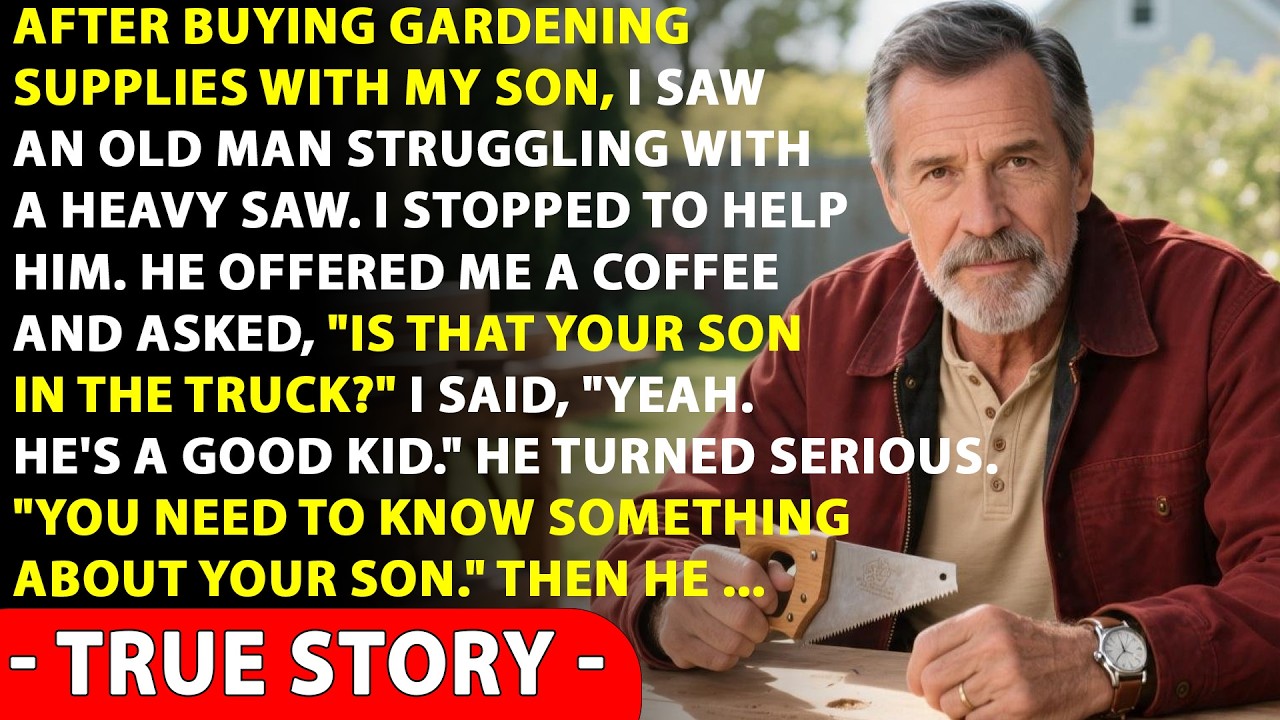
The county road was quiet when I spotted him—an older man, heavy set, in a faded denim shirt and a John Deere cap, hunched over a cast iron table saw that had to weigh two hundred pounds. His battered white Ford sat on the gravel shoulder, and every line of his body said he’d been fighting that machine for a while and losing. “Pull over,” I told my son. Michael glanced at me.
“Dad, pull over, Michael. ”
He slowed the truck and eased onto the shoulder. I had the door open before we fully stopped. The man straightened up, one hand pressed to the small of his back, his face red from the effort.
He looked to be in his early seventies, broad and weathered, with pale blue eyes that took me in with a quick, measuring look. “You look like you could use another set of hands,” I said. He let out a short breath that was almost a laugh. “My neighbor was supposed to come help me load this thing an hour ago.
His wife called some kind of kitchen emergency, apparently. ”
He stuck out his hand. “Henry Briggs. ”
“Arthur Callaway.
”
His grip was firm—the grip of a man who’d worked with his hands his whole life. We got the saw onto his truck bed with a solid, satisfying clang of iron on steel. Henry straightened up, wincing but grinning. “Well, that would have taken me another hour by myself.
Maybe two. ”
He reached behind the seat and pulled out a dented thermos. “Coffee? ”
“Sure.
”
He poured two cups into the thermos caps and handed me one. It was strong and slightly over-brewed, and exactly what I needed. We stood in the thin morning sun on the gravel shoulder, and for a moment neither of us needed to say anything at all. Then Henry looked past me toward Michael’s truck.
Michael was still in the driver’s seat, the blue glow of his phone screen visible through the windshield. Henry watched for a moment. Then he looked back at me, and something in his expression shifted. A subtle tightening around the corners.
“That’s your son in the truck? ” he asked. I felt a familiar warmth move through my chest. “That’s him.
He’s a good kid, just not much for heavy lifting. ”
I meant it as a joke. It came out sounding truer than I intended. Henry nodded slowly.
He looked down at his coffee cup. “Mr. Callaway,” he said, “I need to ask you something, and I need you to hear me out before you say anything. ”
The warmth in my chest shifted.
“There’s something you need to know about your son. ”
Henry wasn’t looking at me anymore. He was looking down at the coffee cup in his hand, turning it slowly between his palms, the way a man does when he’s choosing his words with care. “Mr.
Briggs,” I said, keeping my voice steady, “whatever it is, just say it straight. ”
Henry looked up at me. Those pale blue eyes were serious in a way that made my stomach clench. “I have a habit,” he said slowly.
“Before I buy any piece of equipment, I video the condition of it. Whole thing, top, bottom, every surface. Protects me from disputes later. Been doing it thirty years.
Never once had a problem because of it. ”
I nodded. “Sounds like a smart practice. ”
“A few days ago, I went to look at a piece of equipment at a farm property about twelve miles east of here.
Got there early. The seller was running late. I started filming the machine while I waited—routine, just like always. ”
He paused.
“Two men came around the corner of the building while I was filming. They didn’t see me. I was on the far side of the equipment, crouched down. They were maybe thirty feet away, talking.
Just talking the way men talk when they think they’re alone. ”
My hand had tightened around my coffee cup so hard the thin metal was beginning to flex. “What kind of things? ” I asked.
Henry looked me dead in the eye. “One of them said, and I’m telling you his exact words as best I remember them: ‘Once the old man signs the management transfer, the whole thing moves to us. We close before the end of the year. ’”
The valley around us—the fields, the road, the thin morning sun—all of it seemed to go very quiet.
“The other man,” Henry continued, “the one I could see clearly, asked, ‘What happens if the property owner refuses to sign? ’ And the first man said, ‘He won’t refuse. We’ve been making sure of that for months. He thinks the place is falling apart around him.
He thinks he can’t handle it anymore. ’”
Something cracked open behind my sternum. Not a sharp pain—a slow, spreading one that filled up all the available space before I even realized it had started. “Mr.
Callaway,” Henry said. He set his coffee cup on the truck bed and reached into his shirt pocket for his phone. “I didn’t know whose farm they were talking about. I didn’t know who either of those men were.
I’ve been carrying this around for four days trying to figure out what to do with it. ”
He looked at the truck where Michael was still sitting. Then his voice dropped. “When I saw your son get out of that truck just now, I recognized it.
The first man’s voice. The one I couldn’t see. I recognized it. ”
My legs felt the way they feel when you’ve been standing in cold water too long.
Not numb exactly. Just unreliable. “Show me,” I said. The words came out of my mouth before I had decided to say them.
Henry unlocked his phone. He found the file. He held the phone out to me. I took it.
The video was shaky at first. Henry moving around the base of a piece of equipment. Then two men came into view from the left side of the frame. One of them—heavy set, light blue shirt—was talking with his hands.
The other man was partially obscured by the corner of the outbuilding, visible from the shoulder down, dark jacket, dark trousers. And then the voice came through the phone speaker, thin and slightly distorted by distance, but clear enough. Clear enough for me to know it before he finished his first sentence. My thumb tightened on the edge of the phone.
My jaw locked. I stood on that gravel shoulder in the September morning and listened to my son’s voice explain, in calm and practical terms, exactly how he planned to take everything I had spent my life building. I watched the video to the end. Then I held the phone out to Henry without looking at him.
He took it back carefully. My coffee cup was still in my other hand. I looked down at it. The surface of the coffee was trembling—small concentric rings moving outward from the center.
My hand was shaking. I stood on that gravel shoulder for what felt like a long time. It was probably thirty seconds. Henry didn’t rush me.
He stood with his phone back in his shirt pocket and his arms loose at his sides, giving me the kind of space a man gives another man when he understands that words would be useless right now. “I need to ask you two things,” I said. “Ask them. ”
“Have you told anyone else what’s on that video?
”
“No one. ” His voice was flat and certain. “Not my neighbor. Not my wife—she passed six years ago.
Not a single person. I didn’t know what I had or what to do with it. I just knew I wasn’t going to delete it. ”
“The second thing.
Don’t send it anywhere. Don’t show it to anyone. Not yet. ”
Henry studied me for a moment.
Then he nodded once, slow and firm. “It stays with me until you say different. ”
I reached out and shook his hand. His grip was solid, unhurried—the grip of a man who meant what he said.
I walked back to the truck. Michael looked up from his phone when I climbed in, his expression easy and untroubled. “Everything okay? That took a while.
”
“He needed someone to talk to,” I said. I buckled my seat belt and looked straight through the windshield at the road ahead. “Older guy living alone, you know how it is. ”
Michael made a small sound of agreement and put the truck in drive.
I did not look at him. I watched the county road unspool in front of us, the cracked asphalt, the yellow center line, the fields going past on both sides. I wanted to react. Every nerve in my chest was pulling toward it—toward turning in that seat and demanding an explanation.
But I had spent forty years watching what happened when a man went after a problem before he fully understood it. You end up fighting shadows. You give the real problem time to move. I needed to understand the full shape of what Michael had done before I moved a single step.
That evening, after Michael had gone, I sat down at my desk in the small office off the main hallway and pulled open the bottom drawer—the one with the old files, the contracts, the deeds, the bank records going back twenty years. I started with the bank statements. Twelve months of operating account records, laid out across the desk in order. Every withdrawal tied to the secondary authorization signature Michael had been given.
Twenty-three withdrawals over eighteen months. Eighty-seven thousand dollars. Not taken in large pieces that would draw attention. Taken in careful, patient, unhurried increments—the way you drain a tank slowly enough that nobody notices the water level dropping until the day it runs dry.
Near the back of the second drawer, tucked behind a set of insurance renewal documents, I found a manila envelope I didn’t recognize. My name was written on the front in handwriting that was not mine and not Carol’s. Inside was a document. Four pages, single spaced, on plain white paper.
The header read: “Limited Power of Attorney for Operational Purposes, Callaway Farm Properties. ”
It granted Michael Callaway authority to execute financial transactions, enter binding agreements, and authorize payments on behalf of the principal—myself—in connection with the day-to-day operations of the farm. On the signature page at the bottom, there was a signature. My name.
My signature. I looked at it for a long time. Then I went to the filing cabinet and pulled out the folder where I kept signed copies of old contracts, equipment leases, water rights agreements going back fifteen years. I laid them next to the POA side by side under the lamp.
I’m not a handwriting expert. I’ve never claimed to be. But I have signed my name the same way for sixty-four years. The way the A in Arthur curls back on itself.
The long tail on the final Y in Callaway that I know as well as I know the back of my own hand. The signature on the POA didn’t have that quality. It was close. Whoever had done it had paid attention.
But the curl on the A was slightly too tight, and the tail on the final Y ended too abruptly—like someone who had practiced, but not practiced enough. My chest cavity felt like it had been hollowed out and filled with cold air. I went back to the second drawer. At the very bottom, underneath a layer of old tax documents, there was another envelope.
Sealed, heavier than the first. Inside was a document I had never seen before. A draft—not finalized, no signatures yet—but detailed enough to make the intention unmistakable. It outlined the transfer of all primary assets of Callaway Farm Properties to a limited liability company.
The LLC had been registered in California three months prior. The listed members were Michael Callaway and Sandra Callaway. I read the document twice. The second time, my hands were not trembling anymore.
They had gone completely still—the way hands go still when the body has moved past fear and into something colder. The next day, I called Warren Hodges, my attorney of nineteen years. He listened to everything—the video, the $87,000, the forged POA, the LLC draft—without interrupting. When I finished, he was quiet for a moment.
Then he said, “Arthur, how certain are you that the signature on the POA is not yours? ”
“I’ve been signing my name the same way for sixty-four years. The A curves back on itself. The tail on the final Y runs long.
Whatever is on that document does neither of those things correctly. ”
“If the signature is forged—and I want to be very precise here, because the word matters—what you’re describing constitutes forgery under California Penal Code section 470. That’s a felony. And combined with the unauthorized withdrawals, we’re looking at elder financial abuse under the California Welfare and Institutions Code.
Also a felony. Each carries potential state prison time. ”
The kitchen was very quiet. “We’ll need the man with the video.
Henry Briggs. ”
“He’ll come in. ”
Three days later, Diana Reyes walked into Rudy’s Diner on the west side of town and sat down across from me in the back booth. Her face was the color of old chalk.
She had been our accountant for fourteen years, and I had never once seen her look the way she looked walking toward me. “I don’t know where to start,” she said, her voice low and unsteady. “Start wherever it’s easiest. ”
She let out a short breath that was almost a laugh.
“There isn’t an easy place, Mr. Callaway. ”
“Then start at the beginning. ”
She told me she first noticed the discrepancies fourteen months ago.
Small amounts, but the pattern was clear. Someone with authorization access to the operating account was making systematic withdrawals in amounts small enough to avoid triggering the bank’s automatic review threshold. “I knew it was Mr. Michael,” she said.
“The secondary authorization was his. There was no one else it could have been. ”
“Why didn’t you come to me then? ”
Her jaw tightened.
“Because he came to me first. About eleven months ago, he came to my office alone. He closed the door. He told me that he had reviewed some of the older operational records and that there were several documents I had countersigned that could be considered irregular.
He said the authorizations were unclear and that if anyone looked closely, it might appear that I had been approving transactions without proper oversight. He said he wasn’t accusing me of anything. He was just making sure I understood the situation clearly. ”
The anger that moved through my chest then was not the cold, controlled kind.
It was hot and immediate. “He threatened you,” I said. “He never used that word. He was very careful about that.
He never said anything that could be repeated as a direct threat. He just made sure I understood that if I raised questions about the account, questions would be raised about me. ”
She looked at me with exhausted eyes. “I did not have the money for a lawyer.
I did not understand enough about the law to know whether I had actually done something wrong. I was scared. I am ashamed of that, but it is the truth. ”
“Diana,” I said, and waited until she looked at me.
“You did not do anything wrong. What he did to you has a name. It’s called coercion. ”
She reached into her portfolio and removed a small black USB drive.
“Every transaction record going back twenty months. Bank confirmations, authorization logs, the original account statements before any entries were modified. I copied everything the day after he came to my office. I have kept it in my home every night since.
”
Her voice steadied as she spoke. “I did not know what I was going to do with it. I just knew I was not going to let it disappear. ”
Then she placed a folded piece of paper on the table between us.
Two pages, handwritten, the creases gone soft from handling. “I tried to tell you,” she said. “In April, I wrote you a letter. I put it in the mailbox at the end of the farm road myself.
Addressed to you by name. I waited two weeks. You never called. ”
I never received that letter.
I understand now what must have happened to it. We spent eleven hours at Warren’s office that first day. Diana walked him through the USB records line by line. By the end of the day, Warren had built a timeline on the whiteboard that covered nearly the entire wall.
Twenty-three withdrawals in red. The forged POA in blue. The LLC draft circled twice and marked with a single word in Warren’s careful handwriting: intent. “The withdrawals alone give us elder financial abuse,” he said.
“The forged signature gives us forgery. But the LLC draft—that is what tells a jury this was not impulsive. This was designed. ”
On the second day, Patricia Ogle, a forensic document examiner, spent four hours with the POA and a set of my authenticated signatures pulled from old contracts.
She measured stroke angles, pen pressure ratios, the way letters connected or failed to connect. When she was done, she said, “The signature on this document was not produced by the same individual who signed the comparison samples. The stroke sequence is consistent with deliberate imitation rather than natural execution. Someone studied this signature carefully.
But careful study is not the same as the muscle memory of sixty-four years. ”
On the third day, Henry Briggs came in. He arrived at nine in the morning wearing his good flannel shirt and carrying his thermos. Warren explained that the video, while valuable, required corroboration—because my identification of the voice as my son’s could be challenged on the grounds of emotional bias.
Henry listened without interrupting. When Warren finished, he was quiet for a moment. Then he said, “Twenty years ago, I testified in a property dispute. Neighbor of mine, good man.
The lawyer on the other side spent two days on that stand making me look like a fool. Questioned my eyesight, my memory, my judgment. The man I was trying to help lost everything. His family’s land.
Three generations of work, gone. I blamed myself for a long time after that. ”
I leaned forward. “Henry, I’m not asking you to win anything.
I’m not asking you to save this farm. I’m asking you to tell the truth about what you heard and what you saw on that county road. That’s all it has ever been. ”
Henry looked at me for a long moment.
Then something in his face settled—the way a good piece of timber settles when it finds its bearing. He set the thermos on the table. “All right,” he said. “Tell me what you need.
”
Warren reached for his legal pad. He was halfway through writing the first line when his phone rang. He stepped out into the hallway, took the call, and came back in with a particular stillness about him. “Arthur,” he said.
“Michael filed a petition for conservatorship with Fresno County Superior Court this morning. His attorney hand-delivered the filing at 8:45. ”
Diana’s hand went to her mouth. Henry looked at me steadily, saying nothing.
“How long do we have? ” I asked. “The court has scheduled a preliminary hearing in eighteen days. ”
In the days that followed, Warren did his research on Craig Whitfield—the real estate broker Michael had lined up to sell the property.
Three pending civil complaints from sellers who claimed he had misrepresented market valuations. Nothing that had gone anywhere, but it told a story about the kind of man he was. Warren’s associate hand-delivered a letter to Craig Whitfield’s office outlining what evidence existed, what charges were being considered, and what opportunities for cooperation might be available to parties who came forward promptly. Craig requested two days to consult with his attorney.
On the second day, he signed a proffer agreement—agreeing to provide complete and truthful information to the prosecutor’s office in exchange for consideration regarding his own potential charges. That evening, Warren called me. “Craig confirmed everything. The conversations with Michael, the timeline, the buyer he had lined up for the property.
He gave us names, dates, and written communications going back seven months. ”
Then he paused. “Arthur, he also told us something we did not know. Sandra Callaway was not a passive participant in this arrangement.
She was the one who approached Craig initially. She negotiated the terms of his commission. She drafted the outline of the transfer strategy. ”
Another pause, heavier than the first.
“Michael was the face. Sandra was the architect. ”
I sat with that for a moment. I thought about Sandra bringing soup to my house on cold evenings, asking about my blood pressure, calling me on my birthday in a voice that sounded like she meant it.
“There is something else,” Warren said. “Sandra has retained her own counsel separate from Michael. Her attorney reached out to the prosecutor’s office independently. She offered full cooperation—all internal communications, the original planning documents, her account of every conversation—in exchange for a negotiated plea.
Felony conviction, three years probation, no prison time, and surrender of her California CPA license. ”
“She gave him up,” I said. “Every detail. Every date.
The prosecutor told me that with Sandra’s cooperation combined with Craig’s, the evidentiary case against Michael is airtight. ”
“Does Michael know? ”
“He does now. His attorney was notified this afternoon.
”
I thought about Michael receiving that news. His wife’s name on a cooperation agreement. The person who had designed every step of the plan, choosing the exit door and closing it behind her without looking back. “What do we do now?
” I asked. “Now we let the prosecutor do her job and we prepare for the hearing. Arthur, get some rest this week. Eat properly.
Stay off the phone. Whatever Michael tries to reach you about—and he will try—do not engage. ”
My phone buzzed on the table. A text from Michael.
Four words. “Dad, can we talk? ”
I looked at it for a long moment. Then I set the phone face down on the table, got up, and went to bed.
I did not sleep that night. I lay in the dark with my eyes open and listened to the farm settle around me. The creek of the roof timbers cooling in the night air. The distant sound of the irrigation pump cycling on and off in the east section.
Sounds I had been hearing for forty years. Sounds that had always felt like company. That night they felt like witnesses. I kept thinking about that night at the kitchen table, about three weeks before I met Henry on the county road.
The fog had come in low off the valley floor. Michael and Sandra had come for dinner. She brought a casserole in a ceramic dish and set it on the counter and smiled at me the way she always smiled—warm and easy. After dinner, Michael set two pages on the table.
Clean, simple, the language stripped down. “I talked to the lawyer again,” he said. “He simplified it. This is just the management piece, Dad.
Just so someone can step in and handle things if you ever need them to. You stay in control of everything. This is just a safety net. ”
Sandra reached across the table and put her hand over mine.
Her fingers were warm. “We just love you,” she said. “That’s all this is. ”
I looked at Carol’s photograph on the wall.
Three years, two months, and eleven days since she had sat in that chair and told me the east section needed new drip lines and that I was burning the coffee again. I thought about how tired I was. How the past eight months had ground something down in me. The machinery kept breaking.
The contracts kept falling through. Maybe, I thought, Michael is right. Maybe I am not managing this the way I should be. Maybe this is what getting old looks like and I just haven’t admitted it yet.
Michael slid the papers toward me. Sandra’s hand was still over mine. I picked up the pen. I placed the tip against the signature line.
My phone rang. The sound cracked through the kitchen like something thrown against a wall. I pulled my hand back from the paper—a reflex, pure and immediate. Michael’s jaw tightened.
Sandra’s hand lifted from mine. It was Dale Hutchkins, my broker, calling at 8:45 on a Thursday evening—which he had never done in eleven years of working together. I answered it. We talked for twelve minutes.
When I came back to the table, Michael was standing, his jacket already on, the papers back in his bag. “Another time,” he said pleasantly. I did not sign that night. I have thought about that phone call many times since.
Dale never called at that hour again. He still doesn’t know what he interrupted. The night before the hearing, Michael came to the house at 11:14. He stood on the porch in a dark jacket and jeans, no tie, no pressed shirt.
His hair was slightly off—the kind of off that happens when a man has run his hands through it too many times in one evening. He looked smaller than I was used to seeing him. “Can I come in? ” he said.
I stepped back and let him through. He sat at the kitchen table in the same chair he always took. I poured two glasses of water and set one in front of him. He wrapped both hands around it but did not drink.
“I know you know,” he said finally. “I know about Craig. I know about Sandra. I know you’ve been talking to Warren.
”
I nodded. “I didn’t come here to ask you to stop. I know it’s too late for that. ” He looked up from the table.
His eyes were red at the rims. “I came because I needed to know something. ”
“Ask it. ”
Michael’s throat moved.
“Do you still think of me as your son? ”
The question landed in the kitchen and sat there between us, too large for the room. My chest ached with the specific pain of a man who loves someone he cannot protect. Not from the law, not from consequence, not from the choices that person made with full knowledge of what they were doing.
“You are my son,” I said. “That doesn’t change because of what you did. ”
Michael’s chin dropped toward his chest. His shoulders pulled in.
A sound came out of him—low and compressed, the sound a man makes when he has been holding something for too long and his body simply gives out. His hands pressed flat on the table, and he bent forward over them, his breath coming in hard and uneven. I did not go to him. I wanted to.
Every instinct I had as a father pulled toward it. But I stayed in my chair because the love I had for my son and the thing he had done were two separate facts, and I could not let one cancel the other. When he straightened back up, he wiped his face with the back of his hand. “I’m sorry, Dad.
I know that doesn’t fix anything. ”
“No. It doesn’t. ”
At the door, he stopped.
He did not turn around. “I told myself it was for us. That the farm was worth more developed than the way you were running it. That you were getting old and couldn’t see it.
” A pause. “I think I just wanted it to be easy. And I convinced myself that wanting it to be easy was the same as being right. ”
“Go home, Michael.
”
He went. The morning of the hearing, I stood in front of the bathroom mirror and looked at myself for a long moment. Sixty-four years old. Hands that had split fence posts and pruned trees and hauled irrigation pipe across 340 acres for four decades.
A face that showed every year of it. I did not look like a man who belonged in a courtroom. I looked like a man who belonged in a field. I decided that was all right.
It was honest, at least. I got in the truck at 7:15 and drove to Fresno. I found the parking lot of Fresno County Superior Court at 8:40. I sat in the truck for a moment, looking at the entrance.
A knock on the passenger window. Henry Briggs was standing there in his good flannel shirt, holding his thermos. He climbed in without ceremony, unscrewed the thermos cap, poured two cups, and handed one to me. We sat in the parking lot and drank without saying much.
“You ready? ” Henry asked eventually. I looked at the building. “I don’t know.
But I’m going in. ”
“Good,” Henry said. “A man who says he’s ready for something like this probably hasn’t thought about it carefully enough. ”
Inside the corridor, at the far end of the hallway, I saw Michael standing with his attorney beside a row of wooden benches.
He was in a dark suit, shoulders back, the careful composure of a man managing his expression one moment at a time. He saw me the instant I came through the door. His composure did not break, but something behind his eyes shifted. And for just a moment, before he turned his attention back to his attorney, he looked exactly like the boy who used to knock on my bedroom door during thunderstorms because he needed to know his father was still there.
I held his gaze for that moment. Then I kept walking. Judge Patricia Odum came in at 9:02. The petition was laid out in smooth, practiced language—the operational challenges, the financial irregularities suggesting mismanagement, the petitioner’s deep concern for his father’s well-being.
Then Warren stood up. He did not raise his voice. He simply began in the methodical way of a man who has built something carefully and intends to show you exactly how it holds together. “Your honor, the petitioner’s characterization of my client as unable to manage his own affairs is not supported by evidence.
In fact, the evidence will show the opposite. That the operational difficulties experienced by Callaway Farm over the past eighteen months were not the result of my client’s diminished capacity, but rather the result of deliberate and sustained interference by the petitioner himself. ”
Garrett was on his feet immediately. “Objection, your honor.
Inflammatory and unsupported. ”
Judge Odum looked at Warren. “Do you have documentation to support that characterization? ”
“We do, your honor.
Substantial documentation. ”
“Overruled. Continue. ”
Warren walked through the twenty-three withdrawals, each entry documented.
Then came the POA and the forensic report. Then the LLC draft. Then Craig Whitfield’s sworn statement and his cooperation agreement with the district attorney’s office. At the back of the room, a man in a gray suit with a yellow legal pad on his knee stood up slowly.
“Your honor. My name is Daniel Harmon. I am with the Fresno County District Attorney’s Office. Based on the evidence entered into the record this morning, the state would like to initiate criminal proceedings against Michael Callaway at this time.
”
Judge Odum looked at Michael. “Mr. Callaway. Do you understand what is being said to you?
”
Michael said, “Yes. ” His voice was steady when he said it. I will give him that much. Warren placed another thick folder on the table.
“Your honor, the state has entered a cooperation agreement with Sandra Callaway, petitioner’s spouse. These are electronic communications between Michael Callaway and Sandra Callaway spanning fourteen months. They document, in the participants’ own words, the planning and execution of the scheme outlined in the evidence already entered into the record. ”
Warren read three excerpts aloud.
One from Sandra: “The conservatorship filing needs to go in before the end of the month or the timeline falls apart. ” Another referencing Craig Whitfield by name. A third sent at eleven at night: “He almost signed tonight. Next time, don’t let the phone interrupt.
”
The last one landed in the courtroom like something dropped from a height. I kept my eyes on the table in front of me. Then Warren called Henry to the stand. He walked up the way Henry did everything—without hurrying, without performance.
He described the day, the video, the two men, what he had heard. “Mr. Briggs,” Warren said, “you stated you recognized the voice of the partially obscured individual in the video. How certain are you of that identification?
”
“Certain,” Henry said. No hesitation, no qualification. “On what basis? ”
“I heard him speak for several minutes in that recording.
Three days later, I heard him speak again when he got out of a truck on a county road. It was the same voice. I am seventy-one years old. I have been listening to people talk my whole life.
It was the same voice. ”
Garrett’s cross-examination was aggressive. He challenged Henry’s distance from the speakers. He challenged the audio quality.
He asked whether Henry had consumed any alcohol that day. “No,” Henry said. “I don’t drink. ”
Garrett suggested Henry’s identification might be influenced by his relationship with me.
Henry looked at him steadily. “I met Mr. Callaway the same morning I heard that recording for the second time. I had no relationship with him before that.
I had no reason to favor him or anyone else. I am telling you what I heard. ”
Garrett sat down. Then Michael stood up.
He said something about the people who had entered cooperation agreements, about leniency in exchange for testimony. Judge Odum cut him off. “Mr. Callaway.
You will sit down and speak through your attorney. This is a preliminary hearing. You will have the opportunity to mount a full defense at the appropriate time and place. ”
Michael sat down.
Judge Odum was gone for twenty-two minutes. I watched the clock on the wall above the door—plain white face, black numbers, a second hand that moved in small precise jerks. At 9:54, she came back in. “In the matter of the petition for conservatorship filed by Michael Callaway regarding Arthur Callaway,” she said, “the petition is denied.
The evidence presented by the respondent demonstrates not only that Mr. Arthur Callaway is fully capable of managing his own affairs, but that the operational difficulties cited by the petitioner as evidence of incapacity were in fact the direct result of actions taken by the petitioner himself. This court finds no basis whatsoever for the relief requested. ”
She looked at Garrett.
“The petition is denied in its entirety. ”
Garrett sat very still. “Furthermore,” Judge Odum continued, “pursuant to California Probate Code section 2250, this court is issuing a temporary restraining order prohibiting Michael Callaway from accessing, encumbering, or transferring any assets of Callaway Farm Properties pending the resolution of the criminal proceedings being initiated by the district attorney’s office. ”
She looked at Daniel Harmon.
“Mr. Harmon, your office may proceed. ”
“Thank you, your honor. The state will be filing formal charges of elder financial abuse under California Welfare and Institutions Code section 15610.
30 and forgery under California Penal Code section 470 against Michael Callaway. A preliminary hearing will be scheduled within thirty days. ”
Judge Odum nodded. She closed her folder.
“Mr. Michael Callaway, you are advised to remain available to the court and to have counsel present for all future proceedings. ”
She looked at him directly. “This court is adjourned.
”
Everyone stood. And then it was over. Michael and Garrett spoke in low, urgent voices for a moment. Then Garrett gathered his files, and Michael stood and straightened his jacket with the automatic motion of a man whose hands needed something to do.
He did not look at me. He walked toward the door with Garrett beside him, went through it, and was gone. Warren put his hand briefly on my shoulder. “It’s done.
”
Henry came through the railing gate and stood beside me. He did not say anything. He just stood there, which was exactly right. We walked out of the courthouse together—Warren, Diana, Henry, and me—into the October morning.
The sun had come up fully, and the air was sharp and bright. Diana hugged me, a brief fierce thing. “Thank you, Arthur,” she said. Henry and I walked to my truck.
I got in. I put the key in the ignition. I did not turn it. I sat in the driver’s seat with both hands on the steering wheel and looked through the windshield at the parking lot of the Fresno County Superior Court.
And the thing I had been holding at arm’s length for eighteen days—for three years, if I was honest with myself—moved through the wall I had built around it and hit me all at once. My shoulders pulled in. My chest caved forward. A sound came out of me that I had not heard from myself since the morning Carol died.
Low and rough and coming from somewhere below language. I was not crying because I had lost. I had not lost. The farm was mine.
The petition was gone. Michael was going to face what he had done in a courtroom where I would not have to watch. I was crying because my son had looked at everything I had built and had seen a transaction. I was crying because Carol was not here, and she should have been, and she would have known what to say, and I did not.
Henry did not try to fix any of it. He sat in the passenger seat and put his hand on my shoulder, the same solid, unhurried grip he had used when we shook hands on a county road four weeks ago, and he left it there. We sat in that truck for a long time. Eventually, my breathing evened out.
I straightened up. I wiped my face with the back of my hand. Henry poured two cups from his thermos and handed one to me. The coffee tasted the way Henry’s coffee always tasted—like something made by a man who had never once worried about whether it was perfect, only whether it was honest.
“Thank you,” I said. I was not only talking about the coffee. Henry looked out through the windshield. “Nothing to thank me for.
You stopped and helped me load a saw. I told you the truth. That’s the whole of it. ”
The almond trees bloom in February in the Central Valley.
Most people do not know that. They think of almonds as a summer crop—the harvest, the trucks loaded with burlap sacks moving down the county roads in August heat. But the blossoms come in the cold months when everything else in the valley is gray and dormant. And they come all at once, white and pale pink against bare gray branches, spreading down the rows like something a person might not believe if they had not seen it themselves.
I was standing at the edge of the east section on a Saturday morning in late February, watching the light come up through the blossoms, when I heard Henry’s truck on the gravel. He pulled up beside the equipment barn and got out with his thermos under one arm. We stood together at the edge of the blossoms without saying much for a while. That had become our way, Henry and I.
Saturday mornings, coffee. Whatever needed saying got said, and whatever did not need saying was allowed to stay quiet. A lot had happened in the three months since the courthouse. Michael had appeared for his preliminary hearing in November.
The case was bound over for trial, and his attorney had begun discussions about a negotiated plea. Warren told me the likely outcome was two years in state prison, three years of supervised release, and full restitution of the $87,000 plus interest. Sandra had completed her plea agreement—felony conviction, three years probation, her California CPA license surrendered. She had moved out of the house and, as far as I knew, left Fresno entirely.
Diana had come to my office the first week of November. I told her I wanted to change her title from bookkeeper to chief financial officer, with the salary to match. She looked at the desk for a moment, then looked up and said very quietly, “Thank you, Mr. Callaway.
”
“Arthur,” I said. She pressed her lips together. “Thank you, Arthur. ”
I left Henry at the blossom row and walked to the tool shed.
Inside sat a young almond tree in a burlap root ball—two feet tall, a single straight trunk, a handful of small branches. I had ordered it from the nursery in Visalia three weeks ago. I carried it to the oldest tree on the property—the wide one spreading its branches in every direction without apology, the one beside which Carol had kept her chair, the one at whose base I had sat in the dark in October and talked to her until my bones went cold. I set the young tree down and turned the first shovel full of earth.
The ground was cold and dense and smelled the way good soil smells—mineral and alive. I worked steadily, without rushing. When the hole was the right depth, I lowered the tree in and began filling around the roots with both hands, pressing the soil the way my father had shown me. Not packed tight, just held, given a place to grow from.
Henry’s boots came across the ground behind me. He crouched down and pressed soil around the far side of the root ball without being asked. Two old men on their knees in the dirt, working together in the quiet morning. When it was done, I sat back on my heels.
“She would have said it was crooked,” I told Henry. He looked at it carefully. “It’s not crooked. ”
“I know.
She would have said it anyway. Then she would have gotten her hands dirty fixing it herself. ”
Henry was quiet for a moment. “She sounds like she was a good woman.
”
I looked at the young tree standing straight in the winter ground, the old trees’ blossoms spreading wide above it, the morning light coming through in pieces. “The best I ever knew,” I said. I got to my feet, pressed the last loose soil down with the toe of my boot, and picked up the spade. Around us, as far as I could see, the almond trees stood in full white bloom—340 acres of something that had taken forty years to build, and that I intended, now that I understood what it had cost and what it was worth, to spend whatever years I had left taking care of properly.
I am Arthur Callaway. I am sixty-four years old. This is my land. It was here before me, and if I do my part, it will be here long after.
That is enough. I almost lost everything, not because someone overpowered me, but because I loved too blindly and questioned too little. Look closely at the people around you, especially the ones who call themselves family. The most dangerous person in your life is rarely a stranger.
It is someone who knows exactly how much you trust them and chooses to use that trust as a weapon. God placed a stranger on a county road at exactly the right moment. I stopped to help him. He saved me.
That is not coincidence. That is grace.