My little brother clamped his hand around my wrist and twisted, grinding the small bones together in a clumsy joint lock he must have learned six weeks ago at boot camp. “Looking kind of slim there, my desk jockey big sis,” Derrick announced, loud enough for the neighbors to hear over the fence. He cranked harder, spiking real pain up my forearm. “But those gym muscles are useless.
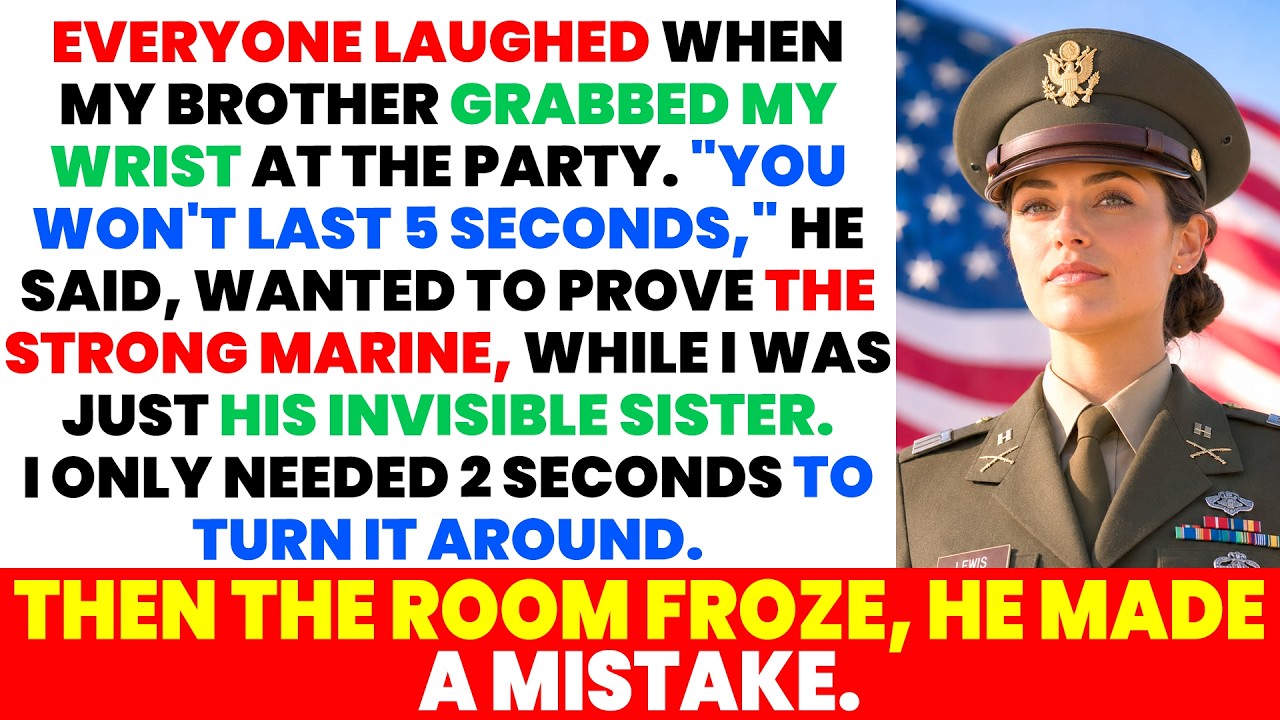
Real life isn’t like your musty logistics office. You wouldn’t last five seconds in the real Marine world. ”
He barked out a laugh, eyes glinting with a contempt he’d been rehearsing all afternoon. He wrenched my arm one more time and leaned in close, close enough for me to smell the cheap beer soaking through his pores.
“See? You’re done. ”
My heart rate did not increase. Not by a single beat.
He had no idea that the sister he was humiliating had, one week ago, put down insurgents twice his size with her bare hands in an operation that would never carry a name. Three hours earlier, it was my parents’ backyard in the suburbs, thick with the smell of burning grease from the grill and the blind worship of a brand-new uniform. Today was Derek’s welcome home barbecue, the grand celebration of my little brother completing Marine boot camp. Twelve weeks of folding blankets and running obstacle courses, and my parents had treated it like a ticker tape parade for a war hero.
My mother Martha had spent two days decorating. Red, white, and blue streamers stapled to the fence. A banner stretched across the back porch that read, “Welcome home, Marine,” in letters so big you could read them from the street. She’d ordered a three-tier cake shaped like a Marine Corps emblem.
She’d invited every neighbor, every cousin, every distant aunt who owned a functioning pair of legs. Derrick strutted across the lawn, radiating the loud, sloppy confidence of a twenty-year-old kid who had just been taught how to pull a trigger, but had never once taken a life. He rolled his shoulders in his dress uniform, flexing for the cameras, tossing grins at the aunts who swooned and the uncles who gripped his hand and told him he was making the family proud. My father, Robert, and my mother flanked him like handlers at a press conference, their faces glowing as if they’d won the lottery.
Every time a new guest arrived, the whole performance started again. The handshake, the salute, the rehearsed story about how Derrick had been top of his class in physical training. None of it was true, but truth had never been a currency my family traded in. I sat in the far corner of the yard, nursing a warm can of soda that had gone flat an hour ago.
A plastic lawn chair, a paper plate with a cold hot dog I hadn’t touched. That was my assigned square footage at this celebration. Invisible, exactly the way I had designed it. My fatigues were generic, stripped of any identifying patches or unit insignia that might raise questions I couldn’t answer.
I looked like what they wanted me to look like. A nobody in a uniform. Neighbors wandered over to my mother one by one, drawn by the spectacle of Derek in his dress blues. A woman from three houses down, Mrs.
Harmon, tilted her head toward me and asked about the fatigues I was wearing. My mother flicked her hand with the same dismissive wave she had been perfecting for a decade. “Oh, that Anna girl,” she said, her lip curling into a strained half smile. “She does logistics.
Just desk work, hauling supplies. Enough for a pension, but not exactly glorious. Certainly can’t compare to what little Derrick is about to sacrifice on the front lines. ”
Mrs.
Harmon nodded politely and moved on. My mother did not look at me once during the entire exchange. Not once. As though I were a piece of lawn furniture that had been left out too long and was starting to rust.
My uncle Carl walked over five minutes later, and my mother delivered an even sharper version of the same script. “Anna’s doing fine, I suppose,” she told him, waving her hand toward my corner like she was pointing at a potted plant. “She counts boxes, inventory, paperwork, that sort of thing. Honest work, but nothing you’d write home about.
” She lowered her voice, but I was trained to hear a whisper through three walls of concrete. “Between us, I think she stays in because she doesn’t have much else going for her. ”
Uncle Carl chuckled. My mother smiled.
I memorized every syllable without moving a muscle in my face. My cousin Linda cornered me five minutes later near the cooler. She meant well. She always did.
“So, Anna, when are you going to settle down? Your mom says you’re just doing filing and shipping over there. Must be lonely. ” She patted my arm with the soft, patronizing touch of a woman who believed my entire career was a participation trophy.
I told her I liked the work. She tilted her head and gave me the same look people give stray dogs in parking lots. My father stood three feet behind my mother during both conversations, beer sweating in his grip, and said nothing. He never said anything.
That was his contribution to the family hierarchy. The strategic silence of a man who let his wife do the cutting while he held the wound open. He caught my eye for half a second, his expression flickering between guilt and something that looked like relief that he was not the one being discussed. Then he turned away and clapped Derek on the shoulder.
That clap rang across the yard like a gavel. Case dismissed. The golden child absorbed the praise, and the invisible daughter sat in her corner and drank her flat soda. Everyone at this barbecue believed I was a low-level supply clerk wasting tax dollars at some forgotten depot overseas.
Unmarried, pushing thirty, unremarkable. They saw a woman shaped by a gym membership, nothing more. They had no idea that the gym membership was a cover story, that the lean muscle under my fatigues had been forged by a decade of close-quarters combat rotations in countries whose names were redacted from every official record. I was a captain, black operations.
My file was classified above the clearance level of every officer in Derek’s entire chain of command. If they knew what I actually did in the dark, they would not be disappointed. They would be terrified. And they would never sleep soundly in this house again.
Marcus sat beside me in a camp chair, playing the role of my civilian boyfriend with the easy calm of a man who had rehearsed a hundred covers. In truth, he was my teammate. Special operations, same unit, same blood, same body count. He wore a Hawaiian shirt and cargo shorts, looking like every other boyfriend dragged to a family cookout against his will.
But underneath the tourist disguise, his posture was textbook. Spine aligned, feet flat, hands always visible, but never far from his center line. He tapped his index finger against the armrest in a slow rhythmic pattern. Three taps, pause, two taps.
I read the signal without turning my head. Hold position. Stay in character. He had spotted the same thing I had.
Derek was done performing for the crowd. He was hunting for a target. My brother stood in the center of the lawn, clearing a space between the folding tables. He rolled his shoulders, cracked his neck with a sound like a branch snapping, and began throwing punches into the air, demonstrating techniques he had memorized from a twelve-week crash course designed to turn civilians into something resembling soldiers.
He threw a hip toss into empty space, grunting with effort. He shadowboxed in a wide, sloppy stance that exposed his kidneys and his jaw simultaneously. The relatives crowded in, phones already rising, and clapped loud, brainless applause that bounced off the vinyl siding and died in the hedges. My cousin Brian whistled.
My aunt Donna said, “Oh my god, that’s incredible. ”
A twenty-year-old throwing practice punches at oxygen. I watched my own brother and saw a recruit who still smelled like laundry detergent and parade ground polish. He did not understand yet that a uniform has no ability to stop an armor-piercing round.
That knowledge cost years and lives. He had paid for neither. His stance was too wide. His chin was up.
His elbows flared like wings. Every gap I identified was a gap that would get him killed in any real engagement. But this was a barbecue, not a battlefield. And the crowd loved the show.
Derrick’s eyes swept the yard. They moved from face to face, searching for something specific. A prop, a stepping stone, something he could break to make himself look taller. His gaze locked on the shaded corner where I sat perfectly still, holding my flat soda.
He smiled, the kind of smile that a bully practices in front of a mirror until it feels natural. I did not do logistics. The irony pressed against my chest like a boot on a rib cage. While Derek had been sweating through how to fold a blanket into a regulation square at boot camp, I had been crouched inside a safe house three hundred meters from a border that was on fire.
I was the commanding officer of a special operations assault team. Six operators, four nationalities, one mission. I did not wear office clothes. I wore thirty kilos of tactical armor, my face painted in camouflage, my world narrowed to the green tunnel of a night vision scope.
My hands did not push pencils. They pushed people into the ground and held them there until they stopped moving. The memory from the week before hit me like a film reel projected onto the backs of my eyes. The hallway was narrow, barely wide enough for two operators abreast.
The air was thick with the sour of sweat and gun oil and something else, something metallic and warm that I had learned to identify as fresh blood. My team stacked on the door. I was first in, always first in. That was the deal.
The commander does not send her people into a room she has not cleared herself. The door blew open. A fighter lunged through the frame, the muzzle of his AK swinging toward my team. The operators behind me were a tenth of a second slow.
Not their fault. Human reaction time has a floor. Mine had been trained below it. My body executed a program that had been drilled into my nervous system for ten years before my conscious mind had time to intervene.
I closed the distance in two steps. I collapsed his weapon arm with a strike to the elbow that hyperextended the joint. The rifle clattered to the concrete. I locked my forearm under his jaw with the exact mechanical precision that Derrick had just used to perform circus tricks for our relatives.
But in that hallway, the movement was not a performance. It was an execution. I locked the choke. His body seized, then softened, then went completely slack.
I lowered him to the floor without a sound, controlled every inch of the descent so that not a single piece of equipment rattled. The man behind me stepped over the body, and we flowed into the next room. Fourteen seconds, three rooms. The building was clear.
That was my reality. That was what logistics looked like. We extracted forty-seven minutes later. No casualties on our side.
My hands did not shake until we were back in the air, sealed inside the belly of a helicopter. And even then, I pressed them flat against my thigh armor until the tremor passed. The medic across from me, a man named Gutierrez, who had a daughter Derek’s age, caught my eye and nodded. That nod said everything.
You did your job. You kept us alive. You are still here. That nod was worth more than every standing ovation Derek would ever receive at every barbecue for the rest of his natural life.
When we landed back at the operating base, I stripped my gear, showered in water that ran brown with dust and someone else’s blood, and sat on my bunk staring at the wall for twenty minutes. Then I packed my cover identity like a suitcase, zipped it shut, and booked a flight home to watch my parents worship a boy who had never fired a weapon outside of a controlled range. I had done that and worse, more times than I cared to catalog. Sixteen deployments, nine countries, a body count I would carry to my grave and never speak aloud.
Every single time I flew home, changed into jeans and a t-shirt, and sat at the same plastic table at these same family barbecues, absorbing the pity and the scorn and the sidelong glances. I was the family disappointment, the invisible daughter, the desk jockey. I chose that cover. I maintained it because the alternative was a security breach that would end my career and potentially endanger every operator I had ever served with.
And every time my mother opened her mouth to apologize for my existence to the neighbors, I swallowed the truth like a hot coal and washed it down with flat soda. The scar on my left side, the one I told them came from a car accident, pulsed with a dull ache. It came from a knife fight in a stairwell eighteen months ago. The man who gave it to me did not survive to give anyone else a scar.
I lifted the can to my lips. The lukewarm sweetness coated my throat. I tilted my chin up and locked eyes with Derrick’s approaching grin. He was walking toward me now, shoulders squared, chest inflated, cutting through the crowd like a man who believed the world owed him a runway.
I set the can down on the armrest. My fingers were steady. Marcus shifted fifteen degrees, shielding my left flank without breaking character. He was the only person at this barbecue who knew what the girl in the lawn chair was capable of.
He had watched me clear buildings. He had watched me drop men twice Derek’s size in rooms with no windows and no witnesses. The verbal daggers my mother threw did not bother him. But Derek closing distance was triggering his defense radar.
Every muscle in Marcus’s body had gone taut beneath his Hawaiian shirt, coiled and ready beneath the tourist costume. He did not look at Derek. His eyes stayed fixed on his plate of potato salad. But I knew he was tracking the threat the way he tracked threats in Fallujah.
Peripheral vision, breathing pattern, distance calculation. Marcus leaned toward me, his elbow pressed into my ribs, a tactical nudge pulling me out of the combat mindset that had started creeping up my spine like voltage through a wire. His voice dropped into a low growl pitched for my ears only. “Stand down, Captain.
We’re not in a war zone. Those burgers out there have no hostile intent. ” The corner of his mouth twitched. He was reminding me of the cover.
We were home, not a border crossing in a country that did not officially exist on any map. This was a suburban backyard with paper plates and citronella candles and a three-tier Marine Corps cake melting in the heat. I exhaled through my teeth. Slow, controlled.
Four seconds in, four seconds hold, four seconds out. Tactical breathing. I forced my heart rate back to resting baseline. I molded my face into a hollow smile and picked up a potato chip, chewing it mechanically, tasting nothing.
Marcus had been doing this for me since our third deployment together, pulling me back from the edge when civilian territory started looking like a target-rich environment. Three years ago, on a rooftop in a city I’m not allowed to name, a sniper round punched through his plate carrier and buried a fragment in his thigh bone. He did not scream. He grunted once, pressed his hand over the wound, and kept returning fire for forty-five seconds until the threat was neutralized.
Then he turned to me, blood soaking through his fingers, and said, “I think I need a band-aid, Captain. ” He carried the limp for six weeks. He never filed a complaint. He never asked for a transfer.
When I tried to thank him after the surgery, he looked at me like I had spoken a foreign language and said, “You’d do the same. ” He was right. I would. I had.
That was the bond. Not blood, not birth certificates, not Thanksgiving dinners and matching last names. The bond was built in the mud and sealed with the kind of trust that only forms when someone has literally bled to keep you breathing. My parents were willing to sell my dignity to the neighbors for a moment of reflected glory from their baby boy.
Marcus was willing to take a bullet for me without asking why. Two years ago, he dragged me three hundred meters through open ground with a bullet fragment lodged in his thigh because I had taken a concussion blast and could not stand. He never mentioned it afterward, not once. That was what family looked like.
Real family, the kind that bleeds with you, not because of you. Marcus bought me three minutes of quiet. He reached over and adjusted the collar of my shirt without looking, a small unconscious gesture of grooming that any civilian would read as affection from a boyfriend. But I recognized the real message.
He was checking the neckline of my undershirt, making sure the edge of my shoulder scar, the one that mapped the trajectory of a piece of shrapnel from a vehicle-borne explosive, was fully covered. Always on mission, always protecting the cover, always protecting me. But Derrick’s ego operated on a different fuel. He could not stop.
Stillness was surrender. Silence was weakness. He grabbed two cold beers from the cooler, one in each fist, and swaggered across the lawn in long, arrogant strides, headed straight for our corner. I set the half-eaten chip on my paper plate.
My right hand drifted down along the outer seam of my jeans, settling against my thigh in the exact spot where my sidearm would ride. Muscle memory from ten years of reaching for a holster that was not there. Marcus noticed. He always noticed.
Derek planted himself in front of my father by the ice chest and launched into a tactical lecture. He stood tall, chest puffed, one hand wrapped around his beer and the other jabbing the air as he dispensed wisdom to a man who had never held anything more dangerous than a staple gun. “You got to keep your head on a constant swivel,” he declared, jerking his chin toward the fence line like he was scanning a perimeter. “You never know where the threat’s coming from.
” My father nodded along, eyes wide with admiration, as though his twenty-year-old son had just cracked the code of modern warfare. He took a sip of his beer and murmured, “That’s what they teach you boys, huh? ” Derrick puffed up even bigger, drunk on the approval. “That’s just the basics, Dad.
Just the basics. ”
Ten seconds after that announcement about constant vigilance, Derek took a long pull from his beer and turned his back completely to the open gate behind him. A FedEx driver walked into the yard carrying a package, paused at the edge of the party, and left the box on the patio table. Derek did not notice, did not flinch, did not register the stranger entering his supposed perimeter.
The man had walked within four feet of him, his head swiveled exactly zero degrees. He was playing soldier, reciting lines from a field manual. His actual situational awareness was a perfect, unblemished zero. I watched from the fence line.
While Derek ran his mouth, I had already cataloged every exit route in the yard without moving my eyes more than a few degrees. The side gate with the rusted latch, seven seconds to open. The sliding glass door currently unlocked, nine steps from my position. The thick hedge line along the south wall, dense enough to provide concealment for a prone figure.
My mind flagged my mother’s hand wrapped around the cake-cutting knife, a serrated blade with a four-inch edge. I noted Uncle Carl’s car keys hanging from his belt loop. The garden shears leaning against the shed, the heavy cast-iron grill fork resting on the table beside the charcoal. That was not paranoia.
That was ten years of survival programming burned into my spinal cord, running in the background like an operating system that could never be shut down. Every room was a kill house. Every crowd was a variable. Every object was a potential weapon or a potential shield.
I could not turn it off. I did not want to. Derek kept going. He demonstrated a rear choke on thin air, narrating each step like a YouTube fitness instructor.
“You got to sink the hooks in like this,” he said, wrapping his arms around nothing, squeezing nothing, defeating nothing. He pointed at imaginary targets in the hedges and described engagement distances he had learned from a PowerPoint slide. My father ate it up. My mother beamed from the dessert table.
I tracked every flaw in his technique the way a mechanic listens for a bad bearing. His elbows flared too wide. He shifted his weight to his heels when he should have been on the balls of his feet. His center of gravity was high, unstable, begging to be collapsed.
He loaded his weight on his right side and left his left knee exposed. One targeted kick and that knee would buckle like wet cardboard. If a real threat materialized in this yard, Derrick would be the first person on the ground. I knew this the way I knew my own blood type.
He tilted his head toward me and smirked. A challenge, an invitation. I stayed motionless against the fence, eyes flat, breathing steady. I calculated the distance from his throat to the toe of my boot.
Three steps, two if I pushed off the fence rail, 1. 6 seconds to close and control. I filed the number away behind my eyes and picked up my soda. He did not know that I had already wargamed this scenario from six different angles while he was busy quoting textbooks.
He did not know that the woman leaning on the fence had been certified in eleven forms of hand-to-hand combat, had trained with Israeli special forces, and had once dislocated a man’s shoulder in an airport bathroom in a country that no longer allows American military aircraft in its airspace. He knew nothing about me. And that ignorance stacked on top of his arrogance was the most dangerous combination a human being can carry into a fight. The cheap beer in Derrick’s bloodstream had been doing its work all afternoon, inflating his arrogance like a balloon stretched well past the breaking point.
He needed a live target now, a demonstration dummy made of flesh and bone. Someone he could flatten in front of the cameras to cement his status as the family’s warrior king. He cut across the lawn in three quick strides and invaded my personal space, planting himself close enough for the sour cloud of alcohol on his breath to hit me in the face like an open hand. “Come on, big sis,” he slurred, grinning down at me with glassy, reddened eyes.
“Let me show everybody what real battlefield strength looks like. ” He spread his hands wide, palms up, a showman inviting the audience to lean in closer. His voice carried across the yard, pitched for maximum spectacle. “Don’t worry, I won’t break your fingernails.
”
I scanned the perimeter without moving my head. My parents stood six feet away. My mother’s hands were clasped in front of her chest, knuckles white against the stem of her wine glass. My father’s jaw was tight.
His weight shifted backward, ready to retreat. Neither of them moved toward us. Neither of them opened their mouths. They were spectators, not protectors.
They were waiting to see if I would embarrass them by running away or embarrass them by crying. Both endings had already been written in their heads. Both versions ended with me losing. I looked up at my brother.
I kept my voice flat, the tone of a woman who had heard this exact pitch a thousand times in a hundred countries and never once found it interesting. “Derek, sit down. Enjoy the party. Nobody wants to watch us fight.
”
I had lowered a ladder for him. A clean, easy way to back down, crack another beer, and preserve his ego with a laugh and a shrug. All he had to do was take it. But in the architecture of a young man’s pride, a refusal to fight is not a boundary.
It is a confirmation of weakness. And weakness in his twelve-week education was the only unforgivable sin. He turned to my parents for backup. My mother gave him a small nod.
Barely perceptible. A micro movement of the chin that anyone else would have missed. But I was trained to read microexpressions on hostile faces in zero-light conditions. That nod was permission.
That nod said, “Go ahead. Prove what we already know about her. ”
“Don’t be such a fragile snowflake, Anna,” Derek sneered, and the cousins shifted forward on their lawn chairs, hungry for the show. Marcus was on his feet before the last syllable hit the air.
He slid between us with the fluid precision of a man who had spent a career inserting himself between loaded weapons and the people they were pointed at. His shoulders squared, his posture shifted. The easygoing boyfriend, the guy in the Hawaiian shirt with the easy laugh, disappeared. What replaced him was six-foot-two of coiled lethality draped in polyester.
“You don’t want to do this, kid. Trust me,” he said, his voice stripped clean of every trace of warmth. That was not a suggestion. That was a final warning from a man who had personally witnessed what happened to people who put their hands on the woman standing behind him.
The last person to try it had been carried out of a building in a bag. Derek laughed in his face, a loud, brainless laugh fueled by cheap beer and cheaper courage. He slapped Marcus’s arm out of the way like he was shoving a department store mannequin. “Back off, civilian.
Let the military handle this,” he barked, and the relatives murmured with nervous excitement, leaning in with their phones. He squared up to me, rolling his shoulders, bouncing on his toes. “Come on. ” Then he made the mistake that ended everything.
He grabbed my wrist, twisting it into that clumsy joint lock, leaning in close with his beer breath to deliver his rehearsed speech about my desk job. When my heart rate didn’t spike, when I didn’t give him the flinch he was begging for, his frustration boiled over. He dropped my wrist and shoved me. Both palms drove into my shoulders with the full force of a two-hundred-pound man who believed he was invincible.
The impact snapped my teeth together with a dry crack that echoed off the patio stones. My head rocked back. My balance shifted two inches. The force was real.
The intent was real. He had crossed the red line. He had transitioned from a loudmouth little brother into a physical aggressor. And every protocol in my nervous system recognized the reclassification instantly.
Hostile contact. Imminent threat. Weapons free. The mask of the desk jockey sister did not crack.
It shattered. It exploded outward like glass hit by a hammer. And what stood behind it was something none of these people had ever seen. And none of them would ever forget.
I reached down and set my cup on the table slowly, deliberately, the way you set a detonator on a flat surface. My eyes opened wide and I locked onto his skull. Not his face. Through it, past the skin and the bone and the bravado, into the soft machinery underneath, calculating angles, pressure points, and structural weaknesses the way a demolition engineer reads a blueprint.
Marcus stepped back. He folded his arms across his chest and exhaled once through his nose. He was done trying to save Derek. He had offered the kid an exit, and the kid had spit on it.
Whatever came next was physics. A ring of bodies formed instantly. The relatives pressed in with their phones raised, cameras rolling, giddy at the promise of watching the big Marine recruit flatten his useless big sister. I caught my mother in my peripheral vision clutching her wine glass.
Her face was stamped with a look of preemptive pity, the expression of a woman who already knew the ending before the scene played out. She had written me off before the first punch was thrown. Twenty-eight years of practice. My cousin Brian was grinning.
Uncle Carl had his phone out. Aunt Donna covered her mouth with her hand, but did not look away. They all wanted the same thing. They wanted to see the weak little desk clerk crumble so the golden Marine could flex over her body.
But inside that circle, the barbecue no longer existed. The lawn chairs and paper plates and citronella candles and three-tier cake and streamers ceased to register in my sensory field. This was a kinetic operating environment, and the man standing in front of me was a hostile variable. I had processed this exact scenario hundreds of times.
An aggressor, a confined space, witnesses. The only difference was that this aggressor shared my DNA. And these witnesses were not enemy combatants, but family members who wanted to watch me fail. I dropped my weight two inches, settling into my hips, centering my gravity over the balls of my feet.
My breathing locked into combat rhythm, four counts, automatic. My hands stayed open at my sides, relaxed, patient. A closed fist signals intent. An open hand signals nothing until it is too late.
Derrick bounced on his toes, fists raised in a guard position that left his entire rib cage exposed like an open door. He telegraphed his attack from a mile away, loading his right shoulder, cocking his elbow, broadcasting every ounce of intention in his posture like a neon sign blinking in the dark. I had seen this telegraph a thousand times in training simulations, in live operations, in rooms where the man throwing the punch was not a twenty-year-old kid running on beer and ego, but a trained combatant fighting for his life. Every single one of them made the same mistake Derrick was about to make.
They committed everything to a single strike and left nothing in reserve. He launched a wide-looping right hook aimed at the collar of my shirt. A haymaker fueled by ego and alcohol, fully expecting me to flinch, to shrink, to scramble backward the way a frightened civilian would. He put everything he had into that swing.
Every pound, every ounce of Marine Corps boot camp muscle, every shred of the story he had told himself about who he was and who I was. He was wrong. I did not retreat. I stepped forward straight into the punch, closing the distance so violently that his arm swept past my head and caught nothing but warm suburban air.
I drove directly into his defensive zone, inside the arc of his swing where his power meant nothing and his reach was a liability. I seized his extended forearm with both hands, redirected his momentum, and stripped his balance in a single motion. His own force betrayed him. Everything he had thrown came back empty.
I torqued my hips across his center line. My leg hooked behind his plant foot, and I wrenched his base out from under him with a sweep that used his own body weight as the engine. This was not wrestling. This was not a bar fight.
This was applied physics delivered by a woman who had been dropping trained fighters in darkened corridors since she was twenty-two years old. A dry, sickening thud exploded through the yard as two hundred pounds of Derek hit the packed earth at full speed. The impact drove every cubic centimeter of air out of his lungs in a single brutal grunt that cut through the crowd noise like a rifle shot. His back flattened against the grass.
His eyes went wide. His mouth opened, but nothing came out. I flowed downward after him, smooth and silent, a shadow following the body to the floor. Before he could twitch, before his brain could even finish processing the fact that the sky was now above him and the ground was pressed against his spine, I was mounted on top of his chest.
I threaded my right forearm under his jaw, locked my left hand over my right bicep, and cinched a textbook blood choke. Not an air choke, not a sloppy headlock. A precision compression of both carotid arteries, cutting the blood supply to his brain the way you shut a valve on a pipe. Clean, controlled, the kind of technique that takes years to perfect and two seconds to apply.
Derek thrashed. He bucked beneath me, his legs kicking furrows in the grass, his hands clawing at my arm. He tried to bridge and roll, tried to shrimp his hips, tried every escape his twelve weeks of training had shown him. None of it worked.
My weight was distributed perfectly across his torso, knees pinched against his ribs, hips sunk low. He was pinned to the earth by geometry and gravity and ten years of practice against men who were trying to kill me, not just embarrass me. His strength meant nothing. His size meant nothing.
Physics does not care about your ego. Physics does not negotiate. I pressed my lips against his ear, so close that my breath moved the fine hair on his skin. I sealed out every other sound in the universe.
The crowd disappeared. The gasps and the screams and the clattering of dropped phones and the crash of a wine glass shattering on the patio all fell away. There was only my voice and his fading consciousness. “Control your breathing, private,” I hissed, my voice carrying no inflection, no emotion, no mercy.
“You’re thrashing around like an amateur. Tap or nap. ”
Derrick’s face turned a mottled, splotchy purple. His eyes bulged, white-rimmed and rolling with the kind of primal terror that only surfaces when your body understands on a cellular level that the lights are about to go out.
His windpipe rattled with choked, wheezing gasps that sounded like a drain backing up. Every ounce of swagger, every shred of Marine Corps bravado, every bit of the costume he had stitched together from boot camp stories and action movies collapsed. Survival instinct demolished pride. It was not even a contest.
His palm slapped against my forearm. Once, hard. Twice, desperate. Three times, frantic.
Tap tap tap. I released the choke instantly. No delay, no drama, no lingering squeeze to make a point. I stood up in a single smooth motion, unfolding from the ground like a coiled spring releasing, and rose to my full height.
I was not breathing hard. My pulse had not cracked seventy. My hair was exactly where it had been before he threw his punch. Not a strand displaced.
I stood over my little brother while he coughed and wretched and rolled onto his hands and knees, dragging air into his lungs in ragged, shuddering gulps. Strings of spit hung from his lower lip, his face still purple, his eyes still streaming. The silence in the backyard was absolute. Not quiet.
Absolute. The kind of silence that presses against your eardrums and makes you wonder if the world has stopped turning. I swept my gaze across the circle, locking onto every face one by one. My mother frozen, her shattered wine glass at her feet, dark red pooling on the patio like a stain she would never scrub out.
My father ash-faced, mouth hanging open, the beer forgotten in his limp hand. Cousin Brian, his phone still recording, but his grin gone, replaced by something that looked like fear. Aunt Donna, both hands pressed over her mouth. Uncle Carl, motionless, his phone screen dark.
Cousin Linda, the one who had pitied my lonely filing career an hour ago, pressed against the fence with her hand over her heart. The neighbors from across the street had stopped mid-chew, hamburgers suspended in the air. Every single person who had walked into this yard believing the myth of the useless desk clerk was now standing in the wreckage of that story. And not one of them had the words to build a new one.
Nobody moved. Nobody breathed. The only sound in the yard was Derrick’s ragged coughing and the distant hiss of meat burning on the forgotten grill. The phones were still recording.
Somewhere in the silence, I heard my mother take a single shuddering breath. It sounded like something breaking that could not be repaired. Derek rolled onto his side and spat into the grass. He craned his neck up at me, and for the first time in his twenty years on this planet, he was not looking at his boring big sister.
He was looking up at something that radiated a kill authority he could not name but understood in his bones. The color had not returned to his face. “Sis, what the hell? ” he rasped, his voice scraped raw.
I reached down and offered my hand. He hesitated, then took it. I pulled him to his feet with one arm. He swayed.
I studied him with a grip on his shoulder, light and clinical, the way a medic studies a casualty. Then I smiled. Easy, weightless, as though I had just shown him a card trick at a birthday party. “Self-defense course for female logistics officers overseas,” I said.
Behind me, Marcus coughed once hard, burying a laugh so deep in his chest I could feel it vibrate through the ground. The frozen yard cracked open. Boots on gravel. Heavy, deliberate grinding footsteps that crushed small stones into powder with every stride.
The kind of walk that does not hurry because it has never needed to. Everyone turned. My grandfather Arthur walked into the circle from the side gate, and the crowd parted for him the way water parts for the hull of a ship. He was seventy-eight years old.
He moved slowly, favoring his left knee, the one that had taken shrapnel outside Da Nang fifty-three years ago. His frame was weathered, his skin creased and leathered by decades of sun and smoke and silence. But his back was straight as a flagpole, and his shoulders were squared. He wore his old fatigue jacket, the one with the faded patches and the Bronze Star ribbon pinned above the breast pocket.
The jacket was worn soft at the elbows and frayed at the cuffs. He had never replaced it. He would never replace it. It was not clothing.
It was a testament. He stopped at the edge of the ring and looked at me. Not at my face. At my feet, at my hips, at the set of my shoulders, and the position of my hands.
He was reading my stance, resting combat posture, feet shoulder-width, weight centered, hips loaded. The stance of a fighter who had just finished working and was cooling down. He recognized it instantly. One predator recognizing another across a crowded room.
My mother lunged for him. She seized his arm with both hands, her voice climbing into a register I’d not heard since I was a child. “No, Dad. He just slipped.
That Anna girl just does supply hauling. How would she know how to fight? ” Her fingers dug into his jacket sleeve. She was holding on to the last plank of a sinking ship.
Derrick, still rubbing his throat, scrambled to prop up the lie. “She… she just got lucky,” he croaked, but his voice broke on the word “lucky,” and everyone heard it crack. Grandpa Arthur stood perfectly still for three full seconds. He let the lies hang in the air so every person in the yard could hear them rotting.
His gray eyes, cold and flat as unpolished steel, moved from my mother’s face to Derek’s and back again, cataloging the desperation, the denial, the decades of manufactured delusion. Then he opened his mouth. “Shut your mouths, all of you. ” His voice detonated across the yard like a mortar round, a bass-register roar that killed every whisper, every shuffle, every nervous breath within fifty feet.
The neighbors flinched. Aunt Donna took a full step backward. My mother’s grip on his arm went slack, and her hands dropped to her sides. His gnarled, scarred finger extended and locked onto Derek’s face like the barrel of a rifle.
“Boy, you’re a soldier. You damn well know the difference between luck and killer skill. Don’t try to argue with someone who outclasses you in every way. ” He held the stare until Derrick’s eyes dropped to the grass.
My brother stood there, throat bruised, ego shredded, chin tucked to his chest like a scolded child. Grandpa Arthur leaned in closer, his voice dropping from a roar to a growl that vibrated in the chest cavities of everyone within ten feet. “And tuck that chin in when you’re standing in front of your sister. ”
The yard was silent.
My grandfather turned to me. The anger drained out of his face like water from a cracked glass. What replaced it was something I had never received from anyone in this family. Recognition.
Not love, not affection. Recognition. The specific, earned, tested-through-fire acknowledgement of one combat veteran assessing another. “Beautiful technique, Anna,” he said, his voice quiet now, almost gentle.
“Very clean. You controlled that takedown perfectly. ” He nodded once, a short, sharp dip of the chin, the same nod he would give a fellow soldier at a memorial service. That single gesture weighed more than every word my parents had spoken about me in twenty-eight years.
He turned back to Derek. His voice did not rise, but it did not need to. “You just got beaten by a real warrior, son. ”
My brother stood there looking at the ground, one hand still rubbing the bruise that was darkening across his throat.
His chin was tucked. Whether that was shame or muscle memory from the old man’s order, I could not tell. Probably both. My mother opened her mouth.
No sound came out. She closed it. She opened it again. “Arthur, you don’t understand what happened.
She is just a logistics—”
My grandfather turned on her, and the sentence died in her throat. He did not raise his voice. He did not need to. The look he gave her was the same look he had given green lieutenants in the Mekong Delta who talked too much and knew too little.
She took a step backward and did not speak again. My father put his beer down on the edge of the grill and walked inside without a word. The screen door banged shut behind him. That was his answer.
Retreat. The same answer he had given to every hard question for thirty years. Uncle Carl pocketed his phone and muttered something about needing to check on his car. Aunt Donna guided my mother toward a chair.
The party was over, not because anyone announced it, but because the story that had held it together — the fairy tale of the golden son and the invisible daughter — had been pulled out from under it like a tablecloth, and everything on the table had crashed to the floor. The myth of the failure daughter did not fade away. It did not gradually dissolve. It detonated.
It vanished from the family record in a single irreversible flash, and everyone standing in that yard understood that the revision was permanent. No one would ever mention my logistics career at a dinner party again. No one would ever pat my arm and ask when I planned to settle down. No one would ever look at Derek and see a warrior without also remembering the sound his back made when it hit the dirt.
Six months later, the backyard was a ghost. Since that afternoon, the power structure in my family had shifted on its axis and locked into a new position. My parents never opened their mouths to brag about Derek to the neighbors again. They never mentioned my logistics career at dinner parties.
Thanksgiving came and went. I did not attend. Christmas arrived, and my mother left a voicemail that was twelve seconds long, mostly silence, ending with, “We miss you, Anna. ” She did not say she was sorry.
She did not say she was wrong. She said they missed me the way you might say you miss a piece of furniture that used to fill an empty corner. I deleted the voicemail and went back to reviewing satellite imagery for an operation that would launch in nine days. When they looked at me now, on the rare occasions I appeared at family events, their eyes carried a weight they could not name, something between fear and reverence and the dawning comprehension that they had spent a decade mocking a person they did not have the clearance to understand.
They always looked away first. My mother flinched when I set a glass down too hard. My father cleared his throat and left the room when I entered. They treated me the way villagers in old stories treat the soldier who came home from the war with different eyes.
The label of the invisible daughter had been torn from the file and shredded. But standing in the silence after the fire, I realized I did not care about the relabeling. I did not need their recognition. I had never needed it.
The craving had been a phantom limb aching for something that was not there and never had been. My real family was not connected to me by blood. My real family was connected by ammunition and scar tissue and the unspoken covenant of people who had dragged each other through mud and fire and come out the other side still breathing. I sat on the cargo ramp of a C-130 Hercules transport plane.
The roar of the four turboprop engines hammered through my body armor and rattled the fillings in my teeth. The vibration traveled up through the metal deck, through my boots, through my spine, and settled behind my eyes as a low, constant hum that was more familiar to me than any lullaby my mother had ever sung. My assault team was seated along both walls of the cargo bay, locked and loaded in full kit, faces painted, weapons checked, magazines seated, night vision rigs mounted. Gutierrez was across from me, taping down a loose strap on his vest.
Marcus sat two seats to my left, his head tipped back against the fuselage, eyes closed, but not sleeping. He never slept before a drop. He prayed. He would deny it if asked, but I had seen his lips move in the dark a hundred times.
We were staged for a deployment that would never appear in any official database, headed for a location that would deny our presence, executing a mission that did not exist on any document in any filing cabinet in any building in Washington. Seconds before the communications blackout order, my phone buzzed against my chest plate. One short vibration. A text.
I pulled the phone from my vest pocket, tilting the screen so the glow would not wash out my night-adjusted vision. The blue light played across my helmet visor. A message from Derek. I opened it.
The attached photo showed my brother drenched in sweat on a grappling mat. His jaw was set hard. His eyes were focused, locked on a point beyond the camera, and there was something in them I had not seen before. Discipline.
Real discipline, not the performed kind. His stance in the photo was lower, tighter, corrected. His chin was tucked. The message below the photo read, “Today the instructor taught us that blood choke.
I straight up told them, ‘My big sister, the captain, locks that choke tighter than any of you. ’ Stay safe on the front lines, my logistics desk jockey sister. ”
I stared at the screen. The engine noise swallowed every other sound in the universe.
My thumb hovered over the glass. He understood. No tears, no groveling apology, no long, winding message about how wrong he had been or how badly he wanted to repair what he had broken. Just one photograph of a young man training harder because his big sister had shown him what real strength looked like.
He had tucked his chin. He had corrected his stance. He had lowered his center of gravity. He had walked into his next training session and used my name as a benchmark instead of a punchline.
The arrogant kid who had grabbed my wrist at a barbecue and told me I would not last five seconds in his world had spent six months rebuilding himself from the ground up. Not because I had humiliated him, but because I had shown him the gap between performance and competence. And for the first time in his life, he had chosen to close it instead of pretending it did not exist. Respect, absolute and irreversible, forged on a patch of suburban grass with a blood choke and a whisper.
That message was worth more than a decade of my mother’s apologies, because it came from the only person in my family who had the courage to admit he had been wrong without being forced. Derek chose this. He typed these words sitting on a sweaty mat in a training facility surrounded by Marines who would never know the full story. He chose to acknowledge the truth.
And that choice, that small private act of honesty, was the only gift my family had ever given me that I actually wanted to keep. The loadmaster stepped into the cargo bay and raised his fist. The signal. Wheels up, comms dark.
I locked the phone screen. The blue light died. I slid the device into my chest pocket, pressed it flat against my heart, and felt it settle against the body armor like a letter tucked into a soldier’s jacket. Marcus opened one eye, looked at me, and tilted his head.
I gave him the nod. The same nod Grandpa Arthur had given me. Short, sharp, everything that needed saying, said without a sound. He closed his eye and went back to his silent prayer.
I squared my shoulders against the vibrating metal frame. The cargo ramp groaned, hydraulics whining and folding upward in a slow, deliberate arc. The last sliver of daylight shrank to a line, then a crack, then nothing. The cabin sealed.
The darkness was total. Real power does not announce itself. It does not puff its chest at family barbecues or throw haymakers to impress a crowd of relatives holding cell phones. Real power sits quietly in the corner with a warm soda, absorbs every insult, catalogs every slight, and waits.
It waits because it knows, with a certainty that runs deeper than bone and blood and everything your family ever told you about yourself, exactly what it is capable of. And it chooses silence. Not the silence of weakness, not the silence of surrender. The silence of a loaded weapon with the safety on.
That silence is more terrifying than any scream ever thrown.