I turned off the engine of my old Ford, adjusted my crisp dress uniform, and inhaled the familiar freezing air of a Minnesota winter. The living room window glowed with laughter. But right outside, I saw Grandma sitting huddled on a wooden chair, trembling in a thin shirt in the deadly -20° cold. My blood boiled.
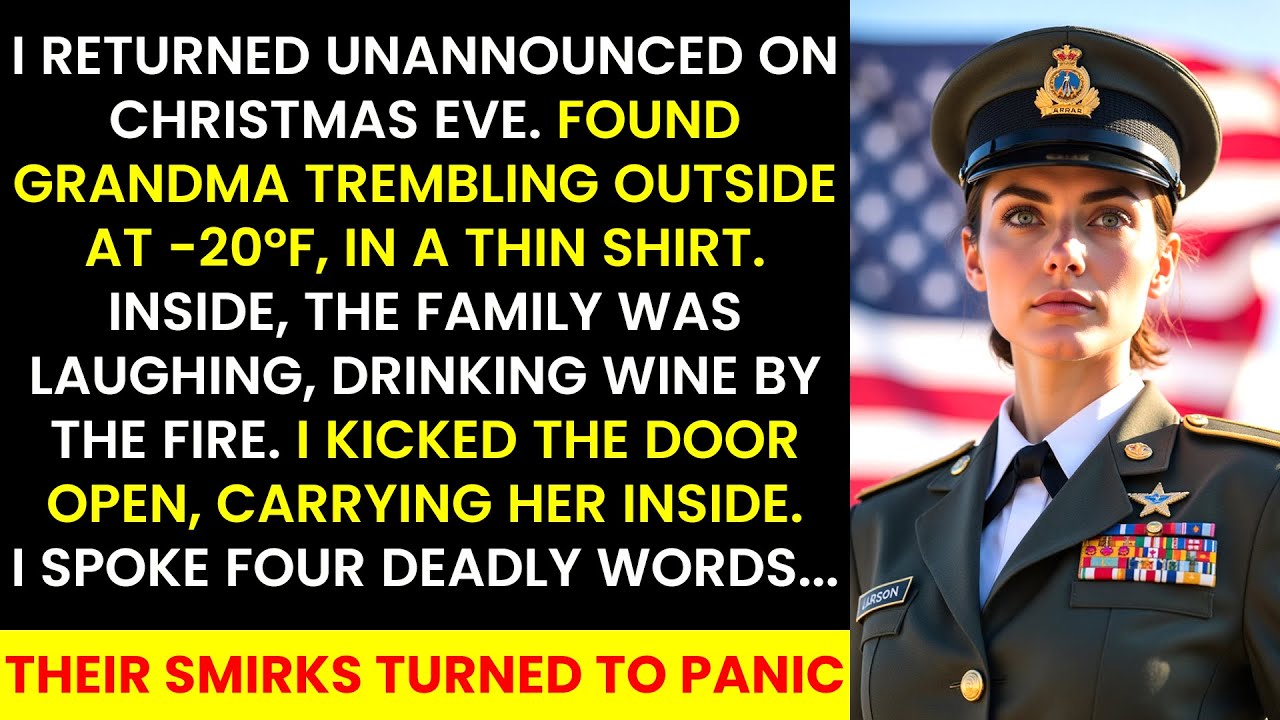
I rushed forward, scooped her up, and used my shoulder to kick the door open. Wood splintered. Her tiny weight rested against my chest. Champagne glasses froze midair.
The fire hissed as if it knew what I was about to say. Mom, Dad, and Tommy were uncorking expensive bottles of wine bought with the disability checks I sent home to care for Grandma. I looked into every eye in that warm room, seeing panic instead of the joy of reunion. Captain Elena Larson didn’t come home to party.
I came home to witness the basest betrayal. I let my voice turn cold. “Who locked this door? ”
I didn’t wait for an answer.
I carried her past them and knelt on the thick Persian rug in front of the roaring fireplace. I laid her down gently. Up close, the damage was undeniable. Her skin was waxy and pale, pulled tight over her cheekbones.
A distinct acrid smell of urine hit my nose—a classic sign of severe hypothermia. My mother, Linda, let out a sharp gasp, but she didn’t rush forward to hold her mother’s hand. She scrambled backward, covering her nose with a manicured hand. “Oh my god,” she shrieked.
“You’re ruining the rug. Do you know how much that costs to import? She’s leaking on the weave. ”
That was the first thing my mother said to me after two years of deployment.
Not welcome home. Not “Is Mom okay? ” Just the rug. I ignored her.
I stripped off my heavy dress coat and wrapped it tight around Grandma’s shivering frame. I began rubbing her hands and feet, checking for a pulse. It was thready, weak. “Call 911,” I barked, not looking up.
My father, Robert, set his wine glass down. He didn’t look remorseful. He looked annoyed, like I had interrupted a business meeting. “Don’t be dramatic, Elena,” he said, waving a dismissive hand.
“We just put her out there for a few minutes to get some fresh air. The house was getting stuffy. We have guests arriving in twenty minutes. ”
He spoke about the woman who birthed him as if she were a wet dog that needed chaining in the backyard.
“Fresh air? ” I repeated, my voice low. “It’s -20°, Dad. That’s not fresh air.
That’s a death sentence. ”
From the corner by the wet bar, a familiar mocking laugh cut through the tension—Tommy, my 28-year-old brother, leaning back and tapping away on a new iPhone his waiter salary couldn’t cover. “Oh, come on, big sis,” he slurred. “She’s senile.
She keeps nagging us to turn up the heat. And you know how expensive gas is. Putting her out there cools her down. ” He smirked.
“Seriously, where did you rent that soldier costume? You look like a clown from the circus. ”
He insulted the uniform I’d worn while bleeding in foreign lands—the very thing that paid for the roof over his head. But I didn’t engage.
My focus was on the woman trembling beneath my coat. Grandma Margaret’s eyes fluttered open. The warmth of the fire and heavy wool were bringing her back, but her mind was still trapped in the cold. Her milky eyes locked onto my face, and she flinched violently, curling into a fetal position.
She didn’t see her granddaughter. She saw a figure in uniform. “I’m sorry. I’m so sorry, ma’am,” she whispered, her voice cracking like dry leaves.
“I know I smell. Please don’t hit me. I’ll go back outside. Just don’t hit me.
”
Those words hit me harder than any shrapnel ever could. What had they done to this proud, strong woman to make her this terrified? I pulled her close, burying my face in her silver hair as hot tears finally spilled over. “No one is going to hit you, Grandma,” I promised, my voice fierce and shaking.
“I swear it. ”
Outside, the faint wail of sirens began to rise in the distance. I stood up, my shadow stretching long across the rug. “I have already called the police,” I announced.
My mother screeched. Her champagne flute slipped from her fingers and shattered on the hardwood floor. “Are you insane, Elena? ” she screamed.
“Tonight is Christmas Eve. Councilman Miller and his family will be here in less than thirty minutes. Do you want to destroy the reputation your father and I have spent years building? ”
She didn’t ask if Grandma was breathing.
She didn’t ask if she needed an ambulance. She lunged at me, hand raised high—an old reflex from my childhood. But I wasn’t twelve anymore. I was a United States Army captain.
I caught her wrist midair, just enough to stop her momentum dead. I held her gaze, letting her see the contempt in my eyes, then released her with a sharp shove. My father stepped forward, trying to inflate his chest. “Let go of your mother.
You go off to play soldier for a few years and think you can come back and run my house. I am your father. ”
I let out a short, dry laugh. “Your house?
” I asked, stepping toward him. He stepped back. “According to my bank statements, I’ve paid the mortgage for the last twenty-four months. I paid for the new roof.
And I paid for the central heating—the same system you’re using to warm your ego while your mother froze to death on the porch. ”
He retreated until he bumped into the mantle. “Where are her pills? ” I demanded.
“Where is her heart medication? ”
My mother averted her eyes. It was Tommy who answered. “The doctor said those pills were getting too expensive,” he said, swirling ice in his glass.
“And honestly, she’s eighty-two, Elena. It’s not like they were going to make her live forever. We switched her to herbal supplements, and it saved us a ton of cash to finally start the kitchen remodel. ”
I felt a wave of nausea.
“I send $3,000 home every single month. Her medication costs $500. You cut her life-saving medicine to remodel a kitchen? ” I looked at them—my mother’s expensive makeup, my father’s tailored Italian suit, Tommy’s brand-new Air Jordans.
Every stitch of clothing, every drop of liquor, was bought with the blood money I earned in a war zone. And the cost was my grandmother’s life. “You aren’t a family,” I said, my voice quiet and deadly. “You are parasites.
You’ve been feeding on me and on her for years. ”
My father opened his mouth to speak, but I cut him off. “But lucky for you,” I whispered, “I just brought home the insecticide. ”
At that exact moment, the sirens exploded into clarity.
Red and blue lights flashed through the front window. A heavy, authoritative pounding echoed from the door. “Open up! ” Sergeant Mike Ruiz boomed.
He was one of the few people I still trusted—he’d grown up three houses down and used to shovel Grandma’s driveway for free just because she gave him oatmeal cookies. My father scrambled backward. “Don’t open that, Elena. Tell them it was a mistake.
”
I walked straight to the door and pulled it open. Mike stepped inside, flanked by two patrol officers. He looked at Grandma shivering on the rug, smelling of urine and neglect. Then he looked at my parents in their finery.
His expression shifted to sheer disgust. “Paramedics thirty seconds out,” Mike said. While the EMTs tended to Grandma, I wasn’t done. I walked to where Tommy was sulking and grabbed his wrist, yanking up his sleeve to reveal a heavy gold watch.
A Rolex Submariner. “Nice watch,” I said lightly. “Bought with my credit card, didn’t you? ”
“You said I could have some pocket money while you were deployed!
” he stammered. “For emergencies. ” I unclasped the watch and held it up. “This is a $12,000 timepiece, Tommy.
Do you know where I got $12,000? ” I hurled it against the brick fireplace. It shattered with a satisfying crunch. “That was my hazard pay—the bonus for surviving an IED explosion that killed two of my friends.
You’re wearing my blood money on your wrist to impress girls at the dive bar. ”
I turned to the liquor cabinet and pulled open the bottom drawer, grabbing a thick manila folder. I dumped the contents onto the dining table: bank statements, credit card bills, and right on top, the power of attorney I had signed over to my father two years ago, trusting him to handle my finances and Grandma’s care. “Withdrawal, Mystic Lake Casino, $500,” I read aloud for the police to hear.
“Withdrawal, Mystic Lake Casino, $800. Mercedes-Benz of Minneapolis, lease down payment, $4,000. Serenity Spa, $300. ”
I flipped to the medical section and held up a letter from the home health agency.
“Service cancellation notice. Reason: client request. Estimated savings: $2,000 a month. ” I shoved the paper into my father’s chest.
“You signed this the week after Grandma fell down the stairs, didn’t you? You fired her nurse. And look at the date on this receipt for the lift kit on your truck—it matches perfectly. ”
My father stared at his polished shoes.
His silence was a confession louder than any scream. Mike placed a hand on my shoulder. “Elena, the EMTs are loading her up. Her heart rate is erratic.
She needs the hospital now. ”
“Mike,” I said, my voice steady and official. “Start the paperwork. First-degree elder neglect, fiduciary abuse, and embezzlement.
”
My mother rushed forward, grabbing my arm. “You can’t do this. I am your mother. Are you going to send your own parents to prison?
”
“No, Mother,” I said, brushing her hand off my uniform. “I’m just letting the law do what I should have done a long time ago. You better pray your lawyer is good. ”
I turned and walked out into the cold night, following the stretcher, leaving the warmth of that house behind forever.
As the paramedics loaded Grandma into the ambulance, my mother blocked the doorframe, arms crossed, face twisted with rage. “If you walk out that door with her,” she hissed, “don’t you ever think about coming back. You are dead to this house, Elena. ”
“You are mistaken, Linda,” I said, using her first name for the first time.
“I have been dead to this house since the day you told me to enlist. You didn’t send me away to serve my country. You sent me away to get the signing bonus so you could pay off Dad’s gambling debts before the loan sharks broke his legs. I died that day.
Now I am just salvaging the only survivor. ”
I signaled the EMTs. “Move out. ”
As I climbed into the ambulance, a loud crash echoed from above—my heavy travel suitcase hurtling down from the second-story window, bursting open on the frozen driveway.
My clothes, my books, and a stack of letters I’d written to them from Syria but never had courage to mail scattered across the snow. “Get out, you traitor! ” Tommy screamed from the window, swaying drunkenly. “Take your trash with you!
”
I watched one letter blow across the yard. For a split second, I thought about salvaging the pieces of my life. Then I looked at the ambulance and turned my back. They were just debris from a past life I no longer needed.
Inside, Grandma reached out, her grip surprisingly strong. “Annie,” she wheezed, her eyes wide with terror. “Don’t leave me. Please don’t let them take me to the home.
”
“No one is taking you to a home, Grandma,” I promised. “I’m taking you to the base. It’s a secure location. I’m going to stand guard.
”
“The base? ” she whispered, panic receding. “That’s right. We’re going to the forward operating base.
It’s safe there. ”
The driver looked back through the partition. “We’re heading to Mercy General Hospital. ETA twelve minutes.
”
My mind raced. The power of attorney wasn’t just financial—it was medical. If we went to a civilian hospital, my father could walk in and legally demand to take her home against medical advice. I tapped hard on the glass.
“Negative,” I said, pulling out my military ID. “Do not go to the hospital yet. Reroute to the Oak Creek Police Station. My father has medical power of attorney.
If we go to the hospital, he takes custody. I need an emergency protective order and an assessment from adult protective services to override his authority. ” My eyes locked with his in the rearview mirror. “If you take her to the hospital, you are handing her back to the people who froze her.
Drive to the police station now. ”
The ambulance banked hard to the left. We weren’t going to a doctor. We were going to a war room.
The station was deserted on Christmas Eve. We bypassed the holding cells and took Grandma to the employee break room—the warmest room in the building. Mike returned with a thick wool blanket and a Styrofoam cup of hot cocoa, complete with marshmallows. “Thank you, officer,” Grandma whispered.
“At home, they don’t let me have this. They say sugar makes me wet the bed. They say it ruins the mattress. ”
The innocence of her statement hung in the air like toxic smoke.
Mike turned away, pretending to check the coffee pot, but I saw him wipe his eyes. Ten minutes later, Sarah from Adult Protective Services arrived. “Captain Larson, I need you to help me remove her wet clothing so we can document her physical condition. ”
When the thin fabric peeled away from Grandma’s skin, I had to bite my lip hard enough to taste blood.
Her body was a map of cruelty. Her ribs protruded sharply—severe malnutrition. But it was the bruises that made the room spin. Purple, black, and yellow, marking injuries old and new.
“See the spacing? ” Sarah pointed to a distinct set of bruises on Grandma’s upper arm. “Three fingers on one side, a thumb on the other. This is a grab mark.
Someone grabbed her here hard and dragged her. ”
I knew that grip. I knew the size of that hand. It was the same hand that wore a platinum wedding ring—my father’s hand.
“And this,” Sarah continued, rolling up Grandma’s pant leg to reveal a jagged, angry gash running down her shin, red and swollen with infection, crudely bandaged with a paper towel and duct tape. “This needed stitches weeks ago. How did this happen, Mrs. Graham?
”
Grandma shrank back. “It was an accident,” she stammered, eyes darting to me. “Tommy was watching the Sunday game. He said I was walking too slow.
I was blocking the television. He pushed the coffee table to get me to move. ”
Tommy—the boy I used to carry on my back—had shoved a heavy table into an eighty-two-year-old woman because she blocked his view of a football game. I pulled out my phone and photographed the evidence.
Mike returned with a file. “I ran a quick check on the address. In the last two years, there have been zero 911 calls from your parents’ home. But your grandmother has been admitted to the emergency room three times for household falls.
Each time, the doctor recommended admitting her for observation and physical therapy. And each time, your father used his medical power of attorney to refuse care. ” He looked me dead in the eye. “This isn’t just neglect, Elena.
This is slow-motion homicide. They were waiting for her to die. ”
He slid a form across the table—an emergency protective custody order. “If you sign this, it strips your father of his legal authority immediately.
But once you sign it, there is no going back. Your parents will face felony charges. Five to ten years in state prison. ”
I looked at Grandma, blowing on her cocoa, looking more peaceful than she had in years.
I picked up the pen. I wasn’t signing a complaint against my parents. I was signing a treaty of protection for an innocent citizen. The scratch of the pen was loud in the quiet room—a daughter becoming a soldier again.
“File it, Mike,” I said. My phone vibrated against the table. My mother’s face lit up the screen. I hit speaker.
“Elena, what are you doing? ” she shrieked. “The police just called your father. He’s under criminal investigation.
Are you trying to kill me? I’m having a heart attack right now! ”
“Have you called 911,” I asked calmly, “or do you need me to come back and dial the number for you since you seem capable of screaming just fine? ”
Silence.
Then the viper returned. “You ungrateful little brat. I carried you for nine months. I gave you life, and this is how you repay us?
By destroying our Christmas? ”
“You didn’t give me life, Linda. You gave me a debt to pay off. ”
My father’s voice boomed through the line.
“If you do not walk back into that police station and retract every word, I will ruin you. I will tell the town you have severe PTSD from the war. I will paint you as a mentally unstable, paranoid veteran making up stories to hurt her loving family. ”
He was weaponizing my service against me.
I laughed, dry and humorless. “Go ahead, Dad. Put me on the stand. But you’re forgetting one thing.
My PTSD isn’t from the war. The army psychologists have a very thick file on me. My complex PTSD is documented as the result of prolonged childhood emotional abuse and domestic instability. My medical records will be exhibit A in court.
They don’t prove I’m crazy. They prove you are a monster. ”
Silence. I had struck the fatal blow.
“We’re coming down there! ” Tommy screamed from the background. “I’m going to smash that station to pieces. ”
I ended the call.
“Get your team ready,” I told Mike. “They’re on their way. And Tommy sounded like he finished the rest of that scotch bottle—add driving under the influence to the charge sheet. ”
Suddenly, the glass front doors vibrated.
High beams cut through the darkness, sweeping across the parking lot. A car screeched to a halt right in front of the entrance. They were here. I stood alone in the interrogation room, staring at my reflection in the two-way glass.
My hands were trembling—not from fear, but from the crushing weight of what I was about to do. I reached into my breast pocket and pulled out a small tarnished St. Michael medal, the patron saint of law enforcement and paratroopers. Grandma had given it to me the day I shipped out for basic training.
“Lord,” I whispered, “give me the strength not to soften. Give me the strength to do what is necessary. ”
The door clicked open. But it wasn’t Mike.
It was Grandma, supported by his elbow. The warmth had brought color back to her cheeks. She sat down slowly on the metal chair and looked at me with sharp, clear eyes. “You’re thinking you’re a bad daughter, aren’t you, Annie?
” she asked softly. She hadn’t called me Annie in years. “They are my parents,” I said, my voice cracking. “I know they’re cruel.
But sending them to prison—am I being too harsh? Am I being evil? ”
Grandma reached out and took my hand. “Forgiveness is God’s business, child.
It is not yours. Not tonight. Our job on this earth is not to enable sin. It is to stop it.
If you let them walk away, if you let them take me back to that house, you’re not loving them. You’re helping them destroy their own souls. ” She paused. “Do you remember when you were ten?
Your father came home angry. He took off his belt. He was coming for you. ”
I flinched at the memory.
“I stood in the doorway,” Grandma said. “I told him that if he wanted to touch you, he would have to go through me first. I didn’t do it because I hated your father. I did it because I loved him too much to let him become a monster who beats his child.
” She leaned forward. “Now the tables have turned, Annie. You’re the one standing in the doorway. You aren’t punishing them.
You’re stopping them from adding murder to their list of sins. ”
Her words blew away the smoke of my doubt. I lifted her hand to my lips and kissed her bruised knuckles. “I will be your shield, Grandma, just like you were mine.
”
Suddenly, a commotion erupted from the front of the station. I heard Tommy’s drunken slurring, my mother’s shrill demanding voice. The storm had made landfall. I buttoned the top button of my dress tunic.
It was a small gesture, but to a soldier, it meant one thing: I was buttoning up for battle. “Stay here, Grandma. Mike will keep this door locked. ”
I walked into the chaos.
The double doors flew open with violence. Tommy stumbled through first, completely wasted. “Where is she? ” he screamed.
“Give us the old hag back. You think you can just kidnap her? ”
He lunged forward, shoving a patrol officer who stepped in his path. “Do you know who my father is?
”
That was the wrong move. The officer swept his legs out from under him. Tommy hit the linoleum with a heavy thud, and before he could process the pain, two officers had his arms twisted behind his back. “Thomas Larson,” Mike announced.
“You’re under arrest for disorderly conduct, assault on a police officer, and suspicion of driving under the influence. ”
My parents froze in the doorway. My father’s jaw dropped. But my mother recovered quickly.
She threw herself onto her knees in the middle of the lobby, grabbing the hem of my trousers. “Elena, what are you doing? ” she wailed. “He’s your baby brother.
He has a bright future. He’s just a boy! ”
“He’s twenty-eight years old, Mother,” I said flatly. “He’s not a boy.
He just drove drunk to a police station to assault his sister. I didn’t ruin his future. He did. ”
“You monster!
” she shrieked, scrambling to her feet. “I should have known, Robert. ”
The voice was soft, but it stopped the room cold. Grandma stood in the doorway, wrapped in the police blanket.
My father’s eyes lit up with desperate hope. “Mom! Thank God. Tell them this is all a misunderstanding.
Tell them you wanted to go outside. Tell them you locked yourself out by accident. We can go home. ”
Grandma looked at him—the son she had raised, protected, given her home to.
She shook her head slowly. “No, Robert. I did not lock myself out. You locked that door.
You watched me through the window. ”
“Mom, please—”
“You locked the door to the house. And tonight, you locked the door on us. You are not my son anymore.
You are just a man who hurt me. ”
My father recoiled as if she had slapped him. Mike stepped forward with a folded warrant. “Robert Larson, Linda Larson, I have an emergency warrant for your arrest on charges of first-degree elder abuse, neglect of a dependent adult, and financial fraud.
”
“You can’t do this! ” my father sputtered. “I know the mayor. We play golf on Sundays.
I’ll have your badge for this. ”
“The mayor actually just called me, Mr. Larson,” Mike said calmly. “He saw the preliminary report.
He told me to tell you he’s very disappointed. Turn around. Hands behind your back. ”
I stood watching the people who had defined my life, who had controlled me, who had haunted my nightmares, being led toward the booking cells.
I expected to feel happy. I expected to feel triumphant. Instead, I felt a massive crushing weight lift off my shoulders. The constant low-level anxiety that had hummed in my background for thirty years simply vanished.
The nightmare hadn’t faded away. I had ended it. By the time the sun rose on Christmas morning, the Oak Creek Gazette had hit the driveways. “Christmas Eve Tragedy: Former Councilman Arrested for Elder Abuse.
” I drove past the house on Maple Street. The curtains were drawn tight. The customized truck and my mother’s leased Mercedes had been towed away—seized as evidence. My parents had spent their entire lives worshiping their reputation.
Now they had lost it all. Later that morning, the forensic accountant slid a spreadsheet across the table. “It’s worse than we thought, Elena. Over the last three years, you sent home nearly $150,000.
Every cent is gone. There’s zero savings left for Mrs. Graham’s care. ”
I looked at the asset list the police had compiled.
Tommy owned three motorcycles. My mother’s closet contained designer handbags appraised at $40,000. I laughed—a dry, bitter sound. “Sell them,” I ordered.
“Liquidate everything. The bikes, the bags, the jewelry, the furniture. Every penny goes into a trust for Grandma’s medical bills. They wanted to live in luxury while she rotted.
Now their luxury will pay for her recovery. ”
That afternoon, I went to the county jail to sign the formal deposition. Without the expensive suits and layers of makeup, my parents looked ancient. Small.
My mother pressed her face against the plexiglass divider. “Elena, please, you have to post bail. It’s Christmas. You can’t leave us in here with these criminals.
”
“I can’t,” I said calmly. “I spoke to the judge this morning. Because your victim is the primary witness, and because you have a history of intimidating her, the judge has denied bail. He considers you a flight risk.
”
“But we’re your parents! ”
“And she is your mother. This is the consequence of your choices. You chose the rug over her.
You chose the kitchen remodel over her heart medication. ”
I hung up the phone and turned my back. When I returned to the police station, the lobby looked like a flower shop—covered in bouquets, boxes of cookies, and handmade Christmas cards. Grandma sat in the captain’s chair, wrapped in a blanket, holding a stuffed bear, surrounded by three burly officers listening to her tell a story about her childhood.
“They call her the Christmas grandma,” Mike said. “Half the town dropped off gifts. ”
I watched her laugh—a real, genuine laugh that crinkled her eyes. She wasn’t scared.
She wasn’t shrinking away. I realized I had been wrong about one thing. I hadn’t destroyed my family. I had just pruned the dead branches so the tree could finally breathe.
Two days later, I wheeled Grandma out of the hospital. I didn’t point the truck toward the suburbs. I pointed it north, toward the deep woods. We drove for two hours, watching the gray city sprawl give way to snow-covered pines and frozen creeks.
“Where are we going, Annie? ” she asked. “We’re never going back to Maple Street, Grandma. We’re going home.
A real home. ”
We pulled up a gravel driveway. Nestled between tall pines, overlooking a frozen lake, sat a small log cabin. It didn’t have crystal chandeliers or imported Persian rugs.
It was made of rough-hewn timber and stone. I had bought it with money I saved during my first tour in Iraq. Honest money. Clean money.
I opened the door, and a golden blur launched itself at us. “Buster, down! ” My golden retriever skidded to a halt, tail wagging so hard his whole back half wiggled. He sniffed Grandma’s hand, then pressed his head against her leg, whining softly.
She froze for a second, then buried her fingers in his fur and giggled—a light, bubbly sound I hadn’t heard in twenty years. I settled her into the big leather armchair and went straight to the stone hearth. Unlike the gas fireplace at my parents’ house—that fake, instant flame with no soul—this was real. I stacked seasoned oak logs and struck a match.
Within minutes, a genuine fire was roaring, filling the room with deep, penetrating heat. I ladled out two bowls of homemade chicken noodle soup, and we sat by the fire, Buster resting his chin on Grandma’s slipper. She ate hungrily, her hands steady. The fear that had defined her existence for so long was melting away.
“Look, Grandma,” I said, pointing to the mantle. She gasped. Hanging there were two red wool stockings. One embroidered with “Annie.
” The other, brand new and fluffy, had “Grandma” stitched in white thread. “Oh, Annie,” she whispered, tears spilling over. “My whole life, I’ve always been the one filling the stockings. I’ve never had one with my name on it before.
”
I wrapped my arms around her shoulders. “From now on, you will always have a stocking. And I promise you, it will always be full. ”
Later that night, after Grandma had fallen asleep with Buster snoring on the rug beside her bed, I stood by the large window in the living room.
The moon cast a silver path across the frozen lake. I began to unbutton my dress uniform, took off the tunic heavy with ribbons and medals, and hung it on the coat rack. The war on Maple Street was over. I had lost my parents.
I had lost my brother. I had lost the house I grew up in. But as I looked toward the bedroom where my grandmother slept safe and warm, I knew I had won the only battle that mattered. I thought about my oath of enlistment.
“I, Elena Larson, do solemnly swear that I will support and defend the Constitution of the United States against all enemies, foreign and domestic. ” For years, I thought the enemy was across the ocean. But sometimes the enemy is in your own living room, holding a glass of champagne while someone freezes on the porch. I had faced the domestic enemy.
I had held the line. “Mission accomplished,” I whispered to the silent, snowy night. I turned off the lamp, leaving only the embers glowing in the dark, keeping watch over my family.