The county courthouse parking lot in Ohio was gray and freezing, matching my mother’s mood as she huddled inside her old Ford Taurus. Her knuckles were white, her thin hands clasped so tight they looked brittle. She wore the same fraying brown wool coat she’d bought on clearance years ago, and she stared out the foggy window at my father’s black Porsche pulling into the reserved spot. “Heidi.
” Her voice trembled. “He has an entire team of lawyers. He told me he’d crush me into dust if I dared to ask for a division of assets. Maybe we should just go home.
I don’t need the money. I just want peace. ”
I took her cold, calloused hand—the hands that had worked thirty years to build my father’s company—and squeezed it. “We aren’t going anywhere, Mom.
”
Inside the lobby, my father stood in a tailored Armani suit, laughing too loud, his young mistress Tiffany glued to her phone, chewing gum with her mouth open. When he saw us, his laughter died into that familiar sneer. “Well, look at that,” he said, loud enough for everyone to hear. “Who did Martha bring along?
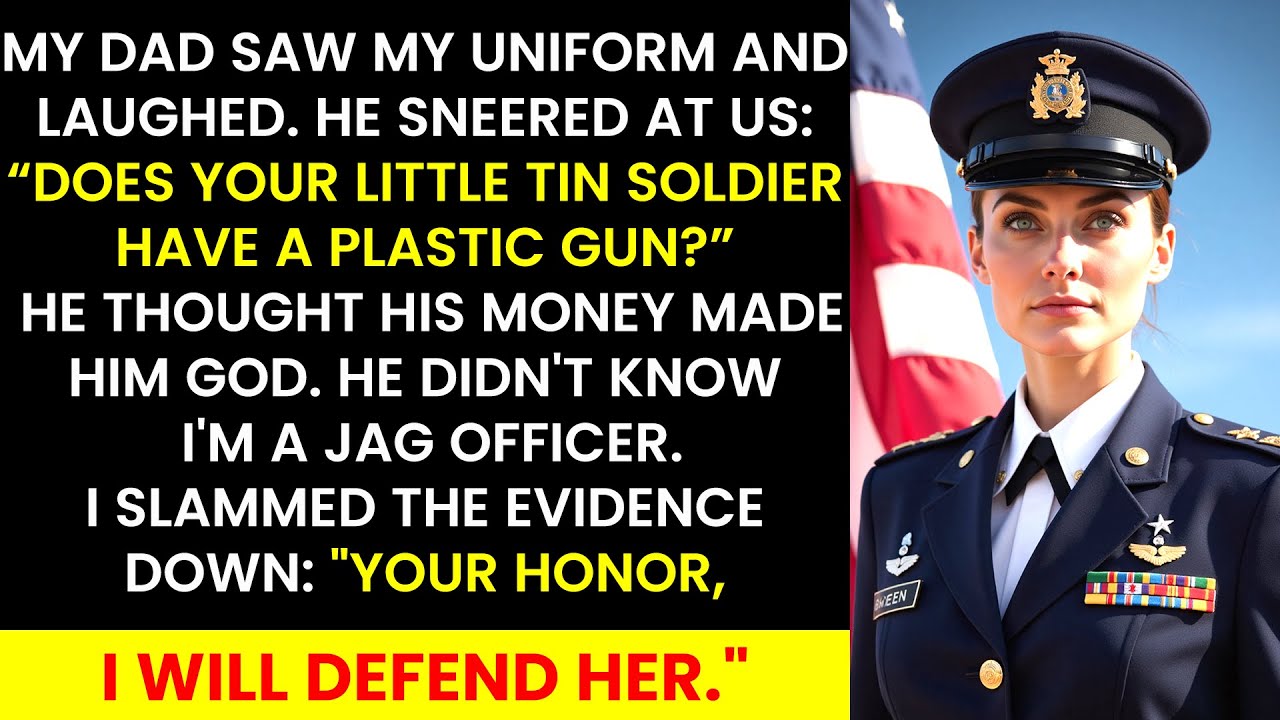
Does her little tin soldier plan to use a plastic gun to scare the judge? ”
His lawyer and Tiffany burst out laughing. My mother shrank into her coat. I kept my face a stone mask, a skill learned through thousands of hours of interrogation training—you never let the enemy see you bleed.
My father leaned down as he passed our table, his cologne sickening. “This is the real world, Heidi, not your little army barracks. Money talks. Honor is garbage for losers.
Tell your mother to sign the waiver and get lost. ” He pulled back, smug, and sat down. Tears dropped silently onto my mother’s battered handbag. That anger rose hot in my throat.
He wasn’t just betraying her—he was trying to strip away her last shred of dignity. “All rise,” the bailiff boomed. Judge Harrison entered, silver-haired and stern. He frowned at the paperwork.
“Defendant Martha Green,” he said, peering over his glasses. “I do not see a record of legal representation in your file. Do you intend to represent yourself today? ”
From the other table, a stifled giggle.
My father and Tiffany leaned in, eager to watch her collapse. But that moment never came. I stood up—not just stood, but snapped to attention. My military dress shoes clacked together, a sharp, singular sound that cut through the murmur of the courtroom.
I adjusted the rack of ribbons on my chest. “Your honor,” I said, projecting with the command authority of a commanding officer, “I, Captain Heidi Green of the United States Army Judge Advocate General’s Corps, will be representing her. ”
The silence was absolute. For the first time all morning, the predator looked unsure.
He thought he was fighting a helpless old woman. He had no idea he had just declared war on the United States Army. As the judge reviewed my power of attorney, I looked at my mother’s hands resting on the table, shaking. Those rough hands, the swollen knuckles, the calluses—they took me back to our cramped kitchen in the mid-nineties, thick with the smell of onions and stale fryer grease.
My father had just started Green Construction, nothing but a guy with a pickup truck and a dream, drowning in debt. To keep the lights on, Mom worked double shifts at Denny’s, on her feet twelve hours a day, coming home with her ankles swollen to the size of softballs. I remember those dinners—cheap blue-box mac and cheese. Mom, still in her stained waitress uniform, would serve my father first, then me.
When she finally sat down, her plate held nothing but the burnt scraps from the pan. “I’m full, sweetie,” she’d say with a tired smile. “Your father needs the energy. He’s building something big for us.
” She was starving. She was feeding his ambition with her own body. But the success came, and everything changed. The rusty pickup was traded in.
And instead of relief, a new tension entered our home. Dad traveled more. He looked at Mom with disgust. I remember one evening, getting dressed for a Chamber dinner.
Mom came out in her best floral dress, and he just sighed. “You always smell like grease and dish soap,” he said, not even looking at her. “It’s embarrassing. You’re making me look bad.
” He didn’t hit her. Words like that leave bruises that never heal. She locked herself in the bathroom and scrubbed her skin raw, trying to wash away the smell of the labor he’d once been thankful for. The ultimate betrayal came on Christmas Eve.
I was eighteen, fresh out of boot camp, come home on leave. I walked in expecting roast turkey and carols. Instead, I found my mother sobbing on the edge of the bed, holding a stack of papers. Dad was packing a suitcase, calm and bored.
“We just aren’t compatible anymore, Martha,” he said. “I’ve outgrown this life. I need someone who can stand beside me at galas. ” He handed her a settlement he’d drawn up himself.
“Sign it. It’s fair. I’ll take care of you. Don’t get the courts involved.
” And she signed it. She believed him. I blinked, pulling myself back to the courtroom. Across the aisle, Tiffany whispered something to my father, giggling, her hand covering her mouth, a diamond ring the size of a grape on her finger.
Worth at least fifty thousand dollars—more than the entire value of the apartment my mother was renting. Paid for by the double shifts, the clipped coupons, the woman being discarded like an old piece of furniture. Starter wife syndrome. The woman builds the man up, and once he reaches the summit, he pushes her off the edge and pulls up a younger model to enjoy the view.
I looked back at my mother’s hands. They were still shaking. But those were the hands that had held me when I cried, that had scrubbed floors and carried heavy trays. I wasn’t here to defend her.
I was here to collect a debt thirty-two years overdue. The recess was announced, and I watched my father strut out into the hallway like a general. He’d always wanted a son, a Robert Jr. to inherit the empire.
When I was born a girl, his disappointment was quiet. When I told him I wanted to study law and join the army, it turned to open contempt. On the day I got my law school acceptance, he didn’t even put down his newspaper. “I’m not paying a single red cent for that,” he said.
“Lawyers are parasites. The army? That’s for people who aren’t smart enough to make it in the real business world. Go play dress up.
Don’t come crawling back to me when you can’t pay the rent. ”
So I didn’t. I joined ROTC to pay for my education. While the children of his business partners drove BMWs bought with daddy’s money, I was low-crawling through freezing mud pits.
I never asked him for a dime. I thought if I succeeded on my own terms, he’d respect me. I was wrong. Every time I came home in my uniform, I only saw a sneer.
In the hallway, I was getting a bitter vending machine coffee when he found me, a Starbucks latte in his hand. “I heard what a captain makes these days,” he said, his voice dripping with fake pity. “It’s embarrassing, Heidi. Look at you.
No makeup. You look so severe. When this is over, come work for me as my executive secretary. The pay is double.
You could finally afford some lipstick. Start looking like a woman. ”
The insult landed with precision. He wasn’t just attacking my career—he was attacking my identity, telling me my value lay in my appearance and my subservience to men like him.
He expected me to get angry, to cause a scene he could use. I took a slow, deliberate sip of my coffee. “Thank you for the offer, Mr. Green,” I said, using his last name, watching him flinch.
“But the United States Army pays me enough to understand a simple concept. Honor is not something you can purchase with a platinum credit card. You should be less worried about my lipstick and more worried about your CEO chair. You made a mistake, Bob.
You judged me by your standards. When I am done with you in that courtroom, you are going to wish you had never woken up this tin soldier. ”
I crushed my cup, dropped it in the trash, and marched away, leaving him rattled for the first time. That night, I transformed my mother’s cramped dining table into a command post.
While she slept, I sifted through boxes of junk she’d saved from the house—old receipts, expired warranties, junk mail. My father had laughed at those boxes. But in the intelligence community, we have a saying: one man’s trash is another man’s conviction. I taped butcher paper to the wall and drew a timeline, scanning for anomalies.
By 3 a. m. , I was exhausted, but then I found it—a carbon copy of a FedEx waybill in an old issue of Field and Stream magazine. Sender: Robert Green.
Recipient: Blue Ocean Holdings, Ltd. Georgetown, Cayman Islands. A construction company in rural Ohio had no business sending documents to a tax haven. I checked the date on the receipt—May 14th.
On his calendar, that was marked as a business conference in Miami. I checked the next year. Another trip to Miami. Another FedEx receipt for a P.
O. box in the Caymans. The pattern emerged like a flare in the night sky. Miami wasn’t the destination.
It was the gateway. He was funnelling money offshore right under my mother’s nose. I didn’t sleep. As the sun rose, I drafted a federal subpoena, targeting the intermediary bank in Miami listed on the wire transfer codes, not the Cayman accounts directly.
My father’s lawyers were arrogant. They hadn’t scrubbed the paper trail because they didn’t respect their opponent. I attached my JAG credentials. It wasn’t a request—it was a demand backed by the United States government.
When I clicked send, I felt the cold thrill of locking a target into a weapon system. Two days later, the encrypted file arrived. As I scrolled through the transaction history, the blood drained from my face. It was worse than I thought.
It wasn’t just greed—it was cruelty. Millions funneled into shell companies registered to Tiffany. The 401k my parents had contributed to for thirty years had been drained; he’d forged my mother’s signature on a hardship withdrawal. And then the final document—a credit report.
Not his, my mother’s. He’d used her social security number to open five high-interest credit cards, maxed them out on gambling debts and gifts for Tiffany, and then defaulted. Her credit score was destroyed. He’d engineered a situation where she was financial poison—no landlord would rent to her, no bank would touch her.
This wasn’t just theft. It was financial domestic violence. I closed the laptop. “It’s not bad, Mom,” I said, my voice eerily calm.
“It’s criminal. ”
I dialed my father’s lawyer. “Tell your client we accept his invitation for lunch tomorrow,” I said. “And tell him to bring his checkbook.
”
The lunch was at the Capital Grill, where the city’s power players eat. My mother didn’t want to go—her shoes were scuffed. “We aren’t going there to eat,” I told her. “We’re going there so you can see exactly who he has become.
”
We were led to a private booth where my father and Tiffany were already seated, a two-hundred-dollar bottle of wine open on the table. He didn’t stand, didn’t greet us, just jerked his chin at the empty chairs. He was in the middle of a bloody ribeye. “Let’s cut the crap,” he said, shoving meat into his mouth.
“Here’s the final offer. ” He slapped a check on the table and slid it across. Twenty thousand dollars. His price for thirty-two years of marriage.
“Take that money,” he said, pointing at the check with his knife. “Buy yourself some new clothes. Go take a cruise. Then get the hell out of my life.
You’re old, Martha. Don’t fight for things you didn’t earn. ”
Mom stared at the paper like she’d been slapped. Then Tiffany decided to speak.
“Honestly, Martha, you should just take it. You haven’t contributed a dime to his success in years. You’re past your prime. What do you need more money for?
Are you saving up for a coffin? Because frankly, that check is enough to bury you comfortably. ”
Bob chuckled. He found it funny.
Mom let out a choked sob and covered her face. I stood up so fast my chair crashed to the floor. Every head in the restaurant turned. I grabbed my glass of ice water and threw it straight into Tiffany’s face.
She shrieked, knocking over the wine bottle. “You crazy bitch! ” she screamed. “Shut your mouth!
” I roared, my voice that of a captain on a drill field. She froze. I leaned across the table, inches from my father’s nose, and whispered, “Twenty thousand? You think my mother is that cheap?
You are going to pay for every single tear she shed today. And you aren’t going to pay with money. You’re going to pay with everything—your reputation, your company, your freedom. ” I picked up the check and ripped it in half, then in quarters, dropping the pieces onto his steak.
“Enjoy your lunch,” I said. “I’ll see you in hell. ”
I helped my mother up and we walked out with our heads held high. I thought the worst was over.
I was wrong. We got back to the apartment around 8 p. m. Mom said she felt tired, a dull ache in her left arm and tightness in her jaw, but she dismissed it as stress.
Ten minutes later, I heard a crash. She was on the floor, clutching her chest, gasping for air, her skin a terrifying shade of gray. I didn’t panic. Panic gets people killed.
I dialed 911 and started CPR, pumping her chest, counting out loud. The paramedics rushed her to County General. At the hospital, I was stopped at the triage desk while they wheeled her into the trauma unit. The administrator typed her name into the computer, and frowned.
“Ms. Green, I’m sorry, but the system is flagging her insurance as inactive. ” “That’s impossible,” I said. “She’s covered under my father’s policy.
” “The primary policy holder, Robert Green, removed her as a dependent effective today. ” “What time? ” I asked. She clicked a tab.
“The timestamp is 5:02 p. m. ”
My knees almost gave out. That was exactly twenty minutes after we walked out of the restaurant.
He’d known the stress could trigger a health crisis. He’d deliberately cut her lifeline. Without insurance, a single night in the ICU is enough to bankrupt a normal person. My phone buzzed.
A text from Bob Green: “See Heidi, this is the real world. Without me, your mother is a zero. I heard the ambulance. Good luck with the hospital bills.
If you withdraw the lawsuit by tomorrow morning, I might consider reinstating her coverage. This is a lesson about real power. ”
He was holding my mother’s beating heart hostage to save his bank account. I gripped my phone until the screen protector splintered.
The fear evaporated, replaced by a cold, dark fire. I thought of the Soldier’s Creed: *I will never leave a fallen comrade. * My mother was my fallen comrade. I whispered to the empty waiting room, “You want to play God?
Fine. I’m going to bring the war to your front door. This time, there will be no prisoners. ”
The next morning, before the sun was even up, I sold my Jeep—the first thing I bought with my own paychecks, my symbol of independence—for a lowball offer.
I didn’t have time to haggle. Assets can be replaced. Mothers cannot. On the bus back to the hospital, I opened Facebook and found my father’s post: him on a golf course in Palm Beach, grinning.
“Living the good life. staying away from negative energy and toxic people. ” He was playing golf while his ex-wife lay in a cardiac ward because he’d cut her insurance. I activated my network.
First, I called Gary, a former Army intelligence officer turned private investigator. “I need eyes on the Caymans,” I said. “I have a paper trail leading to Blue Ocean Holdings. I need proof that links the money to a person.
” Then came the real nuclear weapon. An unknown number. It was Barbara Wilson, the head bookkeeper my father had fired two years ago for refusing to cook the books. “Heidi, I kept a backup,” she whispered.
“I have the shadow ledgers. The real ones. ”
For the next forty-eight hours, room 304 became my war room. We taped spreadsheets to the walls, cross-referencing the bank transfer data with Mrs.
Wilson’s internal ledgers. The picture was staggering: massive federal tax evasion, money laundered through phantom real estate projects, diamond necklaces classified as office supplies. Every page was another nail in his coffin. On the night before the final hearing, Mom opened her eyes, deep and sunken.
“Heidi, you don’t have to do this. He’s powerful. I don’t want him to ruin your career. ” I took her hand.
“He doesn’t have power, Mom. He has money. There’s a difference. Tomorrow, you aren’t going to bow your head to him ever again.
” I put on my Class A uniform slowly, deliberately, fastening every button, pinning my ribbons. The woman in the mirror wasn’t the useless tin soldier he mocked. She was Lady Justice, ready to bring the hammer down. The final hearing began.
My father walked to the witness stand like he was strolling onto a yacht, winking at Tiffany. His lawyer gave a pitiful presentation about market volatility, claiming Bob was scraping by with zero liquid assets. Then it was my turn. “Mr.
Green,” I began, “you have just sworn under oath to tell the truth. Is that correct? ” “I did. ” “And you have stated your total assets are less than $100,000?
” “That is correct. ” He’d just committed perjury on public record. I started to pace. “Then how do you explain your travel schedule?
Twelve trips to Miami in the last eighteen months? ” “Networking,” he shrugged. “It’s part of the job. ” “And while you were networking in Miami, are you aware your wife was using coupons to buy expired bread because you limited her allowance to fifty dollars a week?
” Bob rolled his eyes. “It’s complicated, Heidi. You don’t understand the corporate world. ”
“You’re right,” I said, my voice hardening.
I walked to my table and picked up the heavy black binder—Mrs. Wilson’s ledgers, Gary’s photos. I lifted it high and slammed it down on the witness stand railing. Thud.
“But I do understand financial crimes. Your honor, I would like to submit exhibit A. ” I held up a bank statement from the Cayman National Bank, then the incorporation document for Blue Ocean Holdings. “Mr.
Green, do you recognize this signature? It’s dated two days before he filed for divorce. On that same day, a wire transfer of $2. 5 million was made into this account.
”
The courtroom erupted. Mr. Sterling objected, but the judge overruled him. “Where did that 2.
5 million come from, Bob? Did it come from networking, or from the joint 401k you liquidated by forging your wife’s signature? ” Bob started sweating, the expensive makeup streaking down his forehead. “I was moving funds for tax optimization!
” “You intended to steal,” I cut him off. “You committed federal tax evasion, wire fraud, and perjury five minutes ago. And the worst part, the part that makes you a monster—yesterday at 5:02 p. m.
, you cancelled my mother’s health insurance while she was in cardiac arrest. You tried to kill her with a spreadsheet. ”
Judge Harrison read the termination notice and the mocking text message. His face turned crimson.
“This court finds probable cause to believe the plaintiff has committed multiple felonies, including perjury and dissipation of marital assets. I’m referring this matter to the district attorney. Mr. Green, your bail is revoked.
You are remanded into custody immediately. Marshals, take him. ”
Two marshals grabbed him by the arms. “Heidi, please.
I’m your father. ” I stood at attention, my face a mask of stone. “You’re not my father,” I said. “You’re the defendant.
” The handcuffs clicked. As they dragged him out, Tiffany spun on the lawyer. “What about my allowance? What about the townhouse?
” “Everything is frozen,” Sterling said. “It’s all gone until the audit is complete. ” She stomped over to where the marshals held Bob. “You useless old fool!
” she screamed. “You told me you were untouchable! ” She yanked the massive diamond ring off her finger and threw it at him. It bounced off his Armani lapel and skittered across the floor.
“I hope you rot! ” she spat, and ran out the back door without a backward glance. I helped my mother stand. As the marshals led my father past our table, he stopped.
For the first time, I saw a small graying man, hands bound behind his back, terrified. “Heidi,” he whispered. “I didn’t think you could do it. ” I looked at him, and felt nothing but pity.
“That was your mistake,” I said calmly. “You underestimated the women of the Green family. You thought we were weak because we were kind. You forgot that kindness isn’t a lack of spine.
” “I can make this right. Tell them I’m your dad. ” I shook my head. “My father died a long time ago, the day he chose money over his family.
You’re just a defendant now. Goodbye, Robert. ”
They dragged him away. We walked out onto the courthouse steps, the afternoon sun warm on our faces.
Mom took a deep, shuddering breath, filling her lungs completely, as if for the first time in thirty-two years. “It’s over,” she whispered. She hugged me, burying her face in my shoulder. “Thank you, Heidi.
You saved my life. ” I held her tight. “I’ve got you, Mom. ”
She would get half of the true assets.
She would be safe. But there was a hollow ache in my chest. Justice is a bitter medicine. It tastes like blood and regret.
His lawyer came jogging down the steps. “Captain Green! My client is willing to talk. If you drop the fraud charges, he’ll sign over the Florida property.
It’s family. ” “Yesterday you watched him throw a check at my mother like she was a beggar,” I said coldly. “You aren’t negotiating with a daughter anymore. You’re negotiating with the relentless machinery of the federal government.
There are no deals. There is only the law. ” I waved down a taxi. I’d sold my Jeep; Mom’s Ford was dead in the driveway.
We owned no car between us, but I felt richer than I ever had. “Where do we go from here? ” Mom asked. I smiled.
“First, we’re going to a steakhouse—a nice one—and we’re going to order the biggest steaks and pay full price. No coupons. And then we’re going to find you a new house. A place that smells like flowers.
A place filled with respect. ”
Six months passed. I drove down a winding gravel road to a small white clapboard cottage with a wide front porch and a garden exploding with color. Pink and yellow roses climbed the trellis; hydrangeas bowed their blue heads.
For twenty years, my father had forbidden Mom from planting a garden like this—he called it cluttered and country. But now the air smelled like freedom. The woman who stepped out the screen door didn’t look like the terrified victim I’d defended. She looked ten years younger, in a bright yellow floral dress, her hair loose around her shoulders.
She was glowing. On Thursday, she was going ballroom dancing. “My feet still remember the steps,” she laughed. We sat on the porch drinking iced tea.
She told me she’d gotten a letter from my father, now serving five years for tax evasion and wire fraud. The IRS had seized everything. Tiffany had vanished, rumored to be living in Miami with a car dealership owner twice her age. The letter was shaky, stripped of its arrogance.
He wrote that he was “the poorest man on earth” and that he’d lost the only two people who ever loved him. “How does that make you feel? ” I asked. Mom looked out at her roses.
“Sad for him,” she said. “But I forgive him, Heidi. Not because he deserves it, but because I deserve peace. Holding on to hate is like drinking poison and expecting the other person to die.
I’m done drinking poison. ”
I looked at my uniform, hanging on a chair, my bags packed. “My orders for Germany came through,” I said. “I leave tomorrow at 0600.
” Her eyes got misty, but she smiled. “You have a job to do. ” I stood and ran my fingers over the fabric. “Dad always told me our legacy was the business—buildings, concrete, bank accounts.
He thought I was a failure for not wanting that. But he was wrong. He left a legacy of rubble and shame. You started with nothing, worked double shifts, raised a daughter who knows right from wrong.
I used to be ashamed that we were poor. Today, I’m prouder to be the daughter of a waitress than the daughter of a millionaire. Your resilience is my inheritance, Mom. That’s the real legacy.
”
The sun dipped below the horizon, painting the sky violet and gold. I put on my cover, my uniform hat. She cupped my face in her hands. “You be safe over there, Heidi.
You make them respect you. ” “I will,” I promised. “And you keep dancing. ” I walked to my car, and before I got in, I turned around.
She was standing on the porch, framed by the climbing roses, bathed in golden light. She wasn’t a victim. She wasn’t a starter wife. She was a survivor, the queen of her own castle.
I brought my heels together and raised my hand in a slow, crisp, ceremonial salute—not for a superior officer, but for the bravest warrior I had ever known. Mom smiled through her tears and waved. I got in the car and drove away, the war over, the home front secure. My father’s biggest mistake wasn’t the fraud.
It was his definition of wealth. He believed power came from controlling others. But watching my mother bloom in her sixties taught me the truth: true power is the courage to walk away from what hurts you. No matter how scary the unknown seems, it is never too late to rewrite your story.
You aren’t defined by the scars of your past or the balance in your bank account. You’re defined by your resilience.