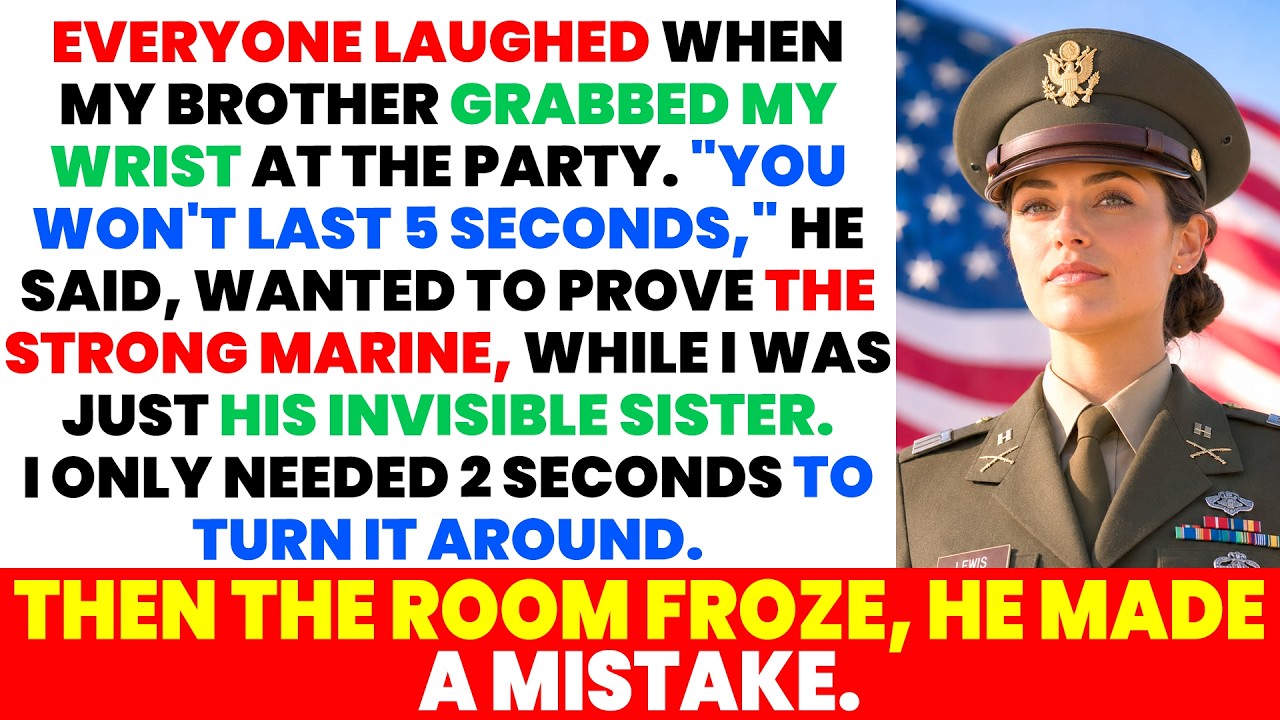
I set my cup down on the plastic table, slow and deliberate, the way you set a detonator on a flat surface. My little brother Derek had just grabbed my wrist in front of every relative we had, twisted it into a clumsy joint lock he must have learned six weeks ago at boot camp, and shoved me hard enough to snap my teeth together. He had been performing all afternoon. The welcome home barbecue was his victory lap, and our parents had treated it like a ticker tape parade for a war hero.
My mother spent two days decorating. Red, white, and blue streamers. A banner reading “Welcome home, Marine” stretched across the porch. A three-tier cake shaped like the Marine Corps emblem.
Every neighbor, every cousin, every distant aunt who owned a functioning pair of legs was invited. I sat in the far corner of the yard in a plastic lawn chair, nursing a warm can of flat soda. My fatigues were generic, stripped of any identifying patches or unit insignia. I looked like what my family wanted me to look like—a nobody in a uniform.
My mother introduced me to the neighbors with the same dismissive wave she had been perfecting for a decade. “Oh, that Anna girl. She does logistics. Just desk work, hauling supplies.
Enough for a pension, but not exactly glorious. Certainly can’t compare to what little Derek is about to sacrifice on the front lines. ”
She did not look at me once during the entire exchange. My cousin Linda cornered me near the cooler.
She meant well. She always did. “So, Anna, when are you going to settle down? Your mom says you’re just doing filing and shipping over there.
Must be lonely. ”
I told her I liked the work. She gave me the same look people give stray dogs in parking lots. My father stood three feet behind my mother during both conversations, beer sweating in his grip, and said nothing.
He caught my eye for half a second, guilt flickering across his face, then turned away and clapped Derek on the shoulder. Case dismissed. The golden child absorbed the praise. The invisible daughter sat in her corner and drank her flat soda.
Marcus sat beside me playing the role of my civilian boyfriend with the easy calm of a man who had rehearsed a hundred covers. In truth, he was my teammate. Special operations, same unit, same blood, same body count. Underneath the Hawaiian shirt and cargo shorts, his posture was textbook.
He tapped his index finger against the armrest in a slow rhythmic pattern. Three taps, pause, two taps. I read the signal without turning my head. Hold position.
Stay in character. Derek was done performing for the crowd. He was hunting for a target. He stood in the center of the lawn, rolling his shoulders, cracking his neck, throwing punches into the air.
Shadow boxing in a wide, sloppy stance that exposed his kidneys and his jaw simultaneously. The relatives crowded in, phones already rising, clapping with loud, brainless applause. My aunt Donna said, “Oh my god, that’s incredible. ”
A twenty-year-old throwing practice punches at oxygen.
I watched my own brother and saw a recruit who still smelled like laundry detergent and parade ground polish. Every gap in his technique was a gap that would get him killed in any real engagement. But this was a barbecue, not a battlefield. And the crowd loved the show.
His eyes swept the yard, searching for a prop, a stepping stone, something he could break to make himself look taller. They locked on my shaded corner. He smiled, the kind of smile a bully practices in front of a mirror. What Derek didn’t know was that I was the commanding officer of a special operations assault team.
Six operators, four nationalities, one mission. I didn’t wear office clothes. I wore thirty kilos of tactical armor. The week before his barbecue, I had cleared a building 300 meters from a border that was on fire.
My team stacked on the door. I was first in, always first in. A fighter lunged through the frame, his AK swinging toward my team. I closed the distance in two steps, collapsed his weapon arm with a strike that hyperextended the joint, locked my forearm under his jaw, and held him until he went completely slack.
I lowered him to the floor without a sound. Fourteen seconds, three rooms. Building clear. No casualties on our side.
My hands didn’t shake until we were back in the air, and even then I pressed them flat against my thigh armor until the tremor passed. The medic across from me, a man named Gutierrez who had a daughter Derek’s age, caught my eye and nodded. You did your job. You kept us alive.
You are still here. That nod was worth more than every standing ovation Derek would ever receive. Sixteen deployments. Nine countries.
A body count I would carry to my grave and never speak aloud. Every single time I flew home, I changed into jeans and a t-shirt and sat at the same plastic table, absorbing the pity and the scorn and the sidelong glances. I chose that cover. I maintained it because the alternative was a security breach that would end my career and endanger every operator I had ever served with.
And every time my mother opened her mouth to apologize for my existence to the neighbors, I swallowed the truth like a hot coal and washed it down with flat soda. The scar on my left side, the one I told them came from a car accident, pulsed with a dull ache. It came from a knife fight in a stairwell eighteen months ago. The man who gave it to me didn’t survive to give anyone else a scar.
Derek swaggered across the lawn now, two beers in his fists, cutting through the crowd like a man who believed the world owed him a runway. He planted himself in front of my father and launched into a tactical lecture. “You got to keep your head on a constant swivel,” he declared, jabbing the air. “You never know where the threat’s coming from.
”
My father nodded along, eyes wide with admiration. Ten seconds after that announcement about constant vigilance, Derek took a long pull from his beer and turned his back completely to the open gate behind him. A FedEx driver walked into the yard carrying a package, paused at the edge of the party, and left the box on the patio table. Derek didn’t notice.
He was reciting lines from a field manual. His actual situational awareness was zero. I tracked every flaw in his technique the way a mechanic listens for a bad bearing. His elbows flared too wide.
His center of gravity was high, unstable. If a real threat materialized in this yard, Derek would be the first person on the ground. I knew this the way I knew my own blood type. He tilted his chin toward me and smirked.
A challenge. I stayed motionless against the fence, eyes flat, breathing steady. I calculated the distance from his throat to the toe of my boot. Three steps.
Two if I pushed off the fence rail. I had already wargamed this scenario from six different angles while he was busy quoting textbooks. The cheap beer had been doing its work all afternoon, inflating his arrogance like a balloon stretched past the breaking point. He needed a live target now.
He cut across the lawn in three quick strides and invaded my personal space, planting himself close enough for the sour cloud of alcohol on his breath to hit me in the face. “Come on, big sis,” he slurred, grinning down at me with glassy, reddened eyes. “Let me show everybody what real battlefield strength looks like. ” He spread his hands wide.
“Don’t worry, I won’t break your fingernails. ”
I scanned the perimeter without moving my head. My parents stood six feet away. Neither of them moved toward us.
Neither of them opened their mouths. They were spectators, not protectors. They were waiting to see if I would embarrass them by running away or embarrass them by crying. Both endings had already been written in their heads.
Both versions ended with me losing. I looked up at my brother. I kept my voice flat. “Derek, sit down.
Enjoy the party. Nobody wants to watch us fight. ”
I had lowered a ladder for him. A clean, easy way to back down and preserve his ego with a laugh and a shrug.
But in the architecture of a young man’s pride, a refusal to fight is not a boundary. It is a confirmation of weakness. He turned to my parents for backup. My mother gave him a small nod.
Barely perceptible. Permission. That nod said, “Go ahead. Prove what we already know about her.
”
“Don’t be such a fragile snowflake, Anna,” Derek sneered. Marcus was on his feet before the last syllable hit the air. He slid between us with the fluid precision of a man who had spent a career inserting himself between loaded weapons and the people they were pointed at. The easygoing boyfriend disappeared.
What replaced him was six-foot-two of coiled lethality draped in polyester. “You don’t want to do this, kid. Trust me,” he said, his voice stripped clean of every trace of warmth. Derek laughed in his face.
He slapped Marcus’ arm out of the way like he was shoving a department store mannequin. “Back off, civilian. Let the military handle this. ”
He squared up to me, rolling his shoulders, bouncing on his toes.
And then he made the mistake that ended everything. He grabbed my wrist, twisting it into that clumsy joint lock, leaning in close with his beer breath to deliver his rehearsed speech about my desk job. “Looking kind of slim there, my desk jockey big sis. Those gym muscles are useless.
You wouldn’t last five seconds in the real Marine world. ”
He wrenched my arm and shoved me. Both palms drove into my shoulders with the full force of a two-hundred-pound man who believed he was invincible. The impact snapped my teeth together with a dry crack that echoed off the patio stones.
My head rocked back. My balance shifted two inches. He had crossed the red line. Hostile contact.
Imminent threat. Weapons free. The mask of the desk jockey sister did not crack. It shattered.
And what stood behind it was something none of these people had ever seen. I reached down and set my cup on the table slowly, deliberately. My eyes locked onto his skull. Not his face.
Through it, past the skin and bone and bravado, calculating angles, pressure points, and structural weaknesses the way a demolition engineer reads a blueprint. Marcus stepped back. He folded his arms and exhaled once through his nose. He was done trying to save Derek.
A ring of bodies formed instantly. The relatives pressed in with their phones raised, giddy at the promise of watching the big Marine recruit flatten his useless big sister. I caught my mother in my peripheral vision clutching her wine glass, her face stamped with preemptive pity. She had written me off before the first punch was thrown.
I dropped my weight two inches, settling into my hips, centering my gravity over the balls of my feet. My breathing locked into combat rhythm. Four counts, automatic. My hands stayed open at my sides, relaxed, patient.
A closed fist signals intent. An open hand signals nothing until it is too late. Derek bounced on his toes, fists raised in a guard position that left his entire rib cage exposed. He telegraphed his attack from a mile away, loading his right shoulder, cocking his elbow, broadcasting every ounce of intention in his posture.
He launched a wide-looping right hook aimed at my head. A haymaker fueled by ego and alcohol. He put everything he had into that swing. I did not retreat.
I stepped forward straight into the punch, closing the distance so violently that his arm swept past my head and caught nothing but warm suburban air. I seized his extended forearm with both hands, redirected his momentum, stripped his balance in a single motion. My leg hooked behind his plant foot and I wrenched his base out from under him with a sweep that used his own body weight as the engine. A dry, sickening thud exploded through the yard as two hundred pounds of Derek hit the packed earth at full speed.
The impact drove every ounce of air out of his lungs in a single brutal grunt. I flowed downward after him, smooth and silent, and before he could twitch, I was mounted on top of his chest. I threaded my right forearm under his jaw, locked my left hand over my right bicep, and cinched a textbook blood choke. Not an air choke, not a sloppy headlock.
A precision compression of both carotid arteries, cutting the blood supply to his brain the way you shut a valve on a pipe. Derek thrashed. He bucked beneath me, his legs kicking furrows in the grass, his hands clawing at my arm. He tried every escape his twelve weeks of training had shown him.
None of it worked. My weight was distributed perfectly across his torso. He was pinned to the earth by geometry and gravity, and ten years of practice against men who had been trying to kill me. I pressed my lips against his ear so close that my breath moved the fine hair on his skin.
“Control your breathing, private,” I hissed, my voice carrying no inflection, no emotion, no mercy. “You’re thrashing around like an amateur. Tap or nap. ”
His face turned a mottled splotchy purple.
His eyes bulged, white-rimmed and rolling with the kind of primal terror that only surfaces when your body understands on a cellular level that the lights are about to go out. Every ounce of swagger, every shred of Marine Corps bravado collapsed. Survival instinct demolished pride. His palm slapped against my forearm.
Once, hard. Twice, desperate. Three times, frantic. Tap tap tap.
I released the choke instantly. No delay, no drama, no lingering squeeze to make a point. I stood up in a single smooth motion, unfolding from the ground like a coiled spring releasing. I was not breathing hard.
My pulse had not cracked seventy. My hair was exactly where it had been before he threw his punch. I stood over my little brother while he coughed and retched and rolled onto his hands and knees, dragging air into his lungs in ragged, shuddering gulps. Strings of spit hung from his lower lip.
His face was still purple, his eyes still streaming. The silence in the backyard was absolute. Not quiet. Absolute.
The kind of silence that presses against your eardrums and makes you wonder if the world has stopped turning. I swept my gaze across the circle. My mother frozen, her shattered wine glass at her feet, dark red pooling on the patio. My father ash-faced, mouth hanging open, the beer forgotten in his limp hand.
Cousin Brian, his phone still recording, his grin replaced by something that looked like fear. Aunt Donna, both hands pressed over her mouth. Uncle Carl, motionless, his phone screen dark. The neighbors across the street had stopped mid-chew, hamburgers suspended in the air.
Every single person who had walked into this yard believing the myth of the useless desk clerk was now standing in the wreckage of that story. And not one of them had the words to build a new one. Derek rolled onto his side and spat into the grass. He craned his neck up at me, and for the first time in his twenty years on this planet, he was not looking at his boring big sister.
He was looking up at something that radiated a kill authority he could not name but understood in his bones. “Sis, what the hell? ” he rasped, his voice scraped raw. I reached down and offered my hand.
He hesitated, then took it. I pulled him to his feet with one arm. He swayed. I studied him with a grip on his shoulder, light and clinical, the way a medic studies a casualty.
Then I smiled. Easy, weightless, as though I had just shown him a card trick at a birthday party. “Self-defense course for female logistics officers overseas,” I said. Behind me, Marcus coughed once hard, burying a laugh so deep in his chest I could feel it vibrate through the ground.
The frozen yard cracked open. Boots on gravel. Heavy, deliberate footsteps that crushed small stones into powder with every stride. The kind of walk that does not hurry because it has never needed to.
Everyone turned. My grandfather Arthur walked into the circle from the side gate, and the crowd parted for him the way water parts for the hull of a ship. He was seventy-eight years old. He moved slowly, favoring his left knee, the one that had taken shrapnel outside Da Nang fifty-three years ago.
But his back was straight as a flagpole, his shoulders squared. He wore his old fatigue jacket, the one with the faded patches and the Bronze Star ribbon pinned above the breast pocket. Worn soft at the elbows, frayed at the cuffs. He had never replaced it.
It was not clothing. It was a testament. He stopped at the edge of the ring and looked at me. Not at my face.
At my feet, at my hips, at the set of my shoulders, the position of my hands. He was reading my stance. Resting combat posture. Feet shoulder-width, weight centered, hips loaded.
The stance of a fighter who had just finished working and was cooling down. He recognized it instantly. One predator recognizing another across a crowded room. My mother lunged for him.
She seized his arm with both hands. “No, Dad. He just slipped. That Anna girl just does supply hauling.
How would she know how to fight? ”
Derek, still rubbing his throat, scrambled to prop up the lie. “She—she just got lucky. ” His voice broke on the word lucky, and everyone heard it crack.
Grandpa Arthur stood perfectly still for three full seconds. He let the lies hang in the air so every person in the yard could hear them rotting. His gray eyes, cold and flat as unpolished steel, moved from my mother’s face to Derek’s, cataloging the desperation, the denial, the decades of manufactured delusion. Then he opened his mouth.
“Shut your mouths, all of you. ” His voice detonated across the yard like a mortar round, killing every whisper, every shuffle, every nervous breath within fifty feet. The neighbors flinched. Aunt Donna took a full step backward.
My mother’s grip on his arm went slack. His gnarled, scarred finger extended and locked onto Derek’s face like the barrel of a rifle. “Boy, you’re a soldier. You damn well know the difference between luck and killer skill.
Don’t try to argue with someone who outclasses you in every way. ”
He held the stare until Derek’s eyes dropped to the grass. My brother stood there, throat bruised, ego shredded, chin tucked to his chest like a scolded child. “And tuck that chin in when you’re standing in front of your sister.
”
My grandfather turned to me. The anger drained out of his face like water from a cracked glass. What replaced it was something I had never received from anyone in this family. Recognition.
Not love, not affection. Recognition. The specific, earned, tested-through-fire acknowledgement of one combat veteran assessing another. “Beautiful technique, Anna,” he said, his voice quiet now, almost gentle.
“Very clean. You controlled that takedown perfectly. ”
He nodded once, a short, sharp dip of the chin, the same nod he would give a fellow soldier at a memorial service. That single gesture weighed more than every word my parents had spoken about me in twenty-eight years.
He turned back to Derek. “You just got beaten by a real warrior, son. ”
My mother opened her mouth. “Arthur, you don’t understand what happened.
She is just a logistics—” The sentence died in her throat. My grandfather turned on her, and the look he gave her was the same look he had given green lieutenants in the Mekong Delta who talked too much and knew too little. She took a step backward and did not speak again. My father put his beer down on the edge of the grill and walked inside without a word.
The screen door banged shut behind him. That was his answer. Retreat. The party was over.
Not because anyone announced it, but because the story that had held it together—the fairy tale of the golden son and the invisible daughter—had been pulled out from under it like a tablecloth, and everything on the table had crashed to the floor. The myth of the failure daughter did not fade away. It detonated. No one would ever mention my logistics career at a dinner party again.
No one would ever pat my arm and ask when I planned to settle down. Six months later, the power structure in my family had shifted on its axis and locked into a new position. My parents never opened their mouths to brag about Derek to the neighbors again. Thanksgiving came and went.
I did not attend. Christmas arrived, and my mother left a voicemail that was twelve seconds long, mostly silence, ending with, “We miss you, Anna. ” She did not say she was sorry. She did not say she was wrong.
I deleted the voicemail and went back to reviewing satellite imagery for an operation that would launch in nine days. When they looked at me now on the rare occasions I appeared at family events, their eyes carried a weight they could not name. Something between fear and reverence, and the dawning comprehension that they had spent a decade mocking a person they did not have the clearance to understand. They always looked away first.
My mother flinched when I set a glass down too hard. My father cleared his throat and left the room when I entered. But standing in the silence after the fire, I realized I did not care about the relabeling. I did not need their recognition.
I had never needed it. My real family was not connected to me by blood. My real family was connected by ammunition and scar tissue and the unspoken covenant of people who had dragged each other through mud and fire and come out the other side still breathing. I sat on the cargo ramp of a C-130 Hercules transport plane.
The roar of the four turboprop engines hammered through my body armor and rattled the fillings in my teeth. My assault team was seated along both walls of the cargo bay, locked and loaded in full kit, faces painted, weapons checked. Gutierrez was across from me, taping down a loose strap on his vest. Marcus sat two seats to my left, his head tipped back, eyes closed, lips moving in silent prayer.
Seconds before the communications blackout order, my phone buzzed against my chest plate. One short vibration. A text. I pulled the phone from my vest pocket, tilting the screen so the glow wouldn’t wash out my night-adjusted vision.
A message from Derek. I opened it. The attached photo showed my brother drenched in sweat on a grappling mat. His jaw was set hard.
His eyes were focused, locked on a point beyond the camera, and there was something in them I had not seen before. Discipline. Real discipline, not the performed kind. His stance in the photo was lower, tighter, corrected.
His chin was tucked. The message below read: “Today the instructor taught us that blood choke. I straight up told them, ‘My big sister, the captain, locks that choke tighter than any of you. ’ Stay safe on the front lines, my logistics desk jockey sister.
”
I stared at the screen. The engine noise swallowed every other sound in the universe. He understood. No tears, no groveling apology, no long message about how wrong he had been.
Just one photograph of a young man training harder because his big sister had shown him what real strength looked like. He had tucked his chin. He had corrected his stance. He had walked into his next training session and used my name as a benchmark instead of a punchline.
Respect. Absolute and irreversible. Forged on a patch of suburban grass with a blood choke and a whisper. The load master stepped into the cargo bay and raised his fist.
The signal. Wheels up, cabin dark. I locked the phone screen. The blue light died.
I slid the device into my chest pocket, pressed it flat against my heart, and felt it settle against the body armor like a letter tucked into a soldier’s jacket. The cargo ramp groaned, hydraulics whining, and folded upward in a slow, deliberate arc. The last sliver of daylight shrank to a line, then a crack, then nothing. The cabin sealed.
The darkness was total. Real power does not announce itself. It does not puff its chest at family barbecues or throw haymakers to impress a crowd of relatives holding cell phones. Real power sits quietly in the corner with a warm soda, absorbs every insult, catalogs every slight, and waits.
It waits because it knows with a certainty that runs deeper than bone and blood and everything your family ever told you about yourself exactly what it is capable of. And it chooses silence. Not the silence of weakness. Not the silence of surrender.
The silence of a loaded weapon with the safety on.